Chemistry › Practicals › Acid–base titration: making and using a standard solution
Required practical 1: standard solution and titration (OCR PAG 2, Edexcel CPs 2 and 3)
Make up a standard solution of sodium carbonate and use it to find the concentration of a hydrochloric acid by titration.
This is the method section of Concentration, volumetric solutions and titration calculations on a page of its own, with its variables, sample results, an evaluation and questions set on it. The chemistry behind it is in that lesson.
The capability this develops
This investigation is one instance of capability P01: Volumetric analysis: standard solutions and titration, which sets out the techniques it belongs to, the calculations it carries and the errors that cost marks in all of them. The notes behind the chemistry are in Amount of substance.
Where this sits on the specifications
Each qualification is mapped to its own specification one numbered heading at a time, against a document whose sha256 is recorded. These are the headings that list the lesson this method is taught in, on the four qualifications mapped. Each links to the route map the row belongs to.
| Qualification | Heading |
|---|---|
| AQA 7404/7405 | 3.1.2.2 The mole and the Avogadro constant |
| AQA 7404/7405 | 3.1.2.5 Balanced equations and associated calculations |
| OCR Chemistry A H032/H432 | 1.1 Practical skills assessed in a written examination |
| OCR Chemistry A H032/H432 | 2.1.3 Amount of substance |
| OCR Chemistry A H032/H432 | 2.1.4 Acids |
| Pearson Edexcel Chemistry 8CH0/9CH0 | 5.7 amounts from mass, gas volume and solution |
| Pearson Edexcel Chemistry 8CH0/9CH0 | 5.11 solution concentrations and titrations |
| Pearson Edexcel Chemistry 8CH0/9CH0 | 5.12 measurement uncertainty and error |
| Cambridge International 9701 | 2.4 Reacting masses and volumes (of solutions and gases) |
Three boards number their practical activities, and those lists were read here from the same specifications as the headings above. This investigation is filed on them as:
- AQA 7404/7405 required practical 1: Volumetric solution and acid–base titration
- OCR Chemistry A H032/H432 PAG 2: Acid–base titration
- Pearson Edexcel Chemistry 8CH0/9CH0 core practical 2: Standard solution of a solid acid; NaOH concentration
- Pearson Edexcel Chemistry 8CH0/9CH0 core practical 3: Concentration of hydrochloric acid
Use your awarding organisation’s current specification and its practical handbook as the authority on which activities your course requires and how they are assessed.
Apparatus
A balance reading to two or, better, three decimal places, and a weighing boat; a 250 cm³ beaker and a glass rod; a filter funnel; a wash bottle of distilled water; a 250 cm³ volumetric flask with its stopper, and a dropping pipette; a 25.0 cm³ pipette and a pipette filler; a 50.0 cm³ burette in a clamp stand; three or four conical flasks; a white tile; methyl orange indicator.
Safety
Risk assessment. Wear eye protection throughout: sodium carbonate and dilute hydrochloric acid both irritate the eyes. Lower the burette in its clamp, or take it down, so that it is filled below eye level and acid cannot splash into the face. Never pipette by mouth. Check the CLEAPSS Hazcards and the school's risk assessment before starting, and where they differ from these precautions, follow them.
Variables
Independent variable
The volume of hydrochloric acid run in from the burette. It is changed a drop at a time near the end point, and the reading at which the indicator turns is the titre.
Dependent variable
The colour of the indicator in the flask, yellow until the last of the sodium carbonate has reacted and orange after it. The titre is read off the burette at the moment that happens.
Control variables
- The standard solution: every portion comes from the same 250 cm³ flask, pipetted with the same 25.0 cm³ pipette, so each flask holds the same amount of sodium carbonate.
- The indicator: three drops of methyl orange in every flask, and the same judgement of the end point, the first lasting orange seen against the white tile, made by the same person.
- The burette and the acid: one burette, rinsed with the acid it holds, filled from the same bottle, read from the same position with the eye level with the meniscus.
- Temperature: the glassware is calibrated at 20 °C, so the solutions are used at room temperature and not warmed.
A titration is one measurement repeated until it agrees with itself. Control here means that every accurate titration is the same measurement, with the same standard, pipette, burette, indicator and end-point judgement, so that any difference between titres is random error and not a change of method. That is what concordance tests, and why a titre that disagrees is dropped rather than averaged in.
Method
| Step | What to do | Why |
|---|---|---|
| 1 | Weigh the weighing boat with about 1.3 g of anhydrous sodium carbonate. Tip the solid into the beaker and reweigh the empty boat. | The difference is the mass that reached the beaker, whatever stayed on the boat |
| 2 | Add about 100 cm³ of distilled water and stir with the glass rod until all the solid has dissolved. | It is easier to see every crystal dissolve in a beaker than in the neck of a flask |
| 3 | Pour the solution through the funnel into the volumetric flask. Rinse the beaker, rod and funnel with distilled water into the flask. | The rinsings carry the solute left on the glass into the flask |
| 4 | Add distilled water to near the line, then drops from the dropping pipette until the bottom of the meniscus is on the line, viewed at eye level. | The flask holds 250.0 cm³ only when filled to the line; past it, start again |
| 5 | Stopper the flask and invert it ten or more times. | The solution must be the same throughout before any is taken |
| 6 | Rinse the pipette with a little of the sodium carbonate solution. Use the filler to draw it to the line and run 25.0 cm³ into a conical flask, touching the tip on the inside of the flask at the end. | Water left in the pipette would dilute the sample. The pipette is calibrated to leave the last drop in the tip |
| 7 | Add three drops of methyl orange. | Indicators are weak acids themselves, so a few drops only |
| 8 | Rinse the burette with a little of the acid. Fill it through a funnel with its top below eye level, remove the funnel, and run acid through the tap until the tip is full. Record the initial reading. | Water would dilute the acid, a funnel left in can drip, and an air bubble in the tip would be read as titre |
| 9 | Run in acid quickly, swirling, until the solution turns orange. Record this rough titre. | It shows roughly where the end point is |
| 10 | With a fresh portion, add acid quickly to about 2 cm³ short of the rough titre, then dropwise, swirling and washing down the inside of the flask, until one drop turns yellow to orange. | Dropwise addition near the end point prevents an overshoot |
| 11 | Repeat step 10 until at least two titres are within 0.10 cm³. Calculate the mean of the concordant titres. | Concordant titres show the end point was judged the same way each time |
Describe the drawing
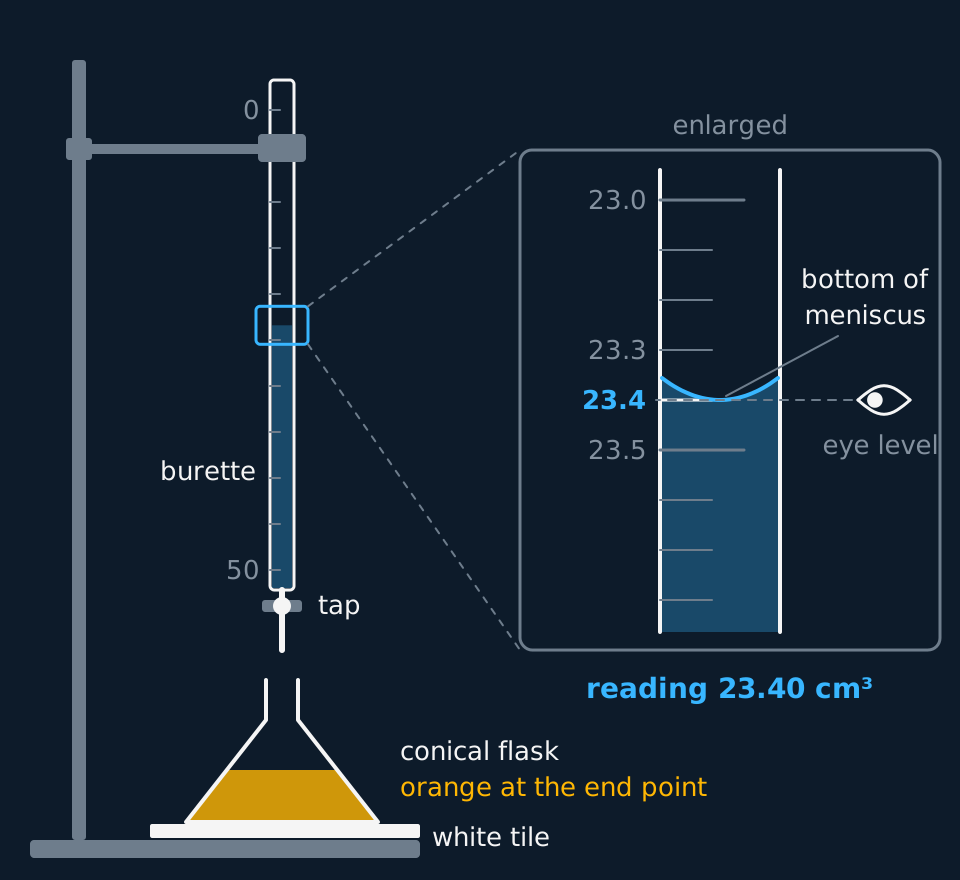
A 50 cubic centimetre burette held in a clamp stand above a conical flask of orange solution, the methyl orange end point, standing on a white tile. The burette's scale reads 0 at the top and 50 at the bottom. An enlarged inset of the scale shows marks from 23.0 to 23.8 increasing downwards, with the bottom of the curved meniscus exactly on the 23.4 mark between 23.3 and 23.5, an eye level with it on the right and a dashed sight line: reading 23.40 cubic centimetres.
What is measured
What is measured: the mass of sodium carbonate by difference, to ±0.02 g on a two-decimal-place balance, and the initial and final burette readings for every titration, each to the nearest 0.05 cm³. The pipette volume, 25.0 cm³, and the flask volume, 250.0 cm³, are fixed by the glassware. Each titre is the difference of two burette readings, and the result is the concentration of the acid, calculated as in the second worked example.
Sample results
These readings are idealised: they are the lesson's worked results table, written as a results table should be, and a real set scatters more.
| Rough | 1 | 2 | 3 | |
|---|---|---|---|---|
| Final reading / cm³ | 24.10 | 23.95 | 23.55 | 24.45 |
| Initial reading / cm³ | 0.00 | 0.50 | 0.20 | 1.05 |
| Titre / cm³ | 24.10 | 23.45 | 23.35 | 23.40 |
| Concordant | no | yes | yes | yes |
In this table titres 1, 2 and 3 lie within 0.10 cm³ of each other, so the mean titre is (23.45 + 23.35 + 23.40) ÷ 3 = 23.40 cm³. Every reading is recorded to two decimal places, the second always 0 or 5, because a burette is read to the nearest half division.
Evaluation
The limitations of the method, what each does to the result and in which direction, and the improvement a mark scheme credits.
| Limitation | What it does to the result | Improvement |
|---|---|---|
| The end point is judged by eye | Methyl orange changes over pH 3.1 to 4.4, and two people stop at a different shade of orange, a drop or two apart; the titres then differ by up to 0.10 cm³ for a reason that is not random | One person judges every end point and keeps the first orange flask beside the next as a colour reference; or follow the titration with a pH meter and take the middle of the vertical section |
| The balance limits the standard more than the burette limits the titre | On a two-decimal-place balance a mass found by difference carries ±0.02 g, which is 1.5% of 1.3 g, more than three times the 0.43% on a titre of 23.40 cm³ | Weigh on a three-decimal-place balance (±0.002 g, 0.15%), or weigh a larger mass into a larger flask, 2.6 g into 500 cm³ |
| Anhydrous sodium carbonate takes up water from the air | Part of the mass weighed is water, so the solution holds fewer moles than calculated, every titre is smaller, and the concentration of the acid comes out too high | Heat the solid before weighing, cool it in a desiccator and weigh it at once with the bottle closed between weighings |
| A titre of 23 cm³ uses less than half the burette | The ±0.10 cm³ on a titre is fixed by the burette, so its percentage share falls as the titre grows; in the sample results the three titres span 0.10 cm³, the same as the uncertainty in one of them | Choose concentrations that give a titre of 30 to 40 cm³, which halves the percentage uncertainty without a better burette |
Errors in carrying it out
| Error | Effect on the calculated concentration of the acid | How to avoid it |
|---|---|---|
| Burette rinsed with water, not acid | The acid is diluted, so the titre is larger and the concentration comes out too low | Rinse the burette with the acid it will hold |
| Air bubble in the burette tip escapes during a run | More volume is read than was delivered, so the concentration comes out too low | Run acid through the tap before the first reading |
| Conical flask rinsed with sodium carbonate solution | Extra carbonate needs extra acid, so the titre is larger and the concentration comes out too low | Rinse the flask with distilled water only, which adds no carbonate |
| Solid left in the beaker or funnel | The standard is weaker than calculated, titres are smaller, and the concentration comes out too high | Rinse every piece of glassware into the flask |
| Volumetric flask filled past the line | The standard is more dilute than calculated, and the concentration comes out too high | Add the last few cm³ dropwise; if the line is passed, start again |
| End point overshot | The titre is too large, and the concentration comes out too low | Add dropwise near the rough titre, swirling all the time |
| Meniscus read from above or below | Each reading is wrong by parallax, in either direction | Read the bottom of the meniscus with the eye level with it |
Questions
Question 1 (6 marks)
Describe how to make a standard solution of sodium carbonate and use it in a titration to find the concentration of a solution of hydrochloric acid.
Mark scheme
Indicative content
- weigh the sodium carbonate by difference, dissolve it in distilled water in a beaker, and transfer it to a volumetric flask with the rinsings of the beaker, rod and funnel
- make up to the line with distilled water, adding the last drops so the bottom of the meniscus is on the line at eye level, then stopper and invert to mix
- rinse a pipette with the carbonate solution and transfer 25.0 cm³ to a conical flask, using a pipette filler, and add a few drops of methyl orange
- rinse the burette with the acid, fill it, remove the funnel, make sure the tip is full and record the initial reading at eye level
- carry out a rough titration, then accurate titrations adding the acid dropwise near the end point with swirling, until one drop turns the indicator from yellow to orange
- repeat until titres are concordant within 0.10 cm³ and use their mean, with the 1 : 2 ratio of Na₂CO₃ to HCl, to calculate the concentration of the acid
Levels
- Level 3 (5–6 marks) the standard solution is made with weighing by difference, rinsings transferred and the flask made up to the line, and the titration is carried out with the pipette, burette, indicator, dropwise end point and concordant titres all described, finishing with the 1 : 2 ratio in the calculation
- Level 2 (3–4 marks) the solution is made up in a volumetric flask and the titration done with an indicator and repeats; transferring the rinsings, reading the meniscus, the dropwise approach to the end point, or the concordance criterion is left out
- Level 1 (1–2 marks) sodium carbonate is dissolved and titrated with the acid; the calculation commonly uses a 1 : 1 ratio, and the steps that make the solution standard are missing
Question 2 (4 marks)
Explain why, in a titration of sodium carbonate solution in a conical flask with hydrochloric acid from a burette, the burette is rinsed with the acid but the flask is rinsed only with distilled water.
Mark scheme
- B1 water left in the burette would dilute the acid, lowering its concentration
- B1 a larger titre would then be needed, so the calculated concentration of the acid would come out too low
- B1 distilled water in the flask adds no carbonate, so the amount delivered by the pipette is unchanged; ignore 'it dilutes the solution'
- B1 rinsing the flask with carbonate solution would leave extra carbonate in it, so the titre would be too large
Question 3 (3 marks)
Explain why, when making a standard solution, the beaker and funnel are rinsed into the volumetric flask and the flask is inverted after making up to the line.
Mark scheme
- B1 some solution remains on the beaker, rod and funnel
- B1 rinsing carries all of the weighed solute into the flask, so the concentration matches the mass used
- B1 inverting mixes the solution so the concentration is the same throughout and every portion taken is identical
Question 4 (4 marks)
Evaluate a student's mean titre of 23.89 cm³, calculated from all four titres in the table of burette readings given.
Mark scheme
- B1 the rough titre should be left out, because it is run quickly and usually overshoots the end point
- B1 run 2 differs from runs 1 and 3 by more than 0.10 cm³, so it is not concordant and should also be left out
- B1 the correct mean is (23.70 + 23.60) ÷ 2 = 23.65 cm³; reject a mean that includes run 2
- B1 the student's mean is 0.24 cm³, about 1%, too high, which is larger than the ±0.10 cm³ uncertainty of a titre, so a concentration calculated from it would be wrong
Question 5 (2 marks)
Explain why the burette is rinsed with the hydrochloric acid but the conical flask is rinsed with distilled water only.
Mark scheme
Water left in the burette would dilute the acid, so a larger volume would be needed and the titre would be too large.
Water left in the flask does not change the amount of sodium carbonate pipetted into it, so the titre is unchanged; rinsing the flask with the carbonate solution would add more carbonate and the titre would be too large.
Question 6 (3 marks)
Each burette reading is uncertain by ±0.05 cm³. Calculate the percentage uncertainty in a mean titre of 23.40 cm³.
Mark scheme
A titre is the difference of two readings, so its uncertainty is 2 × 0.05 = ±0.10 cm³.
Percentage uncertainty = 0.10 ÷ 23.40 × 100.
= 0.43% (accept 0.4%).
Question 7 (2 marks)
An air bubble in the burette tip escapes during the first accurate titration. Explain the effect on that titre and on the concentration of the acid calculated from it.
Mark scheme
The volume of the bubble is read on the burette as acid delivered, so the titre is larger than the volume of acid that reached the flask.
The moles of acid are divided by a volume that is too large, so the concentration comes out too low.
Question 8 (4 marks)
25.0 cm³ portions of 0.0480 mol dm⁻³ sodium carbonate solution need a mean titre of 22.60 cm³ of hydrochloric acid. Calculate the concentration of the acid.
Mark scheme
n(Na₂CO₃) = 0.0480 × 25.0 ÷ 1000 = 1.20 × 10⁻³ mol.
Na₂CO₃ + 2HCl → 2NaCl + H₂O + CO₂, so n(HCl) = 2 × 1.20 × 10⁻³ = 2.40 × 10⁻³ mol.
c = n ÷ V = 2.40 × 10⁻³ ÷ 0.02260.
= 0.106 mol dm⁻³ (three significant figures, since the data are given to three).
Question 9 (2 marks)
State why the rough titre is left out of the mean, and why at least two titres within 0.10 cm³ are needed rather than one accurate titration.
Mark scheme
The rough titre overshoots the end point because the acid is run in quickly, so it is too large.
Concordant titres show the end point was reached and judged the same way each time, so the random error in any one titre is shown to be small (accept: an anomalous titre can be identified and rejected).
Question 10 (2 marks)
Methyl orange is used rather than phenolphthalein. Explain why.
Mark scheme
The end point, when all the carbonate has become carbon dioxide and water, lies on the acid side, at about pH 4.
Methyl orange changes over pH 3.1 to 4.4 and so turns there; phenolphthalein changes at pH 8 to 10, when the carbonate has only reached hydrogencarbonate and half the acid has been added.
Coverage maps are available for AQA 7404/7405, OCR Chemistry A H032/H432, Pearson Edexcel Chemistry 8CH0/9CH0 and Cambridge International 9701. Use the relevant route map to check what InkChemistry covers, and your awarding organisation’s current specification as the final authority on examinable content.