Chemistry › Amount of substance › Concentration, volumetric solutions and titration calculations
Concentration, volumetric solutions and titration calculations
A titration measures how much of one solution reacts exactly with a fixed volume of another, to within a tenth of a cubic centimetre. With n = cV and the mole ratio from the equation, that volume gives a concentration. Required practical 1 makes a standard solution of known concentration and uses it in a titration, and each step in the method keeps the moles in the flask exactly as calculated.
Key terms Every definition in amount of substance, lesson by lesson
Before this The mole, the Avogadro constant and molar mass – n = m ÷ M · Formulae, equations and state symbols – balancing an equation · Measurement, uncertainty and significant figures in chemistry – the uncertainty of a burette reading and of a difference
COMMON MISCONCEPTION
One careful titration is enough; the repeats are only there in case something went wrong.
The first titration is rough, run quickly to find roughly where the end point is. The accurate titres come after it, added drop by drop near the end point, and they are repeated until two or three agree within 0.10 cm³. The mean of the concordant titres is used, and the rough titre is never included in it.
What you should be able to do
- Calculate concentrations in mol dm⁻³ and g dm⁻³, and use n = cV with the volume in dm³.
- Describe how to make up a standard solution, and give the reason for each step.
- Carry out an acid–base titration to concordant titres, and calculate the mean titre.
- Calculate an unknown concentration from a titre, using the mole ratio in the balanced equation.
- Calculate the result of a back titration, and the percentage uncertainty in a titre.
- Predict the effect of a procedural error on the calculated concentration.
Concentration
A concentration is a count of particles per volume. A label reading 'hydrochloric acid, 0.100 mol dm⁻³' says that every cubic decimetre of the solution, a litre, holds 0.100 mol of HCl, and a 25.0 cm³ pipette of it delivers a fortieth of that, 0.00250 mol. Titration calculations turn on that one conversion.
Concentration is the amount of solute in each cubic decimetre of solution, in mol dm⁻³.
n = c × Vn in mol, c in mol dm⁻³, V in dm³
The volume must be in dm³. Burettes and pipettes read in cm³, and 1 dm³ = 1000 cm³, so divide a volume in cm³ by 1000 first: 25.0 cm³ is 0.0250 dm³. A solution of 0.200 mol dm⁻³ therefore holds 0.200 × 0.0250 = 5.00 × 10⁻³ mol in 25.0 cm³. Leaving the volume in cm³ gives 5.00 mol, a thousand times too many.
Concentration can also be a mass per volume, in g dm⁻³. Multiply the concentration in mol dm⁻³ by the molar mass to convert: sodium hydroxide at 0.100 mol dm⁻³ is 0.100 × 40.0 = 4.00 g dm⁻³. Divide by the molar mass to go back.
Diluting a solution adds water and no solute, so the amount of solute stays the same and c₁V₁ = c₂V₂. Making 25.0 cm³ of 2.00 mol dm⁻³ acid up to 250 cm³ gives 2.00 × 25.0 ÷ 250 = 0.200 mol dm⁻³, a tenfold dilution. Here the volumes can stay in cm³, because the same unit appears on both sides.
- Concentration
- The amount of solute, in moles, dissolved in each 1 dm³ of solution.
- Mass concentration
- The mass of solute dissolved in each 1 dm³ of solution, in g dm⁻³.
Making a standard solution
A titration finds an unknown concentration by reacting the solution with one whose concentration is already known, a standard solution. It is made by dissolving an accurately weighed mass of a pure, stable solid and making the solution up to an exact volume in a volumetric flask. Anhydrous sodium carbonate is the usual solid for a standard alkali.
Sodium hydroxide is not used, because its pellets absorb water and carbon dioxide from the air while they are being weighed, so the mass on the balance is not all sodium hydroxide. A sodium hydroxide solution is standardised by titrating it against a standard acid instead.
To make 250 cm³ of 0.0500 mol dm⁻³ sodium carbonate: n = 0.0500 × 0.250 = 0.0125 mol; M(Na₂CO₃) = 2 × 23.0 + 12.0 + 3 × 16.0 = 106.0 g mol⁻¹; m = 0.0125 × 106.0 = 1.325 g. It does not matter if 1.351 g goes into the beaker instead, provided that mass is recorded: the concentration is worked out from the mass actually used, 1.351 ÷ 106.0 ÷ 0.250 = 0.0510 mol dm⁻³.
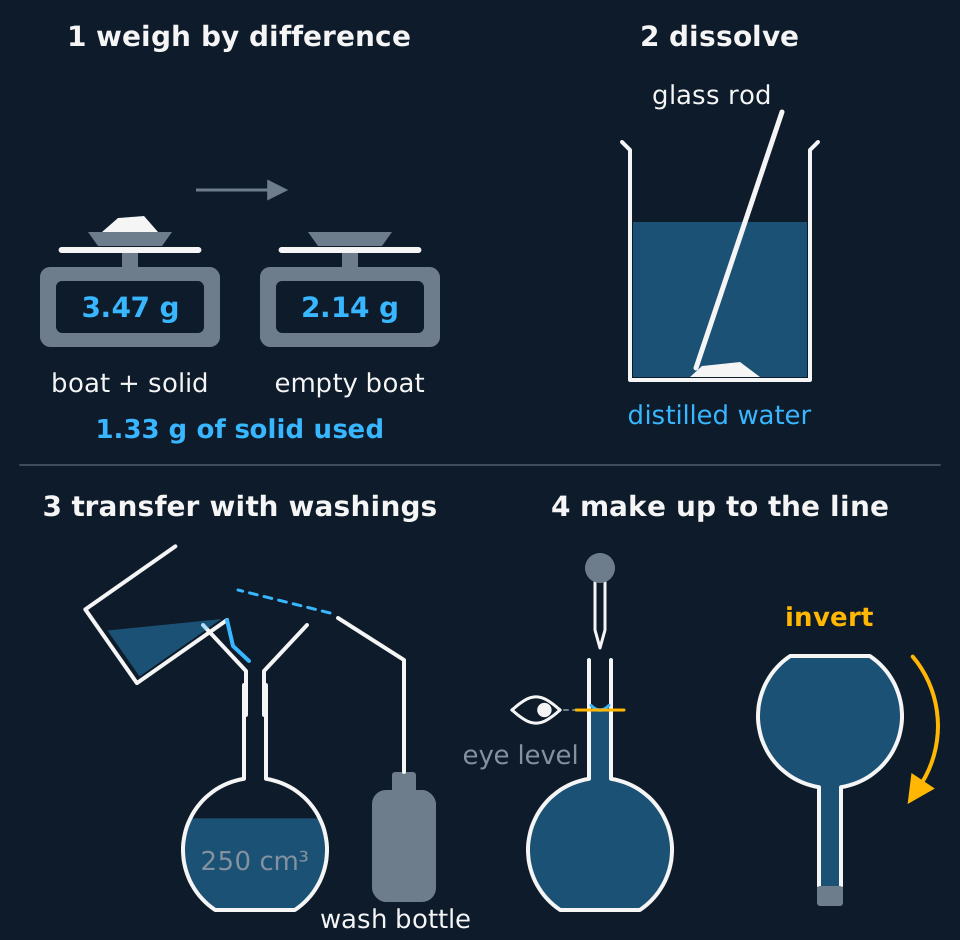
Describe the drawing
Four numbered panels. One: a weighing boat of white solid on a balance reading 3.47 g, then the empty boat reading 2.14 g, so 1.33 g was used, weighed by difference. Two: the solid dissolving in distilled water in a beaker, stirred with a glass rod. Three: a beaker tipped to pour through a funnel into a 250 cubic centimetre volumetric flask while a wash bottle rinses the beaker. Four: a dropping pipette over the flask neck, the bottom of the meniscus sitting on the graduation line with an eye level with it, and beside it the stoppered flask upside down with a curved arrow: invert.
Each step keeps every particle of the weighed solid in the final volume. Weighing by difference, the full weighing boat and then the empty one, gives the mass that actually left the boat. Dissolving in a beaker first makes sure it all dissolves, which is hard to see in the neck of a flask. Rinsing the beaker, rod and funnel into the flask carries in the last of the solute.
The final drops of water go in from a dropping pipette until the bottom of the meniscus sits on the line, read at eye level. Then the stoppered flask is turned upside down several times. Until it is mixed, the solution at the bottom is more concentrated than the solution at the top, and each pipette sample would be different.
A solid that can be weighed straight into a standard solution is a primary standard: available very pure, stable in air, not hygroscopic, soluble, and ideally with a large molar mass, so that the mass weighed is large and its percentage uncertainty small. Anhydrous sodium carbonate qualifies once it has been dried, since it slowly takes up water from the air. Use the word hygroscopic for a solid that absorbs water from the air; a scheme asking why sodium hydroxide is not a primary standard awards the mark for that property, and for its reaction with carbon dioxide in the air.
- Standard solution
- A solution whose concentration is known accurately.
- Primary standard
- A pure, stable, non-hygroscopic solid that can be weighed accurately to make a standard solution directly.
Titration
In a titration, one solution is measured into a conical flask with a pipette and the other is added from a burette until the reaction is exactly complete. An indicator marks that point by changing colour. Phenolphthalein is pink in alkali and turns colourless at the end point. Methyl orange is yellow in alkali and red in acid, and its end point is the first permanent orange. The volume added from the burette is the titre.
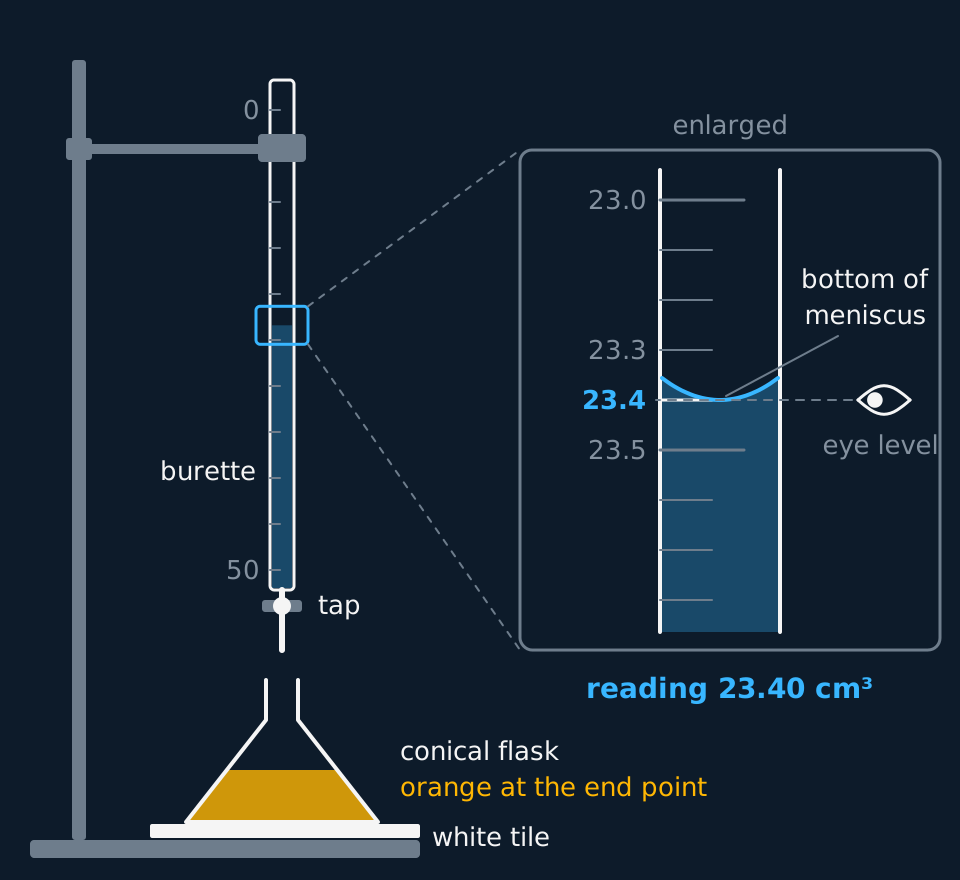
Describe the drawing
A 50 cubic centimetre burette held in a clamp stand above a conical flask of orange solution, the methyl orange end point, standing on a white tile. The burette's scale reads 0 at the top and 50 at the bottom. An enlarged inset of the scale shows marks from 23.0 to 23.8 increasing downwards, with the bottom of the curved meniscus exactly on the 23.4 mark between 23.3 and 23.5, an eye level with it on the right and a dashed sight line: reading 23.40 cubic centimetres.
The first titration is a rough one, run quickly to find roughly where the end point is, and it nearly always overshoots. In the accurate runs the solution goes in quickly to about 2 cm³ short of the rough titre, then drop by drop with swirling, until a single drop changes the colour. The inside of the flask can be washed down with distilled water during a run: that returns splashes to the reaction and changes no amounts.
Titrations are repeated until at least two titres are concordant, within 0.10 cm³ of each other. The mean titre is the mean of the concordant titres only. The rough titre is left out, and so is any accurate titre that does not agree with the others. One titre on its own cannot show whether the end point was judged well; two that agree can.
| Rough | 1 | 2 | 3 | |
|---|---|---|---|---|
| Final reading / cm³ | 24.10 | 23.95 | 23.55 | 24.45 |
| Initial reading / cm³ | 0.00 | 0.50 | 0.20 | 1.05 |
| Titre / cm³ | 24.10 | 23.45 | 23.35 | 23.40 |
| Concordant | no | yes | yes | yes |
In this table titres 1, 2 and 3 lie within 0.10 cm³ of each other, so the mean titre is (23.45 + 23.35 + 23.40) ÷ 3 = 23.40 cm³. Every reading is recorded to two decimal places, the second always 0 or 5, because a burette is read to the nearest half division.
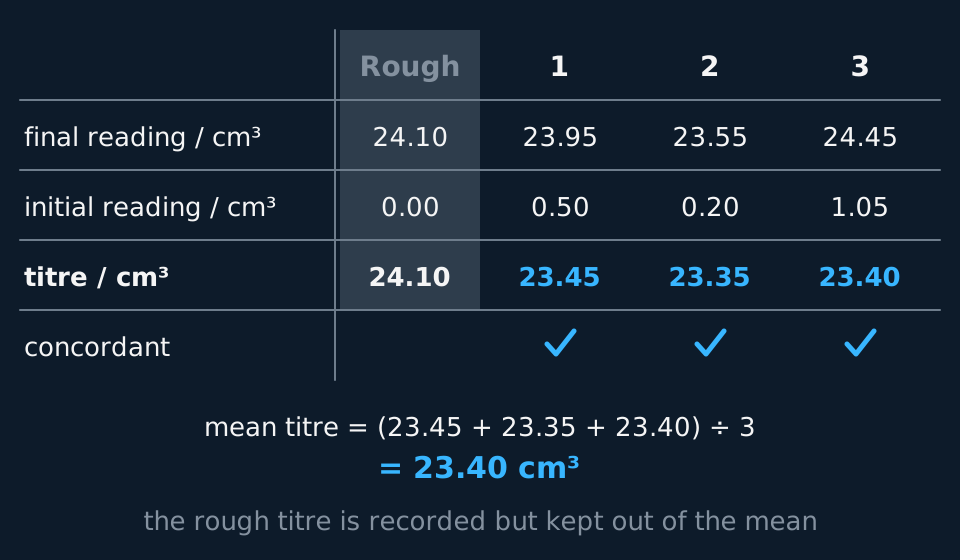
Describe the drawing
A ruled titration results table with columns Rough, 1, 2 and 3. Final readings 24.10, 23.95, 23.55 and 24.45; initial readings 0.00, 0.50, 0.20 and 1.05; titres 24.10, 23.45, 23.35 and 23.40 cubic centimetres. The rough column is shaded grey and titres 1, 2 and 3 are ticked as concordant. Beneath: mean titre equals 23.45 plus 23.35 plus 23.40, divided by 3, which is 23.40 cubic centimetres.
- Titre
- The volume of solution added from the burette to reach the end point.
- End point
- The point in a titration at which the indicator first changes colour permanently.
- Equivalence point
- The point at which the reactants have been added in exactly the amounts the equation requires.
- Concordant titres
- Titres that agree with each other to within 0.10 cm³.
From titre to concentration
Every titration calculation runs through the same four steps: the moles in the solution whose concentration is known, from n = cV; the mole ratio from the balanced equation; the moles of the other substance; and its concentration, from c = n ÷ V.
Sodium hydroxide against hydrochloric acid
25.0 cm³ of sodium hydroxide solution is titrated with 0.100 mol dm⁻³ hydrochloric acid. The mean titre is 23.40 cm³. Calculate the concentration of the sodium hydroxide.
Show the working
Equation: NaOH(aq) + HCl(aq) → NaCl(aq) + H₂O(l). One mole of acid reacts with one mole of alkali.
Moles of HCl in the titre: n = c × V = 0.100 × (23.40 ÷ 1000) = 2.340 × 10⁻³ mol.
Moles of NaOH in the flask: the ratio is 1 : 1, so 2.340 × 10⁻³ mol.
Concentration of NaOH: c = n ÷ V = 2.340 × 10⁻³ ÷ (25.0 ÷ 1000) = 0.0936 mol dm⁻³.
So the sodium hydroxide is 0.0936 mol dm⁻³, to three significant figures. Less acid was needed than the volume of alkali, 23.40 cm³ against 25.0 cm³, so the alkali is the more dilute of the two, as the answer says.
A standard solution used to find an acid
A student dissolves 1.325 g of anhydrous sodium carbonate and makes it up to 250 cm³. 25.0 cm³ portions are titrated with hydrochloric acid using methyl orange, and the mean titre is 22.60 cm³. Calculate the concentration of the acid.
Show the working
Concentration of the standard: n = 1.325 ÷ 106.0 = 0.01250 mol in 0.250 dm³, so c = 0.01250 ÷ 0.250 = 0.0500 mol dm⁻³.
Moles of Na₂CO₃ in each portion: 0.0500 × 0.0250 = 1.250 × 10⁻³ mol. Each titration uses a tenth of the flask.
Equation: Na₂CO₃(aq) + 2HCl(aq) → 2NaCl(aq) + H₂O(l) + CO₂(g). Each mole of carbonate needs two moles of acid, so n(HCl) = 2 × 1.250 × 10⁻³ = 2.500 × 10⁻³ mol.
Concentration of HCl: c = 2.500 × 10⁻³ ÷ (22.60 ÷ 1000) = 0.1106 mol dm⁻³.
Answer: the acid is 0.111 mol dm⁻³ to three significant figures. Using the moles in the whole flask instead of one 25.0 cm³ portion gives an answer ten times too big, and leaving out the 2 from the equation gives one half the size.
A burette is read to ±0.05 cm³, and a titre is the difference of two readings, so its uncertainty is ±0.10 cm³. On a titre of 23.40 cm³ that is 0.10 ÷ 23.40 × 100 = 0.43%. A 25.0 cm³ pipette adds ±0.06 cm³, which is 0.24%. On a balance whose display steps in 0.01 g, a mass by difference is two readings, ±0.02 g, and on 1.33 g that is 1.5%, the largest of the three. A three-decimal-place balance, or a larger mass made up in a larger flask, reduces it.
A small titre makes the burette's share large too: ±0.10 cm³ on 8.00 cm³ is 1.3%. Concentrations are chosen so that titres fall between about 20 and 30 cm³, large enough to keep the percentage uncertainty small and inside a single filling of a 50 cm³ burette.
A titration can also find a ratio, when both concentrations are known and the equation is not. 25.0 cm³ of 0.0500 mol dm⁻³ citric acid, C₆H₈O₇, needs 37.50 cm³ of 0.100 mol dm⁻³ sodium hydroxide. The acid is 1.25 × 10⁻³ mol and the alkali 3.75 × 10⁻³ mol, a ratio of 1 : 3, so each citric acid molecule gives up three hydrogen ions to hydroxide ions.
Back titrations
Some substances cannot be titrated directly. Calcium carbonate in an indigestion tablet is insoluble, reacts slowly with acid, and the fizzing of carbon dioxide hides any end point. A back titration gets round all three. A known amount of acid, more than enough, is added and left until the reaction is complete; then the acid left over is titrated with a standard alkali. The acid used by the carbonate is the difference.
TRY IT: Calcium carbonate by back titration
A 0.500 g sample of impure calcium carbonate is added to 50.0 cm³ of 0.200 mol dm⁻³ hydrochloric acid, an excess. When the reaction has stopped, the acid left needs 20.00 cm³ of 0.100 mol dm⁻³ sodium hydroxide to neutralise it. Calculate the percentage by mass of calcium carbonate in the sample.
Check your answer
Acid added: 0.200 × 0.0500 = 0.0100 mol. Acid left over equals the sodium hydroxide, since they react 1 : 1: 0.100 × 0.02000 = 0.00200 mol.
Acid used by the carbonate: 0.0100 − 0.00200 = 0.00800 mol. From CaCO₃(s) + 2HCl(aq) → CaCl₂(aq) + H₂O(l) + CO₂(g), n(CaCO₃) = 0.00800 ÷ 2 = 0.00400 mol.
Mass of CaCO₃ = 0.00400 × 100.1 = 0.4004 g, so the sample is 0.4004 ÷ 0.500 × 100 = 80.1% calcium carbonate.
- Back titration
- A method in which an excess of a reagent of known amount is added, and the excess left over is then found by titration.
Required practical 1: a standard solution and a titration
AQA required practical; optional reading for other boards
Every board sets this practical: required practical 1, make up a volumetric solution and carry out a simple acid–base titration, is PAG 2 for OCR and core practicals 2 and 3 for Edexcel. The usual version makes a standard solution of sodium carbonate and uses it to find the concentration of a hydrochloric acid of roughly 0.1 mol dm⁻³.
Apparatus: a balance reading to two or, better, three decimal places, and a weighing boat; a 250 cm³ beaker and a glass rod; a filter funnel; a wash bottle of distilled water; a 250 cm³ volumetric flask with its stopper, and a dropping pipette; a 25.0 cm³ pipette and a pipette filler; a 50.0 cm³ burette in a clamp stand; three or four conical flasks; a white tile; methyl orange indicator.
| Step | What to do | Why |
|---|---|---|
| 1 | Weigh the weighing boat with about 1.3 g of anhydrous sodium carbonate. Tip the solid into the beaker and reweigh the empty boat. | The difference is the mass that reached the beaker, whatever stayed on the boat |
| 2 | Add about 100 cm³ of distilled water and stir with the glass rod until all the solid has dissolved. | It is easier to see every crystal dissolve in a beaker than in the neck of a flask |
| 3 | Pour the solution through the funnel into the volumetric flask. Rinse the beaker, rod and funnel with distilled water into the flask. | The rinsings carry the solute left on the glass into the flask |
| 4 | Add distilled water to near the line, then drops from the dropping pipette until the bottom of the meniscus is on the line, viewed at eye level. | The flask holds 250.0 cm³ only when filled to the line; past it, start again |
| 5 | Stopper the flask and invert it ten or more times. | The solution must be the same throughout before any is taken |
| 6 | Rinse the pipette with a little of the sodium carbonate solution. Use the filler to draw it to the line and run 25.0 cm³ into a conical flask, touching the tip on the inside of the flask at the end. | Water left in the pipette would dilute the sample. The pipette is calibrated to leave the last drop in the tip |
| 7 | Add three drops of methyl orange. | Indicators are weak acids themselves, so a few drops only |
| 8 | Rinse the burette with a little of the acid. Fill it through a funnel with its top below eye level, remove the funnel, and run acid through the tap until the tip is full. Record the initial reading. | Water would dilute the acid, a funnel left in can drip, and an air bubble in the tip would be read as titre |
| 9 | Run in acid quickly, swirling, until the solution turns orange. Record this rough titre. | It shows roughly where the end point is |
| 10 | With a fresh portion, add acid quickly to about 2 cm³ short of the rough titre, then dropwise, swirling and washing down the inside of the flask, until one drop turns yellow to orange. | Dropwise addition near the end point prevents an overshoot |
| 11 | Repeat step 10 until at least two titres are within 0.10 cm³. Calculate the mean of the concordant titres. | Concordant titres show the end point was judged the same way each time |
What is measured: the mass of sodium carbonate by difference, to ±0.02 g on a two-decimal-place balance, and the initial and final burette readings for every titration, each to the nearest 0.05 cm³. The pipette volume, 25.0 cm³, and the flask volume, 250.0 cm³, are fixed by the glassware. Each titre is the difference of two burette readings, and the result is the concentration of the acid, calculated as in the second worked example.
| Error | Effect on the calculated concentration of the acid | How to avoid it |
|---|---|---|
| Burette rinsed with water, not acid | The acid is diluted, so the titre is larger and the concentration comes out too low | Rinse the burette with the acid it will hold |
| Air bubble in the burette tip escapes during a run | More volume is read than was delivered, so the concentration comes out too low | Run acid through the tap before the first reading |
| Conical flask rinsed with sodium carbonate solution | Extra carbonate needs extra acid, so the titre is larger and the concentration comes out too low | Rinse the flask with distilled water only, which adds no carbonate |
| Solid left in the beaker or funnel | The standard is weaker than calculated, titres are smaller, and the concentration comes out too high | Rinse every piece of glassware into the flask |
| Volumetric flask filled past the line | The standard is more dilute than calculated, and the concentration comes out too high | Add the last few cm³ dropwise; if the line is passed, start again |
| End point overshot | The titre is too large, and the concentration comes out too low | Add dropwise near the rough titre, swirling all the time |
| Meniscus read from above or below | Each reading is wrong by parallax, in either direction | Read the bottom of the meniscus with the eye level with it |
Risk assessment. Wear eye protection throughout: sodium carbonate and dilute hydrochloric acid both irritate the eyes. Lower the burette in its clamp, or take it down, so that it is filled below eye level and acid cannot splash into the face. Never pipette by mouth. Check the CLEAPSS Hazcards and the school's risk assessment before starting, and where they differ from these precautions, follow them.
Other boards: parts per million and a solid acid standard
Edexcel names parts per million, ppm, in its specification, for pollutants in water and gases in air. It is the mass of solute in every million units of mass of solution. A cubic decimetre of dilute aqueous solution has a mass of very nearly 1 kg, which is 10⁶ mg, so in water 1 ppm is 1 mg dm⁻³.
A 250 cm³ sample of river water holding 2.0 mg of nitrate ions has 8.0 mg dm⁻³, so 8.0 ppm, which is 8.0 × 10⁻³ ÷ 62.0 = 1.3 × 10⁻⁴ mol dm⁻³. For a gas in air ppm counts by volume: carbon dioxide at 420 ppm is 420 cm³ in every cubic metre of air.
- Parts per million
- The mass of solute in one million units of mass of solution, or for a gas the volume in one million units of volume of air.
Edexcel's core practical 2 standardises a sodium hydroxide solution against a solid acid, usually sulfamic acid, H₂NSO₃H (Mr 97.1). It is a primary standard: pure, stable, not hygroscopic, and with one acidic hydrogen, so it reacts 1 : 1 with sodium hydroxide. About 2.4 g made up to 250 cm³ gives roughly 0.1 mol dm⁻³, and the titration then runs exactly as in required practical 1 with the acid in the pipette and the alkali in the burette.
Cambridge asks a titration to find a reacting ratio, which it calls deducing a stoichiometric relationship, from two known concentrations, as with citric acid and its ratio of 1 : 3. It assesses titration in its practical paper rather than through a list of required practicals.
In the exam
- Titration calculations are marked with error carried forward: a wrong mean titre loses its own mark, but n = cV, the ratio and the concentration still score if they use it correctly. Write the balanced equation and its mole ratio before using it.
- The mean titre is credited only if it uses the concordant titres; including the rough titre loses that mark. Burette readings are recorded to two decimal places ending in 0 or 5.
- A description of making a standard solution must contain weighing by difference, rinsing the washings into the flask, making up to the line with the bottom of the meniscus at eye level, and inverting; 'mix it' does not earn the inverting mark.
- The effect of an error is followed through the titre to the calculated concentration, saying which way each moves; 'the result is inaccurate' is not credited.
- An evaluation compares the percentage uncertainties of the weighing, the pipette and the titre, and names the largest.
Check yourself
25.0 cm³ of sulfuric acid is titrated with 0.120 mol dm⁻³ sodium hydroxide, and the concordant titres are 21.10, 21.20 and 21.15 cm³. Calculate the concentration of the acid. Then say what would happen to the answer if the conical flask had been rinsed with the acid before the 25.0 cm³ was pipetted in.
Answer
Mean titre = (21.10 + 21.20 + 21.15) ÷ 3 = 21.15 cm³. n(NaOH) = 0.120 × 0.02115 = 2.538 × 10⁻³ mol.
H₂SO₄(aq) + 2NaOH(aq) → Na₂SO₄(aq) + 2H₂O(l), so n(H₂SO₄) = 2.538 × 10⁻³ ÷ 2 = 1.269 × 10⁻³ mol, and c = 1.269 × 10⁻³ ÷ 0.0250 = 0.0508 mol dm⁻³.
Rinsing with acid leaves extra acid in the flask on top of the 25.0 cm³ pipetted in. More alkali is needed, the titre is larger, and the calculated concentration comes out too high. Rinsing with distilled water adds no acid, so it does not matter.
Questions
Question 16 marks
Describe how to make a standard solution of sodium carbonate and use it in a titration to find the concentration of a solution of hydrochloric acid.
Mark scheme
Indicative content
- weigh the sodium carbonate by difference, dissolve it in distilled water in a beaker, and transfer it to a volumetric flask with the rinsings of the beaker, rod and funnel
- make up to the line with distilled water, adding the last drops so the bottom of the meniscus is on the line at eye level, then stopper and invert to mix
- rinse a pipette with the carbonate solution and transfer 25.0 cm³ to a conical flask, using a pipette filler, and add a few drops of methyl orange
- rinse the burette with the acid, fill it, remove the funnel, make sure the tip is full and record the initial reading at eye level
- carry out a rough titration, then accurate titrations adding the acid dropwise near the end point with swirling, until one drop turns the indicator from yellow to orange
- repeat until titres are concordant within 0.10 cm³ and use their mean, with the 1 : 2 ratio of Na₂CO₃ to HCl, to calculate the concentration of the acid
Levels
- Level 3 (5–6 marks) the standard solution is made with weighing by difference, rinsings transferred and the flask made up to the line, and the titration is carried out with the pipette, burette, indicator, dropwise end point and concordant titres all described, finishing with the 1 : 2 ratio in the calculation
- Level 2 (3–4 marks) the solution is made up in a volumetric flask and the titration done with an indicator and repeats; transferring the rinsings, reading the meniscus, the dropwise approach to the end point, or the concordance criterion is left out
- Level 1 (1–2 marks) sodium carbonate is dissolved and titrated with the acid; the calculation commonly uses a 1 : 1 ratio, and the steps that make the solution standard are missing
Question 25 marks
Calculate the percentage by mass of calcium carbonate in an indigestion tablet from the back-titration results in the table. The tablet is added to an excess of hydrochloric acid, and the acid left over is titrated with sodium hydroxide. CaCO₃(s) + 2HCl(aq) → CaCl₂(aq) + H₂O(l) + CO₂(g).
| Quantity | Value |
|---|---|
| Mass of tablet | 0.600 g |
| Volume of hydrochloric acid added | 50.0 cm³ |
| Concentration of hydrochloric acid | 0.250 mol dm⁻³ |
| Mean titre of sodium hydroxide | 27.30 cm³ |
| Concentration of sodium hydroxide | 0.100 mol dm⁻³ |
| Mr of CaCO₃ | 100.1 |
Mark scheme
- M1 n(HCl) added = 0.250 × 0.0500 = 0.0125 mol
- M1 n(HCl) left = n(NaOH) = 0.100 × 0.02730 = 2.73 × 10⁻³ mol
- M1 n(HCl) used by the tablet = 0.0125 − 0.00273 = 9.77 × 10⁻³ mol, so n(CaCO₃) = 4.885 × 10⁻³ mol
- M1 mass of CaCO₃ = 4.885 × 10⁻³ × 100.1 = 0.4890 g
- A1 percentage = 0.4890 ÷ 0.600 × 100 = 81.5%, to three significant figures
Question 34 marks
Calculate the volume of sodium hydroxide needed to neutralise a portion of a diluted sulfuric acid, using the data in the table: H₂SO₄(aq) + 2NaOH(aq) → Na₂SO₄(aq) + 2H₂O(l).
| Quantity | Value |
|---|---|
| Concentration of the stock sulfuric acid | 1.50 mol dm⁻³ |
| Volume of stock acid diluted | 20.0 cm³ |
| Volume after dilution with distilled water | 500 cm³ |
| Portion of diluted acid titrated | 25.0 cm³ |
| Concentration of sodium hydroxide | 0.100 mol dm⁻³ |
Mark scheme
- M1 concentration of the diluted acid = 1.50 × 20.0 ÷ 500 = 0.0600 mol dm⁻³
- M1 n(H₂SO₄) in 25.0 cm³ = 0.0600 × 0.0250 = 1.50 × 10⁻³ mol
- M1 n(NaOH) = 2 × 1.50 × 10⁻³ = 3.00 × 10⁻³ mol, from the 1 : 2 ratio
- A1 V = 3.00 × 10⁻³ ÷ 0.100 = 0.0300 dm³, which is 30.0 cm³, to three significant figures; allow error carried forward from a wrong dilution
All 18 questions with mark schemes, the other 15 set out in full on the question page.
Worth remembering
- A volume left in cm³ in n = cV gives an amount a thousand times too large.
- A rough titre, or one outside 0.10 cm³ of the others, in the mean moves the answer.
- Scale up from the pipetted portion to the whole flask: 25.0 cm³ taken from 250.0 cm³ is a tenth of it.
- Leaving out the 2 for a diprotic acid or a carbonate halves or doubles the answer.
- In a back titration, subtract the acid left over from the acid added to find the acid that reacted.
CHECK YOUR PROGRESS
Rate how confident you are with each objective for this lesson. Ratings are saved in this browser, on this device, unless you sign in.
- Calculate concentrations in mol dm⁻³ and g dm⁻³, and use n = cV with the volume in dm³.
- Describe how to make up a standard solution, and give the reason for each step.
- Carry out an acid–base titration to concordant titres, and calculate the mean titre.
- Calculate an unknown concentration from a titre, using the mole ratio in the balanced equation.
- Calculate the result of a back titration, and the percentage uncertainty in a titre.
- Predict the effect of a procedural error on the calculated concentration.
Open the full revision checklist to see every objective in the curriculum in one place.
Practise this lesson
WORKBOOK
The written questions from this topic, on paper with room to work, and a separate book of mark schemes. The 4 questions that are set on a diagram stay on this page, where the diagram can be drawn. Free to use; please do not redistribute or sell.
Used later in Measuring an enthalpy change: calorimetry · Collision theory, activation energy and the rate of reaction · The equilibrium constant Kc · Redox titrations: manganate(VII) and thiosulfate