Chemistry › Thermodynamics › Enthalpies of solution and hydration
Enthalpies of solution and hydration
A cold pack goes cold because the salt inside dissolves endothermically; a hand warmer gets hot because its salt dissolves exothermically. Which way a salt goes depends on two large quantities that nearly cancel: the energy needed to break up the lattice and the energy released as water molecules gather round the separated ions. A three-sided cycle joins them.
Key terms Every definition in thermodynamics, lesson by lesson
Before this Lattice enthalpy and Born–Haber cycles – lattice enthalpy of dissociation and what sets its size · Electronegativity, polarity and intermolecular forces – why the water molecule has δ− oxygen and δ+ hydrogen atoms
COMMON MISCONCEPTION
A salt that takes in heat when it dissolves can't really want to dissolve, so endothermic salts must be insoluble.
Ammonium nitrate dissolves readily and cools the water by several degrees. Dissolving is driven by free energy, ΔG = ΔH − TΔS, not by enthalpy alone: ions spreading through water raise the entropy, and at room temperature that TΔS term can outweigh a positive ΔH. Instant cold packs hold ammonium nitrate and water apart until squeezed.
What you should be able to do
- Define enthalpy of solution and enthalpy of hydration, and write an equation with state symbols for each.
- Describe how water molecules are arranged around a cation and around an anion, and explain why hydration is always exothermic.
- Explain how the charge and the radius of an ion affect its enthalpy of hydration.
- Calculate an enthalpy of solution, a hydration enthalpy or a lattice enthalpy from the other terms in the solution cycle.
- Explain how the balance between lattice enthalpy and hydration enthalpy decides a trend in solubility, and why an endothermic enthalpy of solution does not stop a salt dissolving.
- Explain why the entropy change on dissolving is positive for most salts but negative for some salts of small, highly charged ions.
Hot packs, cold packs and two definitions
An ionic solid dissolving in water can give out heat or take it in, and first-aid kits use both. Ammonium nitrate dissolves endothermically, taking in about 26 kJ for every mole, so a sports cold pack that lets water reach the solid is cold enough within a minute to hold against a sprain. Anhydrous calcium chloride dissolves exothermically, releasing about 83 kJ for every mole, and some hand warmers run on it.
Which way a salt goes depends on a balance between two large quantities: the energy needed to separate the ions from the lattice, and the energy released when water molecules gather round each separated ion.
NaCl(s) → Na⁺(aq) + Cl⁻(aq)enthalpy of solution; enough water that the ions do not interact
Na⁺(g) → Na⁺(aq)enthalpy of hydration = −406 kJ mol⁻¹
Cl⁻(g) → Cl⁻(aq)enthalpy of hydration = −364 kJ mol⁻¹
Hydration enthalpies are always negative. The ions start as a gas with nothing around them and finish surrounded by water molecules they attract, and forming attractions releases energy. Each value is for one mole of one kind of ion, so the hydration of a salt is a sum, with each ion counted as many times as the formula holds it: CaCl₂ needs the value for Ca²⁺ once and the value for Cl⁻ twice.
- Enthalpy of solution
- The enthalpy change when one mole of an ionic solid dissolves in enough water that the dissolved ions are well separated and do not interact with one another.
- Enthalpy of hydration
- The enthalpy change when one mole of gaseous ions dissolves in water to form one mole of aqueous ions.
Water around an ion
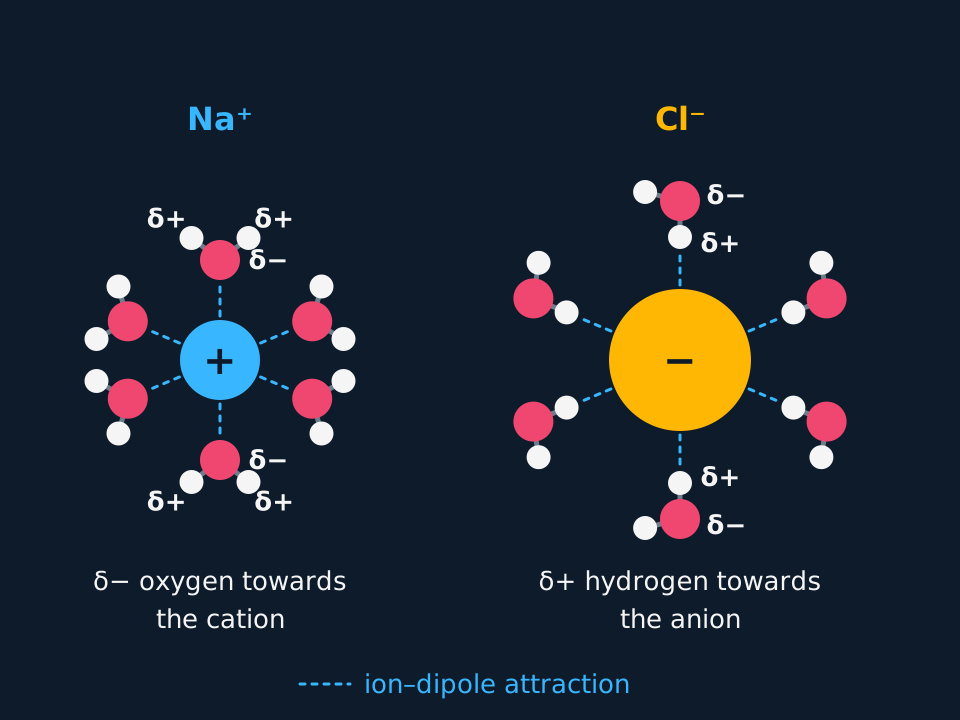
Water is a polar molecule. Its oxygen atom carries a partial negative charge, δ−, and each hydrogen atom a partial positive charge, δ+. Around a cation the water molecules turn their oxygen atoms inwards; around an anion they turn a hydrogen atom inwards. The ion attracts the oppositely charged end of each dipole. A sodium ion in solution has six water molecules in direct contact with it, and a looser second layer beyond them.
Describe the drawing
Two hydrated ions side by side. On the left a small sodium ion marked plus is surrounded octahedrally by six bent water molecules, one above, one below and four around its middle, each with its oxygen atom, labelled delta minus, pointing at the ion and its two hydrogen atoms, labelled delta plus, pointing away. On the right a chloride ion about 1.8 times larger, marked minus, has six water molecules each with one delta plus hydrogen pointing at the ion and the delta minus oxygen further out. Dashed lines from each ion to the nearest atom of every water molecule show the ion–dipole attraction.
The strength of those attractions sets the size of the hydration enthalpy, and two properties of the ion decide it. A larger charge attracts the water dipoles more strongly. A smaller ion lets the water molecules come closer to the centre of the charge, and the attraction is stronger at short range. The two are combined in the idea of charge density, the charge on an ion relative to its size.
| Ion | Ionic radius / pm | Enthalpy of hydration / kJ mol⁻¹ |
|---|---|---|
| Li⁺ | 76 | −519 |
| Na⁺ | 102 | −406 |
| K⁺ | 138 | −322 |
| Mg²⁺ | 72 | −1920 |
| Ca²⁺ | 100 | −1650 |
| Ba²⁺ | 135 | −1360 |
| F⁻ | 133 | −506 |
| Cl⁻ | 181 | −364 |
| I⁻ | 220 | −293 |
Size matters because an attraction between charges weakens with distance. A water molecule in contact with Li⁺ has its oxygen atom about 216 pm from the centre of the ion; one in contact with K⁺ is about 278 pm away. The same charge, further from the dipole, attracts it less. Lithium ions hold their water so firmly that a hydrated Li⁺ ion, with its shell, moves through water more slowly than a hydrated K⁺ ion, although the bare Li⁺ ion is the smaller.
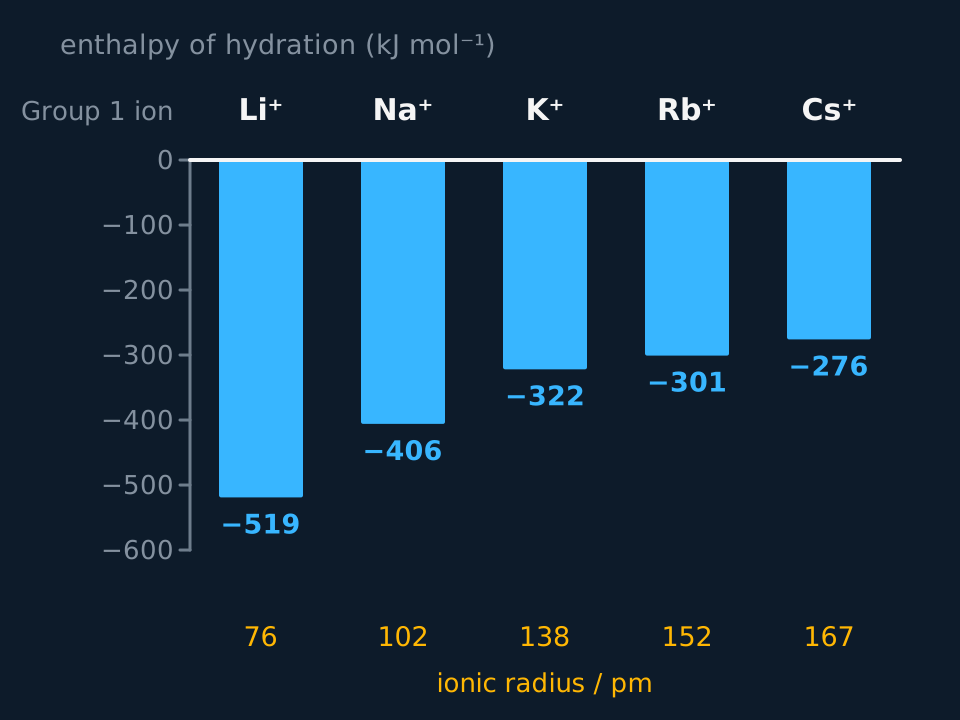
Down Group 1 the radius rises from Li⁺ to K⁺ and the hydration enthalpy becomes less exothermic. Compare Na⁺ with Ca²⁺: the two ions are almost the same size, and doubling the charge makes the hydration enthalpy four times as exothermic. The halide ions follow the same pattern, from F⁻ at −506 kJ mol⁻¹ to I⁻ at −293.
Describe the drawing
Vertical bar chart of the enthalpy of hydration of the Group 1 ions, the bars hanging down from zero on an axis running to −600 kJ mol⁻¹. In order Li⁺ −519, Na⁺ −406, K⁺ −322, Rb⁺ −301 and Cs⁺ −276, the bars shorten steadily from left to right, while the ionic radius printed under each bar rises from 76 to 102, 138, 152 and 167 pm.
The same attractions explain why salt dissolves in water and not in hexane. Hexane molecules are non-polar, with no partial charges for the ions to attract, so almost no energy is released when ions are surrounded by them. Nothing repays the lattice enthalpy, and the salt stays undissolved. An ionic solid dissolves only in a solvent polar enough to solvate its ions strongly. In an answer, name the attraction as ion–dipole and say which end of the water molecule faces each ion; 'water is polar' alone does not explain anything.
- Ion–dipole attraction
- The electrostatic attraction between an ion and the oppositely charged end of a polar molecule such as water.
- Charge density
- The charge on an ion relative to its size; a small ion with a large charge has a high charge density.
- Solvation
- The surrounding of a dissolved ion or molecule by solvent molecules attracted to it; hydration is solvation by water.
The solution cycle
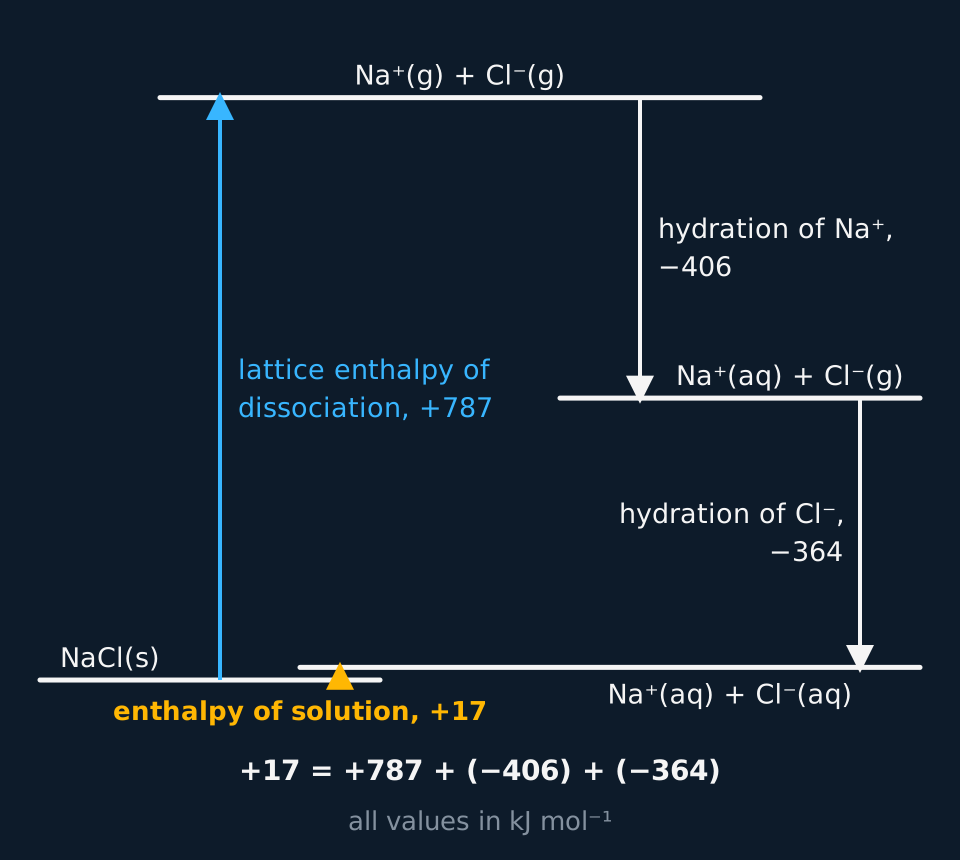
Dissolving can be split into two imaginary steps with the same start and finish. First the lattice is broken into gaseous ions, which is the lattice enthalpy of dissociation. Then the gaseous ions are hydrated. Hess's law gives the enthalpy of solution as the sum of the two.
ΔsolH = ΔLEH(dissociation) + Σ ΔhydHΣ ΔhydH adds the hydration enthalpy of every ion in the formula
Describe the drawing
Enthalpy of solution cycle for sodium chloride drawn as energy levels, energy upwards. A tall arrow climbs from NaCl(s) at zero to Na⁺(g) + Cl⁻(g) at +787, the lattice enthalpy of dissociation. An arrow down, the hydration of Na⁺, −406, reaches Na⁺(aq) + Cl⁻(g) at +381, and a second, the hydration of Cl⁻, −364, reaches Na⁺(aq) + Cl⁻(aq) at +17, only just above the solid. A very short arrow from NaCl(s) up to that level is the enthalpy of solution, +17. Beneath, Hess's law: +17 = +787 + (−406) + (−364), all in kJ mol⁻¹.
The enthalpy of solution of sodium chloride
The lattice enthalpy of dissociation of sodium chloride is +787 kJ mol⁻¹. The enthalpies of hydration are −406 kJ mol⁻¹ for Na⁺ and −364 kJ mol⁻¹ for Cl⁻. Calculate the enthalpy of solution of sodium chloride.
Show the working
Write the cycle: ΔsolH = ΔLEH(dissociation) + ΔhydH(Na⁺) + ΔhydH(Cl⁻).
Add the hydration enthalpies first: −406 + (−364) = −770 kJ mol⁻¹.
Substitute: ΔsolH = +787 + (−770) = +17 kJ mol⁻¹. Sodium chloride dissolves endothermically.
The measured value is +4 kJ mol⁻¹. The difference of 13 kJ mol⁻¹ is under 2% of the terms being added, which is as close as values rounded to the nearest kJ mol⁻¹ and taken from different sources can be expected to come.
Of the three terms in the cycle, only the enthalpy of solution can be measured directly, by dissolving a weighed sample in water in a polystyrene cup and recording the temperature change. Dissolving 8.00 g of ammonium nitrate, 0.100 mol, in 50.0 g of water lowers the temperature by 12.4 °C. Then q = mcΔT = 50.0 × 4.18 × 12.4 = 2590 J, and 2.59 kJ for 0.100 mol is +25.9 kJ mol⁻¹, positive because the solution cooled.
The hand warmer: calcium chloride
Anhydrous calcium chloride is the salt in some hand warmers. Its lattice enthalpy of dissociation is +2255 kJ mol⁻¹, and the enthalpies of hydration are −1650 kJ mol⁻¹ for Ca²⁺ and −364 kJ mol⁻¹ for Cl⁻. Calculate its enthalpy of solution. Then use the measured value, −83 kJ mol⁻¹, to find the temperature rise when 11.1 g of CaCl₂ (Mr = 111.1) dissolves in 100 g of water.
Show the working
Write the cycle with the chloride ion counted twice: ΔsolH = ΔLEH(dissociation) + ΔhydH(Ca²⁺) + 2 × ΔhydH(Cl⁻).
Hydration: −1650 + 2 × (−364) = −1650 − 728 = −2378 kJ mol⁻¹.
ΔsolH = +2255 + (−2378) = −123 kJ mol⁻¹. Exothermic, as a hand warmer needs.
The measured value is −83 kJ mol⁻¹. The gap of 40 kJ mol⁻¹ is under 2% of the hydration total, the same size of disagreement as for sodium chloride. A cycle built from rounded data gives the sign of a small difference reliably, and its size only roughly.
Amount dissolved: 11.1 ÷ 111.1 = 0.100 mol, so the heat released is 0.100 × 83 = 8.3 kJ = 8300 J.
ΔT = q ÷ mc = 8300 ÷ (100 × 4.18) = 19.9 °C, enough to take water at 15 °C to about 35 °C.
The warmer must hold the anhydrous salt. Hydrated calcium chloride, CaCl₂·6H₂O, dissolves endothermically: its ions are already surrounded by water in the crystal, so most of the hydration enthalpy was released when the hydrate formed and is not available again.
The hydration enthalpies of single ions cannot be measured at all, since no solution contains cations without anions. The values in the tables come from cycles like this one, run backwards from measured enthalpies of solution and lattice enthalpies, with one ion's value fixed by convention and the rest worked out from it.
- Hess's law
- The enthalpy change of a reaction is independent of the route taken, provided the initial and final conditions are the same.
- Lattice enthalpy of dissociation
- The enthalpy change when one mole of a solid ionic compound is separated into its gaseous ions under standard conditions.
- Hydrated ion
- An ion in aqueous solution surrounded by water molecules held to it by ion–dipole attractions.
Predicting from the balance
An enthalpy of solution is a small difference between two large numbers. In sodium chloride, 787 kJ mol⁻¹ in and 770 out leaves +17. A change of a few per cent in either term can change the sign, so salts that look alike can dissolve with opposite enthalpy changes.
Both terms grow as the charge rises and the ions shrink, so changing one ion changes both. The trend depends on which changes faster. Hydration depends on each ion on its own. The lattice enthalpy depends on the distance between the centres of the ions, the sum of the two radii, so when one ion is much larger than the other, the large one sets that distance and a change in the small one hardly moves the lattice enthalpy.
The Group 2 sulfates show this. The sulfate ion is large, so the lattice enthalpy falls only a little from MgSO₄ to BaSO₄. The hydration enthalpy of the cation falls much more, from −1920 kJ mol⁻¹ for Mg²⁺ to −1360 kJ mol⁻¹ for Ba²⁺. Hydration falls faster than the lattice enthalpy, the enthalpy of solution becomes more endothermic down the group, and the sulfates become less soluble: magnesium sulfate dissolves readily and barium sulfate hardly at all.
The Group 2 hydroxides go the other way, becoming more soluble down the group. The hydroxide ion is small, so the distance between the ions changes in proportion as the cation grows, and the lattice enthalpy falls faster than the hydration enthalpy does.
| Group 2 sulfates | Group 2 hydroxides | |
|---|---|---|
| The anion | SO₄²⁻, large | OH⁻, small |
| Lattice enthalpy, Mg to Ba | Falls a little | Falls steeply |
| Cation hydration, Mg to Ba | Falls steeply, −1920 to −1360 kJ mol⁻¹ | Falls steeply, −1920 to −1360 kJ mol⁻¹ |
| Which falls faster | Hydration | Lattice enthalpy |
| ΔsolH down the group | More endothermic | Less endothermic |
| Solubility down the group | Falls: BaSO₄ is insoluble | Rises: Ba(OH)₂ is the most soluble |
Why silver fluoride dissolves and silver chloride does not
Silver fluoride is very soluble in water; silver chloride is almost insoluble. Use these values, in kJ mol⁻¹, to calculate the enthalpy of solution of each and to explain the difference: lattice enthalpy of dissociation of AgF +958 and of AgCl +905; enthalpy of hydration of Ag⁺ −464, of F⁻ −506, of Cl⁻ −364.
Show the working
For AgF: ΔsolH = +958 + (−464) + (−506) = +958 − 970 = −12 kJ mol⁻¹.
For AgCl: ΔsolH = +905 + (−464) + (−364) = +905 − 828 = +77 kJ mol⁻¹.
Compare the terms. Going from fluoride to chloride, the lattice enthalpy falls by only 53 kJ mol⁻¹, but the hydration enthalpy of the anion falls by 142 kJ mol⁻¹. F⁻ is small with a high charge density and is strongly hydrated; Cl⁻ is larger and hydrated less exothermically.
The lattice of AgCl stays strong partly because of covalent character: its experimental lattice enthalpy is 72 kJ mol⁻¹ more than the perfect ionic model predicts. Silver chloride's solution step is therefore strongly endothermic, while silver fluoride's is slightly exothermic.
A positive enthalpy of solution alone does not make a salt insoluble, since sodium chloride dissolves at +4 kJ mol⁻¹ (the cycle gives +17). At +77 kJ mol⁻¹, though, the entropy gained on dissolving is not enough to make up for it.
TRY IT: A hydration enthalpy from a solution cycle
The enthalpy of solution of potassium chloride is +17 kJ mol⁻¹ and its lattice enthalpy of dissociation is +703 kJ mol⁻¹. The enthalpy of hydration of Cl⁻ is −364 kJ mol⁻¹. Calculate the enthalpy of hydration of K⁺, and say whether the answer fits the trend in Group 1.
Check your answer
Rearrange the cycle: ΔhydH(K⁺) = ΔsolH − ΔLEH(dissociation) − ΔhydH(Cl⁻) = 17 − 703 − (−364).
ΔhydH(K⁺) = 17 − 703 + 364 = −322 kJ mol⁻¹.
That is less exothermic than Na⁺ at −406 kJ mol⁻¹, which fits: K⁺ is the larger ion, its charge density is lower, and it attracts the water dipoles less strongly.
Enthalpy is not the whole story. Sodium chloride and ammonium nitrate both dissolve endothermically and both dissolve readily. A change can take in heat and still happen when it increases the entropy enough: ions spread through the water are far more disordered than ions fixed in a lattice. The quantity that decides is the Gibbs free-energy change, ΔG = ΔH − TΔS, which weighs the two together.
The entropy term does not always help. A small ion with a high charge, such as Mg²⁺, holds the water molecules round it so tightly that they lose much of their freedom to move. That order in the water can outweigh the disorder gained as the lattice breaks up, so the entropy change on dissolving magnesium sulfate is negative, about −210 J K⁻¹ mol⁻¹. Ions of low charge density, such as K⁺ and NO₃⁻, order the water much less, and their salts gain entropy when they dissolve: about +116 J K⁻¹ mol⁻¹ for potassium nitrate.
Magnesium sulfate and potassium nitrate show both terms at once. The enthalpy terms decide the sign of ΔsolH; the entropy term then decides whether that sign matters.
| Quantity / kJ mol⁻¹ | MgSO₄ | KNO₃ |
|---|---|---|
| Lattice enthalpy of dissociation | +2833 | +685 |
| Hydration enthalpy of the cation | −1920 | −322 |
| Hydration enthalpy of the anion | −1004 | −328 |
| Entropy change on dissolving / J K⁻¹ mol⁻¹ | −210 | +116 |
Why magnesium sulfate warms its water and potassium nitrate cools it
Use the table to calculate the enthalpy of solution of each salt, explain the difference in sign, and use ΔG = ΔH − TΔS to say what the entropy change does to each at 298 K.
Show the working
MgSO₄: ΔsolH = +2833 + (−1920) + (−1004) = +2833 − 2924 = −91 kJ mol⁻¹. KNO₃: ΔsolH = +685 + (−322) + (−328) = +685 − 650 = +35 kJ mol⁻¹.
The sign follows from charge density. Mg²⁺ is small and doubly charged, and its hydration enthalpy is so large that, with the doubly charged sulfate ion, the hydration total outruns even a lattice of 2+ and 2− ions. K⁺ and NO₃⁻ are large and singly charged; both terms are small, and the lattice term wins by 35 kJ mol⁻¹.
MgSO₄ at 298 K: ΔG = −91 − (298 × −0.210) = −91 + 62.6 = −28 kJ mol⁻¹. The entropy change works against dissolving, because Mg²⁺ orders its water shell, but the enthalpy term is large enough to keep ΔG negative.
KNO₃ at 298 K: ΔG = +35 − (298 × 0.116) = +35 − 34.6 = +0.4 kJ mol⁻¹, almost exactly zero. Here the entropy gained by the spreading ions is what makes dissolving possible at all, and since TΔS grows with temperature, potassium nitrate becomes far more soluble in hot water: at 333 K, ΔG = +35 − 38.6 = −3.6 kJ mol⁻¹.
Other boards: lattice energy and choosing a solvent
OCR, Edexcel and Cambridge use the lattice enthalpy, or lattice energy, in the formation direction, so they write the same cycle as ΔsolH = −ΔLEH + Σ ΔhydH, where ΔLEH is negative. For sodium chloride that reads ΔsolH = −(−787) + (−406) + (−364) = +17 kJ mol⁻¹. The arithmetic and the answer are the same; only the sign of the lattice term as written changes, and a cycle drawn as energy levels looks identical on every paper.
Edexcel also asks for a solvent to be chosen for an ionic solid, and the reasoning is the comparison of water with hexane. A solvent dissolves an ionic solid only if its molecules are polar enough to release a solvation enthalpy close to the lattice enthalpy. Water does; ethanol, less polar, dissolves far less sodium chloride; hexane, with no dipole, dissolves none. The same argument run the other way explains why a non-polar molecular solid such as iodine dissolves better in hexane than in water.
In the exam
- The definition of enthalpy of hydration earns its mark only with gaseous ions as the starting state and one mole of them. 'Ions dissolving in water' describes the enthalpy of solution and is not credited.
- A hydration enthalpy is explained by the attraction between the ion and the δ− oxygen (for a cation) or a δ+ hydrogen (for an anion) of water, with the charge and the size of the ions compared. An answer that gives only 'charge density' without saying what it attracts is incomplete.
- Write the cycle as an equation before the numbers. Where the formula holds two of an ion and its hydration enthalpy is not doubled, the method marks can still be awarded but the answer mark cannot.
- A solubility trend is explained by comparing how fast the lattice enthalpy and the hydration enthalpy change down the group; an answer that says only that both fall does not earn the mark.
- On a Calculate from a polystyrene-cup experiment, use the mass of water in q = mcΔT, not the mass of the salt, and give ΔsolH a positive sign when the temperature fell.
Check yourself
Lithium fluoride is only slightly soluble in water, and lithium iodide is very soluble. The lattice enthalpies of dissociation are +1031 kJ mol⁻¹ for LiF and +759 kJ mol⁻¹ for LiI; the enthalpies of hydration are −519 kJ mol⁻¹ for Li⁺, −506 kJ mol⁻¹ for F⁻ and −293 kJ mol⁻¹ for I⁻. Calculate both enthalpies of solution and explain the difference.
Answer
LiF: +1031 − 519 − 506 = +6 kJ mol⁻¹. LiI: +759 − 519 − 293 = −53 kJ mol⁻¹.
The hydration of Li⁺ is the same in both. The fluoride ion is hydrated far more exothermically than the iodide, by 213 kJ mol⁻¹, which on its own would favour LiF.
But the lattice enthalpy falls by more, 272 kJ mol⁻¹. Li⁺ and F⁻ are both small, so they pack very close together and the LiF lattice is very strong. I⁻ is so much larger that the ions in LiI sit much further apart. The lattice term changes faster than the hydration term, so LiI dissolves exothermically and LiF does not.
Questions
Question 16 marks
Explain, in terms of lattice enthalpy and hydration enthalpy, why magnesium sulfate is soluble in water and barium sulfate is almost insoluble.
Mark scheme
Indicative content
- the enthalpy of solution is the lattice enthalpy of dissociation plus the hydration enthalpies of the two ions
- the sulfate ion is large, so the distance between the ions is dominated by the sulfate and changes little from Mg²⁺ to Ba²⁺
- the lattice enthalpy of dissociation therefore falls only slightly from MgSO₄ to BaSO₄
- Ba²⁺ is much larger than Mg²⁺, so its charge density is lower and its hydration enthalpy much less exothermic, −1360 against −1920 kJ mol⁻¹
- the hydration enthalpy falls by much more than the lattice enthalpy, so the enthalpy of solution is much more endothermic for BaSO₄
- the more endothermic the enthalpy of solution, the less soluble the salt, so MgSO₄ dissolves and BaSO₄ does not
Levels
- Level 3 (5–6 marks) the enthalpy of solution is set out as the sum of the two terms for both salts, the lattice enthalpy is shown to change little because the large sulfate ion dominates the spacing, the hydration enthalpy is shown to fall much more because of the lower charge density of Ba²⁺, and the more endothermic enthalpy of solution is linked to insolubility
- Level 2 (3–4 marks) both terms are used and Ba²⁺ is said to hydrate less exothermically because of its size; why the lattice enthalpy hardly changes, or how the enthalpy of solution decides solubility, is not explained
- Level 1 (1–2 marks) lattice or hydration enthalpy is mentioned on its own; barium sulfate is often said to be insoluble because its lattice is the stronger one
Question 24 marks
State what is meant by the terms enthalpy of hydration and enthalpy of solution, and state how the starting states of the two differ.
Mark scheme
- B1 enthalpy of hydration: the enthalpy change when one mole of gaseous ions
- B1 dissolves in water to form one mole of aqueous ions; reject 'one mole of compound' for the hydration enthalpy
- B1 enthalpy of solution: the enthalpy change when one mole of an ionic solid dissolves in enough water that the ions are well separated and do not interact
- B1 hydration starts from separate gaseous ions, whereas solution starts from the solid lattice
Question 34 marks
Describe how water molecules are arranged around a sodium ion and around a chloride ion in aqueous solution, and explain why every enthalpy of hydration is negative.
Mark scheme
- B1 around Na⁺ the water molecules point their δ− oxygen atoms towards the ion
- B1 around Cl⁻ the water molecules point a δ+ hydrogen atom towards the ion
- B1 the gaseous ion attracts the oppositely charged end of each polar water molecule, an ion–dipole attraction; reject 'covalent bonds form between the ion and water'
- B1 attractions form and none are broken, so energy is released and the enthalpy change is negative
All 21 questions with mark schemes, the other 18 set out in full on the question page.
Worth remembering
- Count each ion as often as the formula holds it: CaCl₂ takes the chloride's hydration twice, and once is 364 kJ mol⁻¹ out.
- A hydration definition that starts from anything but gaseous ions describes a different quantity.
- Take the lattice dissociation value, +787, into a solution cycle; lattice formation plus hydration gives a huge negative number.
- Hydration is explained by the ion attracting the oppositely charged end of the water dipole; 'charge density' alone explains nothing.
- 'Endothermic, so it cannot dissolve' is wrong: sodium chloride dissolves at +4 kJ mol⁻¹ (the cycle gives +17) because the entropy gain outweighs it.
CHECK YOUR PROGRESS
Rate how confident you are with each objective for this lesson. Ratings are saved in this browser, on this device, unless you sign in.
- Define enthalpy of solution and enthalpy of hydration, and write an equation with state symbols for each.
- Describe how water molecules are arranged around a cation and around an anion, and explain why hydration is always exothermic.
- Explain how the charge and the radius of an ion affect its enthalpy of hydration.
- Calculate an enthalpy of solution, a hydration enthalpy or a lattice enthalpy from the other terms in the solution cycle.
- Explain how the balance between lattice enthalpy and hydration enthalpy decides a trend in solubility, and why an endothermic enthalpy of solution does not stop a salt dissolving.
- Explain why the entropy change on dissolving is positive for most salts but negative for some salts of small, highly charged ions.
Open the full revision checklist to see every objective in the curriculum in one place.
Practise this lesson
WORKBOOK
The written questions from this topic, on paper with room to work, and a separate book of mark schemes. The 4 questions that are set on a diagram stay on this page, where the diagram can be drawn. Free to use; please do not redistribute or sell.