Chemistry › Bonding and structure › Electronegativity, polarity and intermolecular forces
Electronegativity, polarity and intermolecular forces
Hold a charged plastic rod near a thin stream of water from a burette and the stream bends towards it; a stream of cyclohexane falls straight. Water molecules are polar, because oxygen pulls the bonding pairs towards itself and the bent shape leaves the charge unbalanced. Polarity, and the number of electrons in a molecule, decide which of three intermolecular forces hold molecules together, and those forces set boiling points and solubility.
Key terms Every definition in bonding and structure, lesson by lesson
Before this Shapes of molecules and ions – the shapes of CO₂, CH₄, NH₃ and H₂O · The four crystal structures and their properties – molecular crystals and the open lattice of ice
COMMON MISCONCEPTION
When water boils, the bubbles are hydrogen and oxygen, because the heat breaks the O–H bonds.
The bubbles are steam: water molecules, H₂O, complete and unbroken. Boiling overcomes the hydrogen bonds between molecules, about 20 kJ mol⁻¹ each, not the O–H bonds within them, which need 463 kJ mol⁻¹. The steam condenses back to liquid water on a cold surface, which hydrogen and oxygen would not.
What you should be able to do
- Define electronegativity, describe its trends in the periodic table and use it to explain why a bond is polar.
- Explain why some molecules with polar bonds, such as CO₂ and CCl₄, are not polar.
- Describe the origin of induced dipole–dipole forces, permanent dipole–dipole forces and hydrogen bonds, and put them in order of strength.
- Explain the boiling points of the halogens, the alkanes and the hydrides of Groups 4 to 7, including the anomalous values for NH₃, H₂O and HF.
- Draw hydrogen bonding between molecules, showing partial charges, the lone pair and the 180° angle at hydrogen.
- Explain the solubility of a substance in water in terms of the intermolecular forces it can form.
Electronegativity and polar bonds
Water molecules carry a permanent separation of charge and cyclohexane molecules do not. A thin stream of water running from a burette bends towards a charged plastic rod, while a stream of cyclohexane falls straight past it. The separation starts with the bonds.
In H₂ the two atoms are identical and pull equally on the shared pair, so the pair sits midway. In hydrogen chloride the chlorine nucleus attracts the pair more strongly than the hydrogen nucleus, and the pair sits closer to chlorine. Chlorine carries a small negative charge, δ−, and hydrogen a small positive charge, δ+. The bond is polar, and the separated pair of partial charges is a dipole.
The power of an atom to attract the pair of electrons in a covalent bond is its electronegativity, measured on the Pauling scale from about 0.7 for caesium to 4.0 for fluorine. It increases across a period, because the nuclear charge rises while the bonding electrons stay in the same shell with similar shielding. It decreases down a group, because the bonding pair is further from the nucleus and more shielded from it by inner shells. Fluorine is the most electronegative element, then oxygen, then nitrogen and chlorine.
| Element | H | C | N | O | F | Cl | Br | I |
|---|---|---|---|---|---|---|---|---|
| Electronegativity | 2.1 | 2.5 | 3.0 | 3.5 | 4.0 | 3.0 | 2.8 | 2.5 |
The greater the difference in electronegativity, the more polar the bond. A C–H bond, difference 0.4, is close to non-polar. An O–H bond, difference 1.4, is strongly polar. When the difference is about 2 or more, one atom takes the pair almost entirely and the bond is better described as ionic: in sodium chloride the values are 0.9 and 3.0. Covalent and ionic bonding are the two ends of a range, and many real bonds lie between them.
- Electronegativity
- The power of an atom to attract the pair of electrons in a covalent bond towards itself.
- Polar bond
- A covalent bond between atoms of different electronegativity, in which the bonding pair is shared unequally and the atoms carry partial charges δ+ and δ−.
- Permanent dipole
- A separation of charge within a molecule, caused by polar bonds, that is present at all times.
Polar bonds in a symmetrical molecule
A molecule with polar bonds is not always polar. Each bond dipole has a direction, and in a symmetrical molecule the dipoles cancel. Carbon dioxide has two strongly polar C=O bonds, but the molecule is linear, the two dipoles point in opposite directions, and the molecule has no overall dipole. In tetrachloromethane, CCl₄, four polar C–Cl bonds point to the corners of a tetrahedron and cancel as well, and the three B–F dipoles in trigonal planar BF₃ cancel round the triangle.
Water is different. Both O–H dipoles point towards the oxygen, and because the molecule is bent they do not oppose each other: the oxygen side is δ− and the hydrogen side δ+, so the molecule is polar. Pyramidal ammonia is polar too, its three N–H dipoles all pointing towards the lone pair side. With one chlorine of CCl₄ replaced by hydrogen the symmetry is lost, so trichloromethane, CHCl₃, is polar. The test has two parts: are there polar bonds, and does the shape cancel them? The size of the overall dipole is measured as the molecule's dipole moment, which is zero for CO₂ and CCl₄ however polar their bonds.
Carbon dioxide against sulfur dioxide
CO₂ and SO₂ each have two bonds from the central atom to oxygen. Explain why SO₂ is polar and CO₂ is not.
Show the working
Both sets of bonds are polar: oxygen, 3.5, is more electronegative than carbon, 2.5, and than sulfur, 2.5. Each oxygen is δ−.
Carbon in CO₂ has two bonding regions and no lone pair, so the molecule is linear. Its two bond dipoles are equal and point in opposite directions, so they cancel and the molecule is non-polar.
Sulfur in SO₂ has two bonding regions and a lone pair, so the molecule is bent, at about 119°. Both bond dipoles point partly towards the oxygen side, so they add rather than cancel, and SO₂ is polar.
- Polar molecule
- A molecule with an overall permanent dipole, because its bond dipoles do not cancel.
- Dipole moment
- A measure of the size of the overall separation of charge in a molecule; zero when the bond dipoles cancel.
Three forces between molecules
Molecules attract each other through three kinds of intermolecular force. All are electrostatic, all are much weaker than covalent bonds, and they differ in where the charges come from. The first kind is called induced dipole–dipole forces; van der Waals, dispersion and London forces are other names for the same thing, and a scheme accepts any of them. 'Intermolecular forces' alone does not say which kind is meant, and an explanation of a boiling point needs the kind named.
Induced dipole–dipole forces act between all molecules, polar or not. The electrons in a molecule are always moving, and at any instant there may be more on one side than the other. That gives the molecule an instantaneous dipole. Its δ+ end attracts the electrons of a neighbouring molecule and its δ− end repels them, so the neighbour becomes polarised too: an induced dipole. The two dipoles attract. A moment later both have changed, but new ones are induced in turn, so on average the attraction is always there.
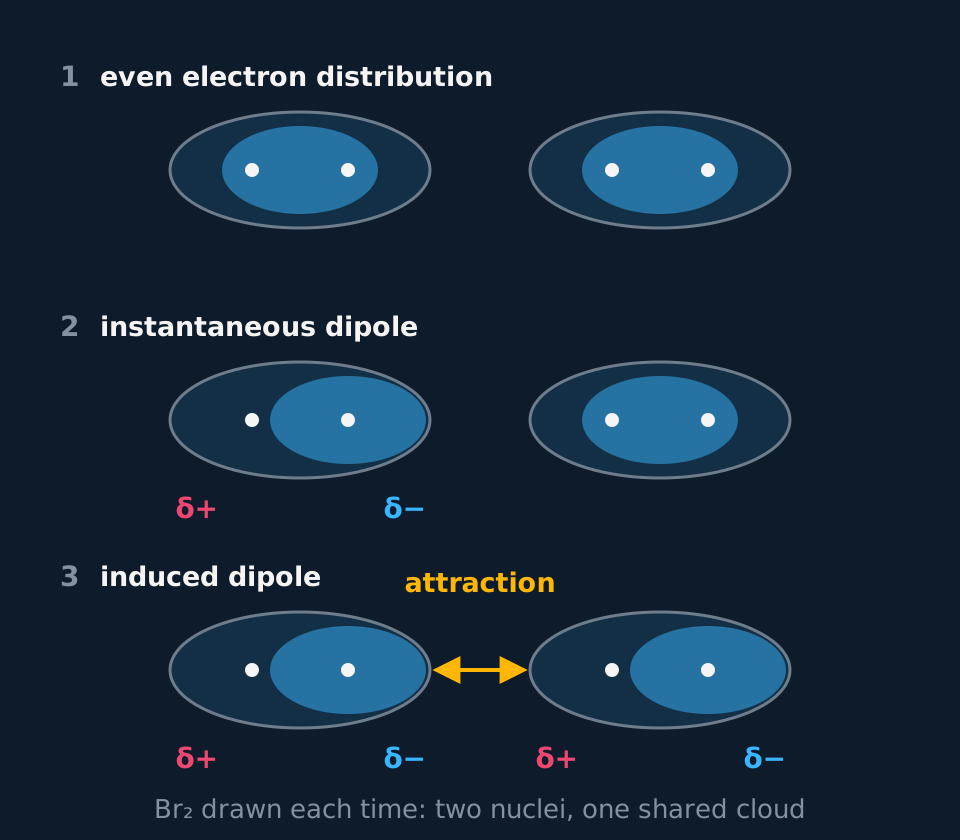
Describe the drawing
Three rows, each showing the same two oval Br₂ molecules side by side with their electron clouds shaded. In the first both clouds are even and neither molecule is charged. In the second the left molecule's cloud has bunched to its right-hand end, marked delta minus, leaving its left end delta plus. In the third the right molecule's cloud has been pushed to its far end, so its near end is delta plus, facing the left molecule's delta minus end, and a double arrow marks the attraction between them.
These forces grow stronger with the number of electrons in a molecule, because a larger electron cloud is more easily distorted, and with the area over which neighbouring molecules touch. Down Group 7 the molecules gain electrons and their boiling points rise: fluorine −188 °C, chlorine −34 °C, bromine 59 °C, iodine 184 °C. That is why the first two are gases at room temperature, bromine a liquid and iodine a solid.
The straight-chain alkanes follow the same pattern, from methane at −162 °C to hexane at 69 °C. Branching lowers the boiling point. Pentane boils at 36 °C, but its isomer 2,2-dimethylpropane, which has the same number of electrons but is nearly spherical and touches its neighbours over a smaller area, boils at 10 °C.
Permanent dipole–dipole forces act between polar molecules. The δ+ end of one molecule attracts the δ− end of the next, all the time, in addition to the induced dipole–dipole forces every molecule has. Propanone, CH₃COCH₃, and butane have the same relative molecular mass, 58, and similar numbers of electrons, 32 and 34. Propanone has a polar C=O bond and boils at 56 °C. Butane is non-polar and boils at −1 °C.
Hydrogen bonding is the strongest of the three. It needs a hydrogen atom covalently bonded to nitrogen, oxygen or fluorine. Those bonds are so polar that the hydrogen, which has no inner electrons to shield its nucleus, is left as a very small, strongly δ+ centre. It is attracted to a lone pair on an N, O or F atom of a neighbouring molecule. The hydrogen bond points along that lone pair, so the O–H···O arrangement is a straight line at 180°.
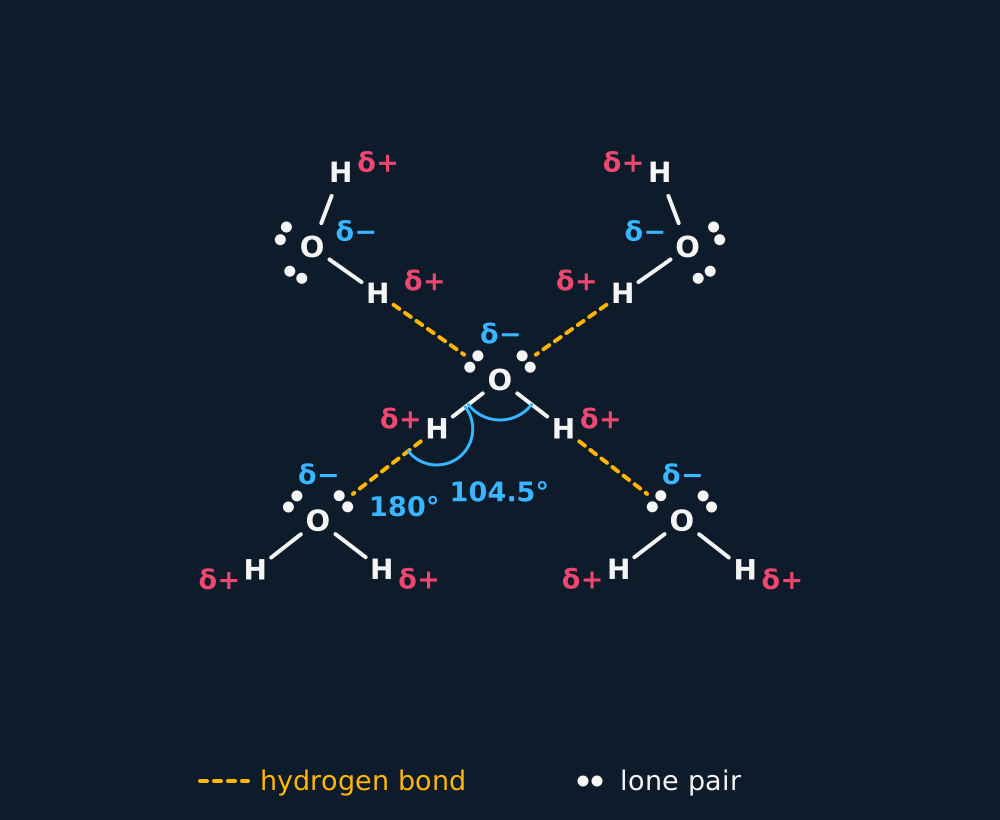
Describe the drawing
A central water molecule with two lone pairs drawn as pairs of dots, two O–H bonds at 104.5°, delta minus on its oxygen and delta plus on each hydrogen, surrounded by four neighbouring water molecules arranged roughly tetrahedrally. Each central hydrogen is joined by a dashed hydrogen bond to a lone pair on a neighbour's oxygen, and each central lone pair receives a dashed hydrogen bond from a neighbour's hydrogen. One O–H···O line is marked as 180°.
A hydrogen bond between water molecules is worth about 20 kJ mol⁻¹, against 463 kJ mol⁻¹ for the covalent O–H bond. For molecules of similar size the order is induced dipole–dipole, then permanent dipole–dipole, then hydrogen bonding. Size can overturn the order. Iodine, with only induced dipole–dipole forces, is a solid at room temperature while water, with hydrogen bonds, is a liquid, because iodine's 106 electrons per molecule outweigh water's 10.
- Induced dipole–dipole force
- An attraction between an instantaneous dipole in one molecule and the dipole it induces in a neighbouring molecule; it acts between all molecules.
- Permanent dipole–dipole force
- An attraction between the δ+ end of one polar molecule and the δ− end of another.
- Hydrogen bond
- An attraction between a lone pair on an N, O or F atom and a δ+ hydrogen atom covalently bonded to N, O or F in another molecule.
The hydrides of Groups 4 to 7, and water
The boiling points of the simple hydrides put all three forces on one graph. Down Group 4, from CH₄ to SnH₄, the molecules are non-polar tetrahedra and the boiling point rises steadily with the number of electrons. Groups 5, 6 and 7 follow the same rise from Period 3 downwards. The first member of each, NH₃, H₂O and HF, breaks the pattern, with a boiling point far above the line through the others.
| Group | Period 2 | Period 3 | Period 4 | Period 5 |
|---|---|---|---|---|
| 4 | CH₄ −162 °C | SiH₄ −112 °C | GeH₄ −88 °C | SnH₄ −52 °C |
| 5 | NH₃ −33 °C | PH₃ −88 °C | AsH₃ −62 °C | SbH₃ −17 °C |
| 6 | H₂O 100 °C | H₂S −60 °C | H₂Se −41 °C | H₂Te −2 °C |
| 7 | HF 20 °C | HCl −85 °C | HBr −67 °C | HI −35 °C |
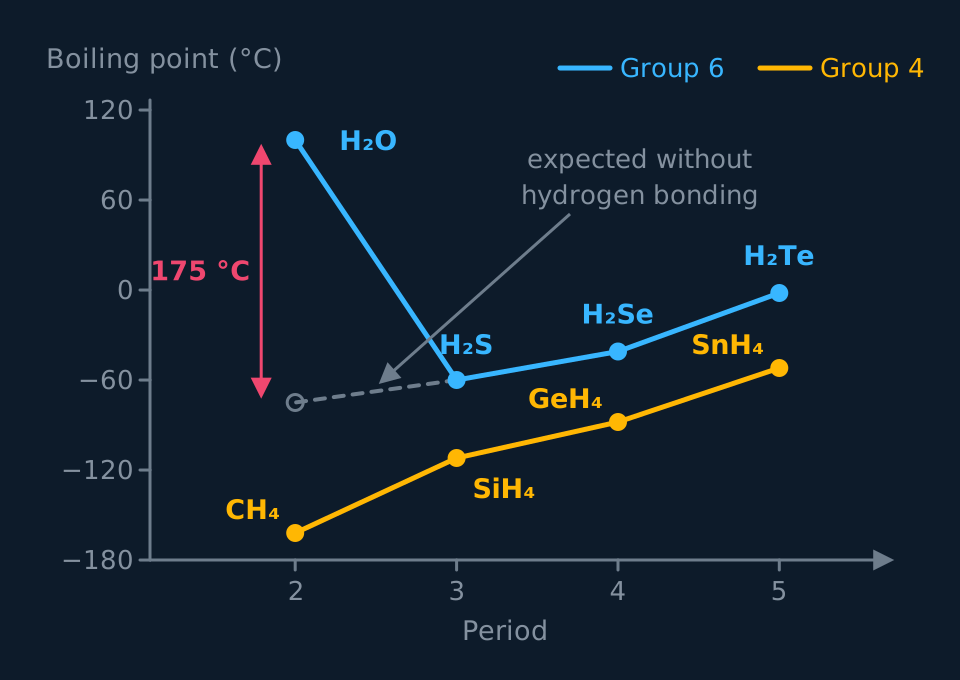
Describe the drawing
Boiling point in degrees Celsius against period two to five. The cyan Group 6 line starts high at water, 100 °C, drops to hydrogen sulfide at minus 60 and rises steadily through hydrogen selenide to hydrogen telluride at minus 2. A grey dashed line continues the lower trend back to period 2 at about minus 75 °C, the value expected without hydrogen bonding, 175 degrees below water. The amber Group 4 line rises steadily from methane at minus 162 to stannane at minus 52 with no anomaly.
Hydrogen bonding explains the anomaly. Nitrogen, oxygen and fluorine are electronegative enough, and small enough, for their hydrides to form hydrogen bonds; phosphorus, sulfur and chlorine are not. Before the molecules of NH₃, H₂O or HF can separate into a gas, the hydrogen bonds between them must be broken as well as the induced dipole–dipole forces that set the rest of the trend.
Water boils higher than hydrogen fluoride, although an F–H bond is more polar than O–H. Each water molecule has two δ+ hydrogen atoms and two lone pairs, so it forms on average two hydrogen bonds. Hydrogen fluoride has one hydrogen and three lone pairs; the hydrogen atoms run out first, and it averages one. Ammonia has three hydrogen atoms but only one lone pair, and nitrogen is the least electronegative of the three, so it boils lowest.
In ice those two hydrogen bonds per molecule hold each molecule to four neighbours in the open tetrahedral lattice that makes ice less dense than water. The same hydrogen bonding gives liquid water its high specific heat capacity, 4.18 J g⁻¹ K⁻¹, and its high surface tension.
A steel needle laid flat on water floats, and pond skaters walk on it. A molecule in the body of the liquid is pulled equally in every direction by hydrogen bonds to the molecules around it. A molecule at the surface has neighbours only beside and below it, so the net pull on it is inwards. The surface contracts to the smallest area it can, and energy is needed to enlarge it: that is surface tension.
Because the inward pull in water comes from hydrogen bonds, its surface tension is high: 73 mN m⁻¹ at 20 °C, against 18 mN m⁻¹ for hexane, whose molecules attract each other only by induced dipole–dipole forces.
- Surface tension
- The energy needed to increase the surface area of a liquid, which arises because molecules at the surface are pulled inwards by the molecules below and beside them.
Solubility and the alcohols
Butane is the fuel in a camping-stove cartridge; butan-1-ol is a liquid that boils at 118 °C. The difference is the O–H group. Butan-1-ol molecules hydrogen bond to each other through it, and those bonds must be broken before the liquid can boil. Pentane makes a fairer comparison, since it has exactly the same number of electrons as butan-1-ol, 42. Pentane boils at 36 °C, so about 80 °C of the difference comes from hydrogen bonding.
A substance dissolves when the forces it can form with the solvent are comparable to the forces that have to be broken. Ethanol mixes with water in all proportions because its O–H group forms hydrogen bonds with water molecules. Hexane does not dissolve in water. It can form only induced dipole–dipole forces with water, much weaker than the hydrogen bonds between water molecules that would have to be broken to make room for it. Hexane does dissolve in other non-polar liquids, where the forces broken and made are of the same kind.
Being polar is not enough to dissolve in water. 1-Chlorobutane has a polar C–Cl bond, but it barely dissolves. It has no hydrogen on N, O or F, so it can form only permanent dipole–dipole and induced dipole–dipole forces with water, and these cannot make up for the hydrogen bonds between water molecules that would have to break. It mixes freely with hexane or with ethoxyethane, whose forces are of its own kind.
Choosing a solvent follows the same rule. Water suits ionic compounds and molecules that can hydrogen bond to it; a non-polar solvent such as hexane suits molecules held together by induced dipole–dipole forces. The choice is argued from the forces broken and made, as with 1-chlorobutane, which is polar and still stays out of water.
Along the alcohols, solubility in water falls as the chain gets longer. Methanol, ethanol and propan-1-ol mix with water completely. Butan-1-ol dissolves only to about 7 g per 100 g of water, because its longer hydrocarbon chain cannot hydrogen bond and gets in the way of the hydrogen bonding between the water molecules around it. Ionic compounds dissolve by a different route: the δ− oxygen atoms of water molecules surround the cations and the δ+ hydrogen atoms surround the anions.
TRY IT: Three molecules with 26 electrons
Propane, CH₃CH₂CH₃, methoxymethane, CH₃OCH₃, and ethanol, CH₃CH₂OH, each have 26 electrons. Put them in order of increasing boiling point and explain the order.
Check your answer
The induced dipole–dipole forces are similar in all three, since the number of electrons is the same, so the order depends on the other forces.
Propane is non-polar and has only induced dipole–dipole forces: lowest, −42 °C. Methoxymethane has polar C–O bonds in a bent C–O–C arrangement, so it also has permanent dipole–dipole forces: −24 °C. Its hydrogen atoms are all bonded to carbon, so it cannot hydrogen bond to itself.
Ethanol has an O–H group, so its molecules hydrogen bond to each other: highest, 78 °C. Order: propane < methoxymethane < ethanol.
Other boards: names for the forces, and water's anomalies
The boards name the weakest force differently. AQA's term is induced dipole–dipole forces. OCR and Edexcel say London forces. Cambridge says instantaneous dipole–induced dipole forces, and uses van der Waals' forces as the name for all intermolecular forces together, hydrogen bonds included, so the same phrase means different things on different boards' papers. Use the board's own term in its exam.
Cambridge lists the anomalous properties of water that hydrogen bonding explains: the high melting and boiling points against the other Group 6 hydrides, the high surface tension, and the low density of ice. An answer is expected to tie each one to hydrogen bonds between the molecules.
Edexcel names halogenoalkanes as polar molecules that do not dissolve in water, and asks for the choice of a solvent to be argued from the forces broken and made: hydrogen bonds between water molecules broken, and only weaker permanent and induced dipole–dipole forces formed with the halogenoalkane in their place.
In the exam
- Electronegativity is 'the power of an atom to attract the pair of electrons in a covalent bond'. The scheme needs 'pair of electrons' and 'covalent bond'; a definition about a single electron, or about ions, is not credited.
- Induced dipole–dipole forces are explained in order: uneven electron distribution, an instantaneous dipole, a dipole induced in a neighbouring molecule, and attraction between the two.
- A hydrogen bond diagram is marked on δ+ and δ− charges, a lone pair on the N, O or F atom, and the hydrogen bond as a dashed line in line with the covalent bond to hydrogen; the scheme accepts an angle shown as 180° or a straight line.
- A boiling point answer names the force overcome, says which substance has the stronger force and why, and states that more energy is needed to overcome it. Any answer that breaks covalent bonds on boiling a molecular substance is rejected.
- The high boiling point of water against H₂S is explained by hydrogen bonding between water molecules, not by the strength of the O–H bond.
Check yourself
Hydrogen fluoride boils at 20 °C and hydrogen chloride at −85 °C, although HCl has more electrons. Explain the difference, then explain why water boils higher still, at 100 °C.
Answer
HCl has more electrons, 18 against 10, so its induced dipole–dipole forces are stronger than those in HF. That cannot be the reason HF boils higher.
Fluorine is far more electronegative than chlorine and is small, so HF molecules form hydrogen bonds: the δ+ hydrogen of one molecule is attracted to a lone pair on the fluorine of the next. HCl has only permanent dipole–dipole and induced dipole–dipole forces, which are weaker, so less energy is needed to separate its molecules.
Each water molecule has two hydrogen atoms and two lone pairs, so it forms on average two hydrogen bonds, against one for HF, whose single hydrogen limits it. More hydrogen bonds per molecule need more energy to break, so water boils highest.
Questions
Question 16 marks
Explain the trend in the boiling points of the Group 6 hydrides given in the table.
| Hydride | H₂O | H₂S | H₂Se | H₂Te |
|---|---|---|---|---|
| Boiling point / °C | 100 | −60 | −41 | −2 |
Mark scheme
Indicative content
- from H₂S to H₂Te the number of electrons in the molecule increases, from 18 to 54, as the Group 6 atom gets larger
- so the induced dipole–dipole forces between the molecules become stronger, because a larger electron cloud is more easily distorted
- and more energy is needed to overcome them, so the boiling point rises steadily from H₂S to H₂Te
- water is anomalous: it has the fewest electrons, only ten, but by far the highest boiling point of the four
- oxygen is small and highly electronegative, so water molecules form hydrogen bonds between a δ+ hydrogen and a lone pair on oxygen
- hydrogen bonds are much stronger than the other intermolecular forces, so far more energy is needed to boil water
Levels
- Level 3 (5–6 marks) the rise from H₂S to H₂Te is explained through more electrons and stronger induced dipole–dipole forces, water is identified as the anomaly, and hydrogen bonding is explained with its cause in the small, highly electronegative oxygen and its strength relative to the other forces; both the steady rise and the break at water are accounted for
- Level 2 (3–4 marks) the rise from H₂S to H₂Te is explained and water is said to hydrogen bond; what causes the hydrogen bond, or why it outweighs the other forces, is not said, or water is never named as the break in the trend
- Level 1 (1–2 marks) the boiling point is said to rise down the group or water to be unusual, often with the O–H bonds in water said to be harder to break than S–H
Question 24 marks
Explain why electronegativity increases across Period 3 and decreases down Group 7.
Mark scheme
- B1 across the period the nuclear charge increases
- B1 the bonding electrons stay in the same shell with similar shielding, so they are attracted more strongly
- B1 down the group the atoms have more shells, so the bonding pair is further from the nucleus
- B1 and is more shielded by inner electrons, so it is attracted less strongly despite the greater nuclear charge
Question 34 marks
Explain how induced dipole–dipole forces arise between two bromine molecules.
Mark scheme
- B1 the electrons in a Br₂ molecule are constantly moving, so at an instant they can be unevenly distributed
- B1 this gives the molecule an instantaneous dipole
- B1 the instantaneous dipole induces a dipole in a neighbouring molecule by attracting or repelling its electrons
- B1 the δ+ end of one dipole attracts the δ− end of the other, so the molecules attract
All 21 questions with mark schemes, the other 18 set out in full on the question page.
Worth remembering
- Check the shape before calling a molecule polar: CCl₄ and BF₃ have polar bonds and no overall dipole.
- 'Hydrogen bonding' in HCl or CH₃Cl, with no H on N, O or F, is wrong.
- End a drawn hydrogen bond on the lone pair, not on the other molecule's hydrogen, and show δ+ and δ− at each end.
- Explaining water's boiling point by its strong O–H bonds confuses bonds with forces.
- Name the kind of force in every comparison: induced dipole–dipole forces (van der Waals forces), permanent dipole–dipole forces or hydrogen bonds.
CHECK YOUR PROGRESS
Rate how confident you are with each objective for this lesson. Ratings are saved in this browser, on this device, unless you sign in.
- Define electronegativity, describe its trends in the periodic table and use it to explain why a bond is polar.
- Explain why some molecules with polar bonds, such as CO₂ and CCl₄, are not polar.
- Describe the origin of induced dipole–dipole forces, permanent dipole–dipole forces and hydrogen bonds, and put them in order of strength.
- Explain the boiling points of the halogens, the alkanes and the hydrides of Groups 4 to 7, including the anomalous values for NH₃, H₂O and HF.
- Draw hydrogen bonding between molecules, showing partial charges, the lone pair and the 180° angle at hydrogen.
- Explain the solubility of a substance in water in terms of the intermolecular forces it can form.
Open the full revision checklist to see every objective in the curriculum in one place.
Practise this lesson
WORKBOOK
The written questions from this topic, on paper with room to work, and a separate book of mark schemes. The 2 questions that are set on a diagram stay on this page, where the diagram can be drawn. Free to use; please do not redistribute or sell.
Used later in Enthalpies of solution and hydration · Group 7: trends down the group and displacement reactions · Structural isomerism and E/Z isomerism · Reaction types, curly arrows and how a mechanism is written