Chemistry › Thermodynamics › Entropy and Gibbs free-energy change
Entropy and Gibbs free-energy change
Ice melts on a kitchen worktop and a cold pack goes cold, both taking in heat, so an exothermic change cannot be the only kind that happens. Entropy, a measure of disorder, is the other half of the story. The Gibbs free-energy change combines it with the enthalpy change and the temperature, and says whether a reaction is feasible and above or below which temperature it becomes so.
Key terms Every definition in thermodynamics, lesson by lesson
Before this Enthalpy change, standard conditions and the definitions – the sign of ΔH and the standard enthalpy of formation · Hess's law and enthalpy cycles – ΔH from enthalpies of formation · Collision theory, activation energy and the rate of reaction – why a reaction with a high activation energy is slow
COMMON MISCONCEPTION
Reactions happen because they give out heat, so an endothermic reaction can only go if you keep forcing energy in.
A reaction is feasible when ΔG = ΔH − TΔS is negative, and a large enough rise in entropy makes that true with ΔH positive. Ammonium nitrate dissolving, ice melting above 0 °C and ammonium carbonate reacting with ethanoic acid all take heat in from their surroundings and go on their own.
What you should be able to do
- Describe entropy as a measure of disorder, and predict the sign of an entropy change from the states and the moles of gas in an equation.
- Calculate the entropy change of a reaction from standard entropies, in J K⁻¹ mol⁻¹.
- Use ΔG = ΔH − TΔS to calculate a Gibbs free-energy change, converting the units correctly, and state the condition for a reaction to be feasible.
- Calculate the temperature at which a reaction becomes feasible, and read ΔH, ΔS and that temperature from a graph of ΔG against T.
- Explain why a reaction that is feasible may not take place at a measurable rate.
- Calculate the entropy change of the surroundings and the total entropy change, and use ΔG = −RT ln K to relate ΔG to the equilibrium constant.CAIE · Edexcel
Endothermic and still happening
Not every change that happens gives out heat. Ice melts at 20 °C, taking in heat from the room, and ammonium nitrate dissolves in a cold pack, taking in heat from the water. A rule that said only exothermic changes can happen would forbid both. Something besides the enthalpy change decides which way a change runs, and it is entropy.
Entropy, S, is a measure of disorder: of the number of ways the particles in a substance, and the energy they carry, can be arranged. In a solid the particles sit in fixed places and vibrate. In a liquid they move past one another. In a gas they move freely through the whole container, and the number of arrangements open to them is enormously larger. Left to themselves, systems move towards the arrangements that are more numerous, which means towards higher entropy.
Entropies are measured in J K⁻¹ mol⁻¹, joules, not kilojoules. A perfect crystal at 0 K has zero entropy, because there is only one way to arrange it, so every substance above 0 K has a positive entropy, elements included. That is the difference from enthalpies of formation, where an element in its standard state is zero by definition.
| Substance | State | Standard entropy / J K⁻¹ mol⁻¹ |
|---|---|---|
| C (diamond) | solid | 2 |
| Mg | solid | 33 |
| NaCl | solid | 72 |
| H₂O | liquid | 70 |
| Br₂ | liquid | 152 |
| H₂ | gas | 131 |
| H₂O | gas | 189 |
| O₂ | gas | 205 |
| CO₂ | gas | 214 |
Diamond, rigid and with every atom held by four covalent bonds, has almost none. Water as a gas has nearly three times the entropy of water as a liquid. Within a state, a substance with more atoms or heavier atoms has more entropy, so CO₂ sits above O₂ in the table.
- Entropy
- A measure of the disorder of a system: the number of ways the particles and their energy can be arranged.
- Standard entropy
- The entropy of one mole of a substance in its standard state at 100 kPa and a stated temperature, usually 298 K.
Entropy through the changes of state
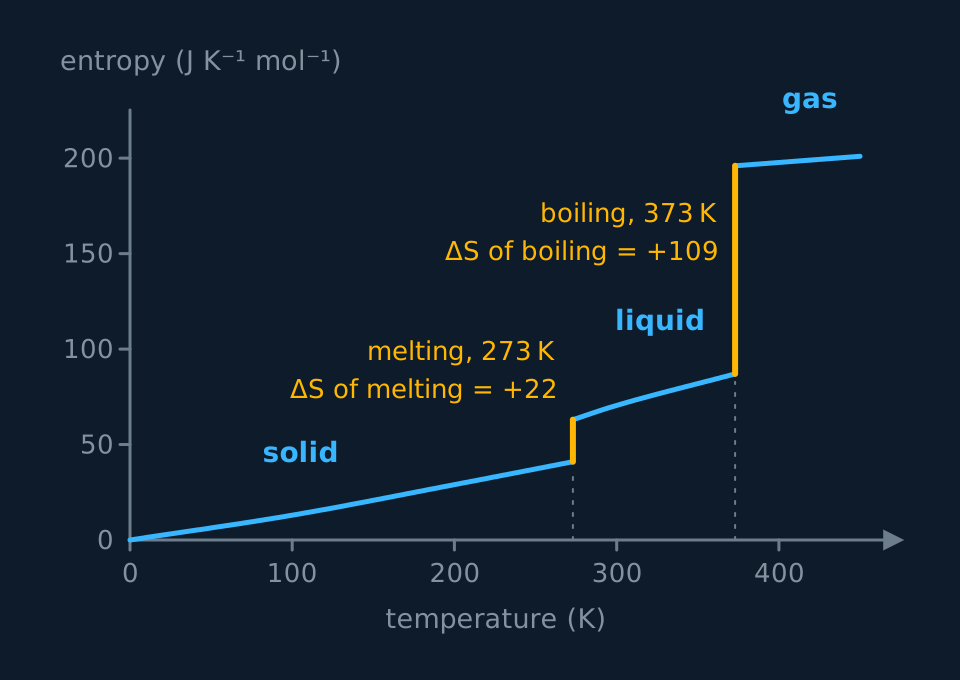
The entropy of a solid climbs slowly as it is warmed from 0 K, because the particles vibrate more and the energy can be shared out in more ways. At the melting point it jumps, because the particles are freed from fixed positions while the temperature stays the same. The liquid then climbs slowly again. At the boiling point it jumps again, and by much more.
Describe the drawing
Graph of the entropy of one mole of water against temperature from 0 to 450 K. The curve starts at zero at 0 K and rises slowly, curving upward, through the solid to 41 J K⁻¹ mol⁻¹ at 273 K, where a vertical step of +22 marks melting. It rises gently through the liquid to 87 at 373 K, where a much taller vertical step of +109 marks boiling, up to 196, then rises gently through the gas to about 201 at 450 K.
The boiling jump is the larger because the change in disorder is the larger. Melting turns a fixed arrangement into one where the particles move but are still in contact. Boiling separates them completely and spreads them through a volume about a thousand times greater. For water, melting adds 22 J K⁻¹ mol⁻¹ and boiling adds 109 J K⁻¹ mol⁻¹.
The same reasoning predicts the sign of the entropy change for a reaction. Gases dominate: a reaction that increases the number of moles of gas has a positive entropy change, and one that decreases it has a negative one. A solid giving a gas, as when calcium carbonate gives off carbon dioxide, is a large increase. Dissolving a solid usually increases entropy too.
The entropy change of a reaction
The entropy change of a reaction is found from the standard entropies of everything in the equation, each multiplied by its number of moles. Elements are included, since their entropies are not zero.
ΔS = ΣS(products) − ΣS(reactants)every value in J K⁻¹ mol⁻¹, multiplied by its coefficient
TRY IT: The entropy change when magnesium burns
Calculate the entropy change for 2Mg(s) + O₂(g) → 2MgO(s), using standard entropies of 33 J K⁻¹ mol⁻¹ for Mg(s), 205 J K⁻¹ mol⁻¹ for O₂(g) and 27 J K⁻¹ mol⁻¹ for MgO(s). Say whether the sign is what the equation predicts.
Check your answer
Products: 2 × 27 = 54 J K⁻¹ mol⁻¹. Reactants: 2 × 33 + 205 = 271 J K⁻¹ mol⁻¹.
ΔS = 54 − 271 = −217 J K⁻¹ mol⁻¹.
The sign is negative, as predicted: one mole of gas is used up and only solids are left, so the system becomes more ordered.
A negative entropy change does not stop magnesium burning, which it does readily. The enthalpy change has to be taken into account as well, and so does the temperature.
- Entropy change of a reaction
- The sum of the standard entropies of the products minus the sum of the standard entropies of the reactants, each multiplied by its number of moles in the equation.
The Gibbs free-energy change
The Gibbs free-energy change, ΔG, combines the enthalpy change, the entropy change and the absolute temperature in one quantity. A reaction is feasible when ΔG is zero or negative.
ΔG = ΔH − TΔSΔG and ΔH in kJ mol⁻¹, T in K, ΔS converted to kJ K⁻¹ mol⁻¹
The units need care. ΔH is in kJ mol⁻¹ and ΔS in J K⁻¹ mol⁻¹, so ΔS is divided by 1000 before it goes into the equation. Leaving it in joules makes the TΔS term a thousand times too large, and the answer is then meaningless. The word for a reaction with ΔG ≤ 0 is feasible; 'spontaneous' suggests that it happens at once, which ΔG does not say.
The temperature multiplies the entropy term, so the higher the temperature, the more entropy counts, and the sign of ΔG can change as a reaction is heated. Setting ΔG = 0 gives the temperature at which the change happens, T = ΔH/ΔS, with both in the same energy unit.
T = ΔH ÷ ΔSthe temperature at which ΔG = 0
Water boiling is a check that the equation behaves. For H₂O(l) → H₂O(g), ΔH = +40.7 kJ mol⁻¹ and ΔS = +109 J K⁻¹ mol⁻¹. Setting ΔG = 0 gives T = 40.7 ÷ 0.109 = 373 K, the boiling point. Below it ΔG is positive and liquid water is the stable state; above it ΔG is negative and steam is. At exactly 373 K the two are in equilibrium, which is what ΔG = 0 means.
The calculation assumes that ΔH and ΔS do not change with temperature. Both do, a little, so a temperature from T = ΔH/ΔS is an estimate. The values used are the standard ones at 298 K, and the error grows the further the answer is from 298 K.
When limestone decomposes
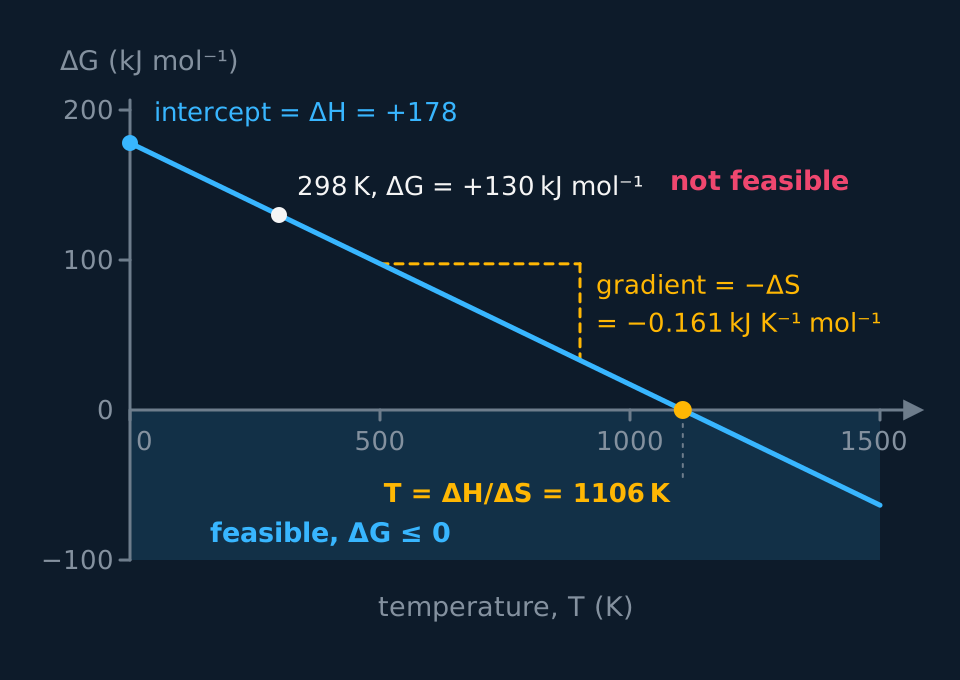
Calcium carbonate decomposes on heating: CaCO₃(s) → CaO(s) + CO₂(g), ΔH = +178 kJ mol⁻¹. The standard entropies are CaCO₃(s) 93, CaO(s) 40 and CO₂(g) 214 J K⁻¹ mol⁻¹. Show that the reaction is not feasible at 298 K, and calculate the lowest temperature at which it is.
Show the working
ΔS = (40 + 214) − 93 = +161 J K⁻¹ mol⁻¹ = +0.161 kJ K⁻¹ mol⁻¹.
At 298 K: ΔG = 178 − (298 × 0.161) = 178 − 48.0 = +130 kJ mol⁻¹. ΔG is positive, so the reaction is not feasible at room temperature, and limestone cliffs last.
It becomes feasible when ΔG = 0: T = ΔH ÷ ΔS = 178 ÷ 0.161 = 1106 K, which is 1110 K to three significant figures, about 830 °C.
Above 1110 K the TΔS term is larger than ΔH and ΔG is negative. Lime kilns run hotter than this, so that the decomposition is also fast.
Describe the drawing
Graph of ΔG against temperature in kelvin for the decomposition of calcium carbonate. A straight line starts at +178 kJ mol⁻¹ on the vertical axis, marked as the intercept equal to ΔH, and falls with a gradient triangle marked minus ΔS, −0.161 kJ K⁻¹ mol⁻¹. A marker at 298 K shows ΔG = +130. The line crosses zero at T = ΔH/ΔS = 1106 K and reaches −63.5 at 1500 K. The region below the temperature axis is shaded and labelled feasible, ΔG ≤ 0; the region above is labelled not feasible.
A graph of ΔG against T is a straight line if ΔH and ΔS stay constant. Its intercept on the ΔG axis is ΔH, its gradient is −ΔS, and it crosses the temperature axis at ΔH/ΔS. The line changes gradient at any temperature where one of the substances melts or boils, because its entropy jumps there.
- Gibbs free-energy change
- The quantity ΔG = ΔH − TΔS, which combines the enthalpy change, the entropy change and the temperature; a reaction is feasible when it is zero or negative.
- Feasible
- Able to take place without a continuous input of energy from outside, which is so when ΔG is zero or negative.
Four sign cases and the position of equilibrium
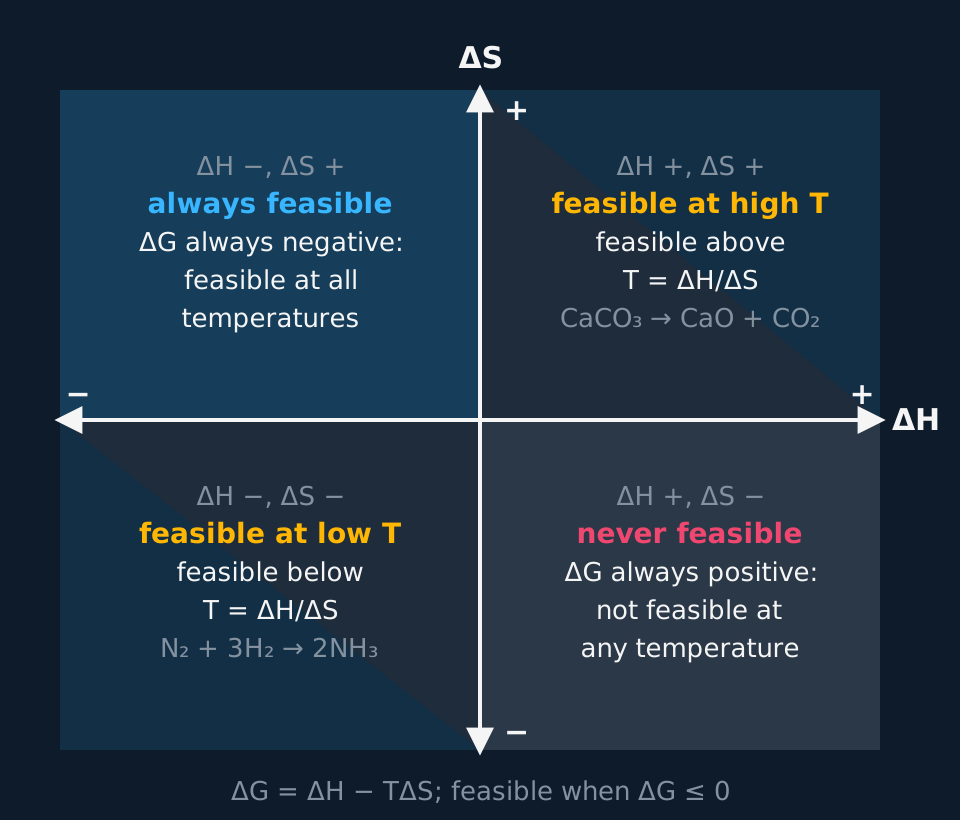
ΔH and ΔS can each be positive or negative, so there are four combinations, and the sign of ΔG in each follows from the equation.
Describe the drawing
Quadrant diagram with ΔH across, negative left and positive right, and ΔS up, negative bottom and positive top. Top left, ΔH negative and ΔS positive, is shaded as always feasible: ΔG is always negative. Bottom right, ΔH positive and ΔS negative, is shaded grey as never feasible: ΔG is always positive. Top right, both positive, is feasible above T = ΔH/ΔS, for example CaCO₃ → CaO + CO₂. Bottom left, both negative, is feasible below T = ΔH/ΔS, for example N₂ + 3H₂ → 2NH₃.
| ΔH | ΔS | ΔG | Feasible |
|---|---|---|---|
| − | + | Always negative | At every temperature |
| + | − | Always positive | At no temperature |
| − | − | Negative at low T | Below T = ΔH/ΔS |
| + | + | Negative at high T | Above T = ΔH/ΔS |
The Haber process at two temperatures
For N₂(g) + 3H₂(g) ⇌ 2NH₃(g), ΔH = −92 kJ mol⁻¹. The standard entropies are N₂(g) 192, H₂(g) 131 and NH₃(g) 193 J K⁻¹ mol⁻¹. Calculate ΔG at 298 K and at 700 K, close to the 450 °C (723 K) the process runs at, and comment.
Show the working
ΔS = (2 × 193) − (192 + 3 × 131) = 386 − 585 = −199 J K⁻¹ mol⁻¹ = −0.199 kJ K⁻¹ mol⁻¹. Four moles of gas become two, so a negative value is expected.
At 298 K: ΔG = −92 − (298 × −0.199) = −92 + 59.3 = −33 kJ mol⁻¹. Feasible.
At 700 K: ΔG = −92 − (700 × −0.199) = −92 + 139.3 = +47 kJ mol⁻¹. Not feasible under standard conditions.
This is the ΔH negative, ΔS negative case, feasible only below T = 92 ÷ 0.199 = 462 K. The plant runs well above that because at 298 K the reaction is far too slow, even with an iron catalyst. A positive ΔG means the equilibrium lies on the side of the reactants, not that no ammonia forms: the high pressure pushes the position back towards ammonia, and the ammonia is condensed out as it forms.
Feasible is not the same as fast
ΔG says whether a reaction can go. It says nothing about how fast. Diamond turning into graphite has ΔG = −2.9 kJ mol⁻¹ at 298 K, so it is feasible, and yet a diamond ring does not change in a lifetime. The activation energy is so high that at room temperature the rate cannot be measured.
Petrol and oxygen are in the same position. Their reaction has a large negative ΔG, but a car's fuel tank does not burn until a spark supplies enough energy for some molecules to get over the barrier, after which the heat released keeps it going. A mixture like this is kinetically stable: feasible on thermodynamic grounds and held back by its activation energy.
Two separate questions are therefore asked of any reaction. Thermodynamics answers whether it can happen, through ΔG. Kinetics answers how fast, through the activation energy and the conditions.
- Kinetically stable
- Describes a feasible reaction mixture that does not react at a measurable rate because its activation energy is high.
- Thermodynamically stable
- Describes a substance or mixture for which the possible reaction has a positive ΔG, so the reaction is not feasible under the conditions stated.
Other boards: total entropy and ΔG = −RT ln K
AQA states the condition as ΔG ≤ 0; OCR and Cambridge write ΔG < 0 for a feasible reaction, and on every paper ΔG = 0 marks a change at equilibrium. Edexcel builds the topic on the total entropy change as well as on ΔG, and uses the link between ΔG and the equilibrium constant, ΔG = −RT ln K. Each has its own calculation and its own worked example.
The entropy change from standard entropies belongs to the system, the reacting substances alone. Burning magnesium also heats its surroundings: 1204 kJ is released for every 2 mol of MgO formed, and that energy spreads through the air and the bench among vastly more particles, so their entropy rises. The same quantity of heat makes more difference to cold surroundings than to hot ones, and dividing ΔH by the temperature allows for that.
ΔS(surroundings) = −ΔH ÷ TΔH in J mol⁻¹ and T in K; positive for an exothermic reaction
ΔS(total) = ΔS(system) + ΔS(surroundings)a change takes place naturally when ΔS(total) is positive
The second law of thermodynamics says that in any change that takes place naturally, the total entropy of the system and its surroundings increases. The entropy of the system can fall, as it does when magnesium burns, provided the surroundings gain more.
The total entropy change when magnesium burns
For 2Mg(s) + O₂(g) → 2MgO(s), ΔH = −1204 kJ mol⁻¹ and ΔS(system) = −217 J K⁻¹ mol⁻¹. Calculate the entropy change of the surroundings and the total entropy change at 298 K.
Show the working
Put ΔH in joules, to match the entropy: −1204 kJ mol⁻¹ = −1.204 × 10⁶ J mol⁻¹.
ΔS(surroundings) = −ΔH ÷ T = +1.204 × 10⁶ ÷ 298 = +4040 J K⁻¹ mol⁻¹.
ΔS(total) = −217 + 4040 = +3823 J K⁻¹ mol⁻¹, which is +3820 J K⁻¹ mol⁻¹ to three significant figures.
The total is positive, so the reaction takes place. The system becomes more ordered, but the heat it releases disorders the surroundings nearly twenty times as much.
- Entropy change of the surroundings
- The entropy change of everything outside the reacting system, equal to −ΔH/T; it is positive for an exothermic reaction.
- Total entropy change
- The sum of the entropy changes of the system and of the surroundings; a change takes place naturally when it is positive.
The total entropy change gives the same verdict. Multiply ΔS(total) = ΔS(system) − ΔH/T through by −T and it becomes −TΔS(total) = ΔH − TΔS(system), which is ΔG. A negative ΔG and a positive total entropy change are one condition written two ways. For burning magnesium at 298 K, ΔG = −298 × 3.823 = −1139 kJ mol⁻¹, with ΔS(total) in kJ K⁻¹ mol⁻¹. On Edexcel papers either route can be asked for.
ΔG = −TΔS(total)ΔS(total) in kJ K⁻¹ mol⁻¹
ΔG = −RT ln KΔG in J mol⁻¹, R = 8.31 J K⁻¹ mol⁻¹, T in K; K has no units here
A positive ΔG that still gives some ammonia at 700 K is explained by the equilibrium constant, which ΔG fixes. Rearranged, ΔG = −RT ln K gives ln K = −ΔG/RT. A negative ΔG makes ln K positive, so K is greater than 1 and the products are favoured at equilibrium. A positive ΔG makes K less than 1, with the reactants favoured, but K is never zero. Only when ΔG is tens of kJ mol⁻¹ either way does the equilibrium lie so far over that the reaction is effectively complete, or effectively absent.
K in this equation has no units, because each concentration or partial pressure is divided by its standard value before it goes in. Since ΔG = −TΔS(total), the same relation can be written ΔS(total) = R ln K, the form Edexcel also uses.
The equilibrium constant for the Haber process
For N₂(g) + 3H₂(g) ⇌ 2NH₃(g), ΔG is −33 kJ mol⁻¹ at 298 K and +47 kJ mol⁻¹ at 700 K. Calculate K at each temperature, using R = 8.31 J K⁻¹ mol⁻¹.
Show the working
Rearrange ΔG = −RT ln K to ln K = −ΔG ÷ RT, with ΔG in J mol⁻¹.
At 298 K: ln K = 33000 ÷ (8.31 × 298) = 33000 ÷ 2476 = 13.33, so K = exp(13.33) = 6.1 × 10⁵.
At 700 K: ln K = −47000 ÷ (8.31 × 700) = −47000 ÷ 5817 = −8.08, so K = exp(−8.08) = 3.1 × 10⁻⁴.
Heating from 298 K to 700 K cuts K by a factor of about two thousand million, as it should for an exothermic forward reaction, so ΔG and Le Chatelier's principle agree. At 700 K, K is small but not zero: some ammonia is present at equilibrium, and the high pressure and the removal of ammonia as it forms make the yield useful.
In the exam
- A ΔS calculation multiplies each entropy by its coefficient and includes the elements. Leaving out oxygen's entropy because elements are zero in enthalpies of formation loses the method mark, and the answer needs its sign and J K⁻¹ mol⁻¹.
- In ΔG = ΔH − TΔS, ΔS goes in as kJ K⁻¹ mol⁻¹. An answer that keeps it in joules is a thousand times out and earns no credit for the value, though the scheme still awards a correctly written expression.
- For the temperature at which a reaction becomes feasible, the method mark is for setting ΔG = 0; then T = ΔH/ΔS with both in kJ, and the answer in kelvin.
- A feasible reaction that does not happen is explained by a high activation energy and a slow rate. 'It is not feasible' contradicts the question and is not credited.
- On a graph of ΔG against T, give the intercept as ΔH and the gradient as −ΔS, and explain a change of gradient by a change of state of one substance, which changes ΔS.
Check yourself
Ammonium nitrate dissolves in water with ΔH = +26 kJ mol⁻¹ and ΔS = +108 J K⁻¹ mol⁻¹. Show that dissolving it is feasible at 298 K, and find the temperature below which it would not be.
Answer
Convert ΔS: +108 J K⁻¹ mol⁻¹ = +0.108 kJ K⁻¹ mol⁻¹.
At 298 K: ΔG = 26 − (298 × 0.108) = 26 − 32.2 = −6.2 kJ mol⁻¹. ΔG is negative, so dissolving is feasible even though it is endothermic: the increase in entropy as the ions spread through the water outweighs the enthalpy term at this temperature.
ΔG = 0 when T = ΔH ÷ ΔS = 26 ÷ 0.108 = 241 K. Below 241 K, about −32 °C, the TΔS term would be smaller than ΔH and ΔG would be positive. The solution would freeze before that, but the figure shows how much the cold pack depends on the entropy term.
Questions
Question 16 marks
Explain how the feasibility of the reaction 2NO₂(g) → N₂O₄(g) depends on temperature, using the data in the table. Include a calculation of the temperature at which ΔG = 0.
| Quantity | Value |
|---|---|
| ΔH for 2NO₂(g) → N₂O₄(g) | −57.2 kJ mol⁻¹ |
| Standard entropy of NO₂(g) | 240 J K⁻¹ mol⁻¹ |
| Standard entropy of N₂O₄(g) | 304 J K⁻¹ mol⁻¹ |
Mark scheme
Indicative content
- ΔS = 304 − (2 × 240) = −176 J K⁻¹ mol⁻¹, negative because two moles of gas become one and the system becomes more ordered
- ΔH is negative and favours the reaction, while the −TΔS term is positive and works against it, more strongly the higher the temperature
- at low temperature TΔS is small compared with ΔH, so ΔG is negative and the dimerisation of NO₂ is feasible
- ΔG = 0 when T = ΔH ÷ ΔS = −57.2 ÷ −0.176 = 325 K, with ΔS first converted to kJ K⁻¹ mol⁻¹; allow 325 to 326 K
- above about 325 K the −TΔS term outweighs ΔH, so ΔG is positive and the reverse change, N₂O₄ splitting into NO₂, is the feasible one
- the calculation assumes ΔH and ΔS do not change with temperature, so 325 K is an estimate; this is the case of negative ΔH and negative ΔS, feasible only below ΔH/ΔS
Levels
- Level 3 (5–6 marks) ΔS is calculated with its sign explained, the competition between ΔH and TΔS is set out, the temperature at which ΔG = 0 is calculated with the unit conversion, the feasibility on both sides of it is stated, and the assumption that ΔH and ΔS are constant is noted
- Level 2 (3–4 marks) ΔS is calculated and the temperature of ΔG = 0 found; the negative ΔS is not explained, feasibility on either side of that temperature is not stated, or kJ and J are mixed
- Level 1 (1–2 marks) ΔG = ΔH − TΔS is quoted or ΔS calculated; the reaction is commonly called feasible at all temperatures because ΔH is negative
Question 24 marks
Calculate the lowest temperature at which the decomposition MgCO₃(s) → MgO(s) + CO₂(g) is feasible, using the data in the table.
| Quantity | Value |
|---|---|
| ΔH for the decomposition | +117 kJ mol⁻¹ |
| Standard entropy of MgCO₃(s) | 66 J K⁻¹ mol⁻¹ |
| Standard entropy of MgO(s) | 27 J K⁻¹ mol⁻¹ |
| Standard entropy of CO₂(g) | 214 J K⁻¹ mol⁻¹ |
Mark scheme
- M1 ΔS = (27 + 214) − 66 = +175 J K⁻¹ mol⁻¹
- M1 ΔS is converted to +0.175 kJ K⁻¹ mol⁻¹ and ΔG is set to zero
- M1 T = ΔH ÷ ΔS = 117 ÷ 0.175
- A1 T = 669 K, three significant figures, in kelvin; allow 668 to 669 K
Question 34 marks
Explain, using ΔG = ΔH − TΔS, why the endothermic decomposition of calcium carbonate is not feasible at room temperature but is feasible at high temperature.
Mark scheme
- B1 ΔH is positive, so on its own it makes ΔG positive
- B1 a solid produces a gas, so ΔS is positive and the term −TΔS is negative
- B1 at room temperature TΔS is smaller than ΔH, so ΔG is positive and the reaction is not feasible
- B1 as T rises, TΔS grows until it exceeds ΔH, so above T = ΔH/ΔS the value of ΔG is negative and the reaction is feasible
All 23 questions with mark schemes, the other 20 set out in full on the question page.
Worth remembering
- Leaving oxygen out of a ΔS sum because 'elements are zero' confuses entropy with enthalpy of formation; every substance has an entropy.
- ΔS left in J K⁻¹ mol⁻¹ inside ΔG = ΔH − TΔS makes the TΔS term a thousand times too large.
- Write 'feasible' for ΔG ≤ 0, not 'spontaneous', which suggests the reaction happens at once.
- A positive ΔG read as 'no reaction' is wrong; K is small, not zero, and some product is present at equilibrium.
- Give the activation energy as the reason diamond does not turn to graphite: ΔG is −2.9 kJ mol⁻¹, so the change is feasible.
CHECK YOUR PROGRESS
Rate how confident you are with each objective for this lesson. Ratings are saved in this browser, on this device, unless you sign in.
- Describe entropy as a measure of disorder, and predict the sign of an entropy change from the states and the moles of gas in an equation.
- Calculate the entropy change of a reaction from standard entropies, in J K⁻¹ mol⁻¹.
- Use ΔG = ΔH − TΔS to calculate a Gibbs free-energy change, converting the units correctly, and state the condition for a reaction to be feasible.
- Calculate the temperature at which a reaction becomes feasible, and read ΔH, ΔS and that temperature from a graph of ΔG against T.
- Explain why a reaction that is feasible may not take place at a measurable rate.
- Calculate the entropy change of the surroundings and the total entropy change, and use ΔG = −RT ln K to relate ΔG to the equilibrium constant.CAIE · Edexcel
Open the full revision checklist to see every objective in the curriculum in one place.
Practise this lesson
WORKBOOK
The written questions from this topic, on paper with room to work, and a separate book of mark schemes. The 5 questions that are set on a diagram stay on this page, where the diagram can be drawn. Free to use; please do not redistribute or sell.
Used later in Ligands, the shapes of complexes, isomerism and ligand substitution