Chemistry › Thermodynamics › Lattice enthalpy and Born–Haber cycles
Lattice enthalpy and Born–Haber cycles
Lattice enthalpy says how strongly the ions in a crystal hold one another, and it is the largest single term in the energy of an ionic solid. A Born–Haber cycle finds it from steps that are each measured: elements to gaseous atoms, atoms to gaseous ions, ions to the solid. Set against a value calculated for perfect spherical ions, the result shows how far a real crystal is from purely ionic.
Key terms Every definition in thermodynamics, lesson by lesson
Before this Ionic bonding and ionic lattices – oppositely charged ions held by electrostatic attraction in a giant lattice · Hess's law and enthalpy cycles – two routes between the same start and finish have the same enthalpy change · Ionisation energies and the evidence for subshells – why the second ionisation energy is larger than the first
COMMON MISCONCEPTION
The lattice enthalpy of sodium chloride is just its enthalpy of formation: the energy given out when sodium reacts with chlorine.
The enthalpy of formation, −411 kJ mol⁻¹, starts from sodium metal and chlorine gas. The lattice enthalpy of formation, −787 kJ mol⁻¹, starts from gaseous ions: Na⁺(g) + Cl⁻(g) → NaCl(s). The difference is the cost of making those ions, and the Born–Haber cycle adds it up.
What you should be able to do
- Define lattice enthalpy of formation and lattice enthalpy of dissociation, and give the sign of each.
- Define the enthalpy of atomisation, the first and second ionisation energies and the first and second electron affinities, and write an equation with state symbols for each.
- Construct a Born–Haber cycle for a Group 1 or Group 2 halide or oxide as an energy-level diagram, labelling every level with its species.
- Calculate a lattice enthalpy, or any other single missing term, from a Born–Haber cycle.
- Explain why an experimental lattice enthalpy can be more exothermic than the value from the perfect ionic model, using polarisation and covalent character.
Lattice enthalpy, in two directions
Sodium chloride melts at 801 °C. Melting only loosens the ions enough for them to slide past one another. Pulling them right apart, into a gas of separate Na⁺ and Cl⁻ ions, takes 787 kJ for every mole, about 13 kJ for each gram of salt. That quantity is the lattice enthalpy, and it measures the strength of the attraction between the oppositely charged ions in the crystal.
It can be written in either direction. Forming the lattice from gaseous ions releases energy, so the lattice enthalpy of formation is negative. Breaking the lattice into gaseous ions absorbs the same amount, so the lattice enthalpy of dissociation is positive. The two have the same size and opposite signs.
Na⁺(g) + Cl⁻(g) → NaCl(s)lattice enthalpy of formation, ΔLEH = −787 kJ mol⁻¹
NaCl(s) → Na⁺(g) + Cl⁻(g)lattice enthalpy of dissociation, ΔLEH = +787 kJ mol⁻¹
Both directions are in use, and the question says which it means. The sign in an answer must match the direction named: 'the lattice enthalpy of dissociation of NaCl is −787 kJ mol⁻¹' contradicts itself. Write the direction into every definition as well, with 'gaseous ions' rather than 'ions', because a lattice can also be dissolved into aqueous ions and that is a different quantity.
Neither direction can be carried out in a laboratory. A gas of free ions cannot be collected in a flask, so no calorimeter will ever record a lattice enthalpy. It is found through Hess's law instead, as one step in a cycle whose other steps have all been measured.
Its size depends on the charges on the ions and the distance between their centres. Larger charges attract more strongly and smaller ions sit closer together, so magnesium oxide, built from Mg²⁺ and O²⁻, has a lattice enthalpy almost five times that of sodium chloride.
- Lattice enthalpy of formation
- The enthalpy change when one mole of a solid ionic compound is formed from its gaseous ions under standard conditions.
- Lattice enthalpy of dissociation
- The enthalpy change when one mole of a solid ionic compound is separated into its gaseous ions under standard conditions.
The steps a cycle needs
A Born–Haber cycle takes the elements to gaseous ions by a route that can be measured one change at a time. Each change has its own name, and each definition says one mole of what is formed, from what, and in which state.
The first job is to make gaseous atoms. The enthalpy of atomisation of sodium turns the solid metal into separate atoms in the gas. For chlorine, atomisation breaks Cl–Cl bonds, and because it is defined per mole of atoms formed it is half the bond enthalpy of Cl₂: 243 ÷ 2 = +122 kJ mol⁻¹. Atomisation is always endothermic.
Na(s) → Na(g)enthalpy of atomisation = +107 kJ mol⁻¹
½Cl₂(g) → Cl(g)enthalpy of atomisation = +122 kJ mol⁻¹
Next the metal atoms lose electrons. Removing one electron from each gaseous atom is the first ionisation energy, endothermic because the electron is attracted to the nucleus. A Group 2 metal loses a second electron as well, and the second ionisation energy is larger, because that electron is pulled from an ion that is already positive.
Na(g) → Na⁺(g) + e⁻first ionisation energy = +496 kJ mol⁻¹
The non-metal atoms gain electrons. The first electron affinity of a halogen or of oxygen is exothermic: the incoming electron is attracted by a nucleus that the existing electrons only partly shield. The second electron affinity of oxygen is endothermic, +798 kJ mol⁻¹, because the second electron is being added to an ion that is already negative and the repulsion between them has to be overcome.
Cl(g) + e⁻ → Cl⁻(g)first electron affinity = −349 kJ mol⁻¹
O⁻(g) + e⁻ → O²⁻(g)second electron affinity = +798 kJ mol⁻¹
An oxide therefore costs energy on the non-metal side as well as the metal side. The two electron affinities of oxygen together come to −141 + 798 = +657 kJ mol⁻¹, so making O²⁻(g) from an oxygen atom is strongly endothermic, and only the lattice enthalpy repays it. In an explanation of the second value, name both negative charges, the electron and the O⁻ ion, and the repulsion between them; 'oxygen already has a full shell' is wrong, since O⁻ has seven outer electrons.
The cycle closes with the enthalpy of formation. Of all the steps it is the only one with a familiar reaction behind it: sodium burning in chlorine, with the elements in their standard states and one mole of solid product.
Na(s) + ½Cl₂(g) → NaCl(s)enthalpy of formation = −411 kJ mol⁻¹
| Step | Sign | Reason |
|---|---|---|
| Atomisation | Always + | Bonds between atoms are broken |
| First ionisation energy | Always + | An electron is removed against the attraction of the nucleus |
| Second ionisation energy | Always +, and larger | The electron leaves an ion that is already positive |
| First electron affinity | − for halogens and oxygen | The electron is attracted by the nucleus |
| Second electron affinity | Always + | The electron is added to an ion that is already negative |
| Lattice enthalpy of formation | Always − | Oppositely charged ions attract as the lattice forms |
- Enthalpy of atomisation
- The enthalpy change when one mole of gaseous atoms is formed from the element in its standard state.
- First ionisation energy
- The enthalpy change when one mole of gaseous atoms each lose one electron to form one mole of gaseous 1+ ions.
- Second ionisation energy
- The enthalpy change when one mole of gaseous 1+ ions each lose one electron to form one mole of gaseous 2+ ions.
- First electron affinity
- The enthalpy change when one mole of gaseous atoms each gain one electron to form one mole of gaseous 1− ions.
- Second electron affinity
- The enthalpy change when one mole of gaseous 1− ions each gain one electron to form one mole of gaseous 2− ions.
- Enthalpy of formation
- The enthalpy change when one mole of a compound is formed from its elements in their standard states under standard conditions.
The cycle for sodium chloride
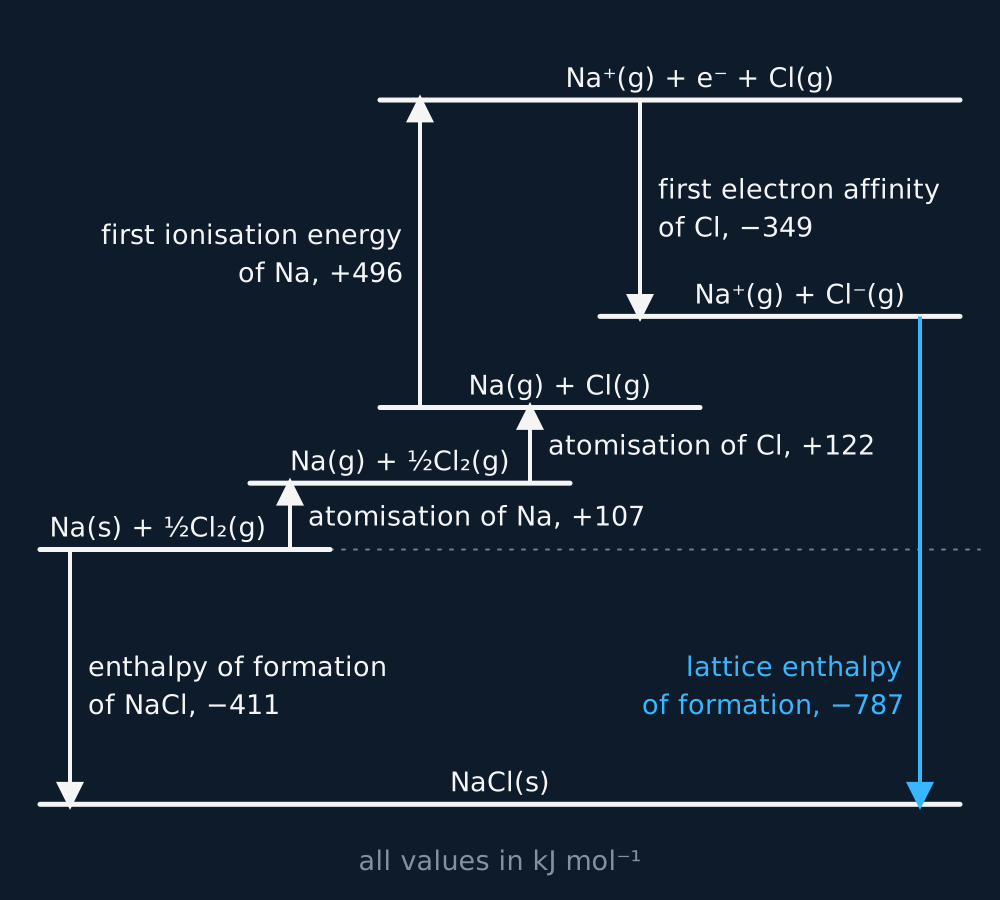
Drawn as energy levels, the cycle starts from the elements in their standard states, at zero. Every endothermic step is an arrow up, every exothermic step an arrow down, and every new level is labelled with all the species present, electrons included, with state symbols.
Describe the drawing
Born–Haber cycle for sodium chloride drawn as horizontal energy levels with energy increasing upwards. From Na(s) + ½Cl₂(g) at zero, three arrows climb: atomisation of sodium, +107, to Na(g) + ½Cl₂(g); atomisation of chlorine, +122, to Na(g) + Cl(g); and the first ionisation energy of sodium, +496, to Na⁺(g) + e⁻ + Cl(g) at +725. The first electron affinity of chlorine, −349, brings it down to Na⁺(g) + Cl⁻(g) at +376, and the longest arrow, the lattice enthalpy of formation, −787, drops on the right to NaCl(s) at −411. On the left a direct arrow down from the elements to NaCl(s) is the enthalpy of formation, −411. All values in kJ mol⁻¹.

Describe the drawing
The Born–Haber cycle for sodium chloride assembled in five stages on energy levels, energy increasing upwards, each new arrow amber when it appears. From Na(s) + ½Cl₂(g) at zero two atomisation arrows climb 107 and 122. The first ionisation energy of sodium climbs 496 to Na⁺(g) + e⁻ + Cl(g) at +725. The electron affinity of chlorine drops 349 to Na⁺(g) + Cl⁻(g), and the lattice enthalpy of formation drops 787 to NaCl(s) at −411. Last, the direct enthalpy of formation arrow, −411, joins the elements to the solid. All values in kJ mol⁻¹.
Two routes join the elements to the solid. The direct route is the enthalpy of formation. The indirect route goes up through atomisation and ionisation, down through electron affinity, and down again through the lattice enthalpy of formation. By Hess's law the two totals are equal.
ΔfH = ΔatH(Na) + ΔatH(Cl) + IE₁(Na) + EA₁(Cl) + ΔLEHHess's law applied to the cycle; ΔLEH is the lattice enthalpy of formation
Rearranged for the lattice enthalpy, with the values in: ΔLEH = −411 − (107 + 122 + 496 − 349) = −411 − 376 = −787 kJ mol⁻¹. The bracket is the height of the Na⁺(g) + Cl⁻(g) level above the elements. The lattice enthalpy of formation is the whole drop from that level to the solid, which is that height plus the further 411 kJ mol⁻¹ below zero.
The lattice enthalpy of potassium bromide
Use these values, all in kJ mol⁻¹, to calculate the lattice enthalpy of formation of potassium bromide: enthalpy of formation of KBr(s) −394; atomisation of potassium +89; atomisation of bromine +112; first ionisation energy of potassium +419; first electron affinity of bromine −325.
Show the working
Write the cycle as a sum. The indirect route from K(s) + ½Br₂(l) to KBr(s) passes through K(g), Br(g), K⁺(g) and Br⁻(g), so ΔfH = ΔatH(K) + ΔatH(Br) + IE₁(K) + EA₁(Br) + ΔLEH.
Add the steps leading up to the gaseous ions: 89 + 112 + 419 − 325 = +295 kJ mol⁻¹.
Rearrange and substitute: ΔLEH = ΔfH − 295 = −394 − 295 = −689 kJ mol⁻¹.
Check the sign and the size. Forming a lattice releases energy, so the value is negative, and K⁺ and Br⁻ are both larger than Na⁺ and Cl⁻, so it is smaller in magnitude than the −787 kJ mol⁻¹ of sodium chloride. Bromine is a liquid at 298 K, so its atomisation includes vaporising it, and +112 is more than half the Br–Br bond enthalpy of 193 kJ mol⁻¹.
Two charges: magnesium chloride and magnesium oxide
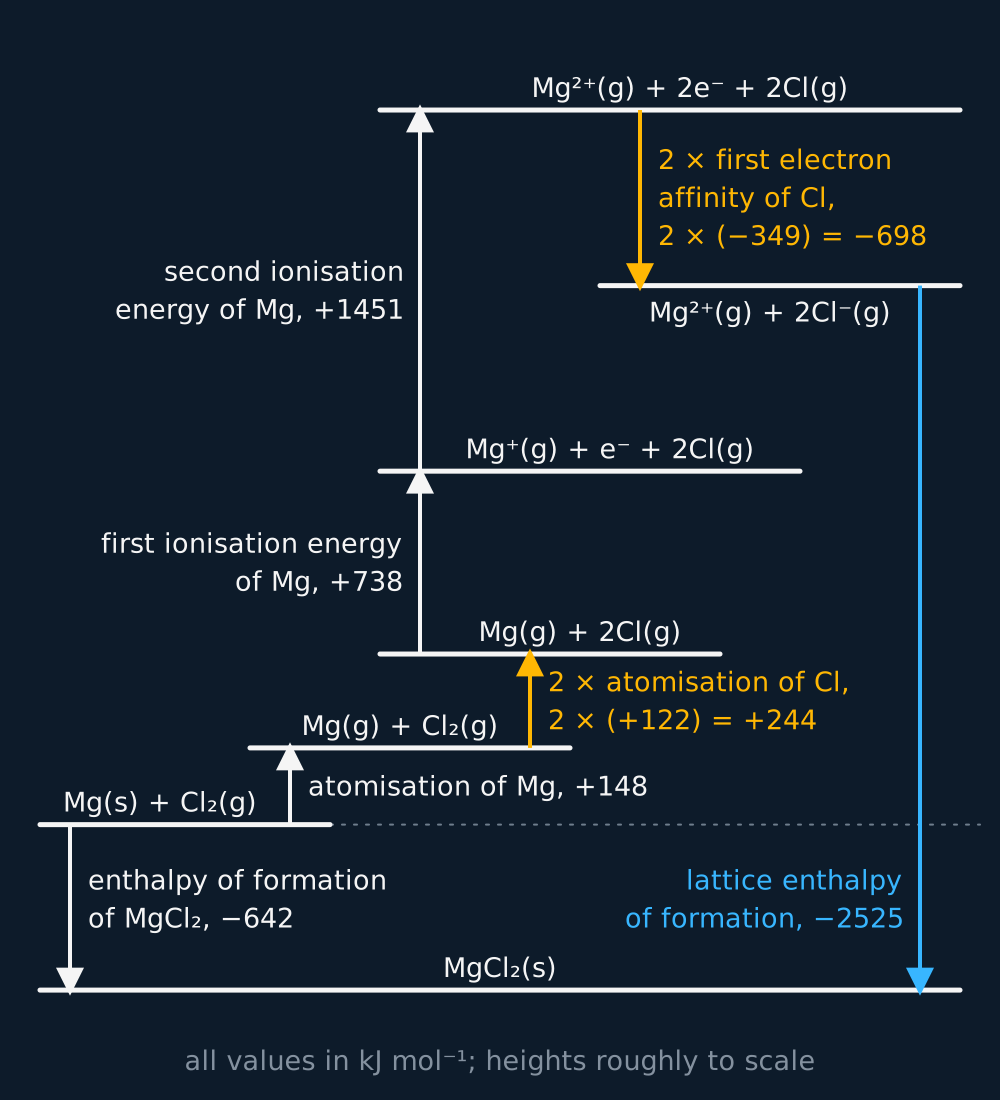
A Group 2 metal adds a second ionisation energy, and its chloride has two chloride ions in the formula, so the atomisation and the electron affinity of chlorine each appear twice. The cycle for MgCl₂ is taller than the one for sodium chloride, and the lattice enthalpy at the bottom of it is far larger.
Describe the drawing
Born–Haber cycle for magnesium chloride drawn as energy levels, energy upwards. From Mg(s) + Cl₂(g) at zero the arrows climb through atomisation of magnesium, +148, two times the atomisation of chlorine, +244, the first ionisation energy, +738, and the second ionisation energy, +1451, the tallest climb, to Mg²⁺(g) + 2e⁻ + 2Cl(g) at +2581. Two times the first electron affinity of chlorine, −698, brings it down to Mg²⁺(g) + 2Cl⁻(g) at +1883, and the lattice enthalpy of formation, −2525, drops on the right to MgCl₂(s) at −642. A direct arrow on the left from the elements to MgCl₂(s) is the enthalpy of formation, −642. The two doubled chlorine steps are highlighted. All values in kJ mol⁻¹.
From the levels: ΔLEH = −642 − (148 + 244 + 738 + 1451 − 698) = −642 − 1883 = −2525 kJ mol⁻¹. Counting chlorine once instead, with 122 and −349, gives −2752 kJ mol⁻¹. That figure is wrong because one mole of MgCl₂ is made from two moles of chlorine atoms and two moles of chloride ions, and each mole needs its own step.
In an oxide the non-metal gains two electrons. The first electron affinity of oxygen is exothermic and the second endothermic, and both appear in the cycle, one arrow down and one arrow up.
The enthalpy of formation of magnesium oxide
Calculate the enthalpy of formation of magnesium oxide from these values in kJ mol⁻¹: atomisation of magnesium +148; first ionisation energy of magnesium +738; second ionisation energy +1451; atomisation of oxygen +249; first electron affinity of oxygen −141; second electron affinity +798; lattice enthalpy of formation of MgO −3845.
Show the working
This time the lattice enthalpy is given and the enthalpy of formation is missing, so the indirect route is summed in full: Mg(s) → Mg(g) → Mg⁺(g) → Mg²⁺(g), ½O₂(g) → O(g) → O⁻(g) → O²⁻(g), and then Mg²⁺(g) + O²⁻(g) → MgO(s).
The endothermic steps: 148 + 738 + 1451 + 249 + 798 = +3384 kJ mol⁻¹.
The exothermic steps: −141 + (−3845) = −3986 kJ mol⁻¹.
ΔfH = +3384 − 3986 = −602 kJ mol⁻¹.
The data-book value is −602 kJ mol⁻¹. The second ionisation energy and the second electron affinity together cost 2249 kJ mol⁻¹, and the lattice repays all of it, because ions of charge 2+ and 2− attract each other four times as strongly as 1+ and 1− ions the same distance apart.
The perfect ionic model and covalent character
A lattice enthalpy can also be calculated with no experiment at all. The perfect ionic model treats every ion as a sphere with its charge spread evenly over it, and adds up every attraction and repulsion in the lattice from the charges and the distances between their centres. The result is the theoretical lattice enthalpy. The value from a Born–Haber cycle, built on measured steps, is the experimental lattice enthalpy.
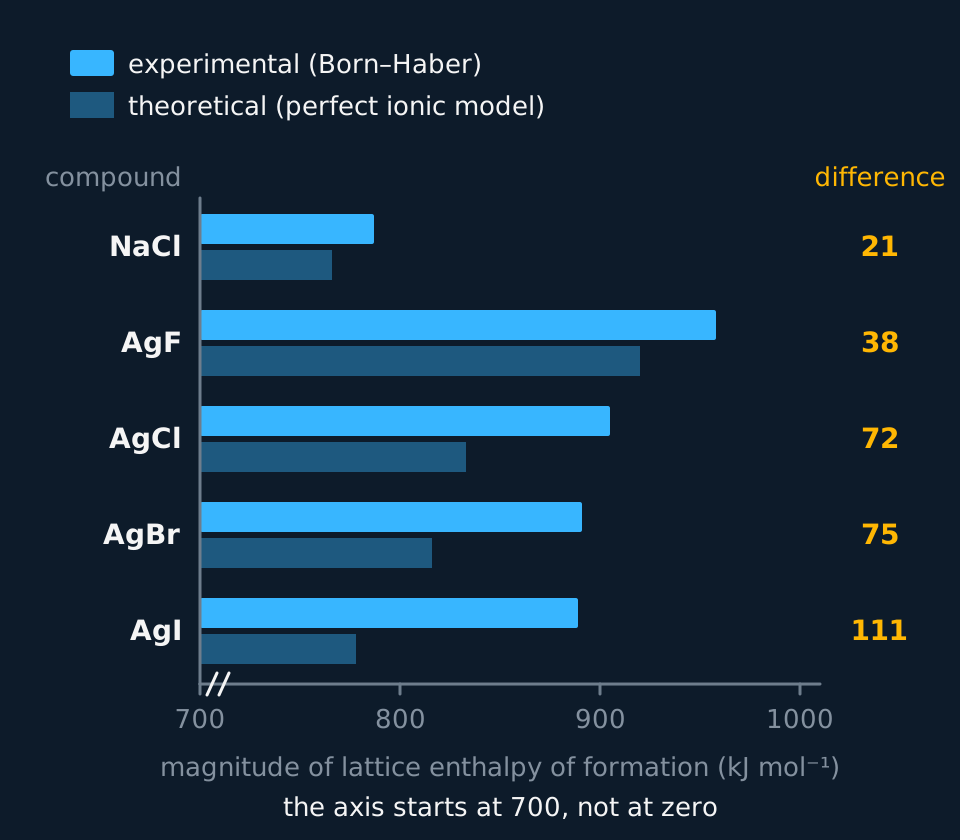
For sodium chloride the two agree closely: −787 kJ mol⁻¹ from the cycle and −766 kJ mol⁻¹ from the model, within 3%. That agreement is the evidence that sodium chloride is close to purely ionic. For the silver halides they do not agree.
Describe the drawing
Horizontal bar chart of lattice enthalpy of formation magnitudes, with the axis starting at 700 kJ mol⁻¹ and a break symbol to show it. Each compound has a solid experimental Born–Haber bar above a paler theoretical perfect ionic model bar. The experimental bar is always the longer. The differences printed at the end of each pair are 21 for NaCl, 38 for AgF, 72 for AgCl, 75 for AgBr and 111 for AgI, widening from the fluoride to the iodide.
| Compound | Experimental / kJ mol⁻¹ | Theoretical / kJ mol⁻¹ | Difference / kJ mol⁻¹ |
|---|---|---|---|
| NaCl | −787 | −766 | 21 |
| AgF | −958 | −920 | 38 |
| AgCl | −905 | −833 | 72 |
| AgBr | −891 | −816 | 75 |
| AgI | −889 | −778 | 111 |
In every case the experimental value is the more exothermic, so the real lattice is held together more strongly than perfect spheres would be. The extra comes from covalent character. The positive Ag⁺ ion attracts the electron cloud of the neighbouring halide ion and distorts it towards itself, so some electron density lies between the two nuclei, as it does in a covalent bond. That distortion is polarisation.
The gap grows from fluoride to iodide because the anion grows. I⁻ is the largest of the four, its outer electrons are furthest from its nucleus and the most shielded, so its electron cloud is the easiest to distort. On the cation side, the higher the charge density, the more strongly an ion polarises: Mg²⁺ and Al³⁺ polarise far more than Na⁺.
The size of the difference is therefore a measure of covalent character, and the word to use in an answer is 'covalent character', not 'covalent bonding': the lattice is still mostly ionic. A small difference means the compound fits the ionic model; a large one means the bonding is partly covalent. The same distortion explains why silver chloride, bromide and iodide are insoluble in water while silver fluoride dissolves.
- Perfect ionic model
- A model of an ionic lattice in which the ions are perfect spheres with evenly spread charge and the only interactions are electrostatic attractions and repulsions.
- Polarisation
- The distortion of the electron cloud of an anion by a neighbouring cation, giving the bond some covalent character.
- Polarising power
- The ability of a cation to distort the electron cloud of an anion; it is greater for a smaller cation with a larger charge, a higher charge density.
- Polarisability
- How easily the electron cloud of an anion is distorted; it is greater for a larger anion with a larger charge.
TRY IT: Two iodides compared
The experimental lattice enthalpy of formation of magnesium iodide is −2327 kJ mol⁻¹ and the perfect ionic model gives −1944 kJ mol⁻¹. For sodium iodide the values are −705 and −686 kJ mol⁻¹. Say which compound has more covalent character, and explain why.
Check your answer
Compare the differences as percentages, since the lattices differ in size: for MgI₂, (2327 − 1944) ÷ 2327 × 100 = 16%; for NaI, (705 − 686) ÷ 705 × 100 = 2.7%.
Magnesium iodide departs much further from the ionic model, so it has more covalent character.
The anion is I⁻ in both, large and easily polarised. The difference is the cation: Mg²⁺ has twice the charge of Na⁺ and a smaller radius, so its charge density is much higher and it distorts the iodide electron cloud far more.
Other boards: lattice energy, electron affinity trends and thermal stability
OCR defines lattice enthalpy in the formation direction only, and Edexcel and Cambridge call the same quantity lattice energy, also for formation, so on those papers it is always negative. The cycle and the arithmetic are exactly as above; only the name and the fixed direction differ. Two topics that AQA does not examine follow. Cambridge sets the trends in first electron affinity down Groups 6 and 7. Edexcel and Cambridge both set the thermal stability of the Group 2 carbonates and nitrates, and Edexcel the Group 1 compounds as well: polarisation applied to an anion that can fall apart.
How exothermic a first electron affinity is depends on how strongly the nucleus attracts the incoming electron, and the factors are the ones that govern ionisation energy: the nuclear charge, the distance from the nucleus to the shell the electron enters, and the shielding by the electrons in the inner shells. Down Group 7 the electron enters a shell further out and more shielded, so the attraction weakens and the values become less exothermic, from −349 kJ mol⁻¹ for chlorine to −295 kJ mol⁻¹ for iodine.
| Period | Group 6 | First EA / kJ mol⁻¹ | Group 7 | First EA / kJ mol⁻¹ |
|---|---|---|---|---|
| 2 | O | −141 | F | −328 |
| 3 | S | −200 | Cl | −349 |
| 4 | Se | −195 | Br | −325 |
| 5 | Te | −190 | I | −295 |
The top of each group breaks the pattern. Fluorine is smaller than chlorine, yet its value is less exothermic, because the electron joins a 2p subshell that already holds five electrons packed into a small volume, and their repulsion cancels part of the stronger pull of the nucleus. Oxygen's value is smaller than sulfur's because its 2p subshell is crowded in just that way. Across each period the Group 6 value is the smaller, since the nucleus has one proton fewer.
Every Group 2 carbonate decomposes on heating to the oxide and carbon dioxide, and the temperature needed rises down the group. Magnesium carbonate gives off carbon dioxide well within the range of a Bunsen burner, while barium carbonate barely changes. Calculations from enthalpy and entropy data put the lowest decomposition temperature at about 670 K for magnesium carbonate and about 1110 K for calcium carbonate.
MCO₃(s) → MO(s) + CO₂(g)M is any Group 2 metal; the temperature needed rises from Mg to Ba
The carbonate ion is large, and its charge is spread over three oxygen atoms, so its electron cloud is easily distorted. A small cation with a high charge density, such as Mg²⁺, pulls electron density from the nearest oxygen atom towards itself. That weakens the C–O bond to that oxygen, so less energy is needed to break it and release CO₂, leaving the oxide ion behind. Down the group the cations grow, their charge density falls, the carbonate is polarised less, and a higher temperature is needed.
The Group 2 nitrates show the same trend, explained by the same polarisation of the anion. They decompose further, to the oxide, nitrogen dioxide and oxygen, and the brown NO₂ is the sign that a nitrate has decomposed.
2Mg(NO₃)₂(s) → 2MgO(s) + 4NO₂(g) + O₂(g)
On Edexcel papers the Group 1 compounds come in too. Group 1 cations carry a single charge and polarise less. Their carbonates do not decompose at Bunsen temperatures, and their nitrates lose only oxygen, leaving the nitrite. Lithium is the exception: Li⁺ is the smallest Group 1 ion, with a charge density far above that of Na⁺, and it polarises the anion enough for lithium carbonate and lithium nitrate to decompose as the Group 2 compounds do.
2NaNO₃(s) → 2NaNO₂(s) + O₂(g)sodium nitrate gives the nitrite
4LiNO₃(s) → 2Li₂O(s) + 4NO₂(g) + O₂(g)lithium nitrate decomposes like a Group 2 nitrate
In the laboratory the stabilities are compared by heating equal amounts of each compound in turn with the same flame and timing how long the carbon dioxide takes to turn limewater milky, or for a nitrate how long until brown gas appears. The shorter the time, the less stable the compound.
In the exam
- A definition earns its marks with three things in it: one mole, the gaseous state of every species, and the direction of the change. 'The energy released when ions form a lattice' leaves out 'gaseous' and 'one mole', and loses both marks.
- Each level of a cycle diagram is marked on its species. A level that leaves out the electrons after an ionisation, or a state symbol, loses that mark however good the arrows are.
- Write the Hess's law sum before the numbers: the method marks go to the sum and the substitution, and they are still awarded when an arithmetic slip spoils the answer. A correct size with the wrong sign does not earn the answer mark.
- For the second electron affinity of oxygen, the answer must name the repulsion between the incoming electron and the negative O⁻ ion, and say that energy is needed to overcome it.
- Asked why an experimental lattice enthalpy is more exothermic than the theoretical one, give the cation distorting the anion's electron cloud and the covalent character that results. 'Experimental error' is the wrong explanation and is not credited.
Check yourself
The lattice enthalpy of formation of MgO is −3845 kJ mol⁻¹ and that of NaCl is −787 kJ mol⁻¹, about a fifth as large. Yet the enthalpy of formation of MgO, −602 kJ mol⁻¹, is less than one and a half times that of NaCl, −411 kJ mol⁻¹. Explain both facts.
Answer
The lattice enthalpy depends on the charges and the distance between the ions. Mg²⁺ and O²⁻ carry twice the charges of Na⁺ and Cl⁻, so the attraction between a pair is four times as strong at the same distance, and both ions are smaller, so they sit closer together. The two effects together give almost five times the lattice enthalpy.
The enthalpy of formation is what is left after the cost of making the gaseous ions has been paid. For MgO that cost includes the second ionisation energy of magnesium, +1451 kJ mol⁻¹, and the second electron affinity of oxygen, +798 kJ mol⁻¹, neither of which appears in the cycle for NaCl.
Those two endothermic steps use up most of the extra lattice enthalpy, so the enthalpy of formation of MgO is only modestly more exothermic than that of NaCl.
Questions
Question 16 marksAQA · Edexcel
Explain what the data in the table show about the bonding in calcium fluoride and in calcium iodide, and why the two compounds differ. The table gives each compound's experimental (Born–Haber) and theoretical (perfect ionic model) lattice enthalpy of formation, and the radius of its anion.
| Compound | Experimental / kJ mol⁻¹ | Theoretical / kJ mol⁻¹ | Anion radius / pm |
|---|---|---|---|
| CaF₂ | −2630 | −2609 | 133 |
| CaI₂ | −2074 | −1905 | 220 |
Mark scheme
Indicative content
- for calcium fluoride the experimental value is only 21 kJ mol⁻¹, under 1%, more exothermic than the theoretical one, so the perfect ionic model fits it closely and the bonding is almost purely ionic
- for calcium iodide the experimental value is 169 kJ mol⁻¹, about 8%, more exothermic than the theoretical one, a far larger departure from the ionic model
- the perfect ionic model treats every ion as a perfect sphere with its charge spread evenly, so it leaves out any distortion of the electron clouds
- the cation is Ca²⁺ in both compounds, so its polarising power is the same and the difference must come from the anion
- I⁻ is much larger than F⁻, 220 pm against 133 pm, with its outer electrons further from the nucleus and more shielded, so its electron cloud is far more easily polarised
- Ca²⁺ draws the iodide electron cloud towards itself, putting electron density between the nuclei, so CaI₂ has covalent character and its real lattice is held more strongly than the model predicts
Levels
- Level 3 (5–6 marks) both comparisons are read from the table with the sizes of the departures, the perfect ionic model is described, the common cation is used to locate the difference in the anion, and the polarisation of the larger iodide ion is explained as the cause of the covalent character and the stronger real lattice
- Level 2 (3–4 marks) the closer fit for calcium fluoride is noted and the covalent character of calcium iodide is explained by polarisation of the larger anion; the sizes of the departures, what the perfect ionic model assumes, or the role of the shared cation is not covered
- Level 1 (1–2 marks) one compound is called more ionic, typically with the iodide ion said to polarise the calcium ion, and the data are not used
Question 24 marks
Explain why the second ionisation energy of magnesium is larger than its first, and why the second electron affinity of oxygen is endothermic although its first electron affinity is exothermic.
Mark scheme
- B1 the second electron is removed from an Mg⁺ ion, which is already positively charged
- B1 the same nuclear charge acts on one fewer electron, so the remaining electrons are held more strongly and more energy is needed to remove one
- B1 the first electron affinity is exothermic because the incoming electron is attracted by the oxygen nucleus
- B1 the second electron is added to an O⁻ ion, which is already negative, so energy is needed to overcome the repulsion; reject 'oxygen has a full outer shell'
Question 34 marks
Calculate the lattice enthalpy of formation of calcium chloride from the data in the table.
| Enthalpy change | Value / kJ mol⁻¹ |
|---|---|
| Enthalpy of formation of CaCl₂(s) | −796 |
| Enthalpy of atomisation of calcium | +178 |
| First ionisation energy of calcium | +590 |
| Second ionisation energy of calcium | +1145 |
| Enthalpy of atomisation of chlorine | +122 |
| First electron affinity of chlorine | −349 |
Mark scheme
- M1 the atomisation and the electron affinity of chlorine are each doubled: 2 × 122 = +244 and 2 × (−349) = −698
- M1 the steps to the gaseous ions sum to 178 + 590 + 1145 + 244 − 698 = +1459 kJ mol⁻¹
- M1 ΔLEH = ΔfH − 1459, from rearranging the cycle; error carried forward from M2 where the chlorine terms were not doubled
- A1 ΔLEH = −796 − 1459 = −2255 kJ mol⁻¹, four significant figures, negative sign required
All 23 questions with mark schemes, the other 20 set out in full on the question page.
Worth remembering
- A sign that does not match the direction the question names is wrong, however right the size: formation negative, dissociation positive.
- Atomisation of chlorine is per mole of atoms, ½Cl₂(g) → Cl(g); writing Cl₂(g) → 2Cl(g) doubles the value.
- Every species between the elements and the solid needs (g), and every level after an ionisation carries its electrons.
- Count each step as often as the formula needs it: undoubled chlorine steps for MgCl₂ give −2752 kJ mol⁻¹ in place of −2525.
- The gap between experiment and theory is covalent character from polarisation, never experimental error.
CHECK YOUR PROGRESS
Rate how confident you are with each objective for this lesson. Ratings are saved in this browser, on this device, unless you sign in.
- Define lattice enthalpy of formation and lattice enthalpy of dissociation, and give the sign of each.
- Define the enthalpy of atomisation, the first and second ionisation energies and the first and second electron affinities, and write an equation with state symbols for each.
- Construct a Born–Haber cycle for a Group 1 or Group 2 halide or oxide as an energy-level diagram, labelling every level with its species.
- Calculate a lattice enthalpy, or any other single missing term, from a Born–Haber cycle.
- Explain why an experimental lattice enthalpy can be more exothermic than the value from the perfect ionic model, using polarisation and covalent character.
Open the full revision checklist to see every objective in the curriculum in one place.
Practise this lesson
WORKBOOK
The written questions from this topic, on paper with room to work, and a separate book of mark schemes. The 6 questions that are set on a diagram stay on this page, where the diagram can be drawn. Free to use; please do not redistribute or sell.