Maths › Differentiation › The derivative from first principles
The derivative from first principles
The derivative is the limit of a difference quotient and gives the gradient of a tangent. Differentiate small positive integer powers of x from first principles, and relate the signs of f' and f'' to the behaviour of the original function.
Builds on Straight lines.
IN THIS TOPIC
- Explain the derivative as the limit of chord gradients, and use f'(x) and dy/dx notation.
- Differentiate small powers of x from first principles.
- Sketch a gradient function from the graph of a curve.
- Read the second derivative as the rate of change of the gradient.
COMMON MISCONCEPTION
The gradient of a curve at a point is the gradient of the line to a nearby point.
That line is a chord, and its gradient only approximates the curve's. The gradient at the point is the limit of the chord gradients as h tends to zero. On y = x2 the chord from x has gradient 2x + h, which is exact for that chord; only the limit turns it into the tangent gradient 2x.
The shrinking chord
A straight line has a single gradient; a curve does not. Start with the gradient of a chord joining (x, f(x)) to a neighbouring point (x + h, f(x + h)), which is the change in y divided by the change in x. That chord gradient approximates the gradient of the curve at x, and the error decreases as h decreases, so the gradient of the curve is the limit of the chord gradients as h tends to zero.
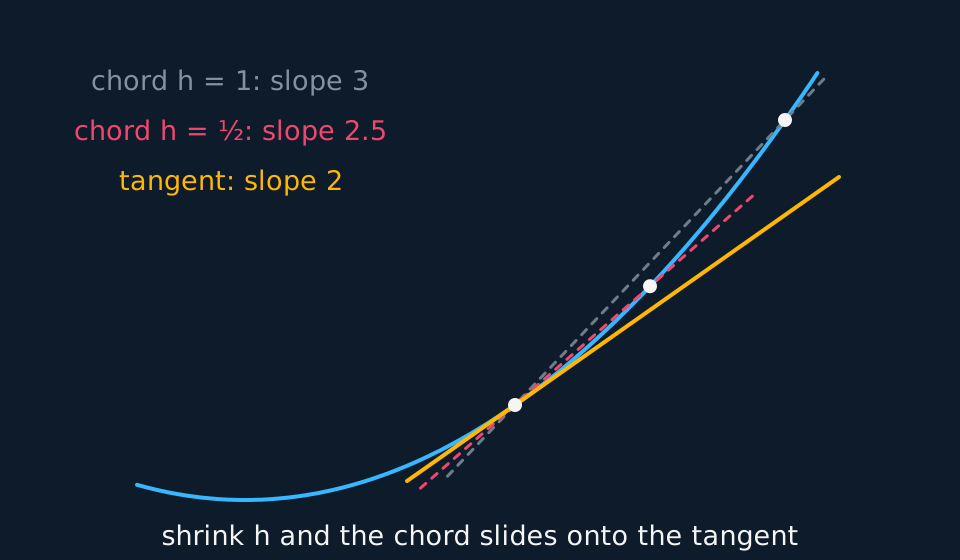
That limit is the derivative, written f'(x) or dy/dx, and it gives the gradient of the tangent at the point. It is printed in the formulae booklet, under Differentiation in the A level Mathematics section, so the statement can be quoted rather than recalled. Computing it directly from the limit is called differentiating from first principles. Some questions write δx in place of h; the quantity and the proof are the same.
The proofs below are for small positive integer powers of x. The derivatives of sin x and cos x are proved the same way, using the compound angle formulae to expand the chord, in Differentiating trig, exponentials and logs.
WORKED EXAMPLE
x² from first principles
Prove from first principles that the derivative of f(x) = x2 is 2x.
Form the chord gradient: [(x + h)2 − x2]/h = (2xh + h2)/h.
For h ≠ 0, divide through, and the chord gradient is 2x + h.
As h → 0 the surviving part is 2x, so f'(x) = 2x. ∎
Cancel the h before taking the limit. Substituting h = 0 into the original fraction gives 0/0, which is why the numerator is expanded and the factor of h divided out first.
GUIDED PRACTICE
A cubic from first principles
Differentiate f(x) = x3 from first principles, before opening the working.
Show the working
Expand: (x + h)3 = x3 + 3x2h + 3xh2 + h3.
The chord gradient is (3x2h + 3xh2 + h3)/h = 3x2 + 3xh + h2.
As h → 0, both terms containing h tend to zero, leaving f'(x) = 3x2. ∎
The surviving term of the expansion is the one with exactly one factor of h, which the division cancels; terms with higher powers of h tend to zero in the limit.
The gradient is a function
Evaluating the derivative across the domain gives the gradient function. Where f'(x) > 0, f is increasing; where f'(x) < 0, it is decreasing; and f'(x) = 0 identifies stationary points. At x = 0, f(x) = x3 has a stationary point of inflection because f'(x) = 3x2 touches zero without changing sign.
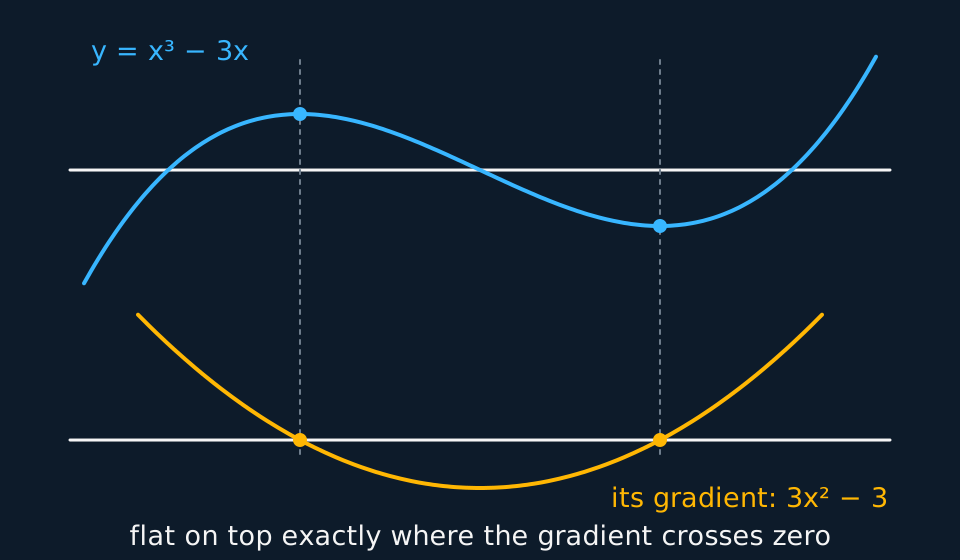
To sketch y = f'(x) from y = f(x), mark the zeros of f' first, directly below the stationary points of f. Then fix the sign of f' on each interval between them, and only then consider the steepness of the sketch.
INDEPENDENT PRACTICE
First principles with two terms
Differentiate f(x) = x2 − 4x from first principles.
Show the working
The chord gradient is [(x + h)2 − 4(x + h) − x2 + 4x]/h.
The numerator expands to 2xh + h2 − 4h, so the chord gradient is 2x + h − 4.
As h → 0, f'(x) = 2x − 4. ∎
The −4x term contributed −4, its own gradient, and the limit acted on each term separately. The derivative of a sum is the sum of the derivatives.
Differentiating twice
Differentiating the gradient function gives the second derivative, written f''(x) or d2y/dx2. It is the rate of change of the gradient. On an interval where the curve is convex the gradient is increasing, so f'' is positive there, and that is the basis of the second-derivative test for classifying stationary points.
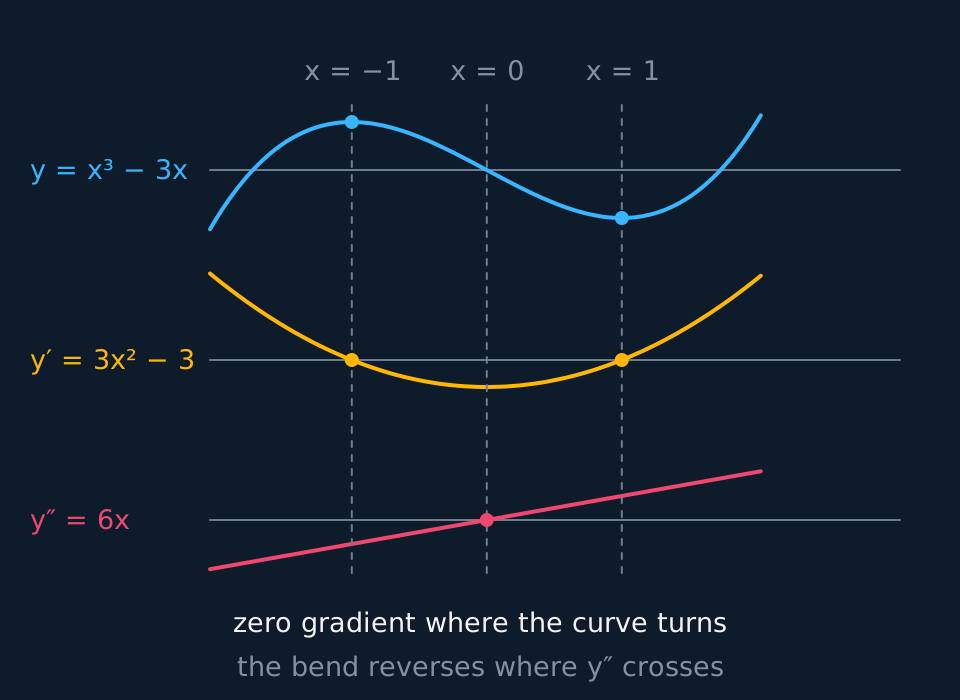
Describe the drawing
Three graphs stacked over the same x-axis. The top is the cubic, turning at x equals minus one and plus one. The middle is its gradient function, crossing zero at exactly those two values. The bottom is the second derivative, a straight line through the origin, negative where the cubic bends downwards and positive where it bends upwards.
ASSESSMENT FOCUS
- A complete first-principles proof has four stages: the chord gradient stated, the numerator expanded, the factor of h divided out, and the limit taken.
- Write the limit statement as well as the algebra. “As h → 0, the gradient → 2x” is the conclusion of the proof.
- f'(x), dy/dx and “the gradient function” all name the same object, and a question stem may use any of the three.
- The chord gradient before the limit, 2x + h, is exact for that chord. Only the limit turns it into a tangent gradient.
CHECK YOURSELF
From first principles, find the gradient of y = 3x2 at the point (2, 12).
Show a hint
Chord from x = 2, expand, cancel h, then let h → 0.
Show the answer
The chord gradient is [3(2 + h)2 − 12]/h = (12h + 3h2)/h = 12 + 3h.
As h → 0 the gradient approaches 12.
The general derivative 6x, evaluated at x = 2, gives the same value, which checks the first-principles working.
The derivative is the limit of the chord gradient as h tends to zero, and it gives the gradient of the tangent.
Divide the factor of h out first, then take the limit; the remaining expression is the gradient function.
WORKBOOK
Printable practice for this topic: original exam-style questions with room to work, and a fully worked answer book. Free to use; please do not redistribute or sell.
Or read them with their worked answers on the derivative from first principles questions page.
CHECK YOUR PROGRESS
Rate how confident you feel with each objective for this lesson. Ratings are saved in this browser, on this device, unless you sign in.
- Explain the derivative as the limit of chord gradients, and use f'(x) and dy/dx notation.
- Differentiate small powers of x from first principles.
- Sketch a gradient function from the graph of a curve.
- Read the second derivative as the rate of change of the gradient.
Open the full revision checklist to see every objective in the course in one place.