Maths › Coordinate geometry › Straight lines
Straight lines
The equation of a straight line is fixed by a point and a gradient, and gradients also determine whether two lines are parallel or perpendicular. Straight-line models describe quantities changing at a constant rate, where the gradient gives the rate and the intercept the initial value.
Builds on Simultaneous equations and inequalities.
IN THIS TOPIC
- Find a line's equation from a point and a gradient, or from two points, in either standard form.
- Use the gradient conditions for parallel and perpendicular lines, showing the gradient product where perpendicularity is claimed.
- Build and interpret a straight-line model, with the gradient as a rate and the intercept as a starting value.
COMMON MISCONCEPTION
Perpendicular gradients are negatives of each other.
Perpendicular gradients are negative reciprocals, so m1m2 = −1. Flip the fraction and change the sign: the perpendicular to gradient 2 has gradient −1/2, since 2 × (−1/2) = −1, while negating alone gives 2 × (−2) = −4. The test assumes both lines have a gradient, so a vertical line and a horizontal one are read off their equations instead.
Two points, one line
A line's gradient is the change in y divided by the change in x between any two of its points, m = (y2 − y1)/(x2 − x1). Once one point (x1, y1) and the gradient are known, every other point (x, y) on the line satisfies
and this point-gradient form is on the must-learn list. The other standard form is ax + by + c = 0 with integer coefficients, which questions often demand for the final answer because it carries no fractions.
WORKED EXAMPLE
From two points to both forms
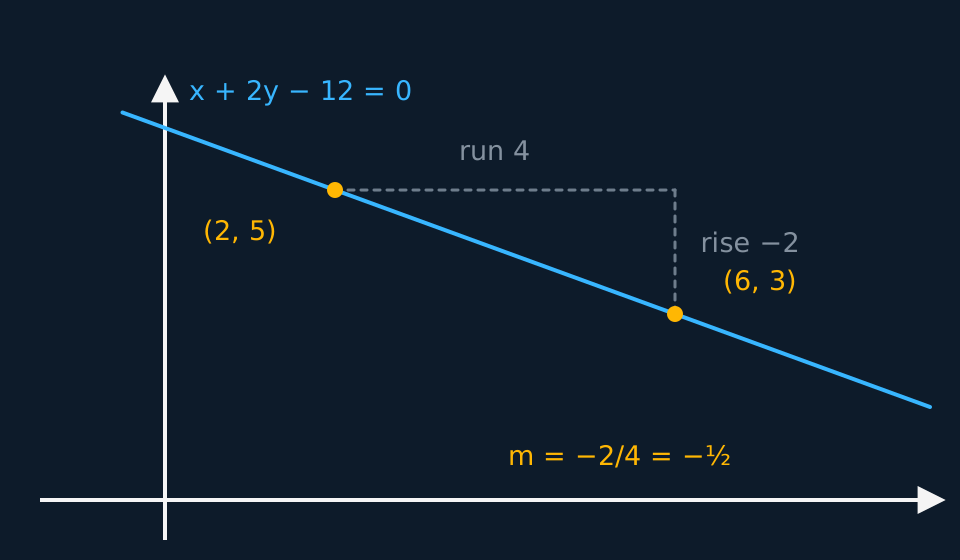
Find the equation of the line through (2, 5) and (6, 3), giving the answer in the form ax + by + c = 0 with integer coefficients.
Gradient first. m = (3 − 5)/(6 − 2) = −2/4 = −1/2.
Point-gradient form with (2, 5) gives y − 5 = −1/2(x − 2).
Double both sides and tidy. 2y − 10 = −x + 2, so x + 2y − 12 = 0.
Substituting the second point checks the equation: 6 + 6 − 12 = 0.
Parallel and perpendicular
Parallel lines stay a constant distance apart, so they share a gradient. Perpendicular lines satisfy the sharper condition, also on the must-learn list,
so each gradient is the negative reciprocal of the other. Flip the fraction, change the sign. Both steps are needed. The perpendicular to gradient 2 is −1/2, and negating alone fails for every gradient except ±1, as the product check 2 × (−2) = −4 makes obvious. The test does assume both lines have a gradient to multiply. A vertical line has none, so a vertical line and a horizontal one are perpendicular with no product to compute, and that pair is read off the equations rather than tested.
WORKED EXAMPLE
A perpendicular bisector
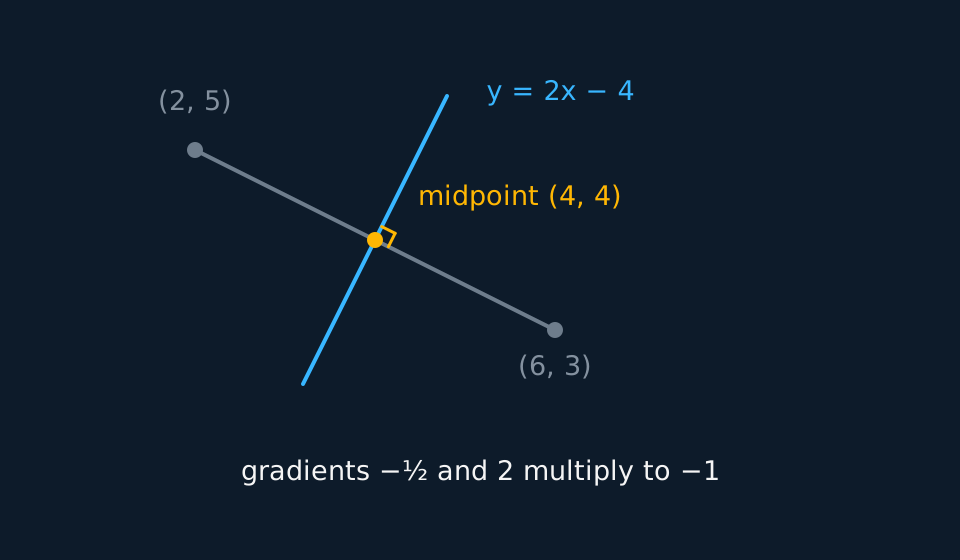
Find the equation of the perpendicular bisector of the segment joining (2, 5) and (6, 3).
Two ingredients. The midpoint is ((2 + 6)/2, (5 + 3)/2) = (4, 4), and the segment's gradient is −1/2.
The bisector is perpendicular, so its gradient is the negative reciprocal, 2.
Through (4, 4) with gradient 2 gives y − 4 = 2(x − 4), which tidies to y = 2x − 4.
Every point of this line is equidistant from the two endpoints, which is the defining property of a perpendicular bisector and the reason it locates the centre of a circle through given points.
GUIDED PRACTICE
A right angle, proved not eyeballed
The points A(1, 2), B(5, 4) and C(3, 8) form a triangle. Show that the angle at B is a right angle, before opening the working.
Show the working
Gradient of AB: (4 − 2)/(5 − 1) = 1/2. Gradient of BC: (8 − 4)/(3 − 5) = −2.
The product is 1/2 × (−2) = −1, so AB ⊥ BC and the angle at B is 90°.
A sketch can suggest a right angle, but the gradient product is what establishes one, since a diagram in a question need not be drawn to scale.
Lines as models
A straight-line model assumes a constant rate of change. The gradient is that rate, with units; the intercept is the value at t = 0. A van bought for £12 000 losing £150 of value each month gives V = 12000 − 150t, and each constant is interpreted in the terms of the situation.
WORKED EXAMPLE
Reading a depreciation model
A van's value in pounds after t months is modelled by V = 12000 − 150t. Interpret the numbers, find when the value reaches £6000, and criticise the model for large t.
The intercept 12 000 is the purchase price. The gradient −150 says the van loses £150 a month.
Setting V = 6000 gives 150t = 6000, so t = 40 months.
At t = 80 the model gives V = 0, and beyond that a negative value, which no van achieves. A linear model is a local description, and stating its range of validity is part of the answer.
INDEPENDENT PRACTICE
Two tariffs cross
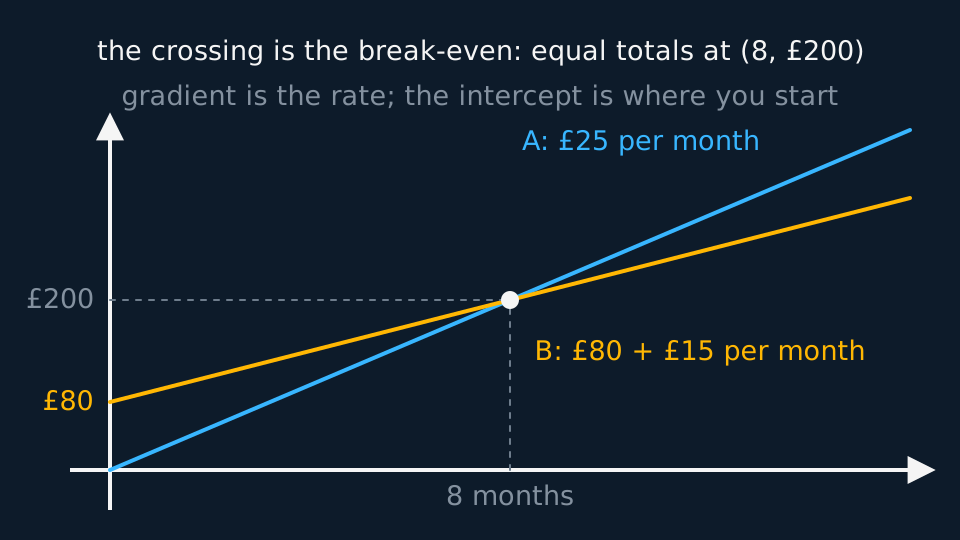
Gym A charges £25 per month. Gym B charges an £80 joining fee plus £15 per month. After how many months does B become the cheaper total, and what does the crossing point mean on a graph?
Show the working
Total costs after m months. A is 25m, B is 80 + 15m.
Equal when 25m = 80 + 15m, so 10m = 80 and m = 8. Both totals are then £200.
B is cheaper for m > 8. On a graph the two cost lines cross at (8, 200), and the steeper line is lower before the crossing while the flatter one is lower after it.
This is the simultaneous-equations lesson applied to costs. An intersection of graphs and a solution of equations are the same thing.
ASSESSMENT FOCUS
- Quote m = (y2 − y1)/(x2 − x1) and keep the order of subtraction the same in numerator and denominator; reversing one of them changes the sign of the gradient.
- Where the required form is ax + by + c = 0 with integer coefficients, clear the fractions and collect the terms on one side; an answer left as y = mx + c is not in the requested form.
- Perpendicular gradients are negative reciprocals. Write the product m1m2 out and show that it equals −1.
- In modelling questions, interpret the gradient and the intercept with units, and state the interval of t on which the model is reasonable. Substituting a known point into the final equation checks it.
CHECK YOURSELF
Find the equation of the line through (−1, 4) perpendicular to the line 3x + y − 2 = 0, giving your answer in the form ax + by + c = 0.
Show a hint
Rearrange to read off the first gradient, then take the negative reciprocal.
Show the answer
3x + y − 2 = 0 is y = −3x + 2, gradient −3, so the perpendicular gradient is 1/3.
Through (−1, 4) gives y − 4 = 1/3(x + 1). Tripling and tidying gives x − 3y + 13 = 0.
Check with the point, −1 − 12 + 13 = 0, and the gradient product is −3 × 1/3 = −1, as it must be.
One point and one gradient determine a line, and y − y₁ = m(x − x₁) is its equation.
Parallel lines share m. Perpendicular gradients multiply to −1.
WORKBOOK
Printable practice for this topic: original exam-style questions with room to work, and a fully worked answer book. Free to use; please do not redistribute or sell.
Or read them with their worked answers on the straight lines questions page.
USED LATER IN
CHECK YOUR PROGRESS
Rate how confident you feel with each objective for this lesson. Ratings are saved in this browser, on this device, unless you sign in.
- Find a line's equation from a point and a gradient, or from two points, in either standard form.
- Use the gradient conditions for parallel and perpendicular lines, showing the gradient product where perpendicularity is claimed.
- Build and interpret a straight-line model, with the gradient as a rate and the intercept as a starting value.
Open the full revision checklist to see every objective in the course in one place.