Maths › Differentiation › Differentiating powers of x
Differentiating powers of x
The power rule differentiates xn wherever the real-valued function is differentiable, including negative and fractional powers. Combine it with the sum and constant-multiple rules after rewriting the expression as powers of x.
Builds on The derivative from first principles and Indices and surds.
IN THIS TOPIC
- Differentiate xn for rational n on a domain where the function is differentiable, with sums, differences and constant multiples.
- Rewrite roots, reciprocals, products and quotients as powers before differentiating.
COMMON MISCONCEPTION
To differentiate a product, differentiate each factor.
The power rule applies to powers of x only, so expand the product first. (2x + 5)(x − 1) is 2x2 + 3x − 5, whose derivative is 4x + 3, and that is 7 at x = 1, while multiplying the separate derivatives gives 2 × 1 = 2 at every point. The product rule differentiates a product without expanding it.
The power rule
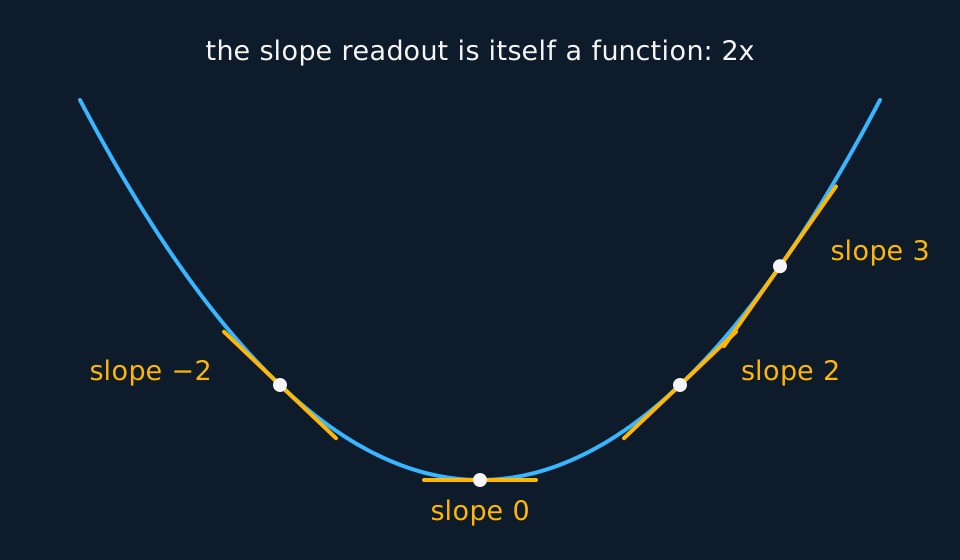
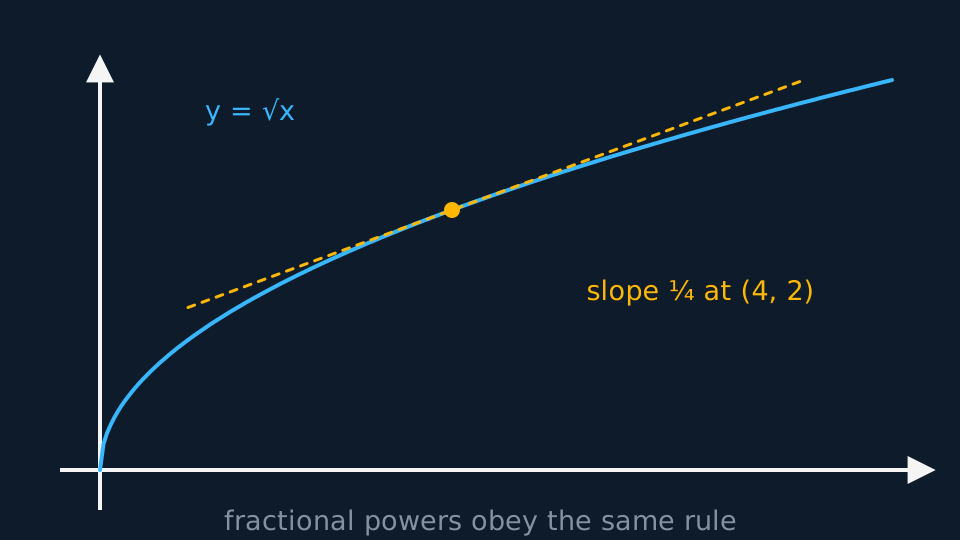
First principles gave 2x from x2 and 3x2 from x3. The same pattern holds for every rational power at each point where the real-valued function xn is defined and differentiable. For negative powers that excludes x = 0, where the function is undefined; for even roots such as x1/2 it excludes negative x, and the derivative at x = 0 does not exist either, since the tangent there is vertical. The rule is not given in the formulae booklet and must be learnt.
Two further rules extend it to any polynomial. A constant multiple is carried unchanged through the differentiation, and sums and differences are differentiated term by term. A constant on its own differentiates to zero, because its graph is a horizontal line, with gradient zero.
WORKED EXAMPLE
Three terms, three exponent styles
Differentiate y = 4x3 − 6√x + 2/x2.
Rewrite everything as powers first: y = 4x3 − 6x1/2 + 2x−2.
Apply the rule termwise: dy/dx = 12x2 − 3x−1/2 − 4x−3.
In the original notation, dy/dx = 12x2 − 3/√x − 4/x3.
Show the rewriting line. Fractional and negative exponents follow the same rule as positive integer ones, but the rule can only be applied once the expression is written as powers of x. Each term here is differentiable for x > 0.
Rewrite, then differentiate
The power rule applies to powers of x only. Expand products and divide fractions term by term first, then differentiate. Differentiating each factor of (2x + 5)(x − 1) separately and multiplying gives 2 × 1 = 2 at every point, which is not the derivative of the product.
GUIDED PRACTICE
Expand first
Differentiate y = (2x + 5)(x − 1), before opening the working.
Show the working
Expand: y = 2x2 + 3x − 5.
Differentiate termwise: dy/dx = 4x + 3.
At x = 1 the derivative is 7, while multiplying the separate derivatives gives 2 for every x. Evaluating both at one value distinguishes them. The product rule, in The product, quotient and chain rules, differentiates a product without expanding it.
INDEPENDENT PRACTICE
Split the fraction
Differentiate y = (x2 + 3x − 5)/(4√x).
Show the working
Divide each term by 4x1/2: y = ¼x3/2 + ¾x1/2 − (5/4)x−1/2.
Differentiate termwise: dy/dx = (3/8)x1/2 + (3/8)x−1/2 + (5/8)x−3/2.
Simplified, dy/dx = (3√x)/8 + 3/(8√x) + 5/(8x√x), valid for x > 0, which is the domain of the original expression.
No quotient was differentiated here: the fraction was divided term by term and the power rule applied to each power of x.
ASSESSMENT FOCUS
- Rewrite before differentiating: every root, reciprocal and quotient becomes x to a power. Show that rewriting line in the answer.
- Apply nxn−1 with the sign of n kept. The derivative of x−2 is −2x−3, the negative exponent growing more negative.
- Give the final answer in the notation the question used. Convert x−1/2 back to 1/√x where the question was written in surds.
CHECK YOURSELF
Differentiate y = x4 − 2/√x + 7, and evaluate the gradient at x = 1.
Show a hint
Rewrite 2/√x as a power first; the 7 contributes nothing.
Show the answer
Rewritten, y = x4 − 2x−1/2 + 7, so dy/dx = 4x3 + x−3/2.
That is 4x3 + 1/(x√x) in surd form.
At x = 1 the gradient is 4 + 1 = 5. The constant 7 differentiates to zero, so it does not appear in the derivative. The expression requires x > 0.
Multiply by the exponent and reduce the exponent by one: the derivative of xn is nxn−1, wherever the real function xn is differentiable.
The rule applies to powers only, so rewrite products, roots and fractions as powers of x before differentiating.
WORKBOOK
Printable practice for this topic: original exam-style questions with room to work, and a fully worked answer book. Free to use; please do not redistribute or sell.
Or read them with their worked answers on the differentiating powers of x questions page.
USED LATER IN
CHECK YOUR PROGRESS
Rate how confident you feel with each objective for this lesson. Ratings are saved in this browser, on this device, unless you sign in.
- Differentiate xn for rational n on a domain where the function is differentiable, with sums, differences and constant multiples.
- Rewrite roots, reciprocals, products and quotients as powers before differentiating.
Open the full revision checklist to see every objective in the course in one place.