Maths › Further Mechanics 1 › Momentum and impulse
Momentum and impulse
A force applied for a time changes momentum by force times time. When two bodies push on each other the pushes are equal and opposite, so with no external impulse the total momentum is unchanged.
Builds on Forces and Newton's laws and Kinematics with constant acceleration.
IN THIS TOPIC
- Use impulse equals change in momentum, including for a rebound.
- Find an average force from an impulse and a contact time.
- Find the impulse of a force given as a function of time, by integrating it.
- Apply conservation of momentum to a direct collision between two spheres.
- Handle coalescence and explosion as special cases of the same principle.
- Work out the jerk when a slack inextensible string becomes taut.
- Find the kinetic energy lost in a coalescence or a jerk, or released in an explosion, by totalling ½mv² before and after.
COMMON MISCONCEPTION
A ball that bounces back off a wall at the same speed it arrived receives no impulse, since its speed is unchanged.
Momentum is a vector, so a rebound reverses its sign and the change is the sum of the two speeds rather than their difference. A ball of mass m arriving at 20 m/s and leaving at 20 m/s the other way takes an impulse of m(20) − m(−20) = 40m newton seconds, and dividing that by the contact time gives the average force the wall applied.
Impulse
Momentum is mass times velocity. It is a vector, and its unit is the newton second, which is the same thing as the kilogram metre per second. Newton's second law rearranges into the impulse-momentum principle.
Pearson Edexcel 9FM0 formulae booklet: not included; nothing on momentum or impulse is printed there. Here F is the resultant force, taken as constant for now. Because momentum is a vector, a rebound is a change of sign, and the change is the sum of the two speeds, not their difference. A ball arriving at 20 and leaving at 20 the other way has had its momentum reversed, and that takes a large impulse.
When the force varies, the impulse is the area under the force-time graph, and an area under a graph is an integral. So the impulse delivered between two instants is I = ∫F dt, taken from the first instant to the second, and it still equals mv − mu. The constant-force version is that integral in the case where F comes outside it: what is left to integrate is 1, over an interval of length t, so ∫F dt becomes Ft.
Divide an impulse by the contact time and you have the average force, meaning the constant force that would have delivered the same impulse over the same time. Longer contact therefore means a gentler force for the same change of momentum, which is the whole idea behind crumple zones and follow-through in a stroke.
WORKED EXAMPLE
A struck ball
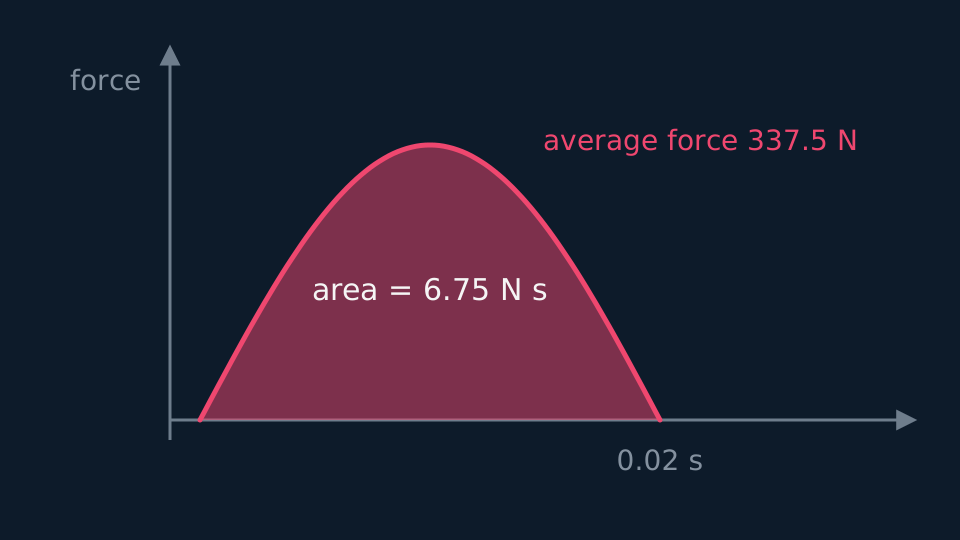
A ball of mass 0.15 kg arrives at 20 m/s and is struck straight back at 25 m/s. The contact lasts 0.02 s. Find the impulse and the average force.
Taking the outgoing direction as positive: u = −20, v = 25.
I = 0.15(25) − 0.15(−20) = 3.75 + 3 = 6.75 N s.
Average force = 6.75/0.02 = 337.5 N, over two hundred times the ball's weight of 1.47 N.
WORKED EXAMPLE
A force that grows and dies away
A particle of mass 0.4 kg rests on a smooth horizontal table. A horizontal force of 6t − 3t² newtons acts on it from t = 0 until t = 2 s. Find the impulse the force delivers and the speed of the particle at the end of it.
I = ∫(6t − 3t²) dt from 0 to 2 = [3t² − t³] from 0 to 2.
That is (12 − 8) − 0 = 4 N s.
The particle started at rest, so 0.4v = 4 and v = 10 m/s.
The force reaches 3 N at t = 1 and has fallen back to zero at t = 2, so the average over the two seconds is 4/2 = 2 N. Multiplying the peak force by the time would have given six newton seconds and a speed half as large again.
Conservation of momentum
During a collision each body exerts a force on the other, and by Newton's third law those forces are equal and opposite for the same length of time. The impulses are therefore equal and opposite. Whatever momentum one body gains, the other loses. Provided no external impulse acts on the pair, or the collision is so brief that any external impulse is negligible, the total is therefore conserved whatever happens to the energy.
Pearson Edexcel 9FM0 formulae booklet: not included. Coalescence, where the two move off together, and explosion, where one body separates into two, are the same equation with the masses grouped differently. Kinetic energy is not conserved in either, and totalling ½mv² before and after answers both: in a coalescence the total falls by the energy the impact has cost, and in an explosion it rises by the energy the explosive has supplied. Signs matter throughout. Choose a positive direction, write every velocity with its sign, and let the algebra report which way anything is moving afterwards.
GUIDED PRACTICE
A direct collision
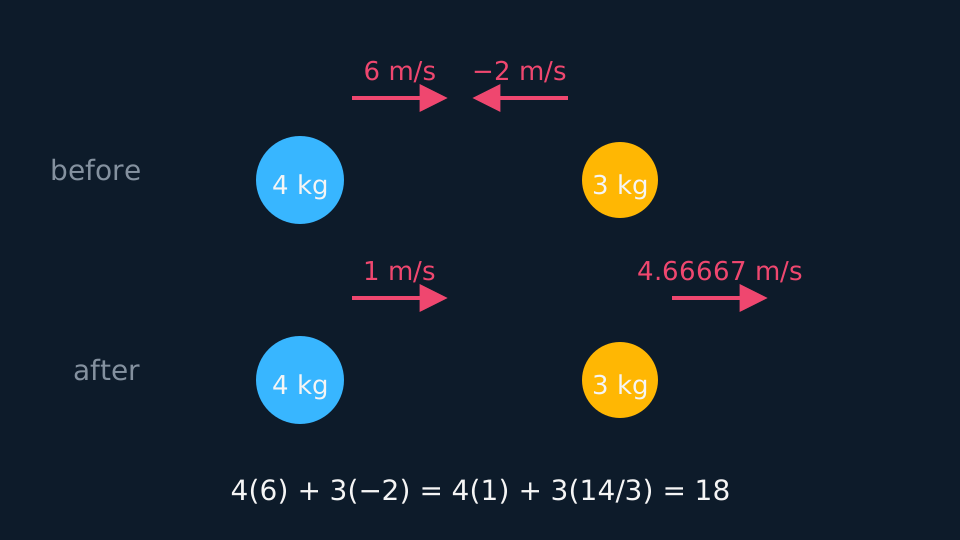
A sphere of mass 4 kg moving at 6 m/s meets a sphere of mass 3 kg moving at 2 m/s towards it. After the collision the 4 kg sphere continues in its original direction at 1 m/s. Find the velocity of the other sphere.
Show the working
Take the 4 kg sphere's direction as positive, so u₁ = 6 and u₂ = −2.
Total momentum before = 4(6) + 3(−2) = 24 − 6 = 18 N s.
After: 4(1) + 3v = 18, so 3v = 14 and v = 14/3 ≈ 4.67 m/s.
The sign is positive, so the 3 kg sphere has reversed and now moves in the original direction of the heavier one.
Impulse from a string becoming taut
Two particles joined by a slack inextensible string move as though the other were not there, right up to the instant the string becomes taut. Then it jerks. The string is light, so the tension it carries has the same magnitude at both ends, it acts along the string, and it acts for the same brief time at each end. The two particles therefore receive equal and opposite impulses, and that pair of impulses is the impulsive tension. It is internal to the pair, in the same way the forces in a collision are, so momentum along the string is conserved through the jerk.
Inextensibility supplies the second equation, and both are needed. Once the string is taut its ends can no longer separate, so the two particles come out of the jerk with equal velocity components along the string. In one dimension that is a common velocity, which makes the arithmetic identical to coalescence even though the two bodies are still separate and the string may go slack again a moment later.
Kinetic energy is lost in a jerk, since the string takes it in deforming and recovering, and a question that asks for the loss is asking you to compute both totals. The impulse on either particle comes from mv − mu applied to that one particle, and the two answers should agree in size and disagree in sign.
WORKED EXAMPLE
A string snapping taut
Particles A and B, of masses 3 kg and 2 kg, lie at rest on a smooth horizontal table joined by a slack inextensible string. A is projected directly away from B at 5 m/s. Find their common speed just after the string becomes taut, the impulsive tension, and the kinetic energy lost.
B stays at rest while the string is slack, so the momentum just before the jerk is 3(5) + 2(0) = 15 N s.
The string is inextensible, so both move at the same speed v afterwards: 5v = 15 and v = 3 m/s.
Impulse on B = 2(3) − 0 = 6 N s, and on A it is 3(3) − 3(5) = −6 N s. Equal and opposite, as the string requires.
Kinetic energy before = ½(3)(25) = 37.5 J, after = ½(5)(9) = 22.5 J, so the jerk has cost 15 J.
ASSESSMENT FOCUS
- Choose a positive direction, mark it on your diagram, and write every velocity with its sign.
- Treat impulse as a vector. A rebound adds the two speeds; it does not subtract them.
- Quote the units: N s for impulse and momentum, which is the same as kg m/s.
- For coalescence, use the combined mass on the right-hand side and one velocity.
- An explosion starts from zero momentum if the body was at rest, so the two fragments must have opposite signs.
- Given a force as a function of time, integrate it between the two instants rather than guessing a mean value for it.
- For a jerk in a string, write down two facts: momentum is conserved along the string, and the two particles share a velocity component along it afterwards.
CHECK YOURSELF
A particle of mass 3 kg moving at 5 m/s collides with a stationary particle of mass 2 kg and they move off together. Find their common speed.
Show a hint
Total momentum before equals combined mass times common velocity.
Show the answer
Momentum before = 3(5) = 15 N s. After: 5v = 15, so v = 3 m/s in the original direction.
Impulse is force times time and equals the change in momentum, so a rebound needs an impulse equal to the mass times the sum of the two speeds.
In a collision the internal forces are equal and opposite, so when the external impulse is negligible the total momentum before equals the total momentum after.
A force that varies delivers I = ∫F dt, with Ft as the constant-force case of it; divide any impulse by the contact time to get the average force.
When a slack inextensible string becomes taut, the impulsive tension is equal and opposite at its two ends, so momentum along the string is conserved and the two particles leave with equal components along it.
WORKBOOK
Printable practice for this topic: original exam-style questions with room to work, and a fully worked answer book. Free to use; please do not redistribute or sell.
Or read them with their worked answers on the momentum and impulse questions page.
USED LATER IN
CHECK YOUR PROGRESS
Rate how confident you feel with each objective for this lesson. Ratings are saved in this browser, on this device, unless you sign in.
- Use impulse equals change in momentum, including for a rebound.
- Find an average force from an impulse and a contact time.
- Find the impulse of a force given as a function of time, by integrating it.
- Apply conservation of momentum to a direct collision between two spheres.
- Handle coalescence and explosion as special cases of the same principle.
- Work out the jerk when a slack inextensible string becomes taut.
- Find the kinetic energy lost in a coalescence or a jerk, or released in an explosion, by totalling ½mv² before and after.
Open the full revision checklist to see every objective in the course in one place.