Maths › Further Mechanics 1 › Direct impact and Newton's law of restitution
Direct impact and Newton's law of restitution
In a direct collision, conservation of momentum gives one equation with two unknown velocities. Newton's law of restitution supplies the second, and together the two equations determine the motion after impact.
Builds on Momentum and impulse and Work, energy and power and Forces and Newton's laws.
IN THIS TOPIC
- State Newton's law of restitution and the range of values e can take.
- Solve a direct collision using conservation of momentum and restitution together.
- Calculate the kinetic energy lost in an impact.
- Recognise what happens at the two extreme values of e.
- Say why the impulses in an impact cancel so momentum is conserved while kinetic energy is not.
COMMON MISCONCEPTION
Since momentum is conserved in a collision, energy is conserved too.
The two conservation laws are separate claims. Momentum is conserved because the internal forces in the impact are equal and opposite, while kinetic energy goes into deforming the spheres and into sound and heat. Only a perfectly elastic collision, e = 1, keeps all of it; total the kinetic energy before and after to find the loss.
Two equations, two unknowns
Newton's law of restitution compares the speed the spheres separate at with the speed they approached at.
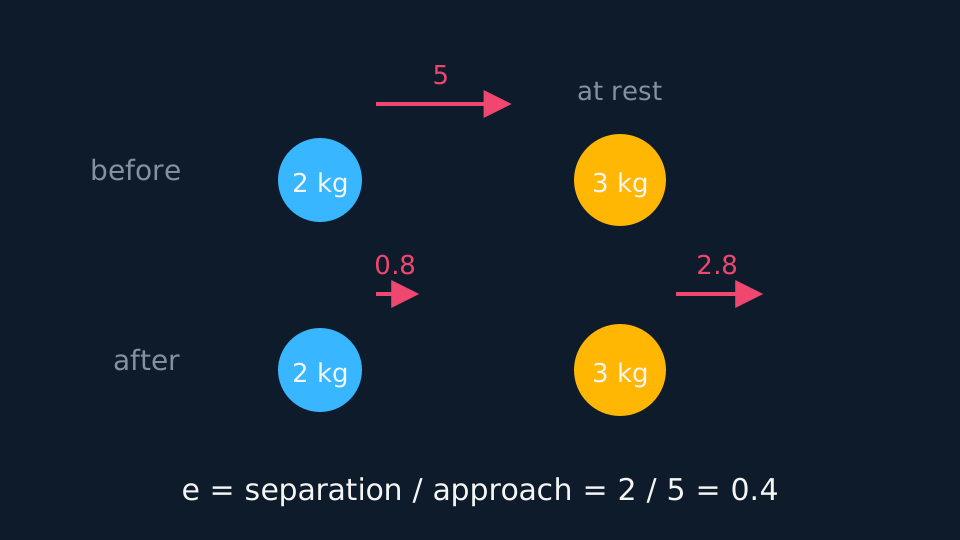
Pearson Edexcel 9FM0 formulae booklet: not included. The coefficient of restitution e satisfies 0 ≤ e ≤ 1. Both speeds here are relative speeds measured along the line of centres, so in terms of velocities the law reads v2 − v1 = e(u1 − u2). Getting that subtraction the right way round is most of the difficulty.
WORKED EXAMPLE
Solving a direct impact
A sphere of mass 2 kg moving at 5 m/s strikes a stationary sphere of mass 3 kg directly. The coefficient of restitution is 0.4. Find both velocities afterwards.
Momentum: 2(5) = 2v1 + 3v2, so 2v1 + 3v2 = 10.
Restitution: v2 − v1 = 0.4(5 − 0) = 2.
Substituting: 2v1 + 3(v1 + 2) = 10 gives 5v1 = 4, so v1 = 0.8 m/s and v2 = 2.8 m/s.
Both are positive, so both spheres move on in the original direction.
The two extreme values
At e = 1 the impact is perfectly elastic. The spheres separate as fast as they approached and no kinetic energy is lost. Two equal masses in that case simply exchange velocities, which is worth spotting because it saves the algebra entirely.
At e = 0 the impact is perfectly inelastic. The separation speed is zero, so the spheres move off together and the problem collapses to coalescence with one unknown. Every real collision on this paper sits somewhere between those two.
Where the energy goes
Momentum is conserved because the internal forces are equal and opposite, so their impulses cancel, and because the collision is over so quickly that any external impulse, from weight or friction, is negligible beside them. That second half is the modelling assumption every question here makes, and it is worth a line whenever a question asks why momentum may be conserved. Kinetic energy is not, because some of it goes into deforming the spheres and into sound and heat. The two conservation laws are separate claims. Only the perfectly elastic collision keeps all its kinetic energy.
To find the loss, calculate ½mv² for every sphere before and after and subtract the totals. Kinetic energy is a scalar and squaring removes the signs, so this is the one part of the calculation where direction can be ignored.
GUIDED PRACTICE
The loss in that impact
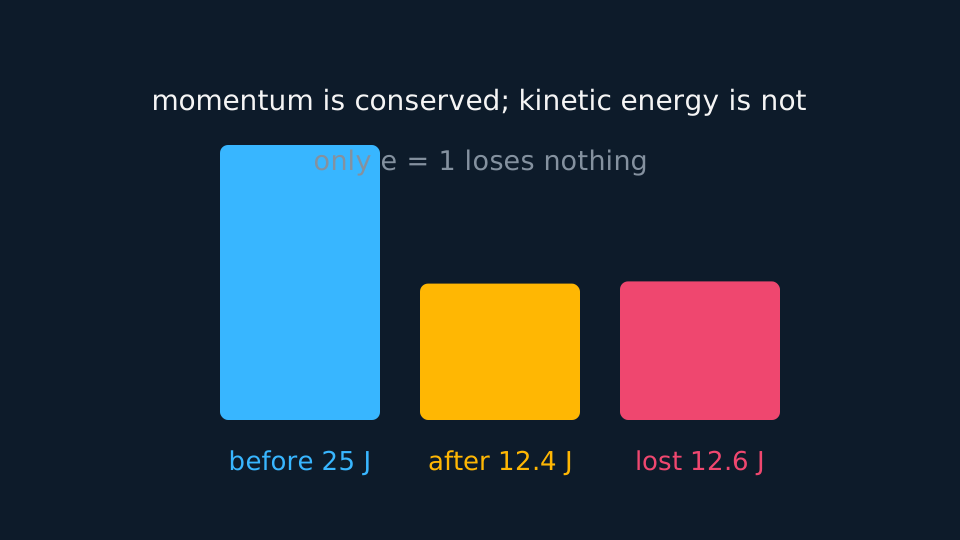
For the collision above, find the kinetic energy lost.
Show the working
Before: ½(2)(5²) = 25 J; the stationary sphere contributes nothing.
After: ½(2)(0.8²) + ½(3)(2.8²) = 0.64 + 11.76 = 12.4 J.
Loss = 25 − 12.4 = 12.6 J, over half the original energy.
With e = 1 the velocities would have been −1 and 4, giving 1 + 24 = 25 J and no loss at all.
ASSESSMENT FOCUS
- Draw before and after diagrams with a chosen positive direction and label every velocity.
- Write the restitution equation as separation over approach. Reversing either subtraction gives a negative e.
- Solve the two equations simultaneously instead of guessing which sphere moves where.
- Check the answers make physical sense. The rear sphere cannot end up faster than the one in front.
- If a question says the impact is perfectly elastic, that is e = 1 and it means no kinetic energy is lost.
CHECK YOURSELF
Two spheres approach each other at a combined 8 m/s and separate at 3 m/s. Find the coefficient of restitution.
Show a hint
Separation over approach.
Show the answer
e = 3/8 = 0.375, which lies between 0 and 1 as it must.
Newton's law of restitution says the separation speed is e times the approach speed, with 0 ≤ e ≤ 1.
Use it with conservation of momentum to get two equations in the two unknown velocities.
Kinetic energy is lost in every impact except e = 1; at e = 0 the spheres coalesce.
WORKBOOK
Printable practice for this topic: original exam-style questions with room to work, and a fully worked answer book. Free to use; please do not redistribute or sell.
Or read them with their worked answers on the direct impact and Newton's law of restitution questions page.
CHECK YOUR PROGRESS
Rate how confident you feel with each objective for this lesson. Ratings are saved in this browser, on this device, unless you sign in.
- State Newton's law of restitution and the range of values e can take.
- Solve a direct collision using conservation of momentum and restitution together.
- Calculate the kinetic energy lost in an impact.
- Recognise what happens at the two extreme values of e.
- Say why the impulses in an impact cancel so momentum is conserved while kinetic energy is not.
Open the full revision checklist to see every objective in the course in one place.