Maths › Further Mechanics 2 › Angular speed and horizontal circular motion
Angular speed and horizontal circular motion
A particle moving in a circle at constant speed is still accelerating, because the direction of its velocity changes. The acceleration is directed towards the centre and has magnitude rω² or v²/r. Identify the force that supplies it, and apply the result to the conical pendulum and to banked tracks.
Builds on Forces and Newton's laws and Radians, arcs and small angles.
IN THIS TOPIC
- Convert between linear speed, angular speed and period.
- Obtain v = rω and the radial acceleration by differentiating a position vector.
- Identify the force providing the radial acceleration in a given situation.
- Solve conical pendulum and banked track problems.
- Handle a conical pendulum held by two strings, and test whether both stay taut.
- Apply F = mrω² to a horizontal circle in other contexts, such as an elastic string or a string through a hole.
- Use a = rω² = v²/r numerically, from the speed or the angular speed.
COMMON MISCONCEPTION
A particle moving in a circle at constant speed has no acceleration, since its speed is not changing.
Constant speed is not constant velocity: the direction keeps changing, so there is an acceleration, it points at the centre, and its magnitude is rω2 or v2/r. Differentiating the position vector (r cos ωt)i + (r sin ωt)j twice gives the acceleration as −ω2 times that vector, which says the size and the direction at once. Some real force must supply it.
Acceleration in circular motion
Angular speed ω is the rate at which the angle at the centre increases, measured in radians per second, and the linear speed is v = rω. Even at constant speed the velocity keeps changing, because its direction does. So there is an acceleration, it points towards the centre, and its magnitude is:
Pearson Edexcel 9FM0 formulae booklet: included, under Motion in a circle, where the rate of turn is written as a theta with a dot over it rather than as ω. It gives the radial acceleration as −v²/r, the minus sign recording that it points inwards. One period is 2π/ω seconds, and questions often supply revolutions per minute, which needs converting before anything else happens.
Where those two results come from
Both of them come out of one position vector, differentiated twice. Put the centre at the origin and let the particle turn at a steady ω, so that after t seconds the angle is ωt and the position is (r cos ωt)i + (r sin ωt)j, with r fixed. Differentiate component by component and the velocity is (−rω sin ωt)i + (rω cos ωt)j. Differentiate once more and the acceleration is (−rω² cos ωt)i + (−rω² sin ωt)j.
Now read the three lines. The velocity has magnitude rω, because sin² + cos² = 1, so v = rω is a consequence and not a definition. Its scalar product with the position vector is −r²ω sin ωt cos ωt + r²ω cos ωt sin ωt, which is zero, so the velocity points along the tangent. And the acceleration is −ω² times the position vector, which says both halves of the earlier claim at once: its magnitude is rω², and it points from the particle straight back at the centre. A particle whose position is 3(cos 2t)i + 3(sin 2t)j metres has r = 3 and ω = 2, so it travels at 6 m/s with an acceleration of 12 m/s² towards the origin.
Nothing in the resolved equations disagrees with any of this; they are these three lines read along the radius and across it, and either route reaches the same numbers. The vectors do say one extra thing, though. Let the angle turn at a rate that changes rather than at a steady ω, and the second differentiation gives two terms instead of one: inwards, r times the square of the current rate of turn, which is the familiar rω²; and along the tangent, r times the rate at which that rate of turn is itself changing. The second term is the tangential acceleration a vertical circle has and a horizontal one does not.
Forces providing centripetal acceleration
Nothing travels in a circle by itself. Some real force must point at the centre to supply the radial acceleration, and naming it is the first line of every solution. A tension does it for a conical pendulum, friction for a car on a flat bend, the horizontal component of a normal reaction for a banked track, and the normal reaction of the wire for a bead threaded on a smooth wire.
There is no separate outward force to include. Resolve vertically as usual, then resolve horizontally towards the centre and set the total equal to mrω² or mv²/r.
The mass cancels in some of these models and not in others, so check rather than assume. For a car on a flat bend at its greatest speed the friction is limiting, and μmg = mv²/r gives v = √(μrg): in this ideal model the limiting speed is independent of mass because both the available friction and the required centripetal force are proportional to mass. The cancellation fails as soon as a force that is not proportional to mass enters the equation, such as a fixed towing force or an aerodynamic one.
WORKED EXAMPLE
A conical pendulum
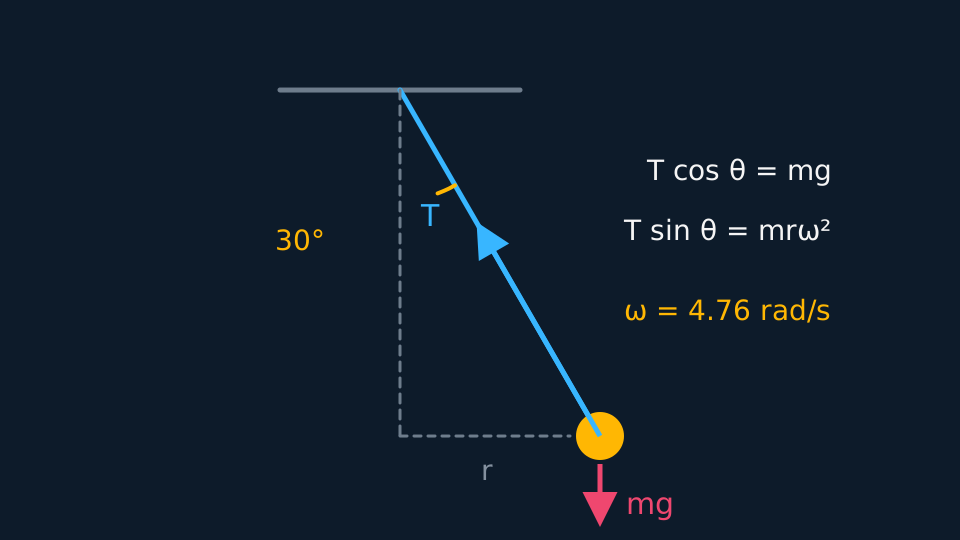
A bob of mass 0.2 kg on a string of length 0.5 m moves in a horizontal circle with the string at 30° to the vertical. Find the tension and the angular speed, taking g = 9.8 m/s².
Vertically: T cos30° = 0.2(9.8), so T = 1.96/0.866 = 2.26 N.
The radius is 0.5 sin30° = 0.25 m. Horizontally: T sin30° = 0.2(0.25)ω².
So 1.132 = 0.05ω², giving ω² = 22.63 and ω = 4.76 rad/s. The period is 2π/ω = 1.32 s.
Two strings, and the one that can go slack
Hang the bob from two points on the same vertical line and both strings pull on it. The geometry now settles more than it did: with both taut, the two string lengths and the distance between the attachment points fix where the bob is, so the radius and both angles are known before a single force is written down. Changing the speed changes the two tensions rather than the angle, which is the opposite of what happens on one string.
Resolve as before, with α and β the angles the upper and lower strings make with the vertical. Vertically the upper string holds the bob up while the lower one pulls it down, so T₁cos α − T₂cos β = mg. Horizontally both pull inwards, so T₁sin α + T₂sin β = mrω². Two equations, two tensions, solved as a simultaneous pair.
Then look at the lower string, because that is where the question is going. It can pull the bob down and in, but a string does not push, so a negative T₂ is not an answer: it means the lower string is slack at that speed and the bob is on a single-string conical pendulum hanging at a smaller angle.
Solving the pair gives T₂ ≥ 0 when rω² ≥ g tan α, and that condition is worth reading rather than memorising. tan α = rω²/g is the single-string result for the upper string at that angle, so the lower string is taut once the bob is going at least as fast as the upper string alone would need to hold it out that far. Any slower and holding the bob out at that angle would need an outward push, which is the one thing a string will not give.
WORKED EXAMPLE
Both strings taut
A bob of mass 2 kg is joined to points A and B on a vertical rod, A being 1 m above B, by strings of length 0.6 m to A and 0.8 m to B. It moves in a horizontal circle at 7 rad/s with both strings taut. Find the two tensions, taking g = 9.8 m/s².
The sides 0.6, 0.8 and 1 make a right angle at the bob, so the radius is 0.6 × 0.8 ÷ 1 = 0.48 m and the bob sits 0.36 m below A and 0.64 m above B.
That gives cos α = 0.6 and sin α = 0.8 for the upper string, cos β = 0.8 and sin β = 0.6 for the lower, with mg = 19.6 N and mrω² = 2(0.48)(49) = 47.04 N.
Vertically 0.6T₁ − 0.8T₂ = 19.6; horizontally 0.8T₁ + 0.6T₂ = 47.04. Solving the pair, T₁ = 49.4 N and T₂ = 12.5 N.
Both are positive, so the assumption was sound, and the condition agrees: rω² = 23.5 against g tan α = 9.8(0.8/0.6) = 13.1. Slow the bob below 5.22 rad/s and the lower string goes slack.
Banked tracks
On a banked track the normal reaction is no longer vertical, so its horizontal component can supply the radial acceleration with no friction at all. Resolve vertically and horizontally, then divide one equation by the other to remove both the mass and the reaction:
Pearson Edexcel 9FM0 formulae booklet: not included. The circular motion entry stops at the radial and transverse components, so this result has to be quoted from memory or obtained by resolving twice and dividing. The formula gives the design speed for the bend. Go slower and the vehicle tends to slide down the bank, so friction acts up the slope; go faster and the tendency reverses. A question that mentions friction is usually asking for the fastest or slowest safe speed, and the friction term has to be added with the right sign for the case being considered.
GUIDED PRACTICE
Designing a bend
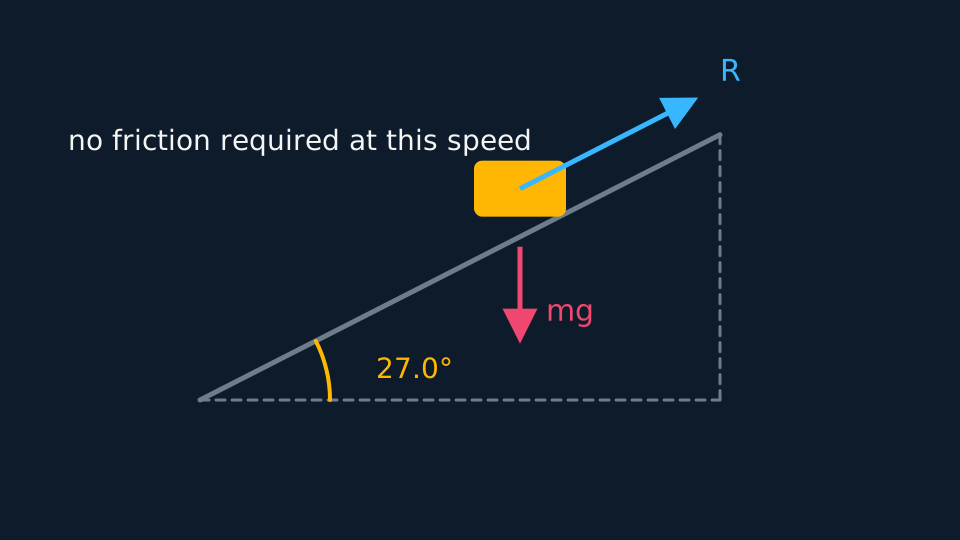
A bend of radius 80 m is to be banked so that a car travelling at 20 m/s needs no sideways friction. Find the banking angle, taking g = 9.8 m/s².
Show the working
Resolving vertically: R cos θ = mg. Horizontally: R sin θ = mv²/r.
Dividing: tan θ = v²/(rg) = 400/(80 × 9.8) = 0.510.
So θ = 27.0°.
The mass has cancelled, so the same bank suits a lorry and a motorcycle. Only the speed matters.
ASSESSMENT FOCUS
- Name the force providing the radial acceleration before writing any equation.
- Resolve vertically and horizontally, not along and perpendicular to a string.
- Use rω² when ω is given and v²/r when the speed is. Converting first wastes a line.
- For a banked track, divide the two equations to remove the reaction and the mass.
- Convert revolutions per minute to radians per second before touching the formula.
- With two strings, take the radius and both angles from the geometry first, then resolve twice and solve the pair.
- Check the sign of the lower tension. A negative value is telling you that string is slack, not that you have made an arithmetic slip.
CHECK YOURSELF
A particle moves in a circle of radius 2 m at 3 rad/s. Find its speed and its acceleration.
Show a hint
One multiplication each.
Show the answer
v = rω = 6 m/s. a = rω² = 2 × 9 = 18 m/s², directed towards the centre.
Circular motion at constant speed still accelerates, towards the centre, with magnitude rω² or v²/r, as differentiating the position vector twice shows.
Some real force must supply that acceleration, so name it before writing an equation.
On a banked track the reaction alone suffices at the design speed given by tan θ = v²/rg.
With two strings from the same vertical line the geometry fixes the radius and both angles, and the lower string stays taut while rω² ≥ g tan α.
WORKBOOK
Printable practice for this topic: original exam-style questions with room to work, and a fully worked answer book. Free to use; please do not redistribute or sell.
Or read them with their worked answers on the angular speed and horizontal circular motion questions page.
CHECK YOUR PROGRESS
Rate how confident you feel with each objective for this lesson. Ratings are saved in this browser, on this device, unless you sign in.
- Convert between linear speed, angular speed and period.
- Obtain v = rω and the radial acceleration by differentiating a position vector.
- Identify the force providing the radial acceleration in a given situation.
- Solve conical pendulum and banked track problems.
- Handle a conical pendulum held by two strings, and test whether both stay taut.
- Apply F = mrω² to a horizontal circle in other contexts, such as an elastic string or a string through a hole.
- Use a = rω² = v²/r numerically, from the speed or the angular speed.
Open the full revision checklist to see every objective in the course in one place.