Maths › Further Mechanics 2 › Motion in a vertical circle
Motion in a vertical circle
In a vertical circle the speed changes as well as the direction, because gravity does work on the way round. Energy handles the speed and the radial equation handles the force, and the question to settle is whether the circle is completed at all.
Builds on Angular speed and horizontal circular motion and Work, energy and power.
IN THIS TOPIC
- Combine conservation of energy with the radial equation of motion.
- Find the condition for a particle on a string to complete a vertical circle.
- Distinguish the string case from the rod and inside-surface cases.
- Say what happens when the circle is not completed.
COMMON MISCONCEPTION
To complete a vertical circle on a string, the particle only needs enough speed to reach the top.
A string pulls but cannot push, so at the top it needs v2 ≥ gr rather than merely v > 0. Below that the string goes slack somewhere before the top and the particle leaves the circle as a projectile. From the lowest point the condition reads u2 ≥ 5gr. A light rigid rod or a wire can push as well, so there v2 ≥ 0 at the top and u2 > 4gr carries it through.
Energy for speed, the radial equation for tension
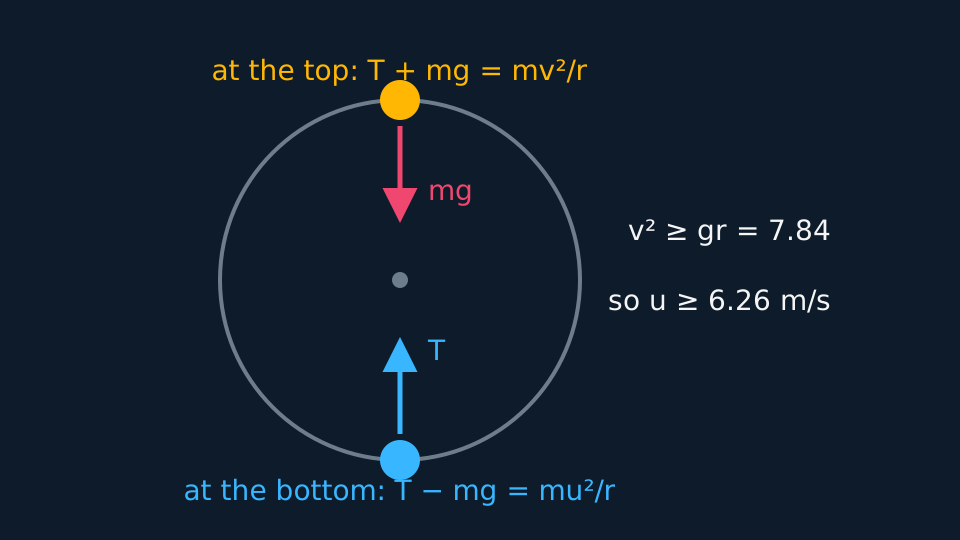
Two results are used together. Conservation of energy relates the speed at any point to the height, because the tension acts along the radius, perpendicular to the velocity, and so does no work. The radial equation of motion, resolving towards the centre, then gives the tension or reaction at that point:
There is a tangential acceleration as well, from the component of gravity along the path, and that is what makes the speed vary. It is rarely needed directly, because the energy equation already accounts for it.
WORKED EXAMPLE
Completing the circle
A particle on a light string of length 0.8 m is swung in a vertical circle. Find the least speed at the lowest point for a complete circle, taking g = 9.8 m/s².
At the top the string can pull but not push, so T ≥ 0, and the radial equation T + mg = mv²/r needs v² ≥ gr = 7.84.
Energy from bottom to top: u² = v² + 4gr = 7.84 + 31.36 = 39.2.
So u ≥ 6.26 m/s. At that speed the tension at the bottom is m(g + u²/r) = 58.8m newtons, six times the weight.
Limiting conditions for a string and for a rod
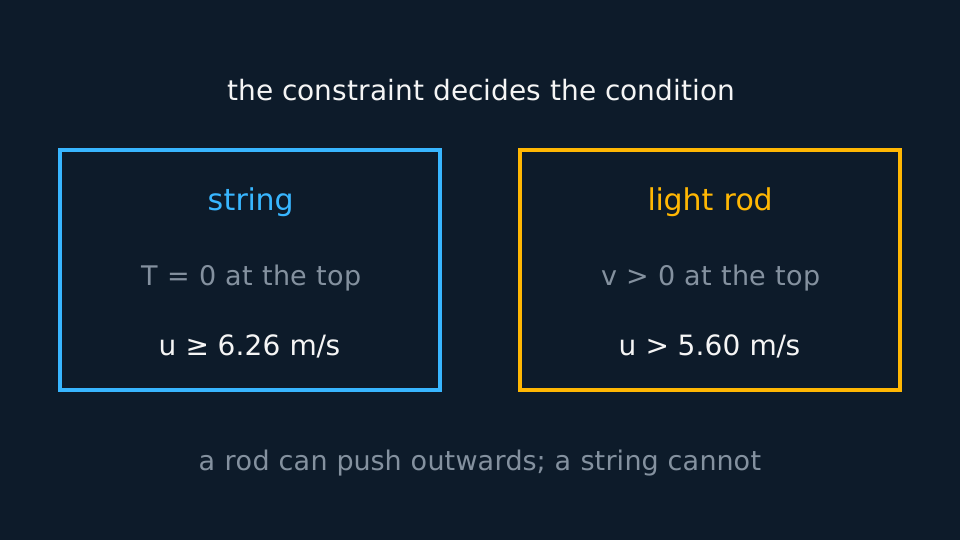
The constraint decides the test. On a string, or on the inside of a circular track, the constraint acts inwards only: a string pulls in and a track pushes in. Neither can act outwards, so the critical condition is that the tension or reaction reaches zero at the top, giving v² = gr there. Arriving at the top any slower is impossible, because the string would already have gone slack lower down and the particle would have left the circle.
On a light rigid rod, or a bead threaded on a wire, the constraint can push as well as pull, so no tension condition applies. The limiting energy condition at the top is therefore v² ≥ 0, which gives u² ≥ 4gr at the bottom; at equality the particle arrives at the top with zero speed and stops there. To continue through the top, use v > 0, so u² > 4gr.
GUIDED PRACTICE
String against rod
A particle is attached to a light rod of length 0.8 m and swung in a vertical circle. Find the least speed at the lowest point for a complete circle, and compare it with the string case.
Show the working
A rod can push, so the particle needs only to reach the top with a speed above zero.
Energy: u² > 4gr = 4(9.8)(0.8) = 31.36.
So u > 5.60 m/s, against 6.26 m/s on a string.
The rod is the easier case, and at the critical rod speed the rod is thrusting outwards at the top instead of pulling in.
When the circle is not completed
For a particle on a string of length r projected with speed u from the lowest point, there are three outcomes and the boundaries are worth memorising. If u² ≥ 5gr the circle is completed. If u² ≤ 2gr the particle never rises past the horizontal through the centre, so the string stays taut and it swings back and forth like a pendulum.
Between those two, 2gr < u² < 5gr, the string goes slack somewhere above the horizontal and the particle leaves the circle. Setting T = 0 in the radial equation locates that point, and from there the particle is a projectile under gravity alone until the string becomes taut again. State which of the three cases applies before doing the arithmetic, and justify it from u².
ASSESSMENT FOCUS
- Use energy for speeds and the radial equation for tensions. One equation will not do both.
- State the limiting condition explicitly: T = 0 at the top for a string; for a rod the limiting case is v = 0 at the top, and v > 0 is needed to pass through it.
- Measure heights from a single level, usually the lowest point of the circle.
- If the particle leaves the circle, say so, find where T = 0, and switch to projectile motion from that point.
- Remember the 2gr and 5gr boundaries; questions often ask only which case applies.
CHECK YOURSELF
A particle on a string of length 0.5 m passes the top of a vertical circle. Find the least speed it can have there, taking g = 9.8 m/s².
Show a hint
The tension is zero at the critical speed.
Show the answer
With T = 0 the radial equation gives mg = mv²/r, so v² = gr = 4.9 and v = 2.21 m/s.
Energy relates speed to height, since the tension does no work; the radial equation then gives the tension at any point.
A string or an inside track can act inwards only, so it needs v² ≥ gr at the top; a rigid rod or a wire can also push, so its limiting condition is v² ≥ 0 and passing through the top needs v > 0.
From the lowest point, u² ≥ 5gr completes the circle and u² ≤ 2gr oscillates; anything between leaves the circle above the horizontal.
WORKBOOK
Printable practice for this topic: original exam-style questions with room to work, and a fully worked answer book. Free to use; please do not redistribute or sell.
Or read them with their worked answers on the motion in a vertical circle questions page.
CHECK YOUR PROGRESS
Rate how confident you feel with each objective for this lesson. Ratings are saved in this browser, on this device, unless you sign in.
- Combine conservation of energy with the radial equation of motion.
- Find the condition for a particle on a string to complete a vertical circle.
- Distinguish the string case from the rod and inside-surface cases.
- Say what happens when the circle is not completed.
Open the full revision checklist to see every objective in the course in one place.