Maths › Differentiation › Differentiating trig, exponentials and logs
Differentiating trig, exponentials and logs
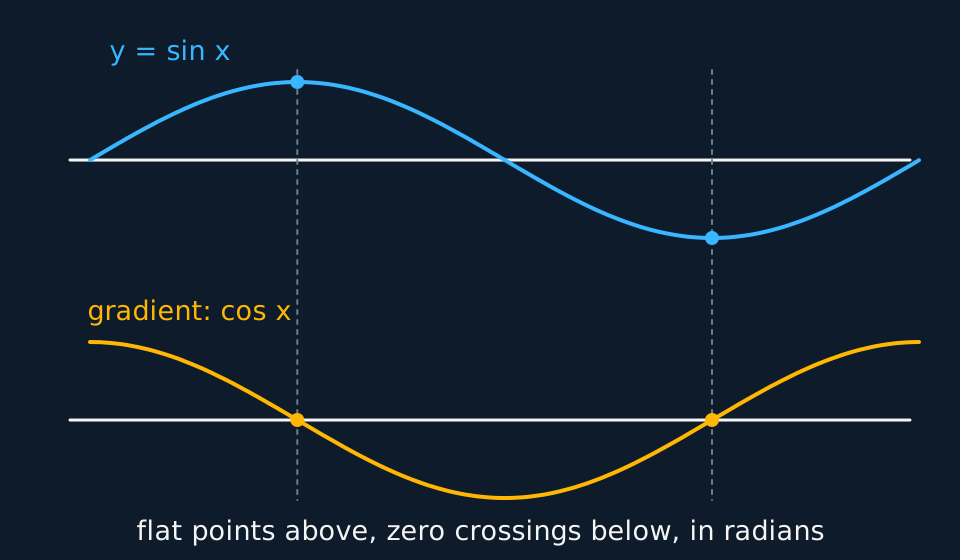
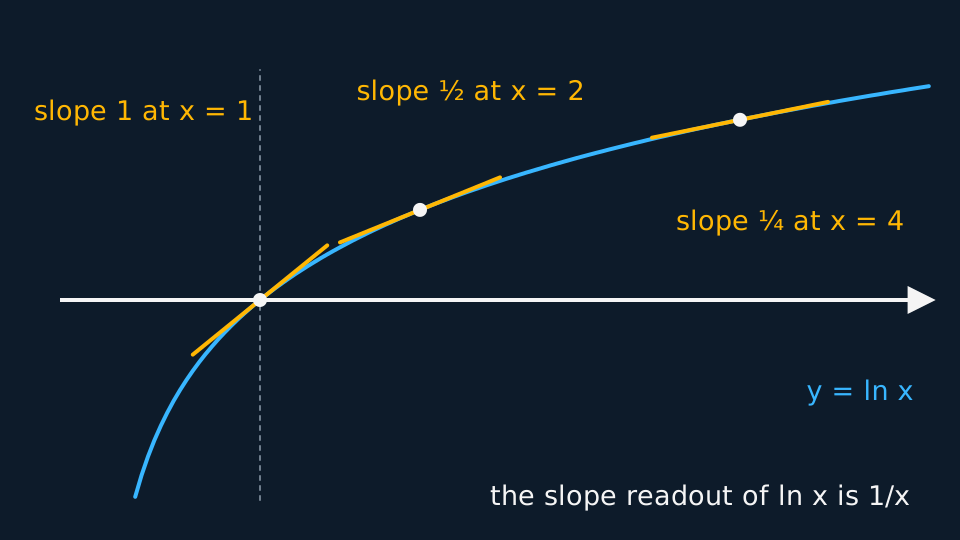
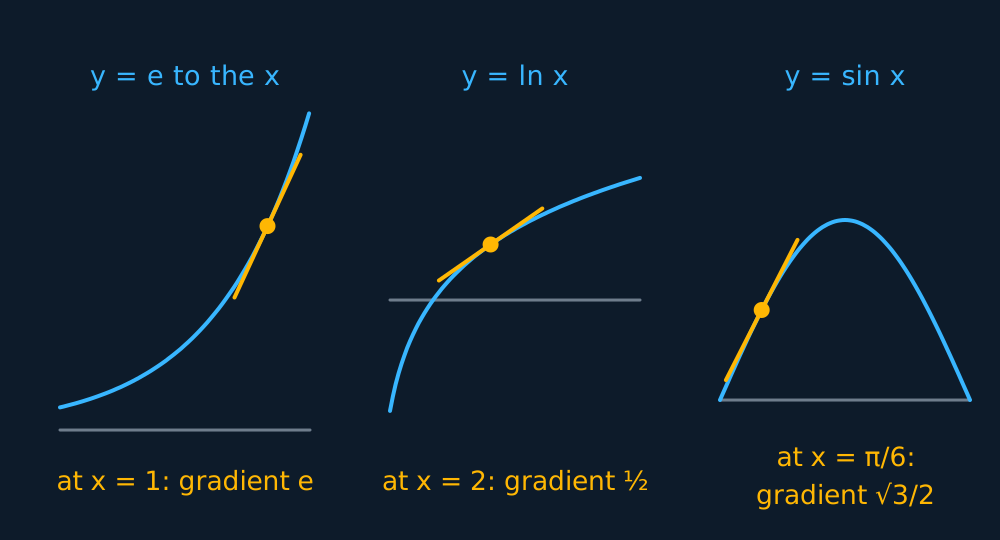
The remaining standard functions have their own derivatives: the derivative of sine is cosine, the derivative of ex is itself, and the derivative of ln x is 1/x. The trigonometric results take these forms only with the angle measured in radians, and the derivatives of sine and cosine can both be proved from first principles, using the compound angle formulae and the small-angle limits.
Builds on Differentiating powers of x and Radians, arcs and small angles.
IN THIS TOPIC
- Differentiate sin kx, cos kx, tan kx, ekx and ln x fluently.
- Handle akx, whose derivative carries a factor of ln a.
- Differentiate sin x and cos x from first principles using the small-angle approximations.
- Find gradients and tangents on trig, exponential and log curves.
COMMON MISCONCEPTION
The derivative of sin x is cos x, whatever unit the angle is in.
The result holds with x in radians. The first-principles proof rests on sin h/h tending to 1 as h tends to zero, and with h in degrees that ratio tends to π/180 instead, so the derivative carries that factor. Work in radians throughout, and set the calculator to them before evaluating any gradient.
The standard derivatives
Four families of standard derivatives join the power rule, and all of them must be learnt. The trigonometric results hold with x in radians; the derivative of ln x is valid for x > 0, where ln x is defined.
Alongside them, the formulae booklet gives tan kx → k sec2 kx, valid where cos kx is non-zero. One further result is named in the specification: akx differentiates to kakx ln a, for a > 0. For base e the factor is ln e = 1, so it disappears; for every other base, include it.
WORKED EXAMPLE
Three standard derivatives, termwise
Differentiate y = 4 sin 3x − 2 cos 5x + e3x.
Termwise: 4 sin 3x gives 12 cos 3x, and −2 cos 5x gives +10 sin 5x, since the derivative of cos 5x is −5 sin 5x and the two minus signs cancel.
The exponential gives 3e3x.
dy/dx = 12 cos 3x + 10 sin 5x + 3e3x.
Each k multiplies the whole term and is unchanged inside the function. Keep the minus sign on the derivative of cosine.
Sine and cosine from first principles
Edexcel 9MA0 7.1 requires both sin x and cos x from first principles. Each proof expands the chord gradient with a compound angle formula, regroups the result into two parts, and uses the same pair of limits, sin h/h → 1 and (cos h − 1)/h → 0 as h → 0, with h in radians.
Both of those come from the booklet's small-angle approximations, with h in radians. Since sin h ≈ h, the first ratio is h/h, which is 1. Since cos h ≈ 1 − h2/2, the second is −h/2, and that shrinks away with h. The two proofs below need nothing beyond them.
WORKED EXAMPLE
sin x from first principles
Prove from first principles that the derivative of sin x is cos x, for x in radians.
The chord gradient is [sin (x + h) − sin x]/h = [sin x cos h + cos x sin h − sin x]/h.
Regroup: sin x (cos h − 1)/h + cos x (sin h/h).
As h → 0, the small-angle approximations give (cos h − 1)/h → 0 and sin h/h → 1, leaving cos x. ∎
Name each result used: the compound angle formula, then both limits. With h in degrees, sin h/h tends to π/180 rather than 1, and the derivative carries that factor.
WORKED EXAMPLE
cos x from first principles
Prove from first principles that the derivative of cos x is −sin x, for x in radians.
The chord gradient is [cos (x + h) − cos x]/h = [cos x cos h − sin x sin h − cos x]/h.
Regroup: cos x (cos h − 1)/h − sin x (sin h/h).
As h → 0 the same two limits give cos x × 0 − sin x × 1, that is −sin x. ∎
This is the sine proof with cos (A + B) supplying the expansion in place of sin (A + B). The minus sign in the derivative of cosine is the minus sign in that compound angle formula, carried through the regrouping.
Gradients on the new curves
The method for tangents is unchanged: take the standard derivative, evaluate it at the point, and use point-gradient form. The arithmetic uses exact values of sin and cos at multiples of π/6, and the calculator must be set to radians, since the derivatives above assume radian measure.
GUIDED PRACTICE
A tangent on a trig curve
Find the equation of the tangent to y = sin 2x at the point where x = π/6, before opening the working.
Show the working
The point: y = sin (π/3) = √3/2.
The gradient: dy/dx = 2 cos 2x, which at x = π/6 is 2 cos (π/3) = 1.
Tangent: y − √3/2 = 1 × (x − π/6), that is y = x − π/6 + √3/2.
The calculus is one standard derivative with its factor of k; the rest is exact values.
INDEPENDENT PRACTICE
A base that is not e
Find the gradient of y = 5 × 2x at x = 3.
Show the working
The standard result gives dy/dx = 5 × 2x ln 2.
At x = 3 the gradient is 5 × 8 × ln 2 = 40 ln 2 ≈ 27.7.
The factor ln 2 distinguishes base 2 from base e. Only for base e is the derivative of the exponential equal to the function itself; every other base carries a factor of the natural logarithm of the base.
ASSESSMENT FOCUS
- Work in radians throughout. The trigonometric derivatives above are not valid for x in degrees.
- The k multiplies the term and remains inside the function: sin 3x gives 3 cos 3x.
- The derivative of cos kx carries a minus sign. Write the standard derivative down before substituting.
- A complete first-principles proof for sin x or cos x states the compound angle expansion, the regrouping, and both small-angle limits. The two proofs differ only in which compound angle formula opens them.
- For akx with a > 0, the derivative is kakx ln a. Include the factor ln a for every base except e.
CHECK YOURSELF
Differentiate y = 3 ln x − cos 4x, and find the gradient at x = π/4.
Show a hint
Termwise from the standard derivatives; sin π has an exact value.
Show the answer
dy/dx = 3/x + 4 sin 4x.
At x = π/4: 3/(π/4) + 4 sin π = 12/π + 0 = 12/π ≈ 3.82.
The sine term is zero because sin π = 0, which the exact values give without a calculator.
With x in radians, sin x differentiates to cos x, cos x to −sin x, ex to itself, and ln x to 1/x for x > 0.
Every k multiplies the term; every base other than e carries a factor ln a.
WORKBOOK
Printable practice for this topic: original exam-style questions with room to work, and a fully worked answer book. Free to use; please do not redistribute or sell.
Or read them with their worked answers on the differentiating trig, exponentials and logs questions page.
USED LATER IN
CHECK YOUR PROGRESS
Rate how confident you feel with each objective for this lesson. Ratings are saved in this browser, on this device, unless you sign in.
- Differentiate sin kx, cos kx, tan kx, ekx and ln x fluently.
- Handle akx, whose derivative carries a factor of ln a.
- Differentiate sin x and cos x from first principles using the small-angle approximations.
- Find gradients and tangents on trig, exponential and log curves.
Open the full revision checklist to see every objective in the course in one place.