Maths › Further Mechanics 2 › Newton's laws with a variable force
Newton's laws with a variable force
When the force varies with time, position or velocity, F = ma becomes a differential equation. Which form of the acceleration to use depends on what the force depends on and on what the question asks for.
Builds on Work, energy and power and Solving differential equations.
IN THIS TOPIC
- Choose between dv/dt and v dv/dx according to what the force depends on, then solve and apply the conditions.
- Handle inverse square forces, including the work done against gravity.
- Integrate a force given against time for its impulse, and read a speed off the change of momentum.
COMMON MISCONCEPTION
For a variable force you can use the SUVAT equations with the average value of the force.
The SUVAT equations assume constant acceleration, so they are unavailable whatever average is taken. Match the form of the acceleration to what the force depends on instead: F(x) = mv dv/dx when it varies with position, F(t) = m dv/dt when it varies with time. Separate, integrate, and apply the initial conditions at once.
Choosing a differential relation
Acceleration can be written as dv/dt or as v dv/dx, and the chain rule makes the two equal. Match the form to the variable the force depends on, so that the equation you get separates.
Pearson Edexcel 9FM0 formulae booklet: not included; no form of Newton's second law and no form of acceleration is printed there. The SUVAT equations assume constant acceleration, so they are unavailable here whatever average you take. Work-energy does still apply, with the work found by integration, and it is often the quickest route when speeds are wanted at particular positions.
Momentum is the matching shortcut for a force given against time. Integrating F(t) over an interval gives the impulse it delivers, and that impulse is m times the change in velocity, so a question asking for the speed after a stated time can be answered without solving the differential equation at all. Which of the three routes is shortest depends on whether the force is written against x or against t, and on whether the answer is wanted at a position or at an instant.
WORKED EXAMPLE
A force that dies away
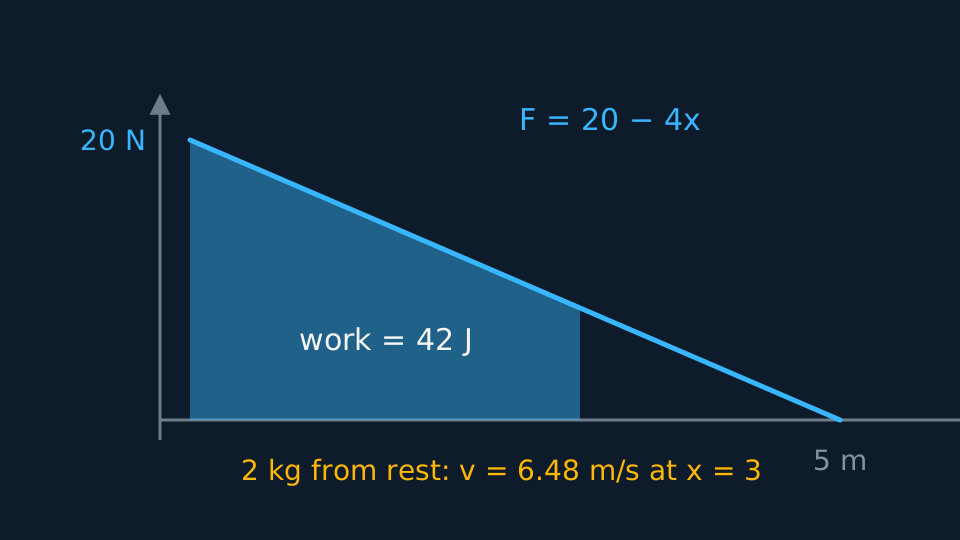
A particle of mass 2 kg starts from rest at the origin under a force F = 20 − 4x newtons. Find its speed at x = 3.
The force depends on x, so use 2v dv/dx = 20 − 4x.
Separating and integrating: v² = ∫(20 − 4x) dx = 20x − 2x² + c, and v = 0 at x = 0 gives c = 0.
At x = 3: v² = 60 − 18 = 42, so v = 6.48 m/s.
The kinetic energy gained, ½ × 2 × 42 = 42 J, is the area under the force-distance graph, so work-energy gives the same result.
Inverse square forces
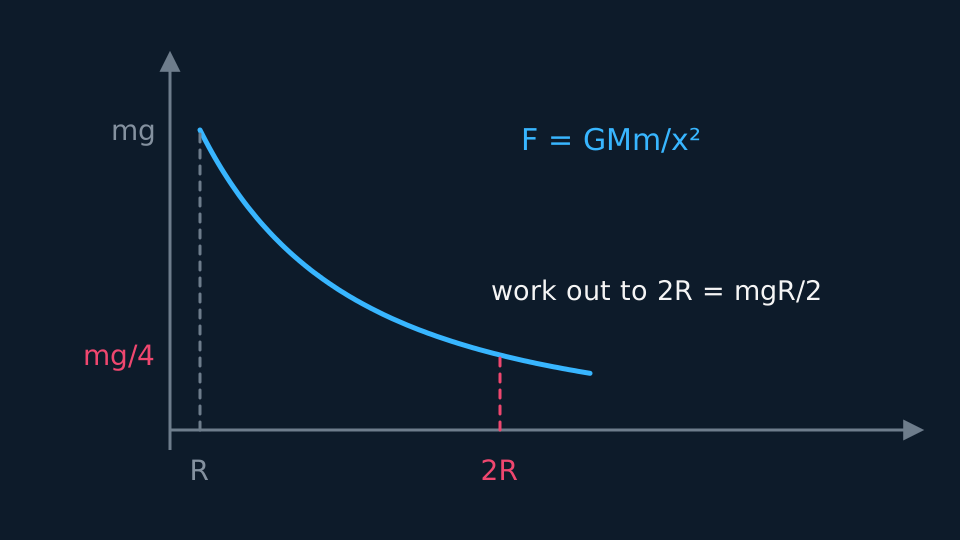
Gravitation gives F = GMm/x² directed towards the centre. Instead of quoting G and M, use the fact that the force equals mg at the surface, where x = R. Then GM = gR² and the force becomes mgR²/x². Both constants have gone, and everything left is a quantity the question supplies.
The force depends on position, so use v dv/dx. Integrating gives the speed as a function of distance, and the work done moving from R out to a distance d is the integral of the force, mgR²(1/R − 1/d). Let d grow without bound and that tends to mgR, the energy needed to escape entirely, or gR per unit mass.
GUIDED PRACTICE
Climbing away from a planet
A body is projected vertically from the surface of a planet of radius R where the surface gravity is g. Find the work done against gravity in reaching a height R above the surface, per unit mass.
Show the working
The force per unit mass at distance x is gR²/x².
Work = ∫gR²/x² dx from R to 2R = gR²[−1/x] from R to 2R.
That is gR²(1/R − 1/(2R)) = gR/2.
Half the escape energy takes you only one radius up, which shows how much of the cost of escaping is paid in the first stretch.
ASSESSMENT FOCUS
- Decide between dv/dt and v dv/dx by looking at what the force depends on, and say why.
- Never reach for SUVAT. State that the acceleration is not constant.
- Apply the initial conditions immediately after integrating, before rearranging.
CHECK YOURSELF
A particle of mass 1 kg moves under a force F = 6x newtons, starting from rest at x = 1. Find its speed at x = 3.
Show a hint
The force depends on x, so use v dv/dx.
Show the answer
v dv/dx = 6x, so v² = 6x² + c. With v = 0 at x = 1, c = −6. At x = 3: v² = 54 − 6 = 48, so v = 6.93 m/s.
Use v dv/dx when the force depends on position and dv/dt when it depends on time; SUVAT is unavailable either way.
For gravitation, write GM as gR² so the inverse square force is mgR²/x², and integrate it for the work done.
WORKBOOK
Printable practice for this topic: original exam-style questions with room to work, and a fully worked answer book. Free to use; please do not redistribute or sell.
Or read them with their worked answers on the Newton's laws with a variable force questions page.
CHECK YOUR PROGRESS
Rate how confident you feel with each objective for this lesson. Ratings are saved in this browser, on this device, unless you sign in.
- Choose between dv/dt and v dv/dx according to what the force depends on, then solve and apply the conditions.
- Handle inverse square forces, including the work done against gravity.
- Integrate a force given against time for its impulse, and read a speed off the change of momentum.
Open the full revision checklist to see every objective in the course in one place.