Maths › Further Pure 1 › Inequalities and inequations
Inequalities and inequations
Algebraic inequalities, including those with rational expressions and the modulus sign, are solved by collecting every term on one side and factorising. Multiplying by an expression whose sign is not known is unsafe: where the expression is negative the inequality reverses, so the solution set comes out wrong. A sign diagram or a sketch then gives the solution set.
Builds on Simultaneous equations and inequalities and Functions, inverses and the modulus.
IN THIS TOPIC
- Solve rational inequalities by collecting on one side and using a sign diagram.
- Handle modulus inequalities by squaring or by splitting into cases.
- State solution sets correctly, excluding the values that break a denominator.
- Use a sketch as a check on an algebraic answer.
COMMON MISCONCEPTION
To solve x/(x − 2) < 3 you simply multiply both sides by x − 2 and solve the linear inequality.
x − 2 is negative for every x below 2, and multiplying an inequality by a negative number reverses it, so that step assumes a sign the expression does not have and loses the whole interval below 2. Subtract to one side instead: x/(x − 2) − 3 is (6 − 2x)/(x − 2), whose sign diagram gives x below 2 or x above 3, both critical values excluded.
Why multiplying through fails
Multiplying an inequality by a negative number reverses it, and x − 2 is negative for every x below 2. Multiplying through by x − 2 therefore assumes a sign the expression does not have throughout, and the interval x < 2 is lost. Instead, subtract to one side, combine over a common denominator, factorise, and read the signs off.
WORKED EXAMPLE
The right way round
Solve x/(x − 2) < 3.
Subtract: x/(x − 2) − 3 < 0, so (x − 3(x − 2))/(x − 2) < 0, that is (6 − 2x)/(x − 2) < 0.
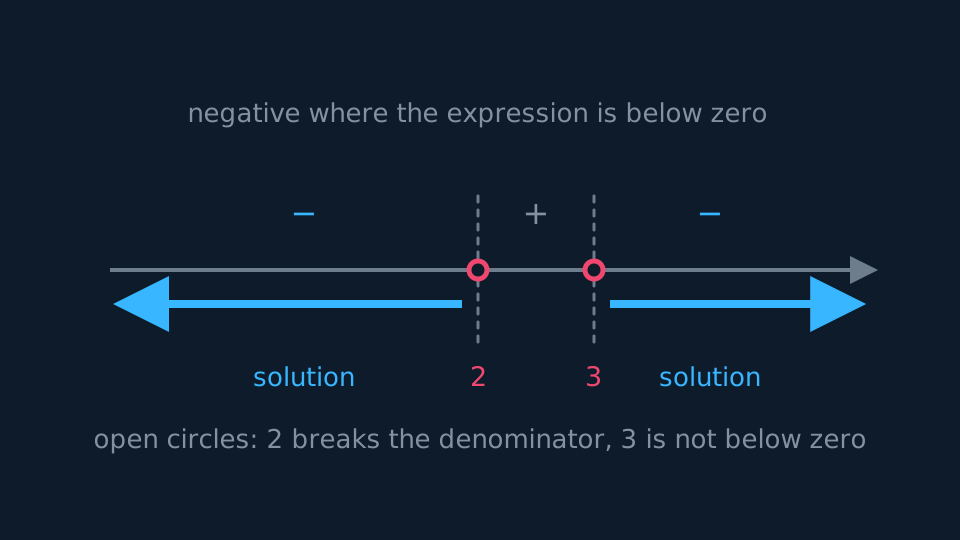
The critical values are x = 2 and x = 3. Testing each interval gives negative for x < 2, positive between them, negative for x > 3.
Solution: x < 2 or x > 3. Multiplying through by x − 2 would have returned x > 3 alone, omitting the interval x < 2.
Describe the drawing
A number line marked at two and three, each with an open circle: both values are excluded. Between them the expression is positive; outside, on both sides, it is negative, and those two outer stretches are picked out by thick cyan rays with outward arrowheads, the open rays x below two and x above three that make up the solution set.
Critical values come from zeros of the numerator and of the denominator alike, and the two behave differently. A numerator zero may be included when the inequality is weak. A denominator zero is always excluded, since the expression has no value there.
Modulus and the sketching route
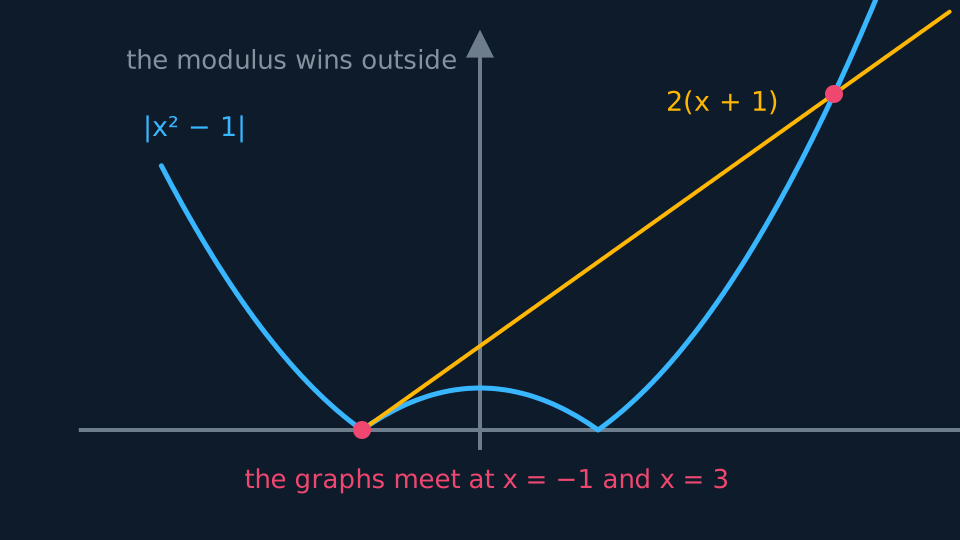
For an inequality between a modulus and something non-negative, squaring is legitimate and usually quickest, because both sides are then non-negative and the direction is preserved. Otherwise split into cases on the sign inside the modulus. Either way, sketch both sides afterwards and read off the intervals where one curve lies above the other, which checks that no interval has been omitted.
WORKED EXAMPLE
A modulus against a line
Solve |x² − 1| > 2(x + 1).
Where x² ≥ 1 the modulus opens directly: x² − 1 > 2x + 2 gives x² − 2x − 3 > 0, that is (x − 3)(x + 1) > 0, so x > 3 or x < −1, both of which lie inside this case.
Where x² < 1 it opens with a sign change: 1 − x² > 2x + 2 gives x² + 2x + 1 < 0, which is (x + 1)² < 0 and therefore impossible.
Solution: x < −1 or x > 3, which the sketch confirms: the modulus graph meets the axis at x = ±1 and lies above the line only outside the two crossings.
INDEPENDENT PRACTICE
Two fractions at once
Solve 1/(x − 1) > x/(x + 2).
Show the working
Subtract and combine: (x + 2 − x(x − 1))/((x − 1)(x + 2)) > 0, which is (2 + 2x − x²)/((x − 1)(x + 2)) > 0.
The numerator vanishes at x = 1 ± √3 and the denominator at x = 1 and x = −2, giving four critical values.
Testing the five intervals leaves −2 < x < 1 − √3 or 1 < x < 1 + √3. Both denominator zeros stay excluded throughout.
ASSESSMENT FOCUS
- Never multiply by an expression of unknown sign; subtract to one side instead.
- List every critical value, from numerator and denominator, before testing any interval.
- Exclude denominator zeros from the solution set even when the inequality is weak.
- Sketch both sides as a check on the algebraic answer; an interval omitted by the algebra shows up at once on the sketch.
CHECK YOURSELF
Solve (x + 1)/(x − 3) ≥ 0.
Show a hint
Critical values −1 and 3; test the three intervals and mind which endpoint can be included.
Show the answer
The expression is positive for x < −1 and for x > 3, and zero at x = −1. So x ≤ −1 or x > 3. The numerator zero is included by the weak inequality, and the denominator zero never is.
Collect on one side, factorise, and read a sign diagram; multiplying by an unknown sign loses intervals.
Square a modulus inequality when both sides are non-negative, otherwise split into cases and sketch to check.
WORKBOOK
Printable practice for this topic: original exam-style questions with room to work, and a fully worked answer book. Free to use; please do not redistribute or sell.
Or read them with their worked answers on the inequalities and inequations questions page.
CHECK YOUR PROGRESS
Rate how confident you feel with each objective for this lesson. Ratings are saved in this browser, on this device, unless you sign in.
- Solve rational inequalities by collecting on one side and using a sign diagram.
- Handle modulus inequalities by squaring or by splitting into cases.
- State solution sets correctly, excluding the values that break a denominator.
- Use a sketch as a check on an algebraic answer.
Open the full revision checklist to see every objective in the course in one place.