Maths › Algebra and functions › Simultaneous equations and inequalities
Simultaneous equations and inequalities
Simultaneous equations, including a linear equation paired with a quadratic, are solved by elimination and substitution, and the solutions are the crossing points of the two graphs. Linear and quadratic inequalities follow, with solutions written in set notation and represented as regions of the plane.
Builds on Quadratic functions.
IN THIS TOPIC
- Solve one linear and one quadratic equation together by substitution.
- Read the discriminant of the substituted equation as the number of intersections.
- Solve linear, quadratic and fractional inequalities, and write the answers in set notation.
- Shade a region of the plane with the right boundary convention.
COMMON MISCONCEPTION
You can always multiply both sides of an inequality by x.
Multiplying by x reverses the inequality whenever x is negative, and the sign of x is not generally known in advance. Multiply by x2 instead, which is positive for every x ≠ 0, so 3/x < 2 becomes 3x < 2x2. Factorising the result gives x(2x − 3) > 0, that is x < 0 or x > 3/2.
Where a line meets a curve
Solving two equations simultaneously means finding the values that satisfy both at once, and geometrically that means the intersection points of their graphs. With one linear and one quadratic equation, the method is substitution. Make the linear equation say y = … or x = …, feed it into the quadratic, and solve the single quadratic that results.
WORKED EXAMPLE
The standard pairing
Solve simultaneously: y = 2x + 3 and y = x2 − 4x + 8.
Equate. x2 − 4x + 8 = 2x + 3, so x2 − 6x + 5 = 0, which factorises as (x − 1)(x − 5) = 0.
x = 1 gives y = 5, and x = 5 gives y = 13. Solutions: (1, 5) and (5, 13).
The solutions are coordinate pairs, so each x must be paired with the y found from it. Substitute each x into the linear equation, which is the simpler of the two, and state that this is what has been done.
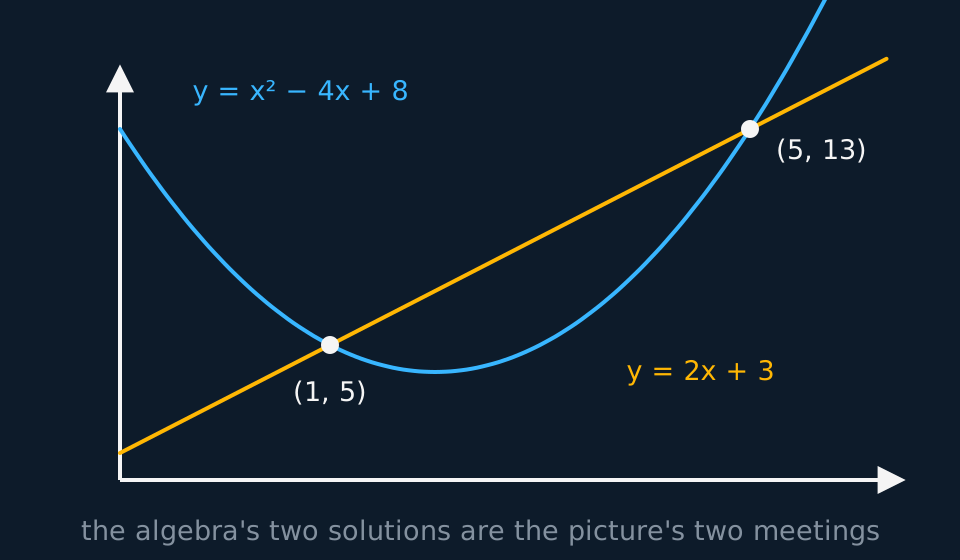
The discriminant of the substituted quadratic gives the number of intersections: two distinct real roots means the line crosses the curve twice, a repeated root means the line is a tangent, and no real roots means the line and the curve do not meet. Substitution also works when the linear equation is not in the form y = mx + c, as in the next example.
GUIDED PRACTICE
A tougher pair
Solve simultaneously: 2x − 3y = 6 and x2 − y2 + 3x = 50, before opening the working.
Show the working
From the linear equation, x = 3 + 3y/2. Substituting and clearing fractions gives 5y2 + 54y − 128 = 0.
The discriminant is 542 + 4 × 5 × 128 = 5476 = 742, so y = (−54 ± 74)/10, giving y = 2 or y = −64/5.
y = 2 gives x = 6, and y = −64/5 gives x = −81/5. Solutions: (6, 2) and (−81/5, −64/5), and both check in the original quadratic equation.
Fractional answers are not an error here: these are the exact solutions, and substituting them into both original equations confirms them.
Inequalities in one variable
A linear inequality is solved like a linear equation, with one additional rule: multiplying or dividing by a negative number reverses the inequality, so 5 − 2x > 1 becomes −2x > −4 and then x < 2. Moving the x term to the side where its coefficient is positive avoids the reversal.
Watch Inequalities: from graphs to shaded regions on the InkPhysics YouTube channel
A quadratic inequality asks where a parabola sits above or below something. Find the roots, sketch the shape, read the sign. For x2 − 6x + 5 < 0 the roots are 1 and 5 and the parabola opens upward, so it is negative between its roots and the answer is 1 < x < 5. In set language that is {x : x > 1} ∩ {x : x < 5}, an “and”. The outside region x < 1 or x > 5 is {x : x < 1} ∪ {x : x > 5}, an “or”.
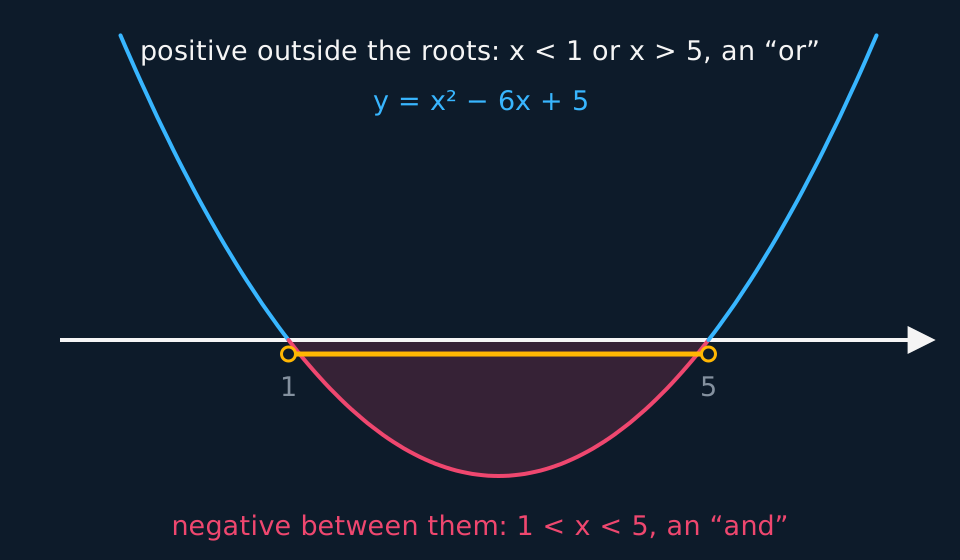
An inequality such as x2 − 4x + 8 < 2x + 3 requires one step first: collect the terms on one side, and the condition that the curve lies below the line becomes the inequality x2 − 6x + 5 < 0 solved above.
Inequalities with an unknown in the denominator
Multiplying an inequality by x reverses it when x is negative, and the sign of x is not generally known in advance. Multiply by x2 instead: it is positive for every x ≠ 0, so a/x < b gives ax < bx2.
WORKED EXAMPLE
A fraction handled safely
Solve 3/x < 2.
Multiply both sides by x2, which is positive for every x ≠ 0. That gives 3x < 2x2, so 2x2 − 3x > 0.
Factorise. x(2x − 3) > 0, an upward parabola with roots 0 and 3/2, positive outside them: x < 0 or x > 3/2.
Check both intervals: x = −1 gives −3 < 2, true; x = 1 gives 3 < 2, false; x = 2 gives 3/2 < 2, true. The negative interval satisfies the inequality because 3/x is negative there, and every negative value is less than 2.
Regions in the plane
Replace the equals sign in y = f(x) with an inequality and the answer stops being a curve and becomes a region. y > f(x) is everything above the graph and y < f(x) everything below. Several inequalities at once intersect their regions, and the drawing conventions carry meaning. Solid boundary for ≤ or ≥, because the edge belongs. Dotted for < or >, because it does not. Shade the region you want.
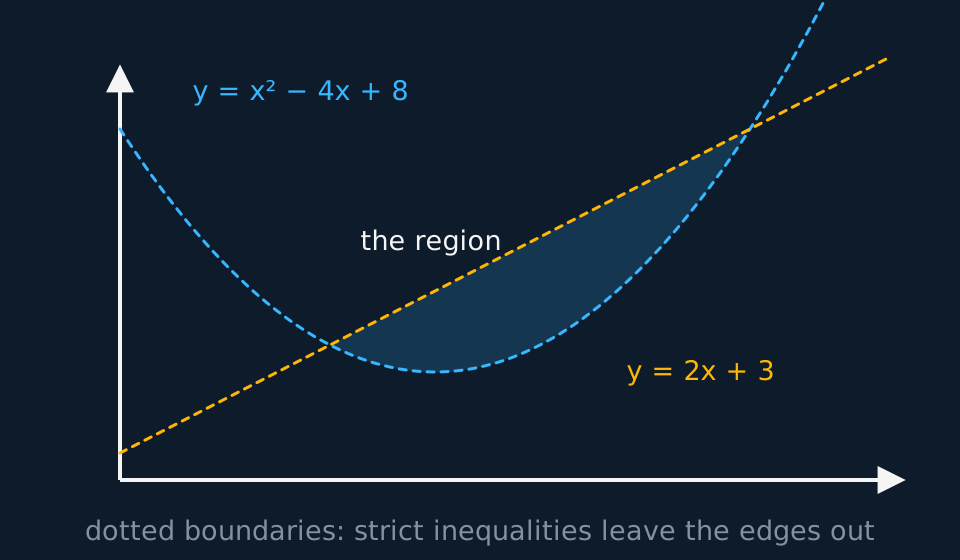
The region between the curve and the line uses all three methods above: its corners are the simultaneous solutions (1, 5) and (5, 13), its interior is where the line lies above the parabola, and its x-extent is the solution 1 < x < 5 of the corresponding quadratic inequality.
INDEPENDENT PRACTICE
Reading a region back into algebra
Write down the pair of inequalities whose region is the set of points below the solid line y = x + 1 and strictly above the dotted parabola y = x2.
Show the working
Below a solid line gives y ≤ x + 1. Strictly above a dotted parabola gives y > x2.
So the region is {(x, y) : y ≤ x + 1} ∩ {(x, y) : y > x2}, or y ≤ x + 1 and y > x2. The solid line gives the ≤ and the dotted parabola gives the >.
ASSESSMENT FOCUS
- Substitute using the linear equation, and find the second coordinates from it too. Present answers as coordinate pairs, correctly matched.
- A tangency question is a discriminant question. Substitute, then set b2 − 4ac = 0 for touching, > 0 for two crossings, < 0 for missing.
- Solve a quadratic inequality from a sketch: roots first, direction of opening second, sign region third. An upward parabola is negative between its roots and positive outside them.
- Do not multiply an inequality by a quantity of unknown sign; multiply by its square, which is positive, or use a sketch.
- Dividing a linear inequality by a negative number reverses it. Rearranging so that the coefficient of x is positive avoids the reversal.
- In set notation, “between” is an intersection and “outside” is a union. On region diagrams, solid boundaries mean included and dotted mean excluded.
CHECK YOURSELF
Find the set of values of x for which x2 + 3x − 10 ≥ 0, giving the answer in set notation.
Show a hint
Factorise, sketch the upward parabola, and decide between or outside.
Show the answer
Factorise. (x + 5)(x − 2) ≥ 0, an upward parabola with roots −5 and 2.
At or above the axis means outside the roots, boundaries included, so x ≤ −5 or x ≥ 2.
In set notation, {x : x ≤ −5} ∪ {x : x ≥ 2}. An “or”, so a union, with both boundary points kept by the ≥.
Substitute the linear equation into the quadratic: the roots are the x-coordinates of the intersections, and the discriminant gives how many there are.
Solve a quadratic inequality from a sketch: find the roots, note which way the parabola opens, then read the sign on each interval.
WORKBOOK
Printable practice for this topic: original exam-style questions with room to work, and a fully worked answer book. Free to use; please do not redistribute or sell.
Or read them with their worked answers on the simultaneous equations and inequalities questions page.
USED LATER IN
CHECK YOUR PROGRESS
Rate how confident you feel with each objective for this lesson. Ratings are saved in this browser, on this device, unless you sign in.
- Solve one linear and one quadratic equation together by substitution.
- Read the discriminant of the substituted equation as the number of intersections.
- Solve linear, quadratic and fractional inequalities, and write the answers in set notation.
- Shade a region of the plane with the right boundary convention.
Open the full revision checklist to see every objective in the course in one place.