Maths › Further Pure 1 › Tangents, normals and loci of conics
Tangents, normals and loci of conics
Differentiate a parametric representation to obtain the tangent and normal at a general point. A repeated root after substituting a line into a conic establishes tangency. For a locus, eliminate the parameter and state every restriction needed to describe exactly the points reached.
Builds on Conic sections and Implicit and parametric differentiation.
IN THIS TOPIC
- Find tangents and normals at a general parametric point of any of the four conics.
- Quote the standard tangent forms, and derive them when the question demands it.
- Use and verify the tangency condition for y = mx + c.
- Eliminate the parameter to find the locus of a moving point, and state every restriction on it.
COMMON MISCONCEPTION
A line either obviously crosses a curve or obviously misses it; tangency needs a picture, not algebra.
Tangency is settled algebraically. Substitute the line into the conic and read the roots of the quadratic that results: a repeated root means the line touches the curve, and two distinct roots mean it crosses. Setting the discriminant to zero derives the conditions, such as c = a/m for y = mx + c on y² = 4ax, with m non-zero.
The tangent at a general point
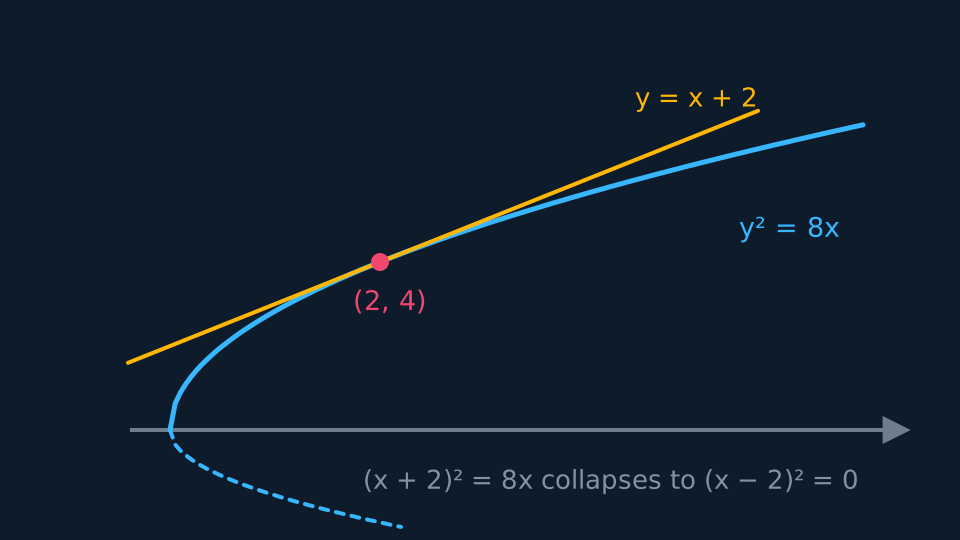
Parametric differentiation gives the gradient at (at², 2at) on y² = 4ax as 1/t, so the tangent there is ty = x + at² and the normal has gradient −t. One derivation covers every point on the curve. Tangency is decided algebraically: substitute the line into the conic, and a repeated root means the line touches the curve while two distinct roots mean it crosses.
WORKED EXAMPLE
Tangent by substitution
Show that y = x + 2 is a tangent to y² = 8x, and find the point of contact.
Substitute: (x + 2)² = 8x, so x² − 4x + 4 = 0.
That is (x − 2)² = 0, a repeated root at x = 2, so the line touches instead of crossing.
Contact point (2, 4), which is (at², 2at) with a = 2 and t = 1. The general tangent ty = x + at² reduces to y = x + 2 there, as it should.
The four tangent forms
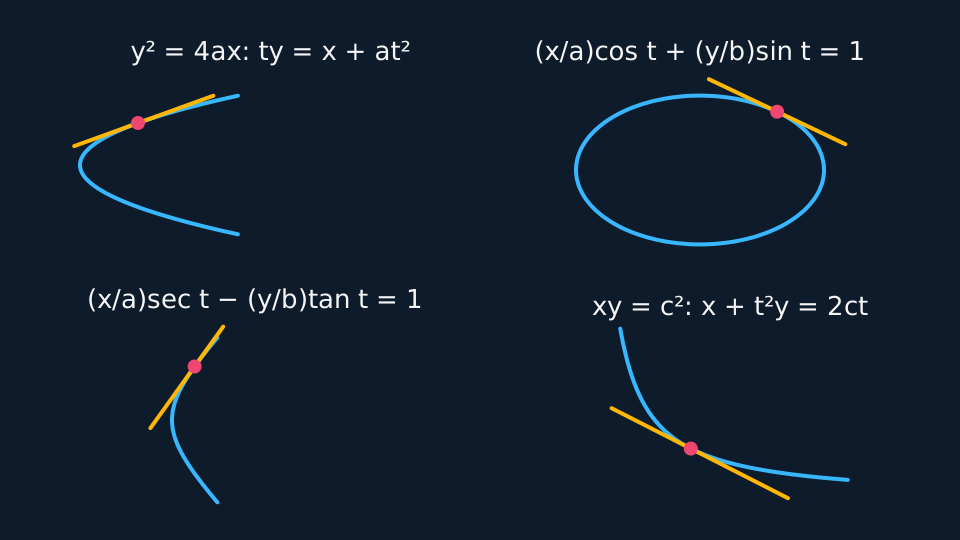
Each conic has a tangent at its general parametric point, and a question that says 'show that' expects the derivation while a question that says 'hence' expects the quoted result. For the parabola at (at², 2at) it is ty = x + at², with normal y + tx = 2at + at³. For the rectangular hyperbola xy = c² at (ct, c/t) the tangent is x + t²y = 2ct.
The ellipse and hyperbola are tidier than they look. At (a cos t, b sin t) on x²/a² + y²/b² = 1 the tangent is (x/a)cos t + (y/b)sin t = 1. At (a sec t, b tan t) on x²/a² − y²/b² = 1 it is (x/a)sec t − (y/b)tan t = 1. Both follow from implicit differentiation in four lines.
Describe the drawing
Four small panels, one for each standard conic, each showing the curve in cyan with its quoted tangent in amber grazing a coral contact point: the parabola with t y equals x plus a t squared, the ellipse and hyperbola with their cos, sin, sec and tan forms, and the rectangular hyperbola with x plus t squared y equals two c t. Substituting any of the four lines into its own curve gives a quadratic whose discriminant is exactly zero, the algebra of a touch.
Tangency conditions for y = mx + c follow from setting the discriminant of the substituted quadratic to zero: c = a/m for y² = 4ax, c² = a²m² + b² for the ellipse, and c² = a²m² − b² for the hyperbola. The parabola condition requires m ≠ 0, since a horizontal line meets y² = 4ax exactly once without touching it.
Loci
A locus is the set of points a moving point reaches. Parametrise that point, express the tracked quantity in terms of the parameter, and eliminate the parameter. The equation that survives is the locus, together with whatever restriction the elimination imposed.
WORKED EXAMPLE
Midpoints of parallel chords
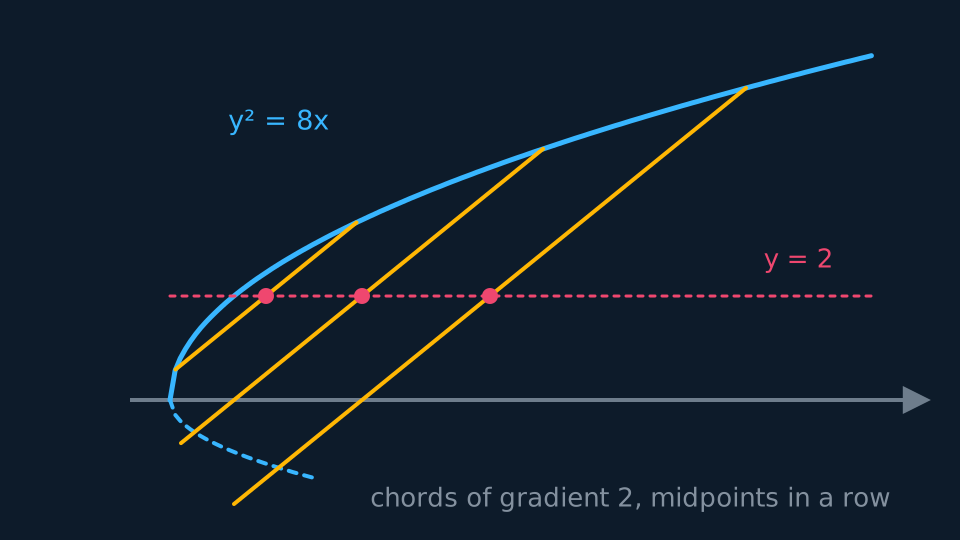
Find the locus of midpoints of chords of y² = 8x with gradient 2.
A chord y = 2x + c meets the parabola where y² = 4(y − c), that is y² − 4y + 4c = 0.
The two intersection y-values sum to 4 whatever c is, so the midpoint always has y = 2.
For two distinct intersections the discriminant 16 − 16c must be positive, so c < 1, and the midpoint has x = (2 − c)/2 = 1 − c/2.
The locus is y = 2 with x > 1/2; the endpoint (1/2, 2) is excluded, being the contact point of the limiting tangent.
GUIDED PRACTICE
Using the tangency condition
The line y = mx + 3 is a tangent to y² = 12x. Find m and verify by substitution.
Show the working
Here a = 3 and the condition is c = a/m, so 3 = 3/m and m = 1.
Substituting y = x + 3: (x + 3)² = 12x gives x² − 6x + 9 = (x − 3)² = 0.
A double root at x = 3, so the line touches at (3, 6) and confirms the condition it was built from.
ASSESSMENT FOCUS
- Derive gradients parametrically and state dy/dx = (dy/dt)/(dx/dt) before using it.
- A repeated root is the algebraic definition of tangency, so use the word 'repeated' explicitly.
- Quote the general tangent only if you have derived it earlier in the paper, or the question says 'hence'.
- For loci, look for combinations of the roots that stay constant; the sum and the product of the roots survive elimination.
- Give the locus as an equation with every restriction stated. An unrestricted answer describes points the moving point never reaches.
CHECK YOURSELF
Find the gradient of the normal to xy = 9 at the point (3, 3).
Show a hint
Differentiate implicitly or use the parametric form (3t, 3/t).
Show the answer
dy/dx = −9/x², which is −1 at x = 3, so the normal has gradient 1. That normal is the line y = x, an axis of symmetry of the rectangular hyperbola.
Tangent to y² = 4ax at (at², 2at) is ty = x + at²; to xy = c² at (ct, c/t) it is x + t²y = 2ct.
A repeated root in the substituted quadratic means tangency, and a zero discriminant is how the conditions are derived.
For a locus, parametrise the moving point and eliminate the parameter; state every restriction, since the equation alone usually describes more points than the locus contains.
WORKBOOK
Printable practice for this topic: original exam-style questions with room to work, and a fully worked answer book. Free to use; please do not redistribute or sell.
Or read them with their worked answers on the tangents, normals and loci of conics questions page.
CHECK YOUR PROGRESS
Rate how confident you feel with each objective for this lesson. Ratings are saved in this browser, on this device, unless you sign in.
- Find tangents and normals at a general parametric point of any of the four conics.
- Quote the standard tangent forms, and derive them when the question demands it.
- Use and verify the tangency condition for y = mx + c.
- Eliminate the parameter to find the locus of a moving point, and state every restriction on it.
Open the full revision checklist to see every objective in the course in one place.