Maths › Further Pure 1 › The vector product and the scalar triple product
The vector product and the scalar triple product
The vector product of two vectors is a third vector perpendicular to both, whose magnitude is the area of the parallelogram they span. Taking the scalar product of that with a third vector gives the volume of the parallelepiped on the three vectors.
Builds on Lines and planes in three dimensions and Determinants and inverses and Intersections, angles and distances.
IN THIS TOPIC
- Compute a × b from components and check it is perpendicular to both factors.
- Settle the product's direction from the right-handed triple, and expand a product of sums using the distributive rule.
- Use |a × b| as an area and |a·(b × c)| as a volume, with the tetrahedron's sixth.
- Write a line as (r − a) × b = 0 and read off direction ratios and cosines.
- Find distances in three dimensions using the vector and triple products.
- Use |a × b| = |a||b| sin θ, and read a zero product as parallel vectors.
COMMON MISCONCEPTION
Multiplying two vectors can only sensibly produce a number, as the scalar product does.
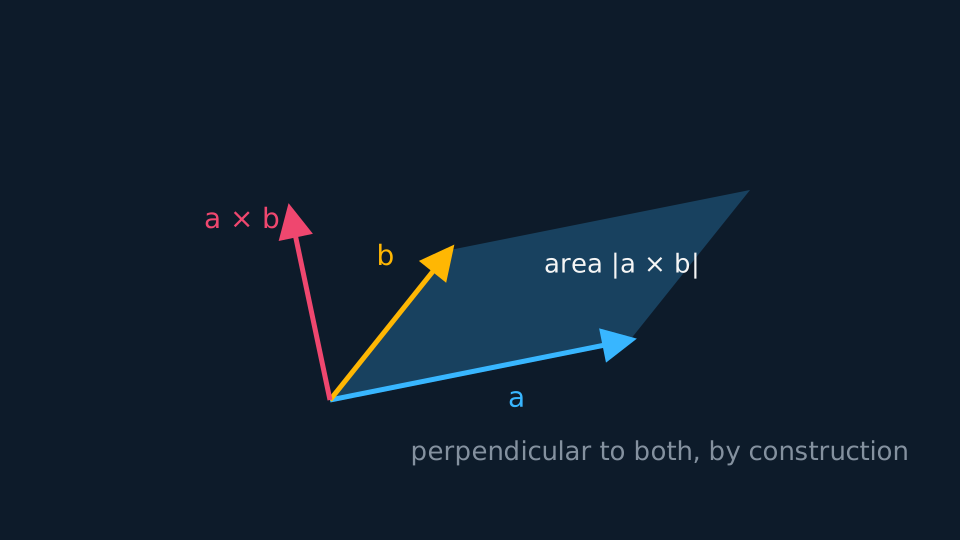
The vector product a × b is itself a vector, perpendicular to both factors, with a, b and a × b forming a right-handed triple. Its magnitude |a||b| sin θ is the area of the parallelogram the two vectors span, and for non-zero vectors the product vanishes exactly when they are parallel, as their scalar product does when they are perpendicular.
A product that is a vector
The vector product a × b is the determinant-style expansion
Check the current formula booklet for your awarding organisation; whether or not the components, the 3 × 3 determinant form and the |a||b| sin θ form are supplied, you must know when each applies. The result is a vector, perpendicular to both factors. Its magnitude is |a||b| sin θ, the area of the parallelogram the two vectors span, and half of that is the triangle's area. Order matters, since b × a = −(a × b).
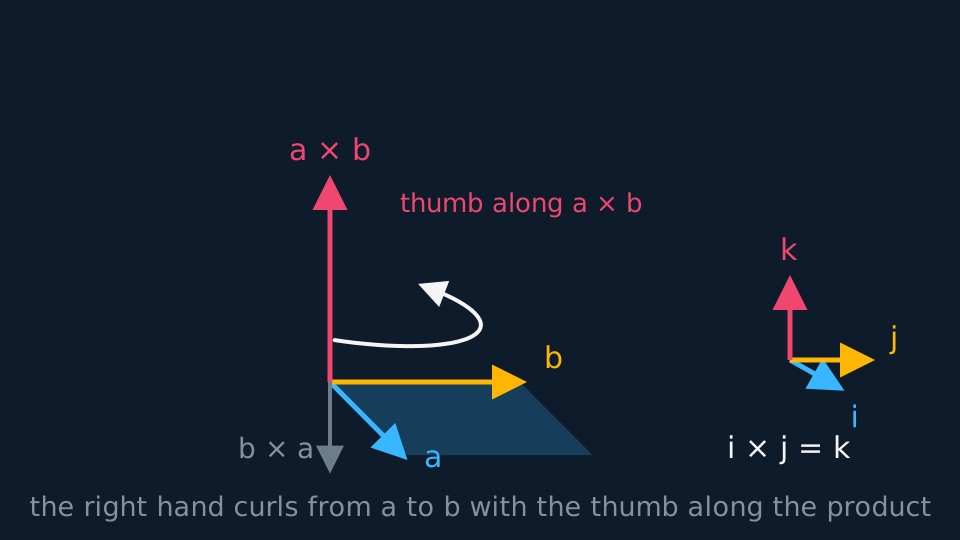
Perpendicular to both still leaves two opposite directions, and the geometrical definition settles which one. Writing n for the unit vector along the product, a × b = |a||b| sin θ n, where a, b and n in that order form a right-handed triple, the same handedness as i, j and k. Curl the fingers of your right hand from a round to b and your thumb lies along n. The components say the same thing: i × j = k, j × k = i and k × i = j, while each reversed product turns the sign over.
Describe the drawing
A cyan arrow a and an amber arrow b spanning a shaded parallelogram, with the coral arrow a × b standing straight up out of it from their common tail. A curved arrow sweeps round that upright, from a towards b, in the direction the fingers of a right hand take when the thumb points along the product. Beside it the unit vectors i, j and k are drawn with the same handedness, so that i × j = k reads off the picture. A grey arrow runs downwards from the same tail for b × a, which is the same length pointing the opposite way.
The algebra needs one more rule. The vector product distributes over addition, a × (b + c) = a × b + a × c, so a product of two sums expands as brackets usually do, as long as each term keeps its two factors in the original order: (a + b) × (c + d) = a × c + a × d + b × c + b × d. Anti-commutativity then simplifies the result: (a + b) × (a − b) = −2(a × b), because a × a and b × b vanish while the two middle terms −(a × b) and b × a are equal rather than cancelling.
WORKED EXAMPLE
A product, checked twice
Find a × b for a = (1, 2, 0) and b = (3, 1, 2), and the area of the triangle the vectors span.
a × b = (2×2 − 0×1, 0×3 − 1×2, 1×1 − 2×3) = (4, −2, −5).
Perpendicularity check: (4, −2, −5)·(1, 2, 0) = 0 and (4, −2, −5)·(3, 1, 2) = 0. Both pass.
|a × b| = √(16 + 4 + 25) = 3√5, so the triangle has area 3√5/2.
Volumes and coplanarity
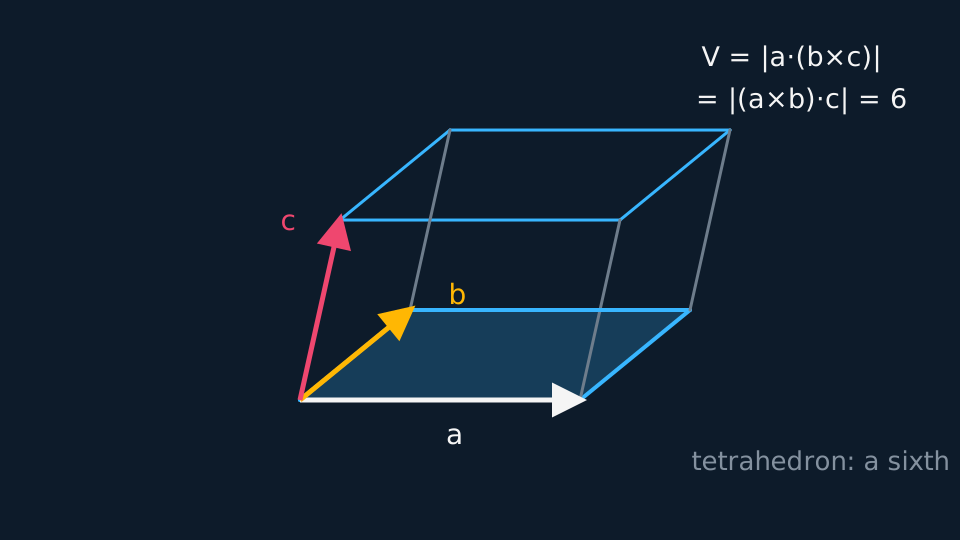
Dotting a third vector in gives the scalar triple product a·(b × c), whose modulus is the volume of the parallelepiped built on the three vectors. The tetrahedron on the same three edges has a sixth of that volume. A zero triple product means the three vectors are coplanar.
WORKED EXAMPLE
A volume from three edges
Find the volume of the parallelepiped with edges a = (1, 0, 0), b = (1, 2, 0), c = (1, 1, 3), and of the tetrahedron on the same edges.
b × c = (2×3 − 0×1, 0×1 − 1×3, 1×1 − 2×1) = (6, −3, −1).
a·(b × c) = 6, so the parallelepiped has volume 6.
The tetrahedron has a sixth of that volume, so its volume is 1.
Describe the drawing
A slanted box drawn on three edge arrows a, b and c from one corner. Its volume is the modulus of the scalar triple product, written either way round as a dot b cross c or a cross b dot c, six for the worked example's vectors, and the tetrahedron sharing those three edges occupies exactly one sixth of it.
Lines, distances and direction cosines
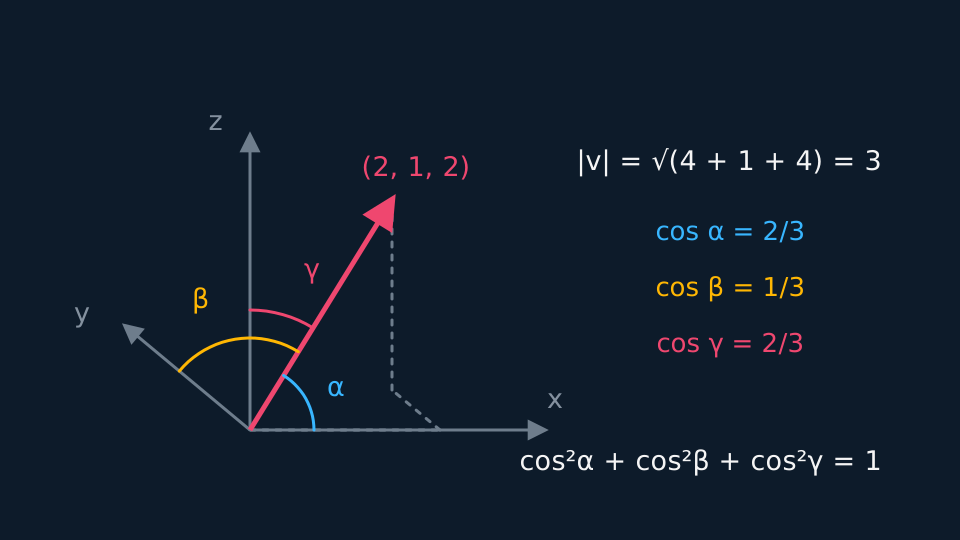
A line through a with direction b can be written as (r − a) × b = 0, since a displacement parallel to b has a vanishing product with it. The components of any direction vector are its direction ratios, and dividing by the length gives the direction cosines (l, m, n), which satisfy l² + m² + n² = 1.
Describe the drawing
A coral arrow for the direction vector two comma one comma two rising through a dashed component box in a three-dimensional sketch, with three arcs marking its angles alpha, beta and gamma to the x, y and z axes. Dividing each component by the length three gives the direction cosines two thirds, one third and two thirds, and their squares add to exactly one, the identity every set of direction cosines must satisfy.
Both products measure distances. The perpendicular distance from a point P to that line is |(p − a) × b|/|b|, because the numerator is the area of a parallelogram whose base is |b|. For two lines with non-parallel directions b₁ and b₂, the shortest distance is the absolute projection of a joining vector onto b₁ × b₂, that is |(a₂ − a₁)·(b₁ × b₂)|/|b₁ × b₂|, which is the volume of a parallelepiped divided by the area of its base. If the directions are parallel, b₁ × b₂ = 0 and the formula does not apply: treat that case as a point-to-line distance instead.
GUIDED PRACTICE
Cosines of a direction
Find the direction cosines of the vector (2, −1, 2), and verify their defining property.
Show the working
The length is √(4 + 1 + 4) = 3.
Cosines: l = 2/3, m = −1/3, n = 2/3.
l² + m² + n² = (4 + 1 + 4)/9 = 1, which the cosines of the angles with the three axes must always satisfy.
ASSESSMENT FOCUS
- After every cross product, take the scalar product of the answer with both factors; two zeros confirm the perpendicularity and catch sign slips.
- For a direction, use the right hand: a, b and a × b form a right-handed triple, and i × j = k checks the orientation.
- Expanding a bracket is allowed, since the product distributes over addition, but keep each term's factors in their original order.
- Areas come from a magnitude and carry a square root; volumes come from a triple product and do not.
- The tetrahedron has one sixth of the parallelepiped's volume, not one third.
- a·(b × c) = 0 is the coplanarity test, and is shorter than constructing a plane.
- Take the modulus of a triple product before calling it a volume, since the sign only records orientation.
- State that the two directions are non-parallel before using the skew-line distance formula, since b₁ × b₂ is then non-zero.
CHECK YOURSELF
Vectors u = (2, 0, 1) and v = (4, 0, 2) satisfy u × v = 0. What does this say about them?
Show a hint
The magnitude of the product is |u||v| sin θ.
Show the answer
Both vectors are non-zero, so sin θ = 0 and they are parallel; indeed v = 2u. For non-zero vectors a zero vector product tests for parallel vectors as a zero scalar product tests for perpendicular ones. If either vector is zero the product vanishes and no angle is defined.
a × b is perpendicular to both factors, with |a × b| = |a||b| sin θ, the parallelogram's area; for non-zero vectors a × b = 0 exactly when they are parallel.
a, b and a × b form a right-handed triple, and the product distributes over addition.
|a·(b × c)| is the parallelepiped's volume, the tetrahedron has a sixth of it, and zero means coplanar.
The shortest distance between two lines with non-parallel directions is |(a₂ − a₁)·(b₁ × b₂)|/|b₁ × b₂|; parallel lines are handled as a point-to-line distance.
WORKBOOK
Printable practice for this topic: original exam-style questions with room to work, and a fully worked answer book. Free to use; please do not redistribute or sell.
Or read them with their worked answers on the vector product and the scalar triple product questions page.
CHECK YOUR PROGRESS
Rate how confident you feel with each objective for this lesson. Ratings are saved in this browser, on this device, unless you sign in.
- Compute a × b from components and check it is perpendicular to both factors.
- Settle the product's direction from the right-handed triple, and expand a product of sums using the distributive rule.
- Use |a × b| as an area and |a·(b × c)| as a volume, with the tetrahedron's sixth.
- Write a line as (r − a) × b = 0 and read off direction ratios and cosines.
- Find distances in three dimensions using the vector and triple products.
- Use |a × b| = |a||b| sin θ, and read a zero product as parallel vectors.
Open the full revision checklist to see every objective in the course in one place.