Maths › Further Pure 1 › Conic sections
Conic sections
Parabola, ellipse and hyperbola form one family: the points whose distance from a focus is a fixed multiple of their distance from a directrix. That multiple, the eccentricity, determines which curve results.
Builds on Parametric equations and Circles.
IN THIS TOPIC
- Write down the cartesian and parametric forms of the four standard conics, with the restriction each parametrisation carries, and use them.
- Compute eccentricity, foci and directrices from a curve's equation.
- Use the focus-directrix property to solve distance problems.
- Write down the asymptotes of a hyperbola and use them when sketching.
- Handle an ellipse whose major axis runs vertically.
COMMON MISCONCEPTION
The parabola, ellipse and hyperbola are three unrelated curves that happen to share a chapter.
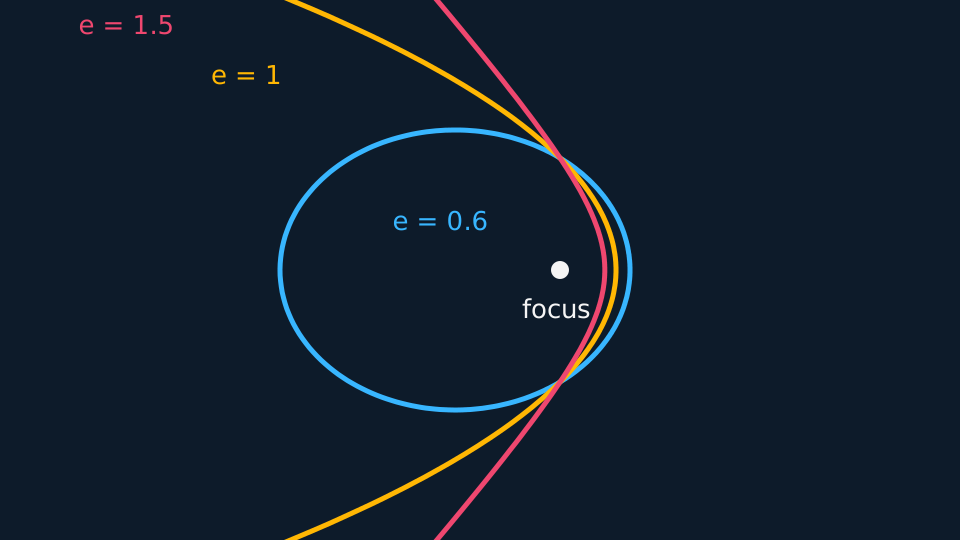
One definition produces all three. The distance to the focus equals e times the distance to the directrix, and the eccentricity decides which curve results: e below 1 an ellipse, e = 1 a parabola, and e above 1 a hyperbola with two branches. Drawn about the same focus with the same semi-latus rectum, the three differ in e alone.
The standard four
Each conic comes with a cartesian equation and a parametrisation. The parabola y² = 4ax is (at², 2at), and the ellipse pairs a cosine with a sine.
The hyperbola x²/a² − y²/b² = 1 is (a sec t, b tan t), or (±a cosh t, b sinh t) with the sign choosing a branch. For xy = c², a parametric point is (ct, c/t), where t ≠ 0. Check the current formula booklet for your awarding organisation; whether or not these forms are supplied, you must know the restriction each one carries. A parametric form reduces a locus question to algebra in one variable.
Describe the drawing
Three nested curves sharing a single marked focus and a common semi-latus rectum, so all three pass through the same two points level with the focus: a closed cyan ellipse, an amber parabola opening leftwards around it, and a coral hyperbola branch opening wider still. With those two ingredients fixed, the eccentricity alone decides whether the curve closes, balances or breaks open.
WORKED EXAMPLE
Reading an ellipse
For the ellipse x²/25 + y²/9 = 1, find the eccentricity, foci and directrices.
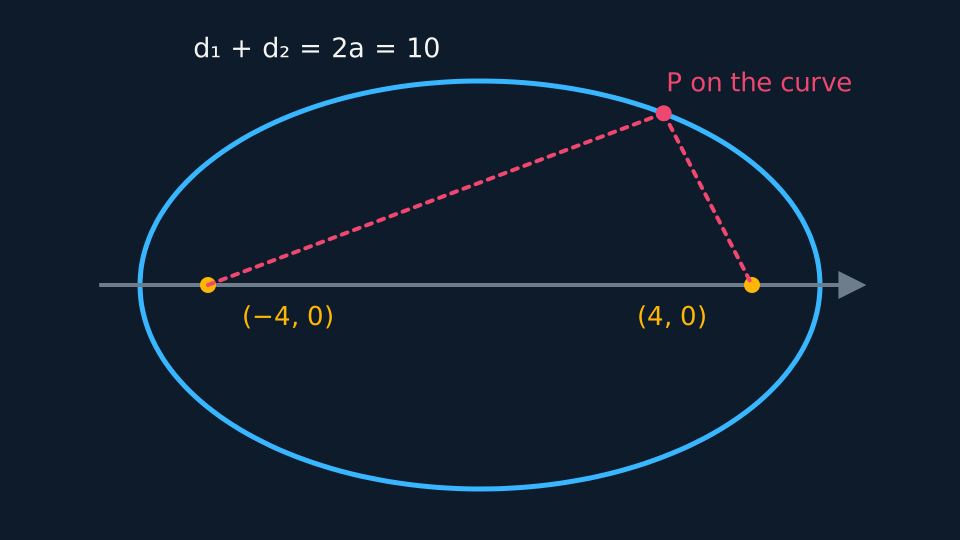
a = 5, b = 3, and b² = a²(1 − e²) gives 9 = 25(1 − e²), so e² = 16/25 and e = 4/5.
Foci (±ae, 0) = (±4, 0). Directrices x = ±a/e = ±25/4.
Check with the point (0, 3). Its distances to the two foci are 5 and 5, and the sum 10 equals 2a, as it must everywhere on the ellipse.
One property, three curves
The focus-directrix property defines the whole family. Distance to the focus equals e times distance to the directrix. For e < 1 the locus is an ellipse, for e = 1 a parabola, and for e > 1 a hyperbola with two branches.
WORKED EXAMPLE
A parabola's defining balance
For y² = 12x, state the focus and directrix, and verify the defining property at the point (3, 6).
4a = 12, so a = 3. The focus is (3, 0) and the directrix x = −3.
Distance from (3, 6) to the focus is 6. Distance to the directrix is 3 + 3 = 6.
Equal, as e = 1 demands. Every point of a parabola sits exactly as far from the focus as from the directrix.
Asymptotes, orientation and sketching
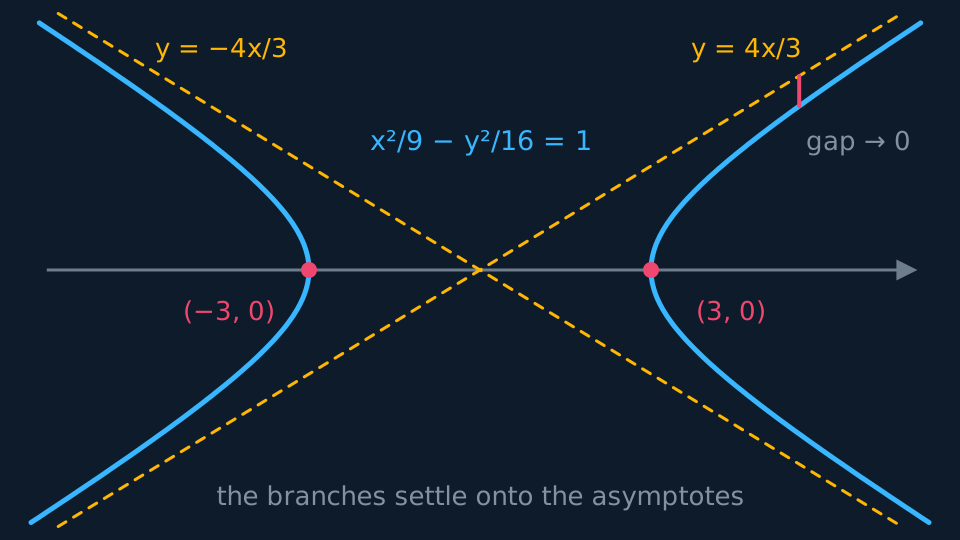
A hyperbola approaches two straight lines, and one step finds them. Replace the 1 in x²/a² − y²/b² = 1 by 0 and factorise, which gives y = ±(b/a)x. For large |x| the constant term is negligible beside the quadratic terms, and the vertical gap between curve and line tends to zero. Sketch the asymptotes first, then mark the vertices at (±a, 0).
Describe the drawing
Both branches of the hyperbola x squared over nine minus y squared over sixteen equals one, opening left and right from coral vertices at plus and minus three, with the two asymptotes y equals plus and minus four thirds x drawn dashed through the origin. A short coral bar marks the narrowing gap between branch and line: the constant one stops mattering as x grows, so the curve settles onto the pair of lines it never quite reaches.
The same reading works beyond the conics. A rational curve whose numerator outranks its denominator by one degree runs away along a slanting line as well, and dividing out finds it: the quotient is the line, which the graphs and transformations lesson in the algebra unit calls the oblique asymptote. Dropping the constant here and dividing out there are the same move: keep the terms that dominate far from the origin and discard the rest.
The rectangular hyperbola is the case a = b, where the asymptotes meet at right angles and the eccentricity is √2. Rotate it by 45° and it becomes the familiar xy = c², whose asymptotes are the coordinate axes.
Orientation decides which relation applies. In x²/a² + y²/b² = 1 with b > a, the major axis is vertical, the foci sit at (0, ±be) on the y-axis, and the relation is a² = b²(1 − e²). Compare the two denominators before quoting anything: using the smaller one as the semi-major axis returns an eccentricity above 1 for a closed curve, which is impossible.
GUIDED PRACTICE
A hyperbola's constants
For x²/9 − y²/16 = 1, find e, the foci and the asymptotes, and evaluate the difference of focal distances at the vertex (3, 0).
Show the working
b² = a²(e² − 1): 16 = 9(e² − 1), so e² = 25/9 and e = 5/3.
Foci (±ae, 0) = (±5, 0), and the asymptotes are y = ±4x/3.
From (3, 0) the distances are 8 and 2, differing by 6 = 2a. That constant difference is the hyperbola's version of the ellipse's constant sum.
ASSESSMENT FOCUS
- The eccentricity relation subtracts in opposite orders for the two curves: b² = a²(1 − e²) for the ellipse and b² = a²(e² − 1) for the hyperbola. Check the current formula booklet for your awarding organisation, and be able to derive whichever it does not supply.
- Foci and directrices come in symmetric pairs, so quote both members of each pair.
- For the parabola, a is read from y² = 4ax, so a is a quarter of the coefficient of x rather than half of it.
- Check which denominator is larger on an ellipse before deciding where the foci lie.
- Draw the asymptotes before the branches when sketching a hyperbola.
- State the restriction a parametrisation carries, such as t ≠ 0 on xy = c².
- Parametrise before working out a locus, since one parameter is easier to eliminate than two coordinates.
CHECK YOURSELF
Write down parametric coordinates for a general point on y² = 8x and on xy = 9.
Show a hint
y² = 4ax has (at², 2at); xy = c² has (ct, c/t) with t ≠ 0.
Show the answer
y² = 8x has a = 2, giving the point (2t², 4t). xy = 9 has c = 3, giving the point (3t, 3/t), where t ≠ 0.
Parabola (at², 2at); ellipse (a cos t, b sin t); hyperbola (a sec t, b tan t); rectangular hyperbola (ct, c/t) with t ≠ 0.
Distance to focus = e × distance to directrix, with e < 1 an ellipse, e = 1 a parabola, e > 1 a hyperbola.
Foci sit at (±ae, 0) and directrices at x = ±a/e when the major axis is horizontal.
The hyperbola x²/a² − y²/b² = 1 has asymptotes y = ±(b/a)x.
WORKBOOK
Printable practice for this topic: original exam-style questions with room to work, and a fully worked answer book. Free to use; please do not redistribute or sell.
Or read them with their worked answers on the conic sections questions page.
CHECK YOUR PROGRESS
Rate how confident you feel with each objective for this lesson. Ratings are saved in this browser, on this device, unless you sign in.
- Write down the cartesian and parametric forms of the four standard conics, with the restriction each parametrisation carries, and use them.
- Compute eccentricity, foci and directrices from a curve's equation.
- Use the focus-directrix property to solve distance problems.
- Write down the asymptotes of a hyperbola and use them when sketching.
- Handle an ellipse whose major axis runs vertically.
Open the full revision checklist to see every objective in the course in one place.