Maths › Differentiation › Implicit and parametric differentiation
Implicit and parametric differentiation
Many curves, circles among them, have no equation of the form y = f(x), but their gradients are still found by calculus. Implicit differentiation treats y as a function of x and differentiates the equation as it stands, while parametric differentiation divides one rate by another.
Builds on The product, quotient and chain rules and Parametric equations.
IN THIS TOPIC
- Differentiate implicit relations term by term, with the chain rule supplying dy/dx.
- Use dy/dx = 1/(dx/dy) for relations given as x in terms of y.
- Find gradients, tangents and normals on parametric curves by dividing rates.
- Find tangents and normals on implicit curves from dy/dx at the point.
COMMON MISCONCEPTION
You cannot differentiate a curve that will not give you y = f(x).
Differentiate the equation as it stands. Every y-term picks up a factor dy/dx from the chain rule, so x2 + y2 = 25 gives 2x + 2y dy/dx = 0 and dy/dx = −x/y for y ≠ 0, which is −3/4 at (3, 4). A parametric curve needs no rearranging either: divide dy/dt by dx/dt wherever dx/dt ≠ 0.
Differentiating in place
Where y depends on x, the chain rule differentiates any term in y with respect to x: the derivative of y2 is 2y × dy/dx, the outer square differentiated, then multiplied by dy/dx for the dependence of y on x. Applying that to every term of an equation is implicit differentiation, and it does not require the equation to be rearranged into the form y = f(x).
WORKED EXAMPLE
The circle, differentiated as it stands
Find the gradient of x2 + y2 = 25 at the point (3, 4).
Differentiate every term with respect to x: 2x + 2y dy/dx = 0.
Solve: dy/dx = −x/y for y ≠ 0, and at (3, 4) the gradient is −3/4.
Circle geometry gives the same tangent, since the tangent is perpendicular to the radius. Either method is a valid answer.
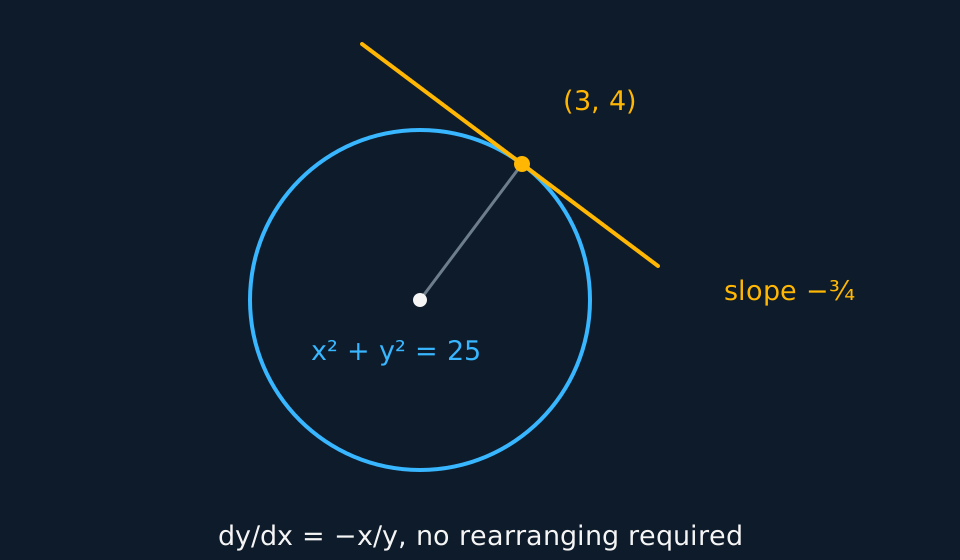
The gradient at a point, together with the point itself, gives the equations of two lines. On the circle at (3, 4) the gradient is −3/4, so the tangent there is y − 4 = −(3/4)(x − 3), that is 3x + 4y = 25. The normal is the perpendicular to the curve through the same point, so its gradient is the negative reciprocal 4/3 and its equation is y − 4 = (4/3)(x − 3), that is 4x − 3y = 0; on a circle the normal passes through the centre, which is a check on the working.
GUIDED PRACTICE
A mixed term joins in
Find the gradient of the curve x2 + 3xy + y2 = 11 at the point (1, 2), before opening the working.
Show the working
The 3xy term needs the product rule, and its derivative is 3y + 3x dy/dx.
Altogether: 2x + 3y + (3x + 2y) dy/dx = 0, so dy/dx = −(2x + 3y)/(3x + 2y).
At (1, 2): −(2 + 6)/(3 + 4) = −8/7.
Collect the dy/dx terms on one side and factorise before dividing, and note that the division requires 3x + 2y ≠ 0.
When x is given in terms of y
A relation such as x = sin y gives dx/dy directly. Differentiate with respect to y and take the reciprocal, which is valid where dx/dy ≠ 0. From dx/dy = cos y,
Show the reciprocal step as a line of working. Writing cos y as √(1 − x2) on −π/2 < y < π/2, where cos y is positive, gives the derivative of arcsin x. That step is not required by Edexcel 9MA0; relations of the form x = sin y and x = 3 tan 2y are.
Dividing parametric rates
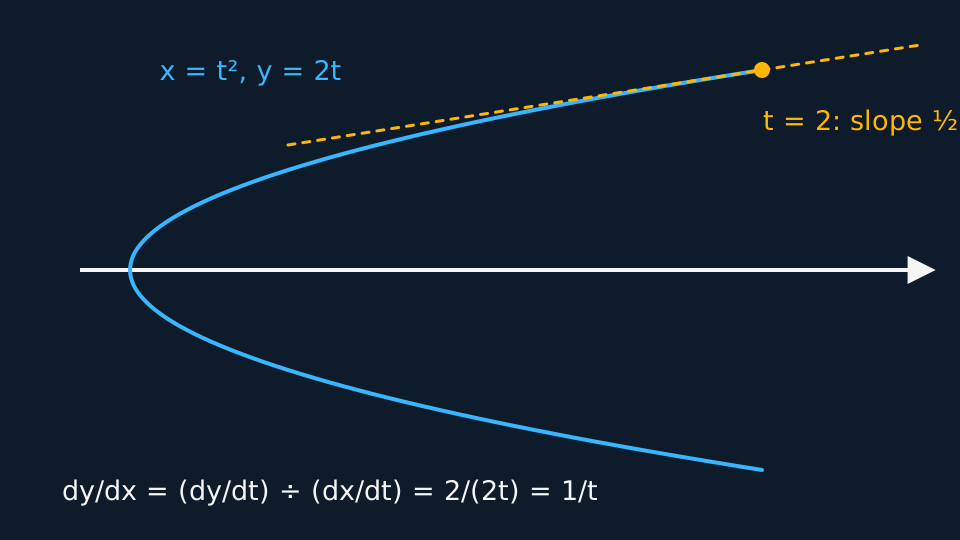
On a parametric curve both coordinates depend on t, and the chain rule gives dy/dx = (dy/dt) ÷ (dx/dt), valid at points where dx/dt ≠ 0. Where dx/dt = 0 and dy/dt ≠ 0 the tangent is vertical. No elimination or conversion to Cartesian form is required: two derivatives and a division.
INDEPENDENT PRACTICE
A parametric tangent, start to finish
The curve C has parametric equations x = t2, y = 2t. Find the equation of the tangent to C at the point where t = 2.
Show the working
Rates: dx/dt = 2t and dy/dt = 2, so dy/dx = 2/(2t) = 1/t.
At t = 2 the point is (4, 4) and the gradient is ½.
Tangent: y − 4 = ½(x − 4), that is y = x/2 + 2.
The working stays in t until the final line. Converting to y2 = 4x first is valid but longer.
ASSESSMENT FOCUS
- Differentiate implicit equations term by term. Every y-term picks up a dy/dx through the chain rule.
- Product-rule any xy term, then collect dy/dx on one side and factorise before dividing.
- For x given in terms of y, find dx/dy and take the reciprocal, showing the flip as its own line.
- Parametric gradients divide dy/dt by dx/dt, where dx/dt ≠ 0. Find dy/dx in terms of t first, then substitute, since a later part may need the general expression.
CHECK YOURSELF
The curve C is given by y2 + 2xy = 8. Find dy/dx in terms of x and y, and the gradient of C at (1, 2).
Show a hint
Both terms need the chain rule; one also needs the product rule.
Show the answer
Differentiating: 2y dy/dx + 2y + 2x dy/dx = 0, so (2y + 2x) dy/dx = −2y.
dy/dx = −y/(x + y).
At (1, 2): −2/3, and the division requires x + y ≠ 0. Check that the point satisfies the original equation, 4 + 4 = 8, before using it.
Differentiate equations as they stand; every y-term carries a factor dy/dx from the chain rule.
Parametric gradients divide dy/dt by dx/dt where dx/dt ≠ 0; for x given in terms of y, dy/dx is the reciprocal of dx/dy where dx/dy ≠ 0.
WORKBOOK
Printable practice for this topic: original exam-style questions with room to work, and a fully worked answer book. Free to use; please do not redistribute or sell.
Or read them with their worked answers on the implicit and parametric differentiation questions page.
CHECK YOUR PROGRESS
Rate how confident you feel with each objective for this lesson. Ratings are saved in this browser, on this device, unless you sign in.
- Differentiate implicit relations term by term, with the chain rule supplying dy/dx.
- Use dy/dx = 1/(dx/dy) for relations given as x in terms of y.
- Find gradients, tangents and normals on parametric curves by dividing rates.
- Find tangents and normals on implicit curves from dy/dx at the point.
Open the full revision checklist to see every objective in the course in one place.