Maths › Further Pure 2 › Transformations of the complex plane
Transformations of the complex plane
Find an image locus by solving the transformation for z and substituting into the original condition. For inversion, distinguish the ordinary complex plane from the extended plane: zero and infinity are interchanged. Record any point left out of the image, either because the transformation is undefined there or because no finite z maps to it.
Builds on Further loci and regions and Complex arithmetic.
IN THIS TOPIC
- Find the image of a line or circle under w = z² by eliminating between real and imaginary parts.
- Invert a Möbius transformation to express z in terms of w before substituting, and state the condition ad − bc ≠ 0.
- Recognise that on the extended plane w = 1/z sends a line not through the origin to a circle through the origin, and say which point an ordinary Argand diagram omits.
COMMON MISCONCEPTION
A transformation of the complex plane sends straight lines to straight lines.
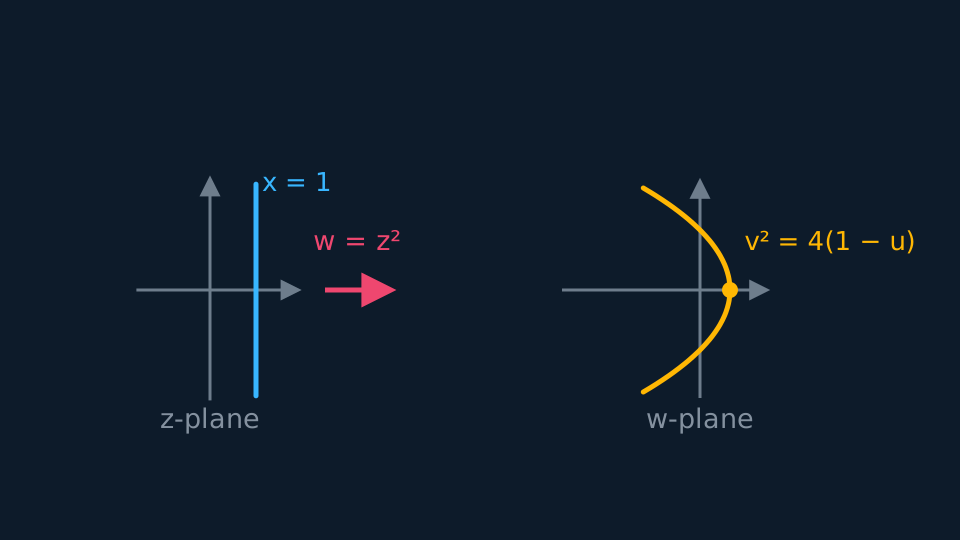
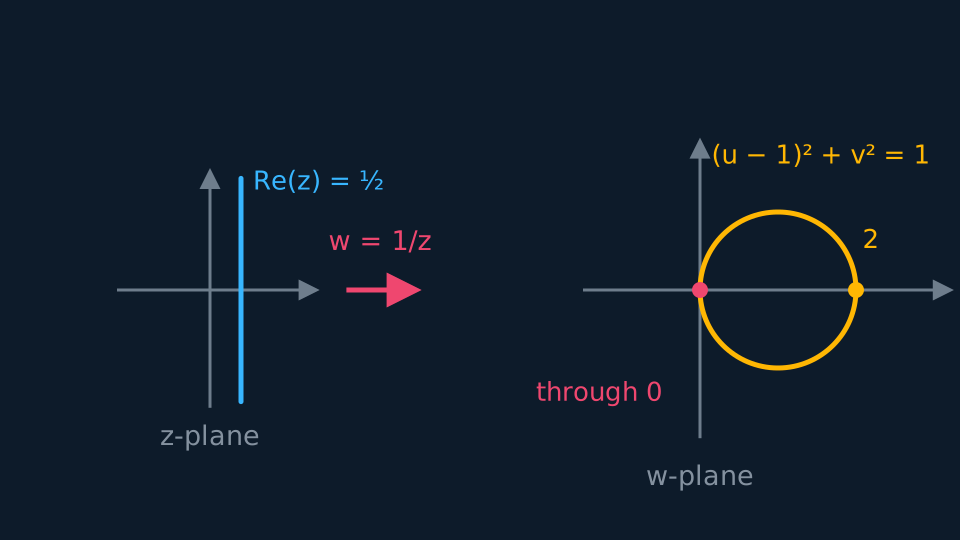
The affine maps w = az + b with a non-zero send every line to a line, being an enlargement, a rotation and a translation together. Squaring and inversion do not: under w = z² the line x = 1 becomes the parabola v² = 4(1 − u), and under w = 1/z the line Re(z) = 1/2 becomes the circle (u − 1)² + v² = 1.
Squaring bends the plane
Under w = z², write z = x + iy and separate into u = x² − y² and v = 2xy. Fix one of x or y, eliminate the other, and the image curve follows. A straight line does not in general map to a straight line. The maps met here that do send every line to a line are the affine ones, w = az + b with a ≠ 0, which combine an enlargement, a rotation and a translation; squaring is not one of them.
WORKED EXAMPLE
A line becomes a parabola
Find the image of the line x = 1 under w = z².
On the line, z = 1 + iy, so w = 1 − y² + 2iy, giving u = 1 − y² and v = 2y.
Eliminating y: y = v/2, so u = 1 − v²/4.
The image is v² = 4(1 − u), a parabola with vertex at (1, 0) opening towards negative u. Check with y = 2: w = −3 + 4i, and 16 = 4(1 + 3) as required.
Circles centred at the origin behave more simply. Squaring squares the modulus and doubles the argument, so |z| = r maps to |w| = r². The image is a circle again; only its radius and the number of times it is traced change.
Möbius transformations
A Möbius transformation has the form w = (az + b)/(cz + d) with ad − bc ≠ 0. Without that condition the numerator is a multiple of the denominator and the map is constant. On the extended complex plane it maps generalised circles to generalised circles, a family that counts a line as a circle through the point at infinity, although individual members change type.
To find an image locus, rearrange for z in terms of w before substituting into the given condition. Under w = 1/z, a line not through z = 0 maps to a circle through w = 0 on the extended plane; for finite z, omit w = 0 from an ordinary Argand diagram, because no finite point of the line has image 0.
WORKED EXAMPLE
A line becomes a circle
Find the image of the line Re(z) = 1/2 under w = 1/z.
Inverting gives z = 1/w. Writing z* for the conjugate, Re(z) = 1/2 says z + z* = 1, so 1/w + 1/w* = 1.
Combining over |w|²: (w + w*)/|w|² = 1, that is 2u = u² + v².
Completing the square gives (u − 1)² + v² = 1, a circle of centre (1, 0) and radius 1. On the extended plane it passes through the origin, which is the image of the point at infinity along the line; on an ordinary Argand diagram omit w = 0, since no finite z on the line maps to it. Check with z = 1/2, where w = 2 and (2 − 1)² = 1.
GUIDED PRACTICE
A translation and a rotation
Describe the transformations w = z + 3 − 2i and w = 2iz geometrically.
Show the working
Adding a constant is a translation, so every point moves 3 right and 2 down.
Multiplying by 2i multiplies the modulus by 2 and adds π/2 to the argument, giving an enlargement of scale factor 2 about the origin combined with a quarter turn anticlockwise.
Both have the affine form w = az + b with a ≠ 0, so both send lines to lines and circles to circles; squaring and inversion do not in general.
ASSESSMENT FOCUS
- Rearrange for z in terms of w before substituting, since substituting w into the original condition describes the wrong set of points.
- Separate into real and imaginary parts early, then eliminate the parameter between them.
- Name the image curve and give its equation, since 'a circle' alone is incomplete without a centre and radius.
- Quote ad − bc ≠ 0 with a Möbius transformation; without it the map is constant.
- Say whether an answer is on the extended plane or on an ordinary Argand diagram, and name any point the finite image omits.
CHECK YOURSELF
Under w = z², find the image of the circle |z| = 3.
Show a hint
Squaring squares the modulus.
Show the answer
|w| = |z|² = 9, so the image is the circle of radius 9 centred at the origin. The argument doubles, so the image is traced twice as z goes once round.
Under w = z², separate u = x² − y² and v = 2xy, then eliminate to find the image curve.
A Möbius map w = (az + b)/(cz + d) needs ad − bc ≠ 0, and on the extended plane it sends generalised circles to generalised circles.
Invert to z in terms of w before substituting; under w = 1/z a line missing the origin maps to a circle through the origin on the extended plane, with w = 0 omitted from a finite Argand diagram.
WORKBOOK
Printable practice for this topic: original exam-style questions with room to work, and a fully worked answer book. Free to use; please do not redistribute or sell.
Or read them with their worked answers on the transformations of the complex plane questions page.
CHECK YOUR PROGRESS
Rate how confident you feel with each objective for this lesson. Ratings are saved in this browser, on this device, unless you sign in.
- Find the image of a line or circle under w = z² by eliminating between real and imaginary parts.
- Invert a Möbius transformation to express z in terms of w before substituting, and state the condition ad − bc ≠ 0.
- Recognise that on the extended plane w = 1/z sends a line not through the origin to a circle through the origin, and say which point an ordinary Argand diagram omits.
Open the full revision checklist to see every objective in the course in one place.