Maths › Further Pure 2 › Further loci and regions in the Argand diagram
Further loci and regions in the Argand diagram
Translate each modulus into a distance and each argument into a direction. Both sides of a modulus equation are non-negative, so square them before expanding, then complete the square and test a point to select the required side of a boundary. State excluded endpoints and degenerate parameter cases.
Builds on Modulus, argument and loci and Circles.
IN THIS TOPIC
- Identify |z − a| = k|z − b| as a circle when a ≠ b and k is positive and not 1, and find its centre and radius.
- Recognise a constant argument of a quotient as an arc of a circle.
- Shade regions defined by combined inequalities.
- Mark clearly which boundaries and endpoints belong to a locus.
- Identify |z − a| = |z − b| as the perpendicular bisector of the segment joining a and b, and find its cartesian equation.
COMMON MISCONCEPTION
|z − a| = k|z − b| is a perpendicular bisector for every value of k.
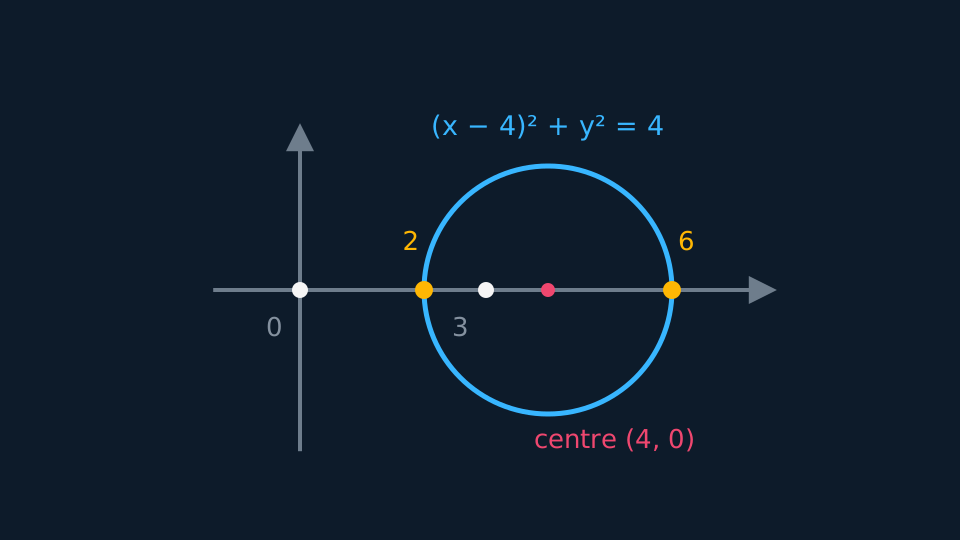
Only k = 1 gives the bisector. Squaring and writing z = x + iy leaves an x² + y² term with coefficient 1 − k², which vanishes at k = 1 alone; for every other positive k, completing the square gives a circle, the circle of Apollonius, and k = 0 reduces it to the single point z = a. So |z| = 2|z − 3| is the circle of centre (4, 0) and radius 2.
Circles from a ratio of distances
For distinct a and b and k > 0, |z − a| = k|z − b| is a circle when k ≠ 1 and the perpendicular bisector when k = 1. For k = 0 it reduces to the single point z = a.
The algebra shows why. Squaring and writing z = x + iy gives an x² + y² term with coefficient 1 − k², which vanishes only at k = 1, leaving a linear equation and so a line. For every other positive k, dividing through by 1 − k² and completing the square gives a circle, the circle of Apollonius.
WORKED EXAMPLE
Finding the circle
Find the locus of points satisfying |z| = 2|z − 3|.
With z = x + iy: x² + y² = 4((x − 3)² + y²).
Expanding and collecting: 3x² + 3y² − 24x + 36 = 0, so x² + y² − 8x + 12 = 0.
Completing the square gives (x − 4)² + y² = 4, a circle of centre (4, 0) and radius 2.
Sense check with the real points. At z = 2, 2 = 2 × 1. At z = 6, 6 = 2 × 3. Both sit on the circle, at its two ends along the real axis.
Arcs from a fixed angle
The condition arg((z − a)/(z − b)) = β fixes the angle that the segment from b to a subtends at z. By the inscribed angle theorem the points satisfying it lie on an arc of a circle through a and b, on one side only, with a and b themselves excluded, since the quotient is zero at z = a and undefined at z = b. The sign of β selects which of the two arcs. Take β = π/2 and the arc is a semicircle on ab as diameter.
WORKED EXAMPLE
A right angle traces a semicircle
Describe the locus arg((z − 1)/(z + 1)) = π/2.
The condition says the segment from −1 to 1 subtends a right angle at z, and the sign of the argument settles which side.
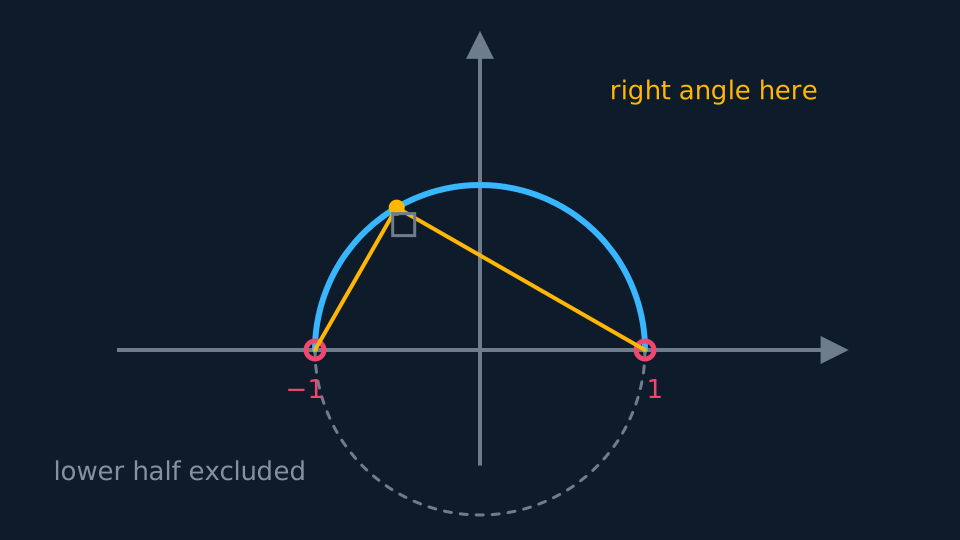
The angle in a semicircle is a right angle, so the locus is an arc of the circle on the diameter from −1 to 1, that is |z| = 1, taking the upper half.
Test z = i: (i − 1)/(i + 1) = i, whose argument is π/2. The endpoints ±1 are excluded, since the quotient is then undefined or zero.
Regions, and which boundaries count
Inequalities cut regions out of the plane. A condition α ≤ arg(z − z₁) ≤ β carves a wedge with its vertex at z₁, while p ≤ Re(z) ≤ q gives a vertical strip and |z − a| ≤ r gives a closed disc. Swapping = for ≤ in the Apollonius condition |z − a| ≤ k|z − b| keeps one side of that circle, and which side depends on the ratio: the region contains the point a, which lies inside the circle for some values of k and outside it for others. Test one convenient point, z = a being the simplest, and shade the side it lies on. Sketch every boundary first, then shade the overlap.
Record which boundaries the region contains. A weak inequality is drawn as a solid line and a strict one as a dashed line, and an argument condition always excludes its vertex, since arg 0 is undefined. State on the diagram which convention is being used.
Describe the drawing
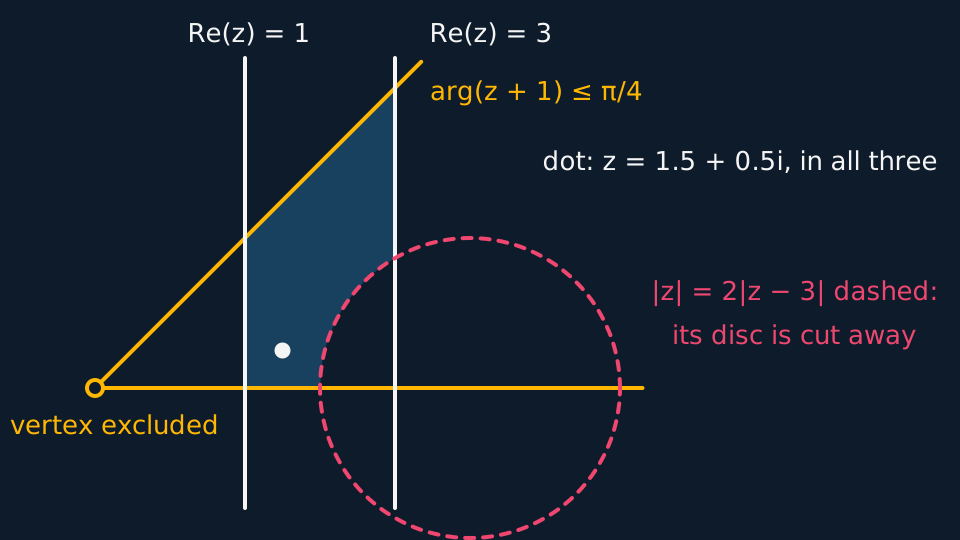
One Argand diagram carrying all three boundary conventions at once. An amber wedge opens from an open circle at minus one, its vertex excluded because arg nought does not exist; two solid vertical lines bound the strip where the real part lies between one and three, boundaries included; and a dashed coral circle through two and six marks the strict Apollonius condition, its closed disc cut out of the shading. The cyan region satisfying all three is shaded, with a marked test point inside it at one point five plus nought point five i.
GUIDED PRACTICE
A region from two conditions
Sketch the region satisfying both |z − 2i| ≤ 2 and 0 ≤ Re(z) ≤ 2, and describe its shape.
Show the working
The first is the closed disc of radius 2 centred at (0, 2).
The second is the vertical strip between x = 0 and x = 2, inclusive.
The overlap is the right half of that disc, bounded on the left by the diameter along x = 0 and cut nowhere on the right, since the disc only reaches x = 2. The region is a half-disc of area 2π.
ASSESSMENT FOCUS
- For |z − a| = k|z − b|, square both sides and convert to cartesian; the circle appears only after completing the square.
- State the value of k before describing the locus: k = 1 gives the perpendicular bisector, k = 0 gives the single point z = a, and every other positive k gives a circle.
- Say that a and b are distinct, since a = b makes the condition either the whole plane (k = 1) or the single point z = a, not a line or circle.
- For an argument locus, state that it is an arc and not a full circle, and name the excluded endpoints.
- Shade regions only after drawing every boundary, and mark whether each boundary is included.
- Give the centre and radius of any circle you find; naming the shape alone is not a complete answer.
CHECK YOURSELF
Describe the locus |z − 1| = |z + 3|.
Show a hint
Here the ratio k equals 1.
Show the answer
Equal distances from 1 and from −3, so this is the perpendicular bisector of the segment joining them, the vertical line x = −1.
For distinct a and b and k > 0, |z − a| = k|z − b| is a circle when k ≠ 1 and the perpendicular bisector when k = 1; for k = 0 it reduces to the single point z = a.
A constant argument of a quotient traces an arc through a and b, with those two points excluded and the sign of the angle choosing the arc.
Sketch every boundary before shading, and record which ones the region includes.
WORKBOOK
Printable practice for this topic: original exam-style questions with room to work, and a fully worked answer book. Free to use; please do not redistribute or sell.
Or read them with their worked answers on the further loci and regions in the Argand diagram questions page.
CHECK YOUR PROGRESS
Rate how confident you feel with each objective for this lesson. Ratings are saved in this browser, on this device, unless you sign in.
- Identify |z − a| = k|z − b| as a circle when a ≠ b and k is positive and not 1, and find its centre and radius.
- Recognise a constant argument of a quotient as an arc of a circle.
- Shade regions defined by combined inequalities.
- Mark clearly which boundaries and endpoints belong to a locus.
- Identify |z − a| = |z − b| as the perpendicular bisector of the segment joining a and b, and find its cartesian equation.
Open the full revision checklist to see every objective in the course in one place.