Maths › Complex numbers › Complex arithmetic and the Argand diagram
Complex arithmetic and the Argand diagram
Introducing i, with i² = −1, allows quadratics with negative real discriminants to be solved in C. More generally, every non-constant polynomial has its full set of roots in C when roots are counted with multiplicity. Complex arithmetic follows the ordinary rules of algebra, and the Argand diagram displays each complex number as a point in a plane.
Builds on Quadratic functions and Vectors in two dimensions.
IN THIS TOPIC
- Solve any quadratic, reading complex roots from a negative discriminant.
- Add, subtract and multiply complex numbers without special rules.
- Divide by using the conjugate to clear the denominator.
- Find the two square roots of a complex number by squaring x + yi and comparing real and imaginary parts.
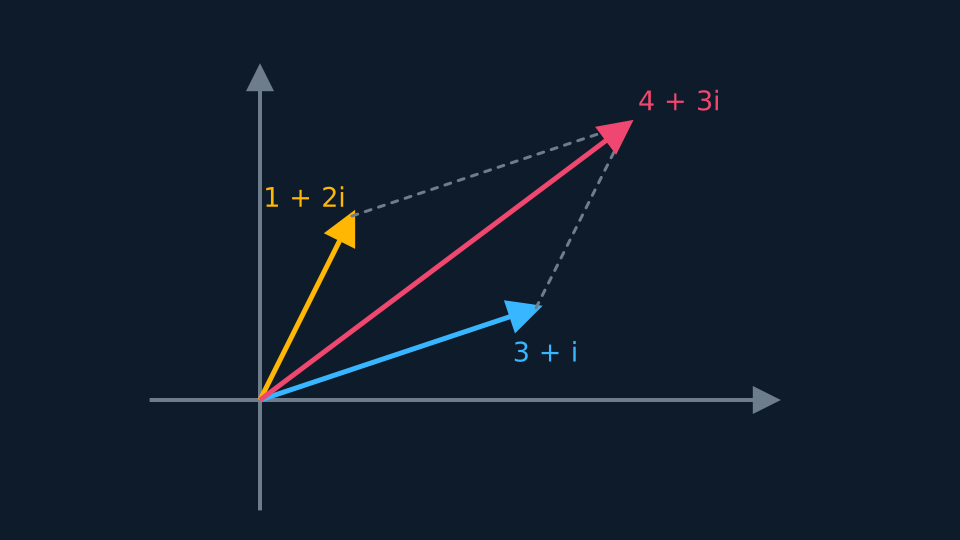
- Plot numbers and their conjugates on the Argand diagram, and read addition as vectors.
- Solve a cubic or quartic with real coefficients from one given root, by pairing it with its conjugate.
- Equate real and imaginary parts to turn one complex equation into two real ones.
COMMON MISCONCEPTION
A negative number has no square root, so z² = −9 has no solutions.
No real number squares to −9, and i is defined by i2 = −1 to supply the roots that are missing: z = ±3i, since (3i)2 = 9i2 = −9. A negative discriminant means the roots are complex rather than that there are none, and for real coefficients they arrive as a conjugate pair.
A number whose square is negative
Define i by i2 = −1; then z2 = −9 has the solutions z = ±3i. A complex number is any z = x + yi with x and y real, where x is the real part and y the imaginary part. The rules of algebra are unchanged: brackets expand, like terms collect, and every i2 is replaced by −1.
A negative discriminant means the roots are complex rather than that there are no roots, and for a quadratic with real coefficients they occur as a conjugate pair, x + yi with x − yi, written z and z*. More generally, every non-constant polynomial has its full set of roots in C when roots are counted with multiplicity.
WORKED EXAMPLE
A quadratic with no real roots
Solve z2 − 6z + 13 = 0.
The discriminant is 36 − 52 = −16, so the roots are complex.
z = (6 ± √(−16))/2 = (6 ± 4i)/2 = 3 ± 2i.
The two roots are conjugates, mirror images across the real axis, and their sum 6 and product 13 recover the original coefficients.
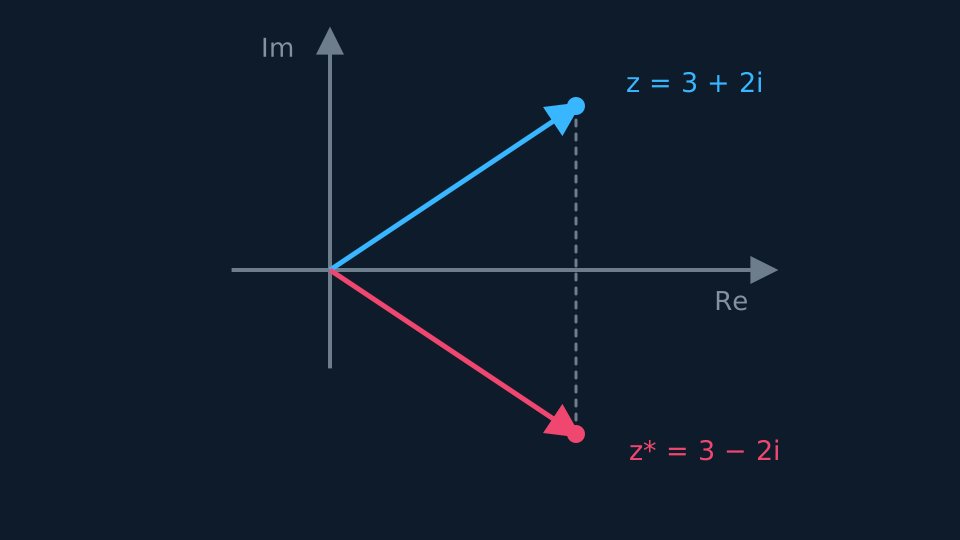
The same pairing solves cubics and quartics with real coefficients. If such a polynomial has one complex root, its conjugate is a root as well, so the two factors multiply to a real quadratic factor, which can be divided out to leave the remaining roots.
WORKED EXAMPLE
A cubic from one complex root
Given that 3 + 2i is a root of f(z) = z3 − 8z2 + 25z − 26, solve f(z) = 0.
The coefficients are real, so 3 − 2i is a root as well.
That pair has sum 6 and product 13, so z2 − 6z + 13 is a factor of f(z), and its coefficients are real.
Write f(z) = (z2 − 6z + 13)(z + a). Comparing constant terms gives 13a = −26, so a = −2, and the z2 terms agree, a − 6 = −8.
The roots are 3 + 2i, 3 − 2i and 2, and f(2) = 8 − 32 + 50 − 26 = 0 confirms the real one.
A cubic with real coefficients has at least one real root, because the complex roots occur in pairs.
Arithmetic, and the conjugate's job
Addition and subtraction work part by part. Multiplication is a bracket expansion, so (3 + 2i)(1 + i) = 3 + 3i + 2i + 2i2 = 1 + 5i. Division needs one idea. Multiplying a number by its conjugate removes the imaginary part, since (x + yi)(x − yi) = x2 + y2, a real number. So to divide, multiply top and bottom by the conjugate of the bottom.
WORKED EXAMPLE
Division via the conjugate
Write (3 + 2i)/(1 − i) in the form x + yi.
Multiply top and bottom by 1 + i. The denominator becomes (1 − i)(1 + i) = 1 + 1 = 2.
The numerator is (3 + 2i)(1 + i) = 3 + 3i + 2i − 2 = 1 + 5i.
So the quotient is 1/2 + (5/2)i. The conjugate is chosen so that the cross terms cancel, as when rationalising a surd denominator.
The denominators of 1/(3 − √2) and 1/(3 − 2i) are cleared by the same method: multiply by a conjugate chosen to produce a difference of squares.
Square roots by comparing parts
Two complex numbers are equal when their real parts are equal and their imaginary parts are equal, so one complex equation is equivalent to two real equations. Comparing parts in this way gives the square roots of a complex number, using only the multiplication above.
WORKED EXAMPLE
The two square roots of 3 + 4i
Find the square roots of 3 + 4i in the form x + yi with x and y real.
Square the unknown. (x + yi)2 = x2 − y2 + 2xyi, and that is to equal 3 + 4i.
Compare real parts and then imaginary parts: x2 − y2 = 3 and 2xy = 4.
The second gives y = 2/x, and substituting into the first gives x2 − 4/x2 = 3, that is x4 − 3x2 − 4 = 0, a quadratic in x2.
It factorises as (x2 − 4)(x2 + 1) = 0. Since x is real, x2 = 4 and x = ±2, and y = 2/x pairs those with y = ±1 in the same order.
The roots are 2 + i and −2 − i. Checking the first, (2 + i)2 = 4 + 4i − 1 = 3 + 4i.
Three points complete the method. The quartic in x is a quadratic in x², so solve it as one. The root x² = −1 is rejected because x was taken to be real; state that reason. And the two square roots differ only in sign, since (−z)2 = z2, so give both.
The Argand diagram
Plotting x + yi at the point (x, y) gives the Argand diagram. Real numbers lie on the horizontal axis, purely imaginary numbers on the vertical axis, and conjugation is reflection in the real axis. Addition corresponds to vector addition, tip to tail or by the parallelogram rule, component by component.
GUIDED PRACTICE
Arithmetic, then a picture
For z = 2 + 3i and w = 4 − i, find z + w, zw and z/w, and state where z and z* sit on the Argand diagram.
Show the working
z + w = 6 + 2i. zw = (2 + 3i)(4 − i) = 8 − 2i + 12i + 3 = 11 + 10i.
For z/w, multiply by the conjugate of w. (2 + 3i)(4 + i)/((4 − i)(4 + i)) = (8 + 2i + 12i − 3)/17 = (5 + 14i)/17.
z sits at (2, 3), and z* = 2 − 3i is its reflection at (2, −3), the same distance below the real axis as z is above.
ASSESSMENT FOCUS
- Keep the ± with the i when reading roots from the formula, then simplify both parts of (6 ± 4i)/2.
- Complex roots of real quadratics come in conjugate pairs, so quote the pair, never one root alone.
- In division, compute the real denominator x² + y² first and keep the answer as one fraction until the end.
- State points on the Argand diagram as coordinates. 3 + 2i sits at (3, 2).
- For square roots, set (x + yi)² equal to the number, compare parts, and say that x is real when you reject the negative value of x².
CHECK YOURSELF
Solve z2 + 4z + 29 = 0, and describe how the two roots sit on the Argand diagram.
Show a hint
Complete the square or use the formula; the discriminant is −100.
Show the answer
The discriminant is 16 − 116 = −100, so z = (−4 ± 10i)/2 = −2 ± 5i. The roots are a conjugate pair at (−2, 5) and (−2, −5), reflections of each other in the real axis.
i squared is minus one. Everything else is ordinary algebra.
To divide, multiply top and bottom by the conjugate of the denominator.
Conjugation reflects in the real axis, and real quadratics have conjugate root pairs.
For square roots, square x + yi, compare real and imaginary parts, and quote the pair ±(x + yi).
WORKBOOK
Printable practice for this topic: original exam-style questions with room to work, and a fully worked answer book. Free to use; please do not redistribute or sell.
Or read them with their worked answers on the complex arithmetic and the Argand diagram questions page.
CHECK YOUR PROGRESS
Rate how confident you feel with each objective for this lesson. Ratings are saved in this browser, on this device, unless you sign in.
- Solve any quadratic, reading complex roots from a negative discriminant.
- Add, subtract and multiply complex numbers without special rules.
- Divide by using the conjugate to clear the denominator.
- Find the two square roots of a complex number by squaring x + yi and comparing real and imaginary parts.
- Plot numbers and their conjugates on the Argand diagram, and read addition as vectors.
- Solve a cubic or quartic with real coefficients from one given root, by pairing it with its conjugate.
- Equate real and imaginary parts to turn one complex equation into two real ones.
Open the full revision checklist to see every objective in the course in one place.