Maths › Further vectors › Intersections, angles and distances
Intersections, angles and distances
Substitute a parametric line into a plane equation to obtain one equation in the line parameter. A unique solution gives an intersection; no solution gives a parallel line outside the plane; an identity means the line lies in the plane. Use dot products for angles and the normal-vector projection for point-to-plane distance.
Builds on Lines and planes in three dimensions.
IN THIS TOPIC
- Substitute a parametric line into a plane's equation to find where they meet.
- Compute angles between a line and a plane, and between two planes.
- Apply the perpendicular distance formula from a point to a plane.
- Find the distance from a point to a line, and the shortest distance between two skew lines.
COMMON MISCONCEPTION
To find where a line meets a plane you must solve three simultaneous equations in three unknowns.
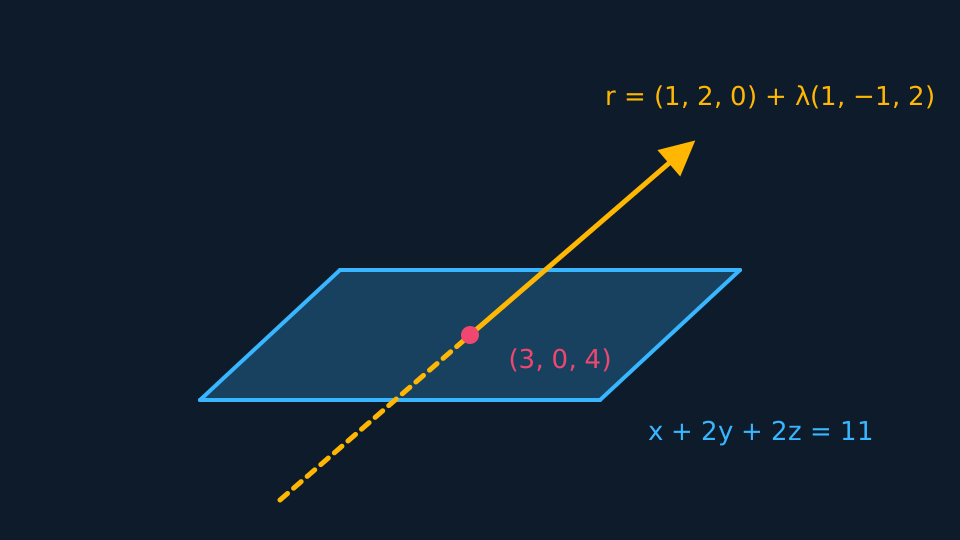
The line already gives all three coordinates in terms of one parameter, so substituting them into the plane's cartesian equation leaves one linear equation in λ. For r = (1, 2, 0) + λ(1, −1, 2) and x + 2y + 2z = 11 that reads 3λ + 5 = 11, so λ = 2 and the point is (3, 0, 4). No solution means the line is parallel to the plane; an identity means it lies in it.
Where a line meets a plane
A line gives each of its points as (x(λ), y(λ), z(λ)). Substituting these into the plane's cartesian equation gives one linear equation in λ. A unique solution gives the point of intersection; no solution means the line is parallel to the plane and does not lie in it; an identity means every point of the line satisfies the plane equation, so the line lies in the plane.
WORKED EXAMPLE
A line meets a plane
Find where r = (1, 2, 0) + λ(1, −1, 2) meets the plane x + 2y + 2z = 11.
Parametrise: x = 1 + λ, y = 2 − λ, z = 2λ.
Substitute: (1 + λ) + 2(2 − λ) + 2(2λ) = 11, so 3λ + 5 = 11 and λ = 2.
The point is (3, 0, 4). Check: 3 + 0 + 8 = 11.
Angles between lines and planes
Both cases use a dot product, but with different trigonometric ratios. For two planes, the angle between them equals the angle between their normals, so use cosine. For a line and a plane, the direction b and the normal n give sin θ = |b·n|/(|b||n|), because the normal is perpendicular to the plane. Using cosine in that case gives the complement of the required angle.
GUIDED PRACTICE
The angle of entry
Find the angle between the line with direction b = (1, −1, 2) and the plane x + 2y + 2z = 11.
Show the working
n = (1, 2, 2), and b·n = 1 − 2 + 4 = 3.
|b| = √6 and |n| = 3, so sin θ = 3/(3√6) = 1/√6.
θ = 24.1° to one decimal place. Using cosine would have given the complement, 65.9°, which is the angle to the normal rather than to the plane.
How far from a plane?
The perpendicular distance from a point to the plane n₁x + n₂y + n₃z = d comes from projecting onto the unit normal:
Check the current formula booklet for your awarding organisation, and note the convention it uses: where the plane is written n₁x + n₂y + n₃z + d = 0, the numerator carries a plus sign and that d is the negative of the d used here. The distance is the same either way. Substitute the point, subtract d, divide by |n| and take the modulus. The sign of the expression inside the modulus records which side of the plane the point lies on: two points give the same sign exactly when they lie on the same side.
WORKED EXAMPLE
A point-to-plane distance
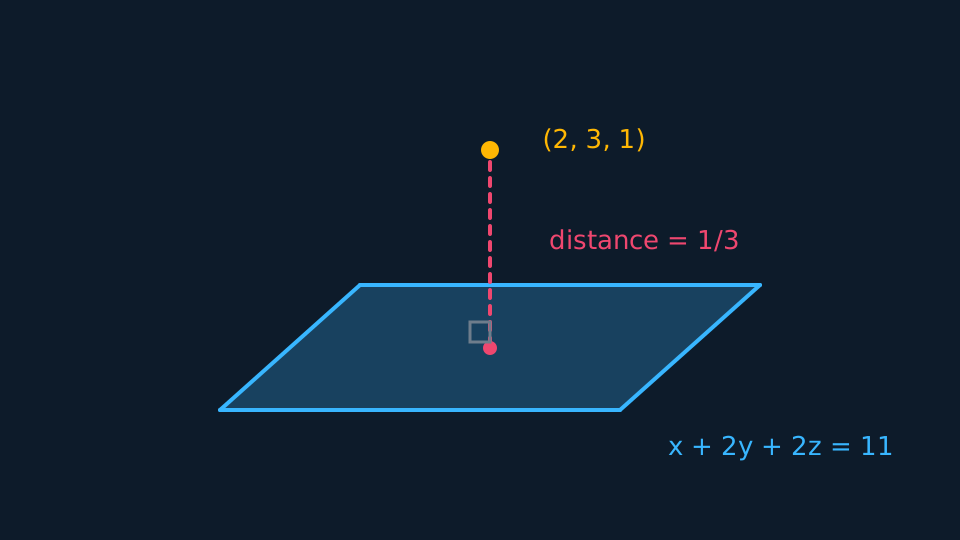
Find the distance from (2, 3, 1) to the plane x + 2y + 2z = 11.
Numerator: |2 + 6 + 2 − 11| = 1.
Denominator: √(1 + 4 + 4) = 3.
Distance = 1/3.
The origin is |0 − 11|/3 = 11/3 from the plane and lies on the same side as (2, 3, 1), because both signed substitutions are negative: 2 + 6 + 2 − 11 = −1 and 0 − 11 = −11.
Distances involving lines
The same method covers both cases. Write down a general point on the line, form the joining vector, and impose perpendicularity to each available direction. For a point to a line there is one such condition and one unknown parameter.
WORKED EXAMPLE
From a point to a line
Find the shortest distance from A(3, 0, 0) to the line r = λ(1, 2, 2).
A general point on the line is F = (λ, 2λ, 2λ), so AF = (λ − 3, 2λ, 2λ).
Perpendicularity: AF·(1, 2, 2) = λ − 3 + 4λ + 4λ = 9λ − 3 = 0, so λ = 1/3.
AF = (−8/3, 2/3, 2/3), whose length is 2√2.
Check by Pythagoras: |OA| = 3, the foot of the perpendicular is 1 from the origin, and √(9 − 1) = 2√2.
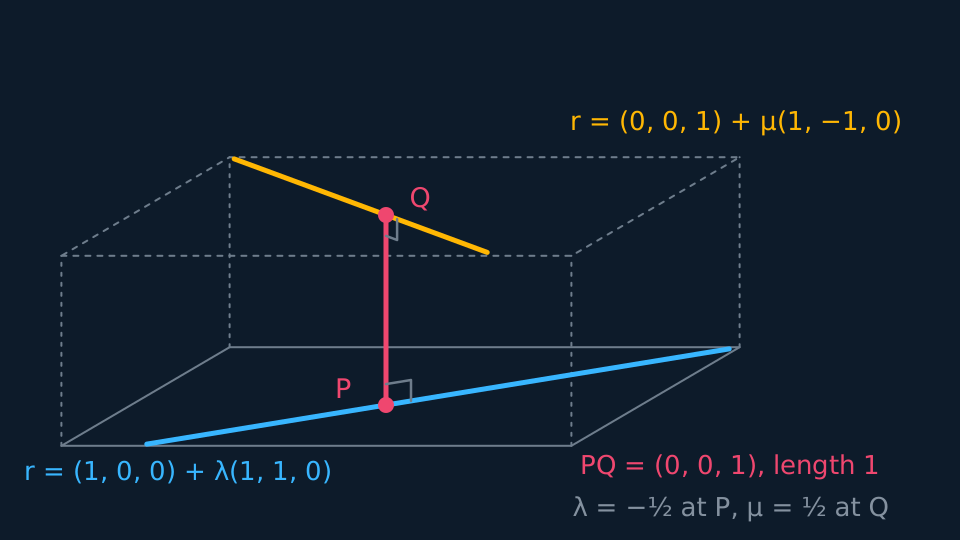
Two skew lines require the same method with two conditions. Take a general point on each, form the joining vector PQ, and impose PQ·b₁ = 0 and PQ·b₂ = 0. Solve for λ and μ, then evaluate |PQ|. The two directions must be non-parallel; parallel lines are handled as a point-to-line distance. For r = (1, 0, 0) + λ(1, 1, 0) and r = (0, 0, 1) + μ(1, −1, 0), the two conditions give λ = −1/2 and μ = 1/2, so PQ = (0, 0, 1) and the shortest distance is 1. This agrees with the geometry, since the two lines lie in horizontal planes one unit apart. Other pairs of lines require more arithmetic but the same two perpendicularity conditions.
Describe the drawing
Two horizontal planes drawn as a wireframe box, a cyan line crossing the floor and an amber line crossing the ceiling in a different direction, with a vertical coral strut PQ joining them and right-angle marks at both feet. Demanding PQ perpendicular to both directions fixes lambda at minus one half and mu at one half, and the shortest distance between the skew lines is the strut's length, exactly 1.
ASSESSMENT FOCUS
- Substitute the parametric line into the plane equation and state the value of λ obtained.
- A line and a plane use sine with the normal; two planes use cosine of their normals. State which is being used.
- Quote the distance formula with the modulus in place: a distance is non-negative.
- If b·n = 0 the line is parallel to the plane. Substitute a point of the line to distinguish 'parallel to' from 'lying in' the plane.
- For shortest distances, write the perpendicularity conditions before solving.
- Two points lie on the same side of a plane when the signed substitutions n·r − d have the same sign.
CHECK YOURSELF
Find the acute angle between the planes x + 2y + 2z = 11 and x − z = −1, to one decimal place.
Show a hint
cos θ = |n₁·n₂|/(|n₁||n₂|) with the two normals.
Show the answer
Normals (1, 2, 2) and (1, 0, −1) have dot product 1 + 0 − 2 = −1, so |n₁·n₂| = 1. The lengths are 3 and √2, giving cos θ = 1/(3√2) and θ = 76.4°.
Line into plane: substitute the parametric coordinates and solve one equation in λ; no solution means parallel, an identity means the line lies in the plane.
Line-plane angles use sine with the normal; plane-plane angles use cosine.
Shortest distances come from making the joining vector perpendicular to each of the available directions.
WORKBOOK
Printable practice for this topic: original exam-style questions with room to work, and a fully worked answer book. Free to use; please do not redistribute or sell.
Or read them with their worked answers on the intersections, angles and distances questions page.
USED LATER IN
CHECK YOUR PROGRESS
Rate how confident you feel with each objective for this lesson. Ratings are saved in this browser, on this device, unless you sign in.
- Substitute a parametric line into a plane's equation to find where they meet.
- Compute angles between a line and a plane, and between two planes.
- Apply the perpendicular distance formula from a point to a plane.
- Find the distance from a point to a line, and the shortest distance between two skew lines.
Open the full revision checklist to see every objective in the course in one place.