Maths › Further vectors › Lines and planes in three dimensions
Lines and planes in three dimensions
A line is determined by one point and a direction vector, in two dimensions or three. A plane is determined by one point and two non-parallel directions lying in it, or equivalently by one point and a normal vector. Write each object in vector, cartesian and parametric form, and convert between them.
Builds on Vectors in three dimensions.
IN THIS TOPIC
- Write a line as r = a + λb in two dimensions or three, and convert to cartesian form and back.
- Write a plane as r·n = d, as ax + by + cz = e and as r = a + λb + μc, and switch between them.
- Find a plane's normal from two directions lying in it.
- Decide whether two lines meet, are parallel or are skew.
COMMON MISCONCEPTION
A plane needs three separate equations to describe, one for each coordinate.
One equation describes a plane. The points whose displacement from an anchor a is perpendicular to the normal n are exactly those with r·n = a·n = d, which expands to n₁x + n₂y + n₃z = d with the normal's components as the coefficients. The plane through (1, 0, 2), (2, 1, 3) and (0, 1, 1) has normal (1, 0, −1) and equation x − z = −1.
Lines: a point and a direction
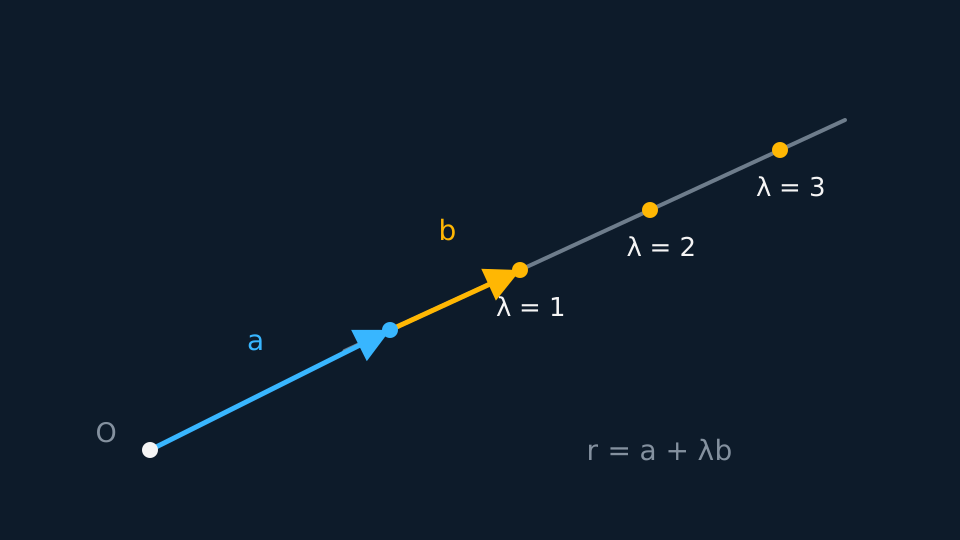
Every point of a line comes from one position vector a and some multiple of a direction vector b:
Check the current formula booklet for your awarding organisation; whether or not a form is supplied, you must know when it applies and how to derive it. Each value of λ gives one point of the line, and distinct values give distinct points when b ≠ 0.
If every component of the direction vector is non-zero, eliminate the parameter to obtain the symmetric form (x − a₁)/b₁ = (y − a₂)/b₂ = (z − a₃)/b₃. If a component is zero, write the corresponding coordinate as a constant and equate only the remaining fractions: for b = (2, 0, 3) through (1, 4, 5) the line is y = 4 with (x − 1)/2 = (z − 5)/3.
WORKED EXAMPLE
Line through two points
Find a vector equation of the line through P(3, 1, 2) and Q(5, 0, 4).
Direction: b = PQ = (2, −1, 2).
So r = (3, 1, 2) + λ(2, −1, 2), and the cartesian form is (x − 3)/2 = (y − 1)/(−1) = (z − 2)/2.
Either point may be used as the anchor: using Q instead of P shifts λ by one and describes the same line.
The same construction applies in two dimensions, which some awarding organisations, including OCR, assess. There r = a + λb is again a point plus a direction, so r = (1, 2) + λ(3, −1) is the line through (1, 2) that runs 3 across for every 1 down. Eliminating λ from x = 1 + 3λ and y = 2 − λ gives (x − 1)/3 = 2 − y, which tidies to x + 3y = 7, and dividing the direction's components, −1/3, gives the gradient. Converting back is quicker: y = mx + c passes through (0, c) with direction (1, m), so r = (0, c) + λ(1, m) describes it, and ax + by = c can be handled by finding two of its points and subtracting them for a direction.
Planes: a point and a normal
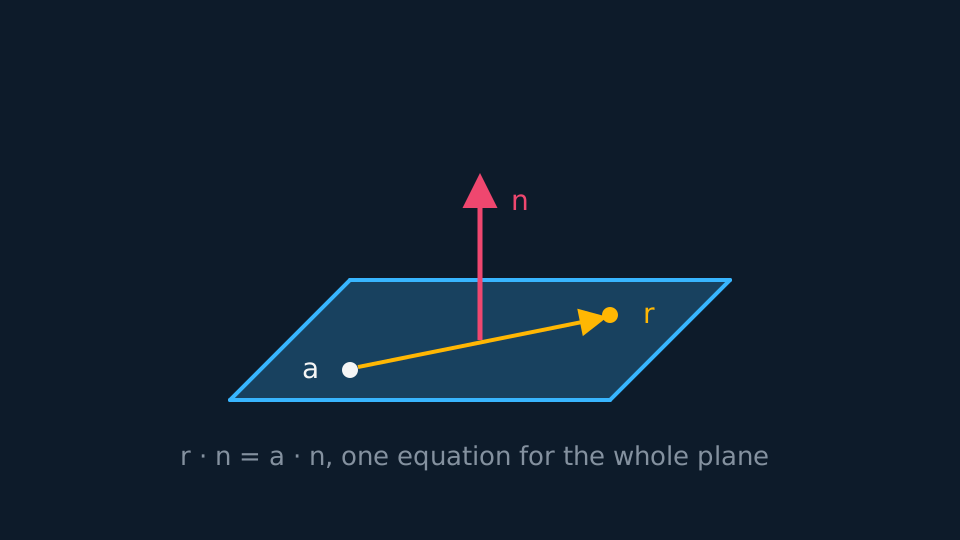
A plane through point a, perpendicular to a normal vector n, contains exactly the points r for which r − a sits at right angles to n. Taking scalar products turns that sentence into one equation:
Check the current formula booklet for your awarding organisation. Writing r = (x, y, z) and n = (n₁, n₂, n₃) expands this to the cartesian form n₁x + n₂y + n₃z = d, in which the coefficients are the components of the normal. Note the sign convention: some sources write a plane as n₁x + n₂y + n₃z + d = 0 with d = −a·n, so that d is the negative of the d used here. State which convention you are using before quoting a formula.
WORKED EXAMPLE
The plane through three points
Find a cartesian equation of the plane through A(1, 0, 2), B(2, 1, 3) and C(0, 1, 1).
Two directions in the plane: AB = (1, 1, 1) and AC = (−1, 1, −1).
A normal n = (a, b, c) must satisfy n·AB = 0 and n·AC = 0, so a + b + c = 0 and −a + b − c = 0.
Adding gives b = 0, and then a = −c, so n = (1, 0, −1).
d = n·A = 1 − 2 = −1, and the plane is x − z = −1. Both B and C confirm it, since 2 − 3 = −1 and 0 − 1 = −1.
The two directions describe the plane without reference to a normal: take a point of the plane and add multiples of each direction.
The result, r = a + λb + μc with b and c non-parallel directions lying in the plane, is the two-parameter form. A line requires one parameter and a plane two. The plane just found is r = (1, 0, 2) + λ(1, 1, 1) + μ(−1, 1, −1), and the conversion back is a subtraction: x = 1 + λ − μ and z = 2 + λ − μ, so x − z = −1 whatever the two parameters do, which is the cartesian equation again. Going the other way, pick one point satisfying the equation and two non-parallel directions whose scalar product with n is zero.
GUIDED PRACTICE
From scalar product form to cartesian
A plane has equation r·(1, 2, 2) = 5. Write the cartesian form, and decide whether the point (3, 1, 0) lies in it.
Show the working
Cartesian: x + 2y + 2z = 5.
Test the point. 3 + 2 + 0 = 5, so (3, 1, 0) lies in the plane.
The normal is unchanged; converting between the forms is expanding the scalar product.
Deciding whether two lines meet
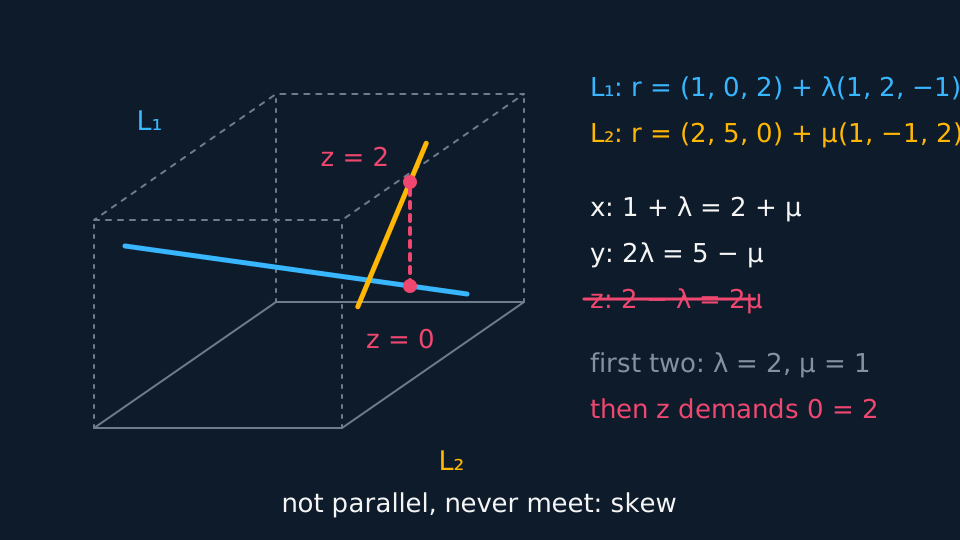
In two dimensions two lines either meet or are parallel. In three dimensions there is a third case: skew lines, which are not parallel and do not meet. Test by equating the two position vectors, which gives three equations in λ and μ. Solve any two and check the third. If it is satisfied, the lines meet. If it is not, and the directions are not scalar multiples of each other, the lines are skew.
WORKED EXAMPLE
Two lines that do meet
Do r = (1, 0, 2) + λ(1, 2, −1) and r = (2, 5, −2) + μ(1, −1, 2) intersect?
Equate components: 1 + λ = 2 + μ, 2λ = 5 − μ, 2 − λ = −2 + 2μ.
From the first, μ = λ − 1. The second becomes 2λ = 6 − λ, so λ = 2 and μ = 1.
Check the third: 2 − 2 = 0 and −2 + 2 = 0. It holds, so the lines meet at (3, 4, 0).
The angle between them comes from the directions. (1, 2, −1)·(1, −1, 2) = −3, both lengths are √6, so cos θ = 3/6 and the acute angle is 60°.
The third equation must be checked. Two equations in two unknowns generally have a solution whether or not the lines meet, so it is the third component that decides.
Describe the drawing
A wireframe box holding a cyan line and an amber line that pass without touching, with a dashed coral gap where they would have met: at lambda 2 and mu 1 the x and y coordinates agree but one line sits at z equals 0 and the other at z equals 2. Beside the box the three component equations are listed, the first two ticked off and the third struck through, since it collapses to 0 equals 2. Directions not parallel plus no meeting point means the lines are skew.
ASSESSMENT FOCUS
- State direction vectors and normals explicitly before using them.
- A zero component of the direction vector means that coordinate is constant: write it as a separate equation and equate only the remaining fractions.
- To find a normal without a formula, solve n·(each direction) = 0, choosing one component freely.
- Different anchor points and scaled direction vectors give different-looking equations for the same line or plane.
- A plane given as r = a + λb + μc converts to cartesian form by eliminating both parameters, or by finding a normal perpendicular to b and to c.
CHECK YOURSELF
Does the point (7, −1, 5) lie on the line r = (1, 2, 3) + λ(2, −1, 1)?
Show a hint
Find λ from the x-coordinate, then test the other two.
Show the answer
From x: 1 + 2λ = 7, so λ = 3. Then y = 2 − 3 = −1, which matches, but z = 3 + 3 = 6 ≠ 5. One coordinate fails, so the point is not on the line.
Line: r = a + λb, one anchor point plus multiples of a direction, in two dimensions or three; the symmetric cartesian form requires every component of b to be non-zero.
Plane: r·n = d, every point whose displacement from the anchor is perpendicular to n.
Plane again: r = a + λb + μc, one parameter for each direction lying in it.
WORKBOOK
Printable practice for this topic: original exam-style questions with room to work, and a fully worked answer book. Free to use; please do not redistribute or sell.
Or read them with their worked answers on the lines and planes in three dimensions questions page.
CHECK YOUR PROGRESS
Rate how confident you feel with each objective for this lesson. Ratings are saved in this browser, on this device, unless you sign in.
- Write a line as r = a + λb in two dimensions or three, and convert to cartesian form and back.
- Write a plane as r·n = d, as ax + by + cz = e and as r = a + λb + μc, and switch between them.
- Find a plane's normal from two directions lying in it.
- Decide whether two lines meet, are parallel or are skew.
Open the full revision checklist to see every objective in the course in one place.