Maths › Integration › Integrating standard functions
Integrating standard functions
The standard derivatives reverse into standard integrals: exponentials, sines, cosines, and 1/x, whose integral is ln|x| + c, the case the power rule excludes. Where an integrand has no standard form, a trigonometric identity can rewrite it as terms that do.
Builds on Definite integrals and areas and Differentiating trig, exponentials and logs.
IN THIS TOPIC
- Integrate ekx, 1/x, sin kx, cos kx and sec2 kx, dividing by k throughout.
- Use ∫(1/x) dx = ln|x| + c, the case the power rule could not reach.
- Reshape sin2 x, cos2 kx and tan2 x by identity before integrating.
COMMON MISCONCEPTION
1/x follows the reversed power rule like every other power.
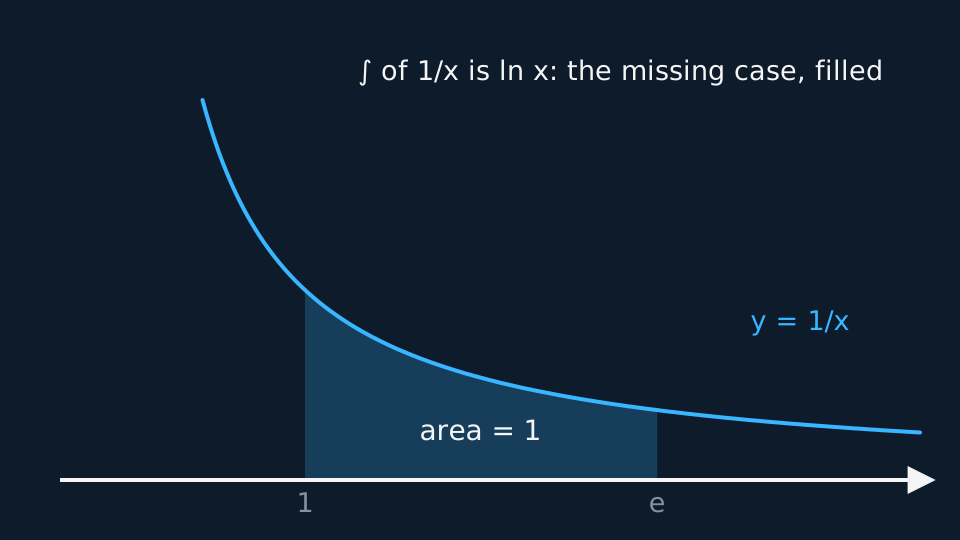
n = −1 is the case the power rule cannot reach: adding one to the exponent gives zero, and the rule would divide by it. The antiderivative is ∫(1/x) dx = ln|x| + c, valid on any interval not containing 0, and the modulus is what makes the result hold for negative x as well.
The standard integrals
Each standard derivative reverses into a standard integral, and all four of these must be learnt. They hold with x in radians, and the last one for x ≠ 0.
The formulae booklet adds sec2 kx, which integrates to (1/k) tan kx. Where differentiation multiplies by k, integration divides by it, and the minus sign moves from the derivative of cosine to the integral of sine. The last entry supplies the case the power rule excludes: at n = −1 the reversed power rule would divide by zero, and the antiderivative of 1/x is ln|x| + c, valid on any interval not containing 0.
WORKED EXAMPLE
Three standard integrals, termwise
Find ∫(e5x + 1/(2x) + cos 3x) dx.
Termwise: e5x gives e5x/5, and 1/(2x) is ½ × 1/x, giving ½ ln|x|.
cos 3x gives (1/3) sin 3x.
The integral is e5x/5 + ½ ln|x| + ⅓ sin 3x + c.
Each term is divided by its k. Differentiating the answer returns the integrand.
Identities before integrals
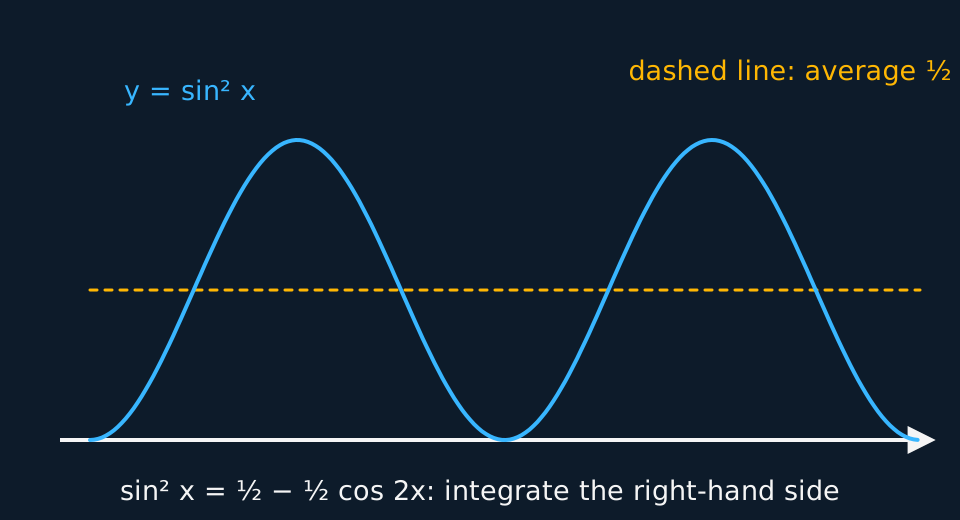
sin2 x is not a standard integral, so rewrite it first. The double angle identity cos 2x = 1 − 2 sin2 x rearranges to sin2 x = ½ − ½ cos 2x, and both of those terms are standard integrals.
WORKED EXAMPLE
Integrating sin² x by identity
Find ∫sin2 x dx.
Rewrite: sin2 x = ½ − ½ cos 2x.
Integrate termwise: ½x − ½ × (1/2) sin 2x.
∫sin2 x dx = x/2 − (sin 2x)/4 + c.
The identity converts the integrand into two standard integrals, which are then integrated termwise.
GUIDED PRACTICE
The tangent version
Find ∫tan2 x dx, before opening the working.
Show the working
The identity sec2 x = 1 + tan2 x rearranges to tan2 x = sec2 x − 1.
Both terms are standard integrals: ∫tan2 x dx = tan x − x + c, valid where tan x is defined.
The identity is covered in Reciprocal and inverse trigonometric functions. A squared trigonometric integrand is rewritten by an identity before integrating.
INDEPENDENT PRACTICE
A squared cosine, with a k
Find ∫cos2 3x dx.
Show the working
cos 2A = 2 cos2 A − 1 with A = 3x gives cos2 3x = ½ + ½ cos 6x.
Integrating: x/2 + (sin 6x)/12 + c.
Doubling the angle 3x gives 6x, and integrating cos 6x divides by 6. Substitute the whole angle into the identity rather than the x alone.
ASSESSMENT FOCUS
- Integration divides by k where differentiation multiplied. Check each term by differentiating back.
- ∫(1/x) dx = ln|x| + c, with the modulus, which is what makes the result valid on an interval of negative x.
- Squared trig integrands rewrite by identity first. Double angle for sin² and cos², the sec² identity for tan².
- Substitute the full angle into the identity. cos² 3x involves cos 6x, and the halved coefficients follow from that.
CHECK YOURSELF
Find the exact value of ∫1e (2/x) dx, and evaluate ∫0π/4 sec2 x dx.
Show a hint
Both are standard integrals, and both limits give exact values.
Show the answer
∫1e (2/x) dx = [2 ln|x|] from 1 to e = 2 − 0 = 2.
∫0π/4 sec2 x dx = [tan x] from 0 to π/4 = 1 − 0 = 1.
Both values are exact because ln e = 1 and tan (π/4) = 1.
Reverse each standard derivative and divide by k; the case excluded by the power rule is ∫(1/x) dx = ln|x| + c.
A squared trigonometric function is not a standard integral; use an identity to rewrite it as terms that are.
WORKBOOK
Printable practice for this topic: original exam-style questions with room to work, and a fully worked answer book. Free to use; please do not redistribute or sell.
Or read them with their worked answers on the integrating standard functions questions page.
USED LATER IN
CHECK YOUR PROGRESS
Rate how confident you feel with each objective for this lesson. Ratings are saved in this browser, on this device, unless you sign in.
- Integrate ekx, 1/x, sin kx, cos kx and sec2 kx, dividing by k throughout.
- Use ∫(1/x) dx = ln|x| + c, the case the power rule could not reach.
- Reshape sin2 x, cos2 kx and tan2 x by identity before integrating.
Open the full revision checklist to see every objective in the course in one place.