Maths › Integration › Definite integrals and areas
Definite integrals and areas
A definite integral gives signed area: regions above the x-axis contribute positively and regions below it negatively. To calculate geometric area, find any axis crossings, split the interval and add the absolute values of the separate integrals.
Builds on Integration as antidifferentiation and Simultaneous equations and inequalities.
IN THIS TOPIC
- Evaluate definite integrals with the square-bracket routine.
- Find geometric areas under curves and between a curve and a line.
- Split the interval at the axis crossings and add the absolute values where part of the region lies below the axis.
- Use the properties of a definite integral: adjacent intervals add, reversed limits change the sign, and an odd integrand over a symmetric interval gives zero.
COMMON MISCONCEPTION
A definite integral is an area, always.
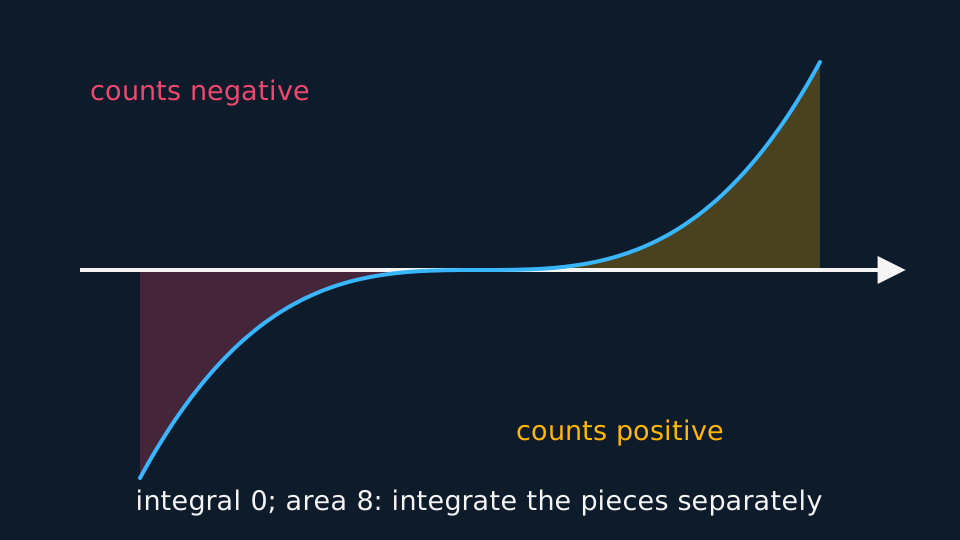
A definite integral gives signed area: parts above the x-axis count positively and parts below it negatively. The integral of x3 from −2 to 2 is 0, while the geometric area enclosed is 8. Sketch first, and where the curve crosses the axis inside the interval, split there and add the absolute values.
Numbers out of integrals
A definite integral carries limits, ∫ab f(x) dx, and the fundamental theorem of calculus evaluates it. Antidifferentiate, then take the value at the upper limit and subtract the value at the lower. The constant c cancels in that subtraction, so square-bracket working leaves it out.
WORKED EXAMPLE
The square-bracket routine
Evaluate ∫13 x2 dx.
Antidifferentiate inside brackets: [x3/3] from 1 to 3.
Substitute and subtract: 27/3 − 1/3 = 26/3.
Substitute the upper limit first and subtract the value at the lower limit. Exchanging the limits reverses the sign of the result.
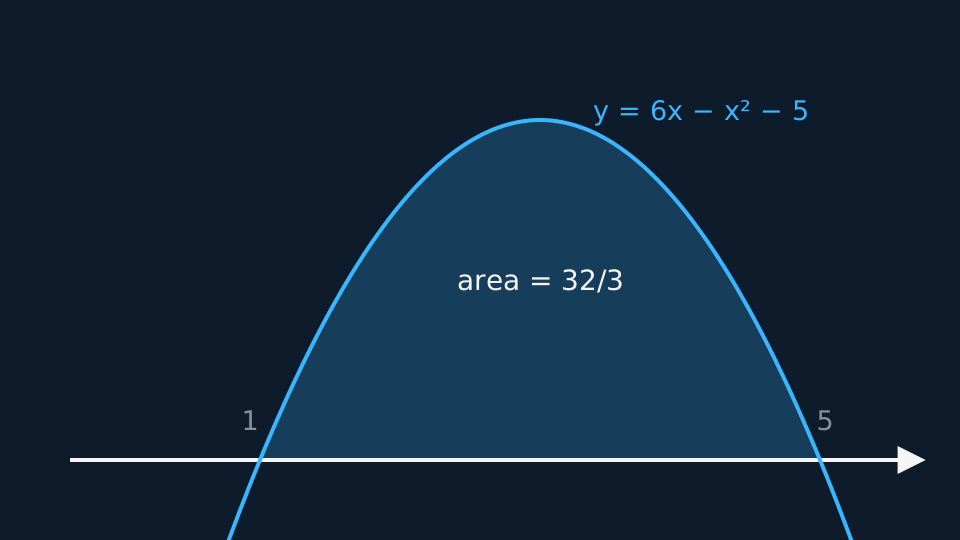
A definite integral gives signed area: where the curve lies above the x-axis the contribution is positive, and where it lies below the axis the contribution is negative. When the curve is above the axis throughout the interval, the value of the integral equals the geometric area between the curve and the axis. Check that condition before quoting an integral as an area.
GUIDED PRACTICE
Area between a curve and a line
Find the area of the region enclosed by the parabola y = x2 and the line y = 2x + 3, before opening the working.
Show the working
Intersections first: x2 = 2x + 3 gives (x − 3)(x + 1) = 0, so the region runs from −1 to 3.
Integrate the difference, top minus bottom: ∫(2x + 3 − x2) dx from −1 to 3 = [x2 + 3x − x3/3].
Evaluating, 9 − (−5/3) = 32/3.
Integrating the difference of the two functions handles both boundaries in one integral, and the limits come from solving the two equations simultaneously.
Below the axis
Where a curve lies below the axis, f(x) is negative throughout, so the integral over that interval is negative. Because the integral is a signed total, a region below the axis cancels part of a region above it rather than adding to it. To find geometric area, integrate over each interval between axis crossings separately and add the absolute values.
INDEPENDENT PRACTICE
Signed against true
Evaluate ∫−22 x3 dx, and find the total area enclosed between y = x3 and the x-axis over the same interval.
Show the working
The integral is [x4/4] from −2 to 2 = 4 − 4 = 0.
For the geometric area, split at the axis crossing at x = 0. Each part has integral of absolute value 4, so the total area is 4 + 4 = 8.
The integral is zero over a region of area 8 because the two contributions have opposite signs. Sketch the curve, split at the roots, and add the absolute values.
The value 0 there is an instance of a general fact: an odd integrand, one with f(−x) = −f(x), integrated over an interval symmetric about zero gives zero, because the two halves contribute the same size with opposite signs. The condition is on the function, not on the shape of the region: y = x2 − 4 lies below the axis between −2 and 2, but it is even, and its integral there is −32/3.
ASSESSMENT FOCUS
- Sketch before integrating. The sketch shows whether the curve crosses the axis inside the interval, and therefore whether the integral must be split.
- Use square brackets, substitute the upper limit and subtract the lower, and omit c: it cancels in the subtraction.
- Between a curve and a line, integrate top minus bottom between the intersection points, found by solving the equations simultaneously.
- A negative integral over an interval with no axis crossing shows that the region lies below the axis. Give a geometric area as a positive value, and state that the negative sign records the position of the region.
- Give an exact value such as 32/3 unless the question requests a decimal approximation.
CHECK YOURSELF
Using algebra, find the exact value of ∫04 (x + 2)2/√x dx.
Show a hint
Expand the bracket, divide each term by √x, then integrate powers.
Show the answer
The integrand expands to x3/2 + 4x1/2 + 4x−1/2.
Integrating gives [(2/5)x5/2 + (8/3)x3/2 + 8x1/2] from 0 to 4.
At 4 the terms are 64/5, 64/3 and 16, and at 0 all of them vanish, so the value is 752/15.
The three methods used are index rewriting, the reversed power rule and the square-bracket routine.
Antidifferentiate, bracket, substitute both limits and subtract; the constant of integration cancels.
A definite integral is signed area; a geometric area is not signed. Sketch the curve, split at the axis crossings, and add the absolute values.
WORKBOOK
Printable practice for this topic: original exam-style questions with room to work, and a fully worked answer book. Free to use; please do not redistribute or sell.
Or read them with their worked answers on the definite integrals and areas questions page.
USED LATER IN
CHECK YOUR PROGRESS
Rate how confident you feel with each objective for this lesson. Ratings are saved in this browser, on this device, unless you sign in.
- Evaluate definite integrals with the square-bracket routine.
- Find geometric areas under curves and between a curve and a line.
- Split the interval at the axis crossings and add the absolute values where part of the region lies below the axis.
- Use the properties of a definite integral: adjacent intervals add, reversed limits change the sign, and an odd integrand over a symmetric interval gives zero.
Open the full revision checklist to see every objective in the course in one place.