Maths › Integration › Integration as antidifferentiation
Integration as antidifferentiation
Integration reverses differentiation: it finds the functions with a given derivative, using the power rule in reverse. An indefinite integral includes an arbitrary constant, because differentiation removes additive constants; a further condition is needed to determine it.
Builds on Differentiating powers of x.
IN THIS TOPIC
- Integrate powers of x by reversing the power rule, with the constant of integration.
- Rewrite expressions into powers before integrating, and check answers by differentiating.
- Recover a curve from its gradient function and the conditions that pin its constants.
- Explain why the constant of integration is required, and why two antiderivatives of the same function differ only by a constant.
COMMON MISCONCEPTION
∫xn dx = xn+1/(n + 1), and that is the whole answer.
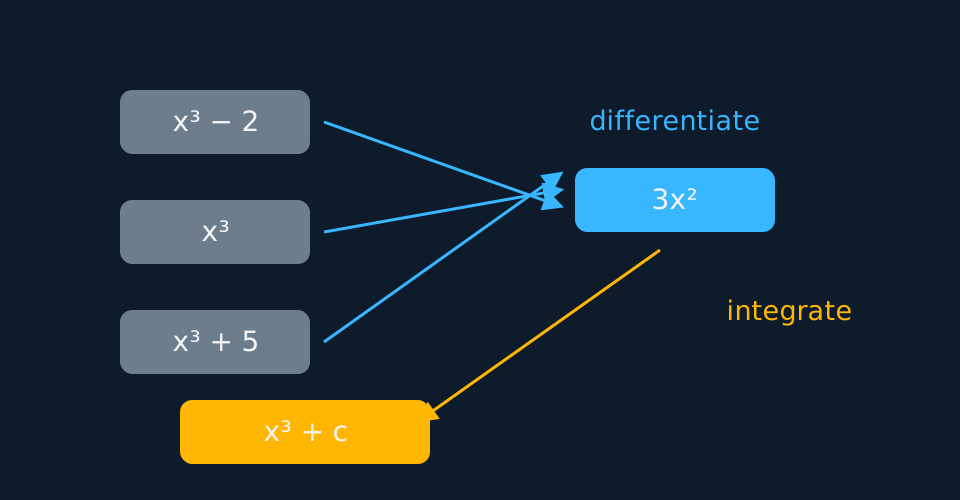
Two conditions come with that formula. The + c is required, because differentiation removes additive constants: x3 − 2, x3 and x3 + 5 all differentiate to 3x2, so running backwards can only give x3 + c. And n = −1 is excluded, since the formula would divide by zero.
Reversing differentiation
Integration reverses differentiation, a statement made precise by the Fundamental Theorem of Calculus, so every derivative result gives a corresponding integral. Reverse the power rule by adding one to the exponent and then dividing by the new exponent.
Two conditions come with it. The + c is required, because differentiation removes additive constants, so the reverse process determines the function only up to a constant. And n = −1 is excluded, since the formula would divide by zero; ∫(1/x) dx = ln|x| + c is treated in Integrating standard functions.
WORKED EXAMPLE
Termwise, with the constant
Find ∫(6x2 − 4x + 3) dx.
Integrate each term by the reversed power rule. 6x2 becomes 2x3, −4x becomes −2x2, and 3 becomes 3x.
So the integral is 2x3 − 2x2 + 3x + c.
Differentiating the answer returns 6x2 − 4x + 3, which checks the integration. Every integral can be checked this way.
GUIDED PRACTICE
Rewrite as powers first
Find ∫(½x2 − 3/√x) dx, before opening the working.
Show the working
Rewrite the second term as a power: −3x−1/2.
Integrating termwise gives x3/6 − 3 × 2x1/2 + c, that is x3/6 − 6√x + c.
The exponent −½ rose to +½, and dividing by ½ doubled the coefficient. Differentiating the answer checks both steps.
One point pins the constant
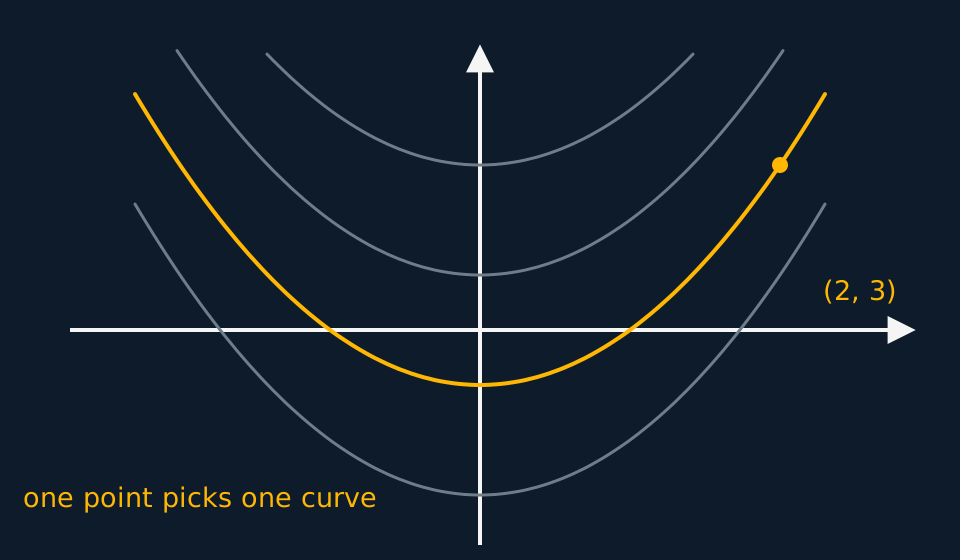
An indefinite integral defines a family of curves, one for each value of c, all with the same gradient at each x. A point on the required curve determines c: substitute its coordinates into the integrated equation and solve.
INDEPENDENT PRACTICE
From gradient to curve
A curve has gradient function dy/dx = 3x2 − 8x and passes through (2, 3). Find its equation.
Show the working
Integrate: y = x3 − 4x2 + c.
Substitute the point: 3 = 8 − 16 + c, so c = 11.
The curve is y = x3 − 4x2 + 11, the only member of the family through (2, 3).
Integrate first and substitute second. Substituting the point into the gradient function gives the gradient at that point, not the value of c.
ASSESSMENT FOCUS
- Add one to the exponent, divide by the new exponent, and include + c on every indefinite integral: without it the answer names one antiderivative rather than all of them.
- Rewrite roots, reciprocals and quotients as powers before integrating, as for differentiation.
- Check by differentiating the answer back to the integrand.
- Given dy/dx and a point, integrate first and substitute second, then state the full equation as your answer.
CHECK YOURSELF
Find ∫(4x3 + 2/x3) dx, and verify your answer by differentiation.
Show a hint
2/x³ is 2x⁻³; the exponent increases to −2.
Show the answer
Rewriting and integrating termwise, ∫(4x3 + 2x−3) dx = x4 − x−2 + c, that is x4 − 1/x2 + c.
Differentiating back gives 4x3 + 2x−3, the original integrand, so the answer stands.
The exponent rose from −3 to −2, and dividing by −2 changed the sign of the term. Show both steps.
Raise the exponent by one, divide by the new exponent, and include the + c.
A gradient function determines a family of curves; one known point determines which member.
WORKBOOK
Printable practice for this topic: original exam-style questions with room to work, and a fully worked answer book. Free to use; please do not redistribute or sell.
Or read them with their worked answers on the integration as antidifferentiation questions page.
USED LATER IN
CHECK YOUR PROGRESS
Rate how confident you feel with each objective for this lesson. Ratings are saved in this browser, on this device, unless you sign in.
- Integrate powers of x by reversing the power rule, with the constant of integration.
- Rewrite expressions into powers before integrating, and check answers by differentiating.
- Recover a curve from its gradient function and the conditions that pin its constants.
- Explain why the constant of integration is required, and why two antiderivatives of the same function differ only by a constant.
Open the full revision checklist to see every objective in the course in one place.