Maths › Mechanics › Kinematics with variable acceleration
Kinematics with variable acceleration
When the acceleration is not constant the suvat equations do not apply. Differentiate displacement to obtain velocity and acceleration, integrate to reverse the process, and determine each constant of integration from a stated condition.
Builds on Differentiating powers of x and Integration as antidifferentiation.
IN THIS TOPIC
- Differentiate x(t) to get velocity and acceleration, and integrate a(t) back with constants found from stated conditions.
- Find times and positions where a particle is at rest or changes direction.
- Distinguish displacement from total distance when the motion reverses.
- Differentiate and integrate a position vector in i and j notation, and find speed as the magnitude of the velocity.
COMMON MISCONCEPTION
If a particle's velocity is zero at some instant, its acceleration is zero then too.
Acceleration is the rate of change of velocity, so it depends on how v is changing and not on the value v happens to take. For v = 6t − 3t2, a = dv/dt = 6 − 6t, and the particle is at rest at t = 0 and t = 2, where the acceleration is 6 and −6 m s⁻². Solving v = 0 locates the times at which the motion can change direction.
Displacement, velocity and acceleration
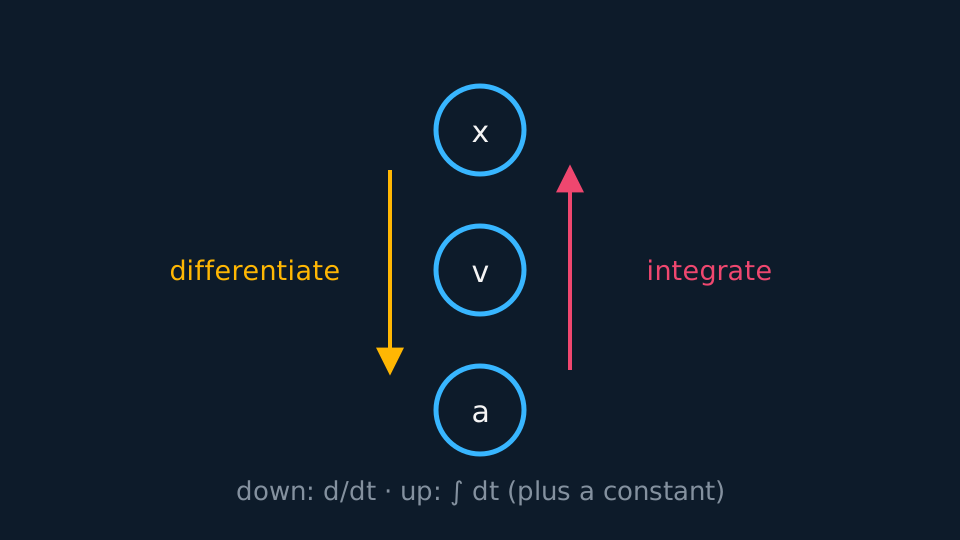
Velocity is the rate of change of displacement and acceleration the rate of change of velocity, so differentiation moves from x to v to a and integration reverses each step. Every integration introduces a constant, which is determined by a stated condition such as “starts at the origin” or “initially at rest”. Constant acceleration is the special case in which these integrals reproduce the suvat equations.
Turning points, displacement and distance
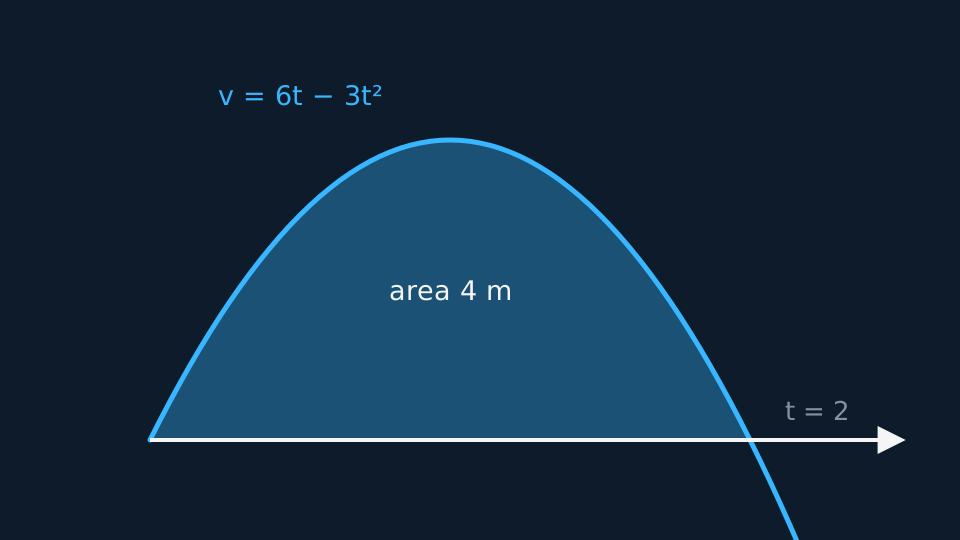
“At rest” means v = 0, and solving that equation locates the times at which the motion can change direction. Between those times the sign of v gives the direction of travel. Total distance is the sum of the magnitudes of the separate legs, while displacement adds them with their signs.
WORKED EXAMPLE
One particle, fully read
A particle moves with v = 6t − 3t² m s⁻¹. Find its acceleration at t = 1.5, and its displacement from t = 0 to t = 2.
Differentiate: a = 6 − 6t, so at t = 1.5, a = 6 − 9 = −3 m s⁻². The velocity is still positive there, so the particle is slowing down.
Integrate: x = 3t² − t³ (+ 0, starting at the origin). At t = 2, x = 12 − 8 = 4 m.
Check: v = 3t(2 − t) is zero at t = 0 and t = 2, so the particle moved forward throughout and 4 m is both the displacement and the distance.
Motion in two dimensions
In two dimensions the same operations are applied to each component. Write the position as r = x(t)i + y(t)j and differentiate each component separately to obtain v, then again to obtain a. Integration works the same way, one component at a time, and the constant of integration is itself a vector.
Speed is the magnitude of the velocity, so it needs Pythagoras after the differentiation. If r = (3t² − t)i + (t³ + 2)j metres, then v = (6t − 1)i + 3t²j, and at t = 2 the velocity is 11i + 12j with speed √(11² + 12²) = √265 ≈ 16.3 m s⁻¹.
Two standard phrasings translate into component conditions. “Moving parallel to i” means the j component of the velocity is zero. “Moving north-east” means the i and j components are equal and both positive. Form the corresponding equation in t and solve it.
ASSESSMENT FOCUS
- Translate the wording into an equation: “at rest” means v = 0, “velocity is constant” means a = 0, “returns to the start” means x = 0.
- Every integration introduces a constant, determined by a stated condition. Write the condition down before using it.
- For distance when the motion reverses, split the interval at v = 0 and add the magnitudes of the pieces.
- In vector questions, differentiate or integrate the components and take the magnitude only at the end: the magnitude discards the direction information needed for any later component work.
- State the units of every final answer.
CHECK YOURSELF
A particle starts from rest and has a = 12t − 6. Find v(t), and the time after t = 0 at which it is next at rest.
Show a hint
Integrate once; the constant is fixed by starting from rest.
Show the answer
v = 6t² − 6t + c, and v(0) = 0 gives c = 0, so v = 6t² − 6t.
v = 6t(t − 1) = 0 at t = 1 s.
Differentiate x to v to a, integrate back, and let the conditions fix the constants.
Solve v = 0 to find the turning points, and add distance leg by leg.
WORKBOOK
Printable practice for this topic: original exam-style questions with room to work, and a fully worked answer book. Free to use; please do not redistribute or sell.
Or read them with their worked answers on the kinematics with variable acceleration questions page.
CHECK YOUR PROGRESS
Rate how confident you feel with each objective for this lesson. Ratings are saved in this browser, on this device, unless you sign in.
- Differentiate x(t) to get velocity and acceleration, and integrate a(t) back with constants found from stated conditions.
- Find times and positions where a particle is at rest or changes direction.
- Distinguish displacement from total distance when the motion reverses.
- Differentiate and integrate a position vector in i and j notation, and find speed as the magnitude of the velocity.
Open the full revision checklist to see every objective in the course in one place.