Maths › Matrices › Systems of equations and invariance
Systems of equations and invariance
Write a linear system as Mv = b. A non-zero determinant gives one solution. When the determinant is zero, compare the rank of the coefficient and augmented matrices to distinguish inconsistency from an infinite solution set. An invariant line maps to itself as a set; on a line of invariant points, every point maps to itself.
Builds on Determinants and inverses.
IN THIS TOPIC
- Write simultaneous equations as a matrix equation and solve with an inverse.
- Interpret consistent and inconsistent three-plane systems geometrically.
- Find invariant points and invariant lines of a matrix transformation.
COMMON MISCONCEPTION
If three planes have no common point, at least two of them must be parallel.
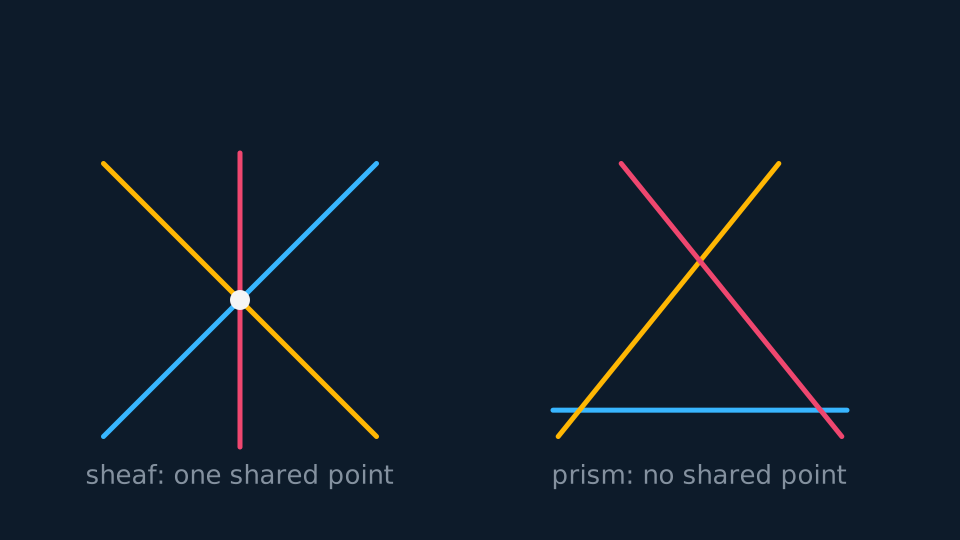
Three planes can meet in pairs and still share no point. That configuration is a prism: the planes meet along three parallel lines, and a cross-section perpendicular to those lines shows a triangle rather than a single point, with no two planes parallel. Once the determinant is zero, rank or consistency decides which case holds.
Solving by inverse
A pair of simultaneous equations can be written as one matrix equation, Mv = b. If det M ≠ 0 the solution is v = M⁻¹b. The same method applies unchanged to three equations in three unknowns.
WORKED EXAMPLE
Two equations, one multiplication
Solve 3x + y = 5 and x + 2y = 5 using an inverse matrix.
M has rows (3, 1), (1, 2) and determinant 5, so M⁻¹ = (1/5) times the matrix with rows (2, −1), (−1, 3).
v = M⁻¹(5, 5), giving x = (2 × 5 − 1 × 5)/5 = 1 and y = (−5 + 15)/5 = 2.
Substituting back: 3 + 2 = 5 and 1 + 4 = 5. Both hold.
If det M = 0 there is no unique solution. Compare the rank of the coefficient matrix with the rank of the augmented matrix, or test the equations for consistency: there is either no solution or an infinite family. In three variables the solution set may be a line or a plane; a system in which every coefficient and constant is zero has the whole of R³ as its solution set.
Three planes in three variables
Each equation in three unknowns represents a plane, so a 3 × 3 system asks where three planes meet. A non-zero determinant gives a single point of intersection. When the determinant is zero, the configurations include a sheaf, in which the three planes share a common line, giving infinitely many solutions; and a prism, in which the planes meet in pairs along three parallel lines, so there is no common point although no two planes are parallel. Parallel or coincident planes give further cases, and rank or consistency decides between them.
Invariant points and invariant lines
An invariant point satisfies Mv = v; for many matrices the origin is the only one. An invariant line maps to itself as a set: points may move along the line, but their images stay on it. To test a line y = mx through the origin, apply the matrix to (1, m) and require the image to satisfy y = mx, which gives a quadratic in m.
GUIDED PRACTICE
Two invariant lines
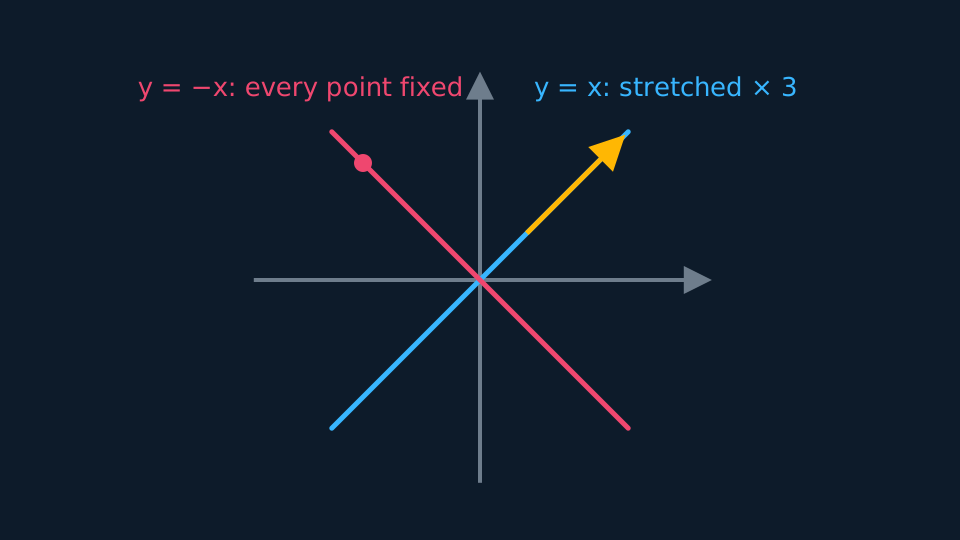
For the matrix with rows (2, 1), (1, 2), show that y = x and y = −x are invariant lines, and identify which is a line of fixed points.
Show the working
Take (1, 1) on y = x. Its image is (3, 3), which lies on y = x at three times the distance from the origin. The line is invariant, with scale factor 3.
Take (1, −1) on y = −x. Its image is (1, −1), unchanged. Every point of y = −x is fixed, so it is a line of invariant points.
A line of invariant points is always an invariant line; the converse is false, as y = x shows.
ASSESSMENT FOCUS
- Write Mv = b explicitly before inverting.
- With det = 0, compare ranks or test consistency before describing the geometry: a sheaf and a prism differ in the constants on the right-hand side.
- Distinguish 'invariant line' from 'line of invariant points', and say which you have shown.
- For lines y = mx + c with c ≠ 0, substitute a general point and match both coordinates.
CHECK YOURSELF
Solve the system 2x + y = 4, x + 3y = 7 by inverse matrix, and verify the answer.
Show a hint
The determinant is 5.
Show the answer
M has rows (2, 1), (1, 3) and determinant 5, so the inverse is (1/5) times rows (3, −1), (−1, 2). Then x = (3 × 4 − 7)/5 = 1 and y = (−4 + 14)/5 = 2. Check: 2 + 2 = 4 and 1 + 6 = 7.
det ≠ 0 gives the unique solution v = M⁻¹b; when det = 0, compare ranks or test consistency to decide between no solution and infinitely many.
An invariant line maps to itself as a set; a line of invariant points fixes each of its points.
WORKBOOK
Printable practice for this topic: original exam-style questions with room to work, and a fully worked answer book. Free to use; please do not redistribute or sell.
Or read them with their worked answers on the systems of equations and invariance questions page.
USED LATER IN
CHECK YOUR PROGRESS
Rate how confident you feel with each objective for this lesson. Ratings are saved in this browser, on this device, unless you sign in.
- Write simultaneous equations as a matrix equation and solve with an inverse.
- Interpret consistent and inconsistent three-plane systems geometrically.
- Find invariant points and invariant lines of a matrix transformation.
Open the full revision checklist to see every objective in the course in one place.