Maths › Matrices › Determinants and inverses
Determinants and inverses
The determinant tests invertibility and gives the signed scale factor of a linear transformation. Use |det M| for area or volume scaling and the sign for orientation. If det M ≠ 0, an inverse exists; if det M = 0, the image has lower dimension and no inverse exists. Find inverses in the 2 × 2 and 3 × 3 cases, and use row and column operations to factorise a determinant.
Builds on Matrix algebra and transformations.
IN THIS TOPIC
- Evaluate 2 × 2 and 3 × 3 determinants and interpret them as scale factors.
- Use row and column operations to simplify a determinant and return it in factorised form.
- Recognise singular matrices and describe the lower-dimensional image a zero determinant gives.
- Find and verify inverses of 2 × 2 and 3 × 3 matrices, and use det(AB) = det A det B and the reversal rule for products.
COMMON MISCONCEPTION
Every matrix has an inverse, just as every non-zero number has a reciprocal.
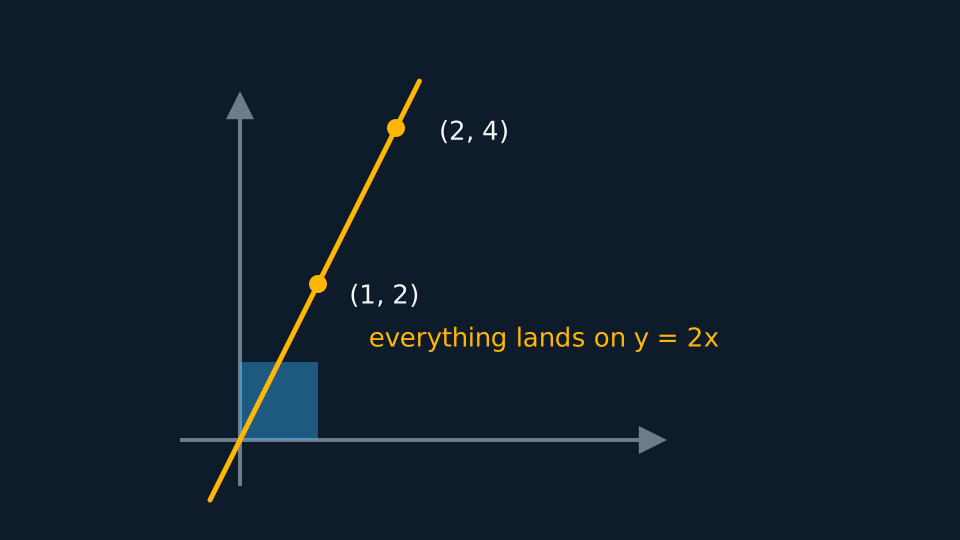
A square matrix has an inverse only when its determinant is non-zero. If det M = 0 the matrix is singular and its image has lower dimension: rows (1, 2) and (2, 4) send the whole plane onto the line y = 2x, so distinct points share an image and no mapping undoes that. State the determinant before writing any inverse, since it also supplies the divisor.
The determinant
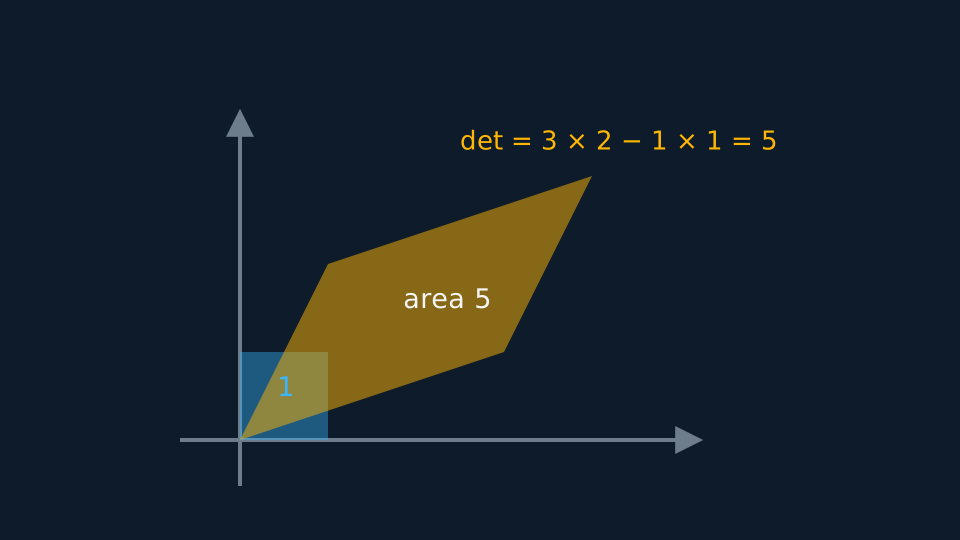
For a 2 × 2 matrix with rows (a, b) and (c, d), the determinant is ad − bc. For a two-dimensional transformation |det M| is the area scale factor; in three dimensions it is the volume scale factor. The sign records whether orientation is preserved or reversed. If det M = 0, the transformation has a lower-dimensional image and M is singular. The unit square maps to a parallelogram of area |ad − bc|.
A 3 × 3 determinant expands along its top row. Each entry multiplies the 2 × 2 determinant left after deleting its own row and column, with signs +, −, + across the row. For rows (1, 2, 0), (0, 1, 3), (2, 0, 1) the expansion gives 1(1 − 0) − 2(0 − 6) + 0 = 13. In three dimensions that number is the volume scale factor, so the unit cube becomes a parallelepiped of volume 13.
Determinants multiply: det(AB) = det A × det B, for square matrices of the same size. This follows from the scale-factor interpretation: applying B and then A scales area by det B and then by det A, so the composite scales it by the product, and the same argument applies to volume in three dimensions. Two consequences follow. A product is singular if either factor is, since the product of the determinants is then zero. And taking B = A⁻¹ gives det(A⁻¹) = 1/det A, since AA⁻¹ = I has determinant 1.
Operating on rows and columns
Expansion is not the only method, and for a determinant with algebraic entries it is usually not the shortest. Three operations change the value in a known way, and they are used to produce zeros before expanding.
Swapping two rows reverses the sign. Multiplying one row by k multiplies the determinant by k, which read backwards lets a factor common to a whole row be taken outside; multiplying the entire 3 × 3 matrix by k multiplies the determinant by k³, since that scales three rows rather than one. Adding any multiple of one row to another leaves the determinant unchanged; this is the operation used most often.
The third operation can be justified as follows. Expanding along the altered row shows the determinant to be additive in that row, so the new determinant is the old one plus a second determinant whose row i is k times row j. That second determinant has two proportional rows, and a determinant with two equal rows is zero: exchanging the identical pair leaves the matrix as it was, yet the swap rule says the sign must reverse, so D = −D. Proportional rows go the same way once the factor has been taken outside.
Each of these statements holds for columns as well as rows, because a matrix and its transpose have the same determinant. The purpose is factorisation: a determinant with algebraic entries is usually required as a product of factors, which row and column operations produce, whereas expansion produces an expanded polynomial.
WORKED EXAMPLE
A determinant handed back in factors
Factorise the determinant with rows (x, 1, 1), (1, x, 1) and (1, 1, x).
Every column adds up to x + 2, so replace row 1 by the sum of all three rows. Adding rows changes nothing, and the top row is now (x + 2, x + 2, x + 2).
Take the common factor out of that row. The determinant is (x + 2) times the determinant with rows (1, 1, 1), (1, x, 1), (1, 1, x).
Now produce zeros. Subtract column 1 from column 2 and from column 3, which again changes nothing, leaving rows (1, 0, 0), (1, x − 1, 0) and (1, 0, x − 1).
Expanding along the top row gives (x − 1)², so the determinant is (x + 2)(x − 1)². At x = 3 that reads 5 × 4 = 20, and expanding rows (3, 1, 1), (1, 3, 1), (1, 1, 3) directly gives 20 as well.
GUIDED PRACTICE
Three factors out of one determinant
Factorise the determinant with rows (1, 1, 1), (a, b, c) and (a², b², c²).
Show the working
Subtract column 1 from column 2 and from column 3. The value is unchanged and the top row becomes (1, 0, 0).
Expanding along that row leaves the 2 × 2 determinant with rows (b − a, c − a) and (b² − a², c² − a²).
Take b − a out of the first column and c − a out of the second, using b² − a² = (b − a)(b + a). What is left has rows (1, 1) and (b + a, c + a), of value c − b.
So the determinant is (b − a)(c − a)(c − b). Test it at a = 1, b = 2, c = 3: the factors give 1 × 2 × 1 = 2, and expanding rows (1, 1, 1), (1, 2, 3), (1, 4, 9) gives 6 − 6 + 2 = 2.
When the determinant is zero
When the determinant is zero the matrix is singular and the image has lower dimension: a singular 2 × 2 matrix maps the plane to a line or to the origin, and a singular 3 × 3 matrix maps space to a plane, a line or the origin. Distinct points then have the same image, so the mapping is not one-to-one and no inverse exists.
The 2 × 2 inverse
For det ≠ 0 the inverse exists and satisfies A⁻¹A = AA⁻¹ = I. In the 2 × 2 case there is a closed formula: swap the leading-diagonal entries, negate the other two, and divide by the determinant.
WORKED EXAMPLE
An inverse, found and checked
Find the inverse of the matrix M with rows (3, 1), (1, 2).
det M = 3 × 2 − 1 × 1 = 5.
Swap, negate, divide: M⁻¹ = (1/5) × the matrix with rows (2, −1), (−1, 3).
Check by multiplying: MM⁻¹ = rows (1, 0), (0, 1), the identity. One multiplication confirms the signs.
For a product the inverse reverses the order: (AB)⁻¹ = B⁻¹A⁻¹. The transformation AB applies B first and A second, so its inverse applies A⁻¹ first and B⁻¹ second.
GUIDED PRACTICE
Two determinants and an inverse
Find the determinants of the matrices with rows (5, 2), (7, 3) and rows (6, 4), (3, 2); invert whichever is invertible.
Show the working
First, det = 15 − 14 = 1. Second, det = 12 − 12 = 0, so it is singular and has no inverse.
The first is invertible. With determinant 1 the inverse is obtained by swapping and negating: rows (3, −2), (−7, 5).
Multiplying back gives I.
The 3 × 3 inverse
The 3 × 3 case has five steps. Compute the determinant. Replace every entry by its minor, the 2 × 2 determinant obtained by deleting that entry's row and column. Apply the alternating pattern of signs to turn minors into cofactors. Transpose. Divide by the determinant.
WORKED EXAMPLE
Inverting a 3 × 3 matrix
Find the inverse of M with rows (1, 2, 3), (0, 1, 4), (5, 6, 0).
Determinant along the top row: 1(0 − 24) − 2(0 − 20) + 3(0 − 5) = −24 + 40 − 15 = 1.
Matrix of minors, rows (−24, −20, −5), (−18, −15, −4), (5, 4, 1).
Apply the signs to get cofactors, rows (−24, 20, −5), (18, −15, 4), (5, −4, 1), then transpose.
Since det = 1, the inverse is rows (−24, 18, 5), (20, −15, −4), (−5, 4, 1). Multiply back to check that the product is I.
The 3 × 3 inverse arises mainly in solving simultaneous equations, and a calculator can produce it directly. A 'show that' question requires the minors, the signs and the transpose to be shown, so use the full method there.
ASSESSMENT FOCUS
- State the determinant before writing any inverse: it establishes that the inverse exists and supplies the divisor.
- Keep the 1/det outside the matrix until the final line.
- For 3 × 3 expansions, write the +, −, + signs above the top row before starting.
- Include the transpose in the 3 × 3 inverse: the matrix of cofactors alone is not the adjugate.
- Verify an inverse by multiplying back to I.
- When the entries are algebraic, use row and column operations before expanding: a 'factorise the determinant' question requires the factorised form.
- Name each operation as you use it, in the form R1 → R1 + R2 + R3 or C2 → C2 − C1, so the value can be followed line by line.
CHECK YOURSELF
The matrix with rows (4, k), (2, 3) is singular. Find k, and describe what the transformation does to the plane at that value.
Show a hint
Set the determinant to zero.
Show the answer
12 − 2k = 0, so k = 6. With rows (4, 6), (2, 3), both columns lie along the direction (2, 1), so the image of the whole plane is the line y = x/2 and no inverse exists.
|det M| is the area scale factor in two dimensions and the volume scale factor in three; the sign records whether orientation is preserved or reversed.
A zero determinant means the image has lower dimension, so there is no inverse.
2 × 2 inverse: swap the diagonal, negate the off-diagonal, divide by the determinant. 3 × 3 inverse: minors, signs, transpose, divide.
Adding a multiple of one row or column to another leaves a determinant unchanged, scaling one scales it, swapping two flips the sign, and det(AB) = det A × det B.
WORKBOOK
Printable practice for this topic: original exam-style questions with room to work, and a fully worked answer book. Free to use; please do not redistribute or sell.
Or read them with their worked answers on the determinants and inverses questions page.
USED LATER IN
CHECK YOUR PROGRESS
Rate how confident you feel with each objective for this lesson. Ratings are saved in this browser, on this device, unless you sign in.
- Evaluate 2 × 2 and 3 × 3 determinants and interpret them as scale factors.
- Use row and column operations to simplify a determinant and return it in factorised form.
- Recognise singular matrices and describe the lower-dimensional image a zero determinant gives.
- Find and verify inverses of 2 × 2 and 3 × 3 matrices, and use det(AB) = det A det B and the reversal rule for products.
Open the full revision checklist to see every objective in the course in one place.