Maths › Further Pure 2 › Eigenvalues and eigenvectors
Eigenvalues and eigenvectors
An eigenvector is a non-zero vector whose direction is unchanged by a linear transformation; its eigenvalue is the corresponding scale factor. Solve det(M − λI) = 0 for eigenvalues, then solve (M − λI)v = 0 for each eigenspace. State whether the calculation is over the real or complex numbers.
Builds on Determinants and inverses and Systems of equations and invariance.
IN THIS TOPIC
- Form and solve the characteristic equation of a 2 × 2 or 3 × 3 matrix.
- Find eigenvectors for each eigenvalue, and normalise them when asked.
- Interpret real eigenvectors as the directions whose line the transformation maps to itself.
- Say what repeated and non-real eigenvalues mean for the transformation, and over which field the calculation is being made.
COMMON MISCONCEPTION
Every real matrix has a real direction it leaves on its own line.
Over the complex numbers every square matrix has an eigenvalue, but a real matrix need not have a real eigenvector. A planar rotation through an angle that is not an integer multiple of π maps no real line to itself, and its characteristic equation delivers a non-real conjugate pair instead. State which field the calculation is being made over before counting eigenvalues.
Directions the transformation preserves
An eigenvector is a non-zero vector v with Mv = λv, where the scalar eigenvalue λ is the factor by which v is scaled. Rearranging to (M − λI)v = 0 requires M − λI to be singular if v is to be non-zero, which gives the characteristic equation.
Over C, every square matrix has at least one eigenvalue. A real matrix may have no real eigenvectors; a planar rotation through an angle that is not an integer multiple of π is the standard example. State whether the calculation is being made over the real or the complex numbers before counting eigenvalues.
WORKED EXAMPLE
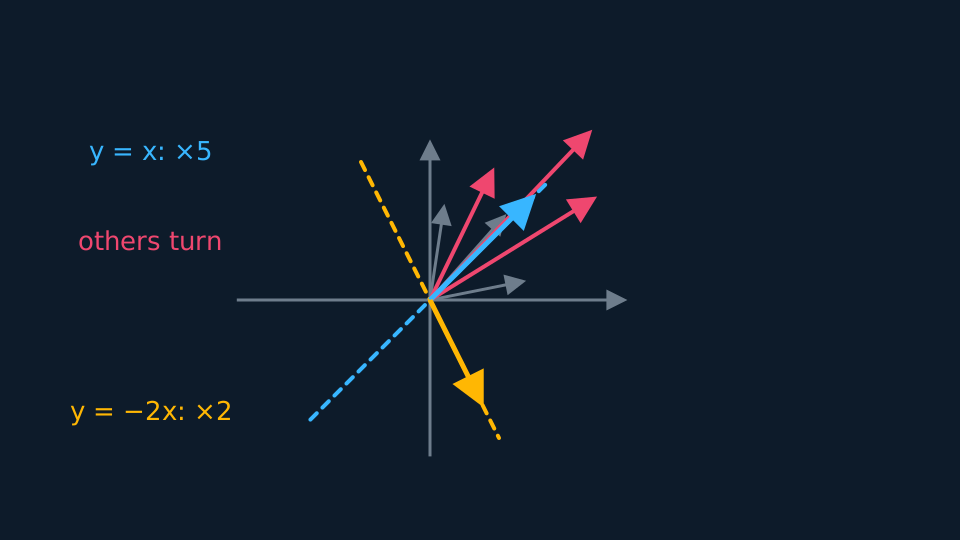
Both eigen-pairs of a 2 × 2
Find the eigenvalues and eigenvectors of the matrix with rows (4, 1) and (2, 3).
The characteristic equation is λ² − 7λ + 10 = 0, built from the trace 7 and the determinant 10, so λ = 5 or λ = 2.
For λ = 5: (4 − 5)x + y = 0 gives y = x, so v = (1, 1) and indeed Mv = (5, 5).
For λ = 2: 2x + y = 0 gives y = −2x, so v = (1, −2) and Mv = (2, −4) = 2v.
These are the invariant lines from the core matrices unit, now with their stretch factors named.
Three dimensions
For a 3 × 3 matrix the characteristic equation is a cubic, so there are three eigenvalues counted with repeats. Substitute each back into (M − λI)v = 0 and the system always has a free parameter, since the matrix is singular by construction. Any non-zero solution will do, because an eigenvector is only ever determined up to a scalar multiple.
WORKED EXAMPLE
A symmetric 3 × 3
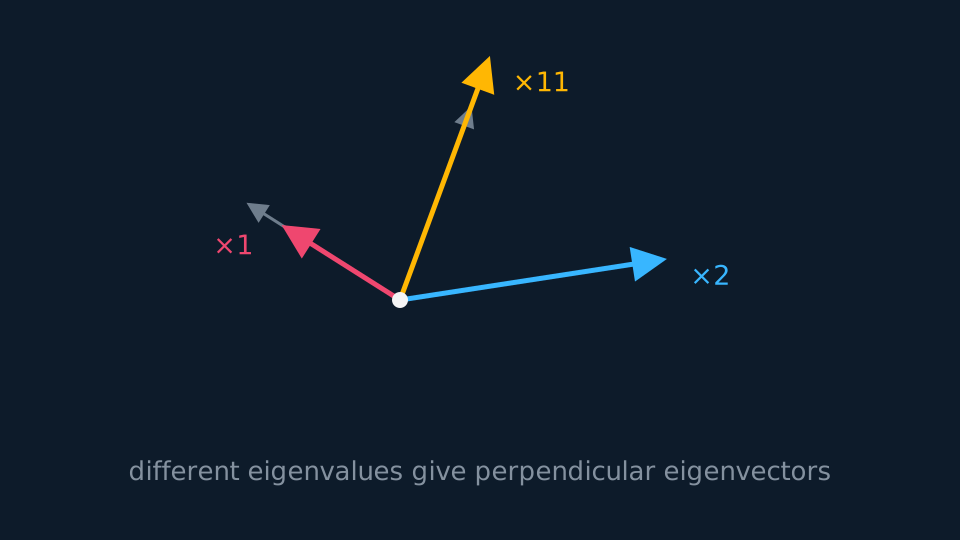
Find the eigenvalues and eigenvectors of the matrix with rows (2, 0, 0), (0, 3, 4) and (0, 4, 9).
The first row and column isolate the direction (1, 0, 0) with λ = 2. What remains is the 2 × 2 block with rows (3, 4) and (4, 9), of trace 12 and determinant 11, so λ² − 12λ + 11 = 0 and λ = 1 or 11.
Write the block's variables as y and z. For λ = 11: −8y + 4z = 0, giving (0, 1, 2). For λ = 1: 2y + 4z = 0, giving (0, 2, −1).
The eigenvalues are 1, 2 and 11. Note that (0, 1, 2)·(0, 2, −1) = 0. Eigenvectors of a real symmetric matrix belonging to different eigenvalues are perpendicular, and all three eigenvalues differ here, so that scalar product checks the working.
Normalising, repeats and complex pairs
Normalising divides an eigenvector by its length to give a unit vector, so (0, 1, 2) becomes (0, 1/√5, 2/√5). Questions ask for this when the eigenvectors are about to be used as the columns of an orthogonal matrix, and the surds are unavoidable.
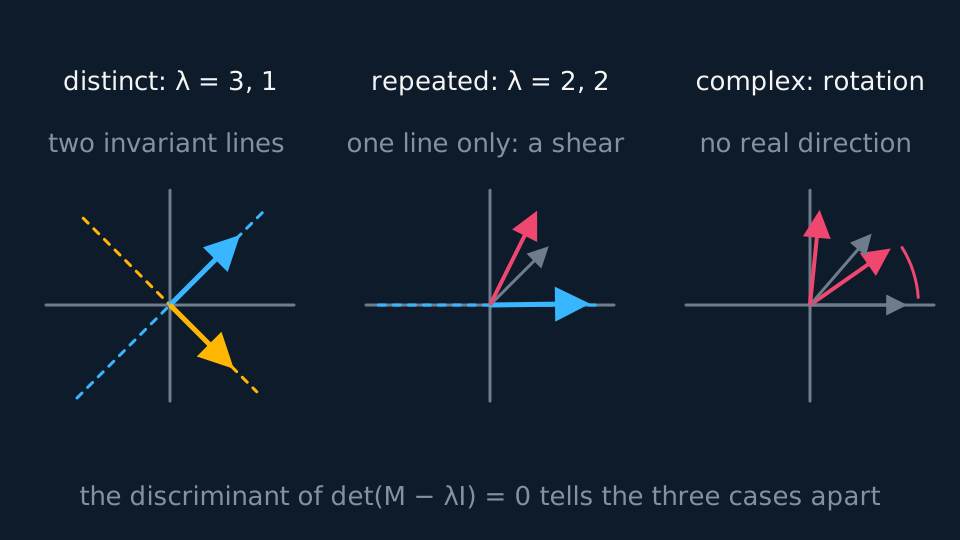
A repeated eigenvalue may come with a whole plane of eigenvectors rather than a single line, and any two independent directions from that plane may then be chosen. It may equally come with only one independent direction, as for a shear.
For a real 2 × 2 matrix, a non-real conjugate pair means there are no real eigenvectors and may indicate a rotational component. It does not by itself make the transformation a rotation: any real 2 × 2 matrix whose characteristic equation has negative discriminant has such a pair, including ones that also scale.
Describe the drawing
Three panels. In the first a symmetric matrix leaves two dashed lines invariant, stretching one direction by three and the other by one. In the second a shear has the eigenvalue two twice but only a single invariant line, and a grey off-line vector is visibly carried off its direction. In the third a rotation turns every drawn vector by the same angle, so no real eigenvector exists and the characteristic equation's discriminant is negative, a complex pair.
GUIDED PRACTICE
A quick characteristic equation
Find the eigenvalues of the matrix with rows (5, 2) and (2, 2).
Show the working
Trace 7 and determinant 10 − 4 = 6, so λ² − 7λ + 6 = 0.
Factorising gives (λ − 1)(λ − 6) = 0, so λ = 1 or 6.
The sum of the eigenvalues is the trace and their product is the determinant, which checks both roots in one line.
ASSESSMENT FOCUS
- Write det(M − λI) = 0 explicitly before expanding it, so the characteristic equation is on the page.
- For a 2 × 2, quote λ² − (trace)λ + determinant = 0 and save yourself the expansion.
- Any non-zero multiple of an eigenvector is an eigenvector, so state that rather than looking for a single canonical one.
- Check every pair by computing Mv and comparing with λv, which catches sign slips.
- Normalise only when the question asks, and leave the surds in exact form when you do.
- Say whether you are working over the real or the complex numbers; a real matrix with a non-real conjugate pair has no real eigenvectors.
CHECK YOURSELF
A 2 × 2 matrix has eigenvalues 3 and −4. Write down its trace and determinant.
Show a hint
The characteristic equation is λ² − (trace)λ + det = 0.
Show the answer
Trace = 3 + (−4) = −1 and determinant = 3 × (−4) = −12. The eigenvalues fix both, even without seeing the matrix.
Eigenvectors satisfy Mv = λv with v non-zero; solve det(M − λI) = 0 for the eigenvalues, then solve (M − λI)v = 0 for each eigenspace.
Over C every square matrix has an eigenvalue; a real matrix need not have a real eigenvector, and a rotation through an angle that is not a multiple of π is the standard example.
Trace is the sum of the eigenvalues and determinant their product; a real symmetric matrix has perpendicular eigenvectors whenever the eigenvalues differ.
WORKBOOK
Printable practice for this topic: original exam-style questions with room to work, and a fully worked answer book. Free to use; please do not redistribute or sell.
Or read them with their worked answers on the eigenvalues and eigenvectors questions page.
CHECK YOUR PROGRESS
Rate how confident you feel with each objective for this lesson. Ratings are saved in this browser, on this device, unless you sign in.
- Form and solve the characteristic equation of a 2 × 2 or 3 × 3 matrix.
- Find eigenvectors for each eigenvalue, and normalise them when asked.
- Interpret real eigenvectors as the directions whose line the transformation maps to itself.
- Say what repeated and non-real eigenvalues mean for the transformation, and over which field the calculation is being made.
Open the full revision checklist to see every objective in the course in one place.