Maths › Sequences and series › Arithmetic series
Arithmetic series
An arithmetic sequence adds a constant common difference at each step. The sum formula is proved by writing the sum forwards and backwards and adding, which pairs the terms into equal totals. The formula is given in the formulae booklet, and Edexcel 9MA0 4.4 also requires the proof.
Builds on Sequences and sigma notation.
IN THIS TOPIC
- Use un = a + (n − 1)d fluently, including to recover a and d from two given terms.
- Prove the sum formula, and use it in both of its forms.
- Apply arithmetic series to modelling, saving schemes included.
COMMON MISCONCEPTION
The 10th term of an arithmetic sequence is a + 10d.
The 10th term is a + 9d. The bracket in un = a + (n − 1)d counts steps rather than terms, and reaching the 10th term takes nine steps, so a + 10d is the 11th term. The same counting recovers d from two given terms: from the 3rd to the 10th is seven steps, so 7d is the difference between them.
The nth term
An arithmetic sequence increases by a fixed common difference d from a first term a, so the nth term is
which must be learnt. The bracket counts steps rather than terms: reaching the 10th term takes nine steps, so it is a + 9d, and a + 10d is the 11th term.
WORKED EXAMPLE
Two terms pin the sequence
The 3rd term of an arithmetic sequence is 14 and the 10th term is 35. Find a and d, and the 20th term.
From the 3rd to the 10th is seven steps, so 7d = 35 − 14 = 21 and d = 3.
Then a + 2d = 14 gives a = 8.
u20 = 8 + 19 × 3 = 65.
Subtracting the two given terms eliminates a and leaves d times the number of steps between them, here 10 − 3 = 7.
The sum, and its proof
The sum of the first n terms has a closed formula, printed in the booklet in two equivalent forms,
with l the last term. Edexcel 9MA0 4.4 requires the proof. Write the sum forwards, write it again backwards underneath, and add: each of the n columns totals a + l, so twice the sum is n(a + l), and halving gives the formula. ∎
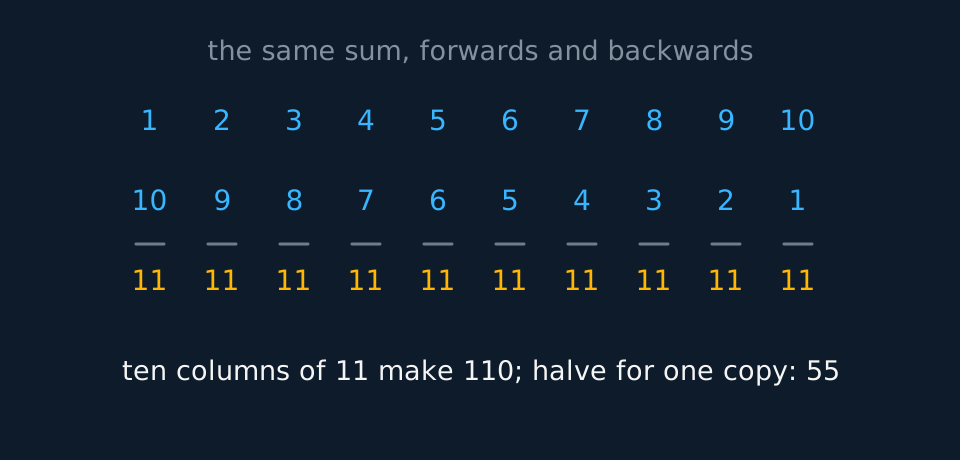
Run the same argument on 1 + 2 + … + n and you get the sum of the first n natural numbers, n(n + 1)/2. Once proved, quote it freely.
WORKED EXAMPLE
A sum from scratch
Find the sum of the first 20 terms of 5 + 9 + 13 + …
Here a = 5 and d = 4, so S20 = 10 × (10 + 19 × 4) = 10 × 86 = 860.
The last-term form agrees. l = 5 + 19 × 4 = 81, and 10 × (5 + 81) = 860.
The two forms of the formula give the same value, so computing both checks the result.
GUIDED PRACTICE
Recover, then sum
Using a = 8 and d = 3 from the last worked example's sequence, find S15, before opening the working.
Show the working
S15 = (15/2)(2 × 8 + 14 × 3) = 7.5 × 58 = 435.
Keep the factor n/2 outside the bracket while evaluating the bracket, then multiply once.
Series that save money
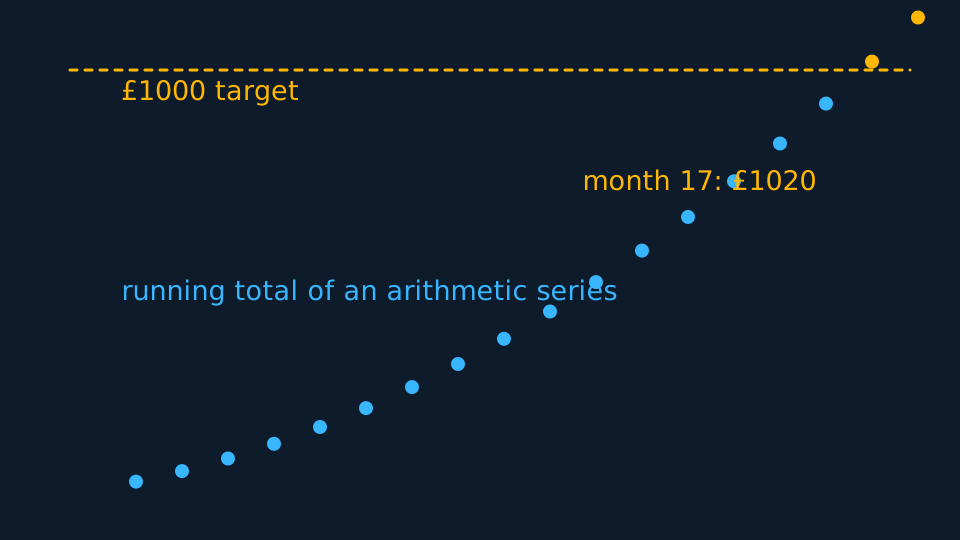
An arithmetic series models a quantity increasing by equal instalments, such as a saving scheme with a fixed increase each month. Asking when the total first exceeds a target gives a quadratic inequality in n, whose solution is rounded up, since n counts whole months.
INDEPENDENT PRACTICE
When does the pot pass £1000?
A saver deposits £20 in month 1, and each month deposits £5 more than the month before. Show that the total after n months is n(5n + 35)/2, and find the month in which the total first exceeds £1000.
Show the working
The deposits are arithmetic with a = 20 and d = 5, so Sn = (n/2)(40 + 5(n − 1)) = n(5n + 35)/2.
Setting n(5n + 35)/2 > 1000 gives n2 + 7n − 400 > 0, and the positive root of the equation is n = (−7 + √1649)/2 = 16.8.
The first whole month past that is month 17, where the total is £1020. Month 16 gives £920 and falls short.
State the rounding: for “first exceeds”, round up, and give the totals for the months either side to show where the target is passed.
ASSESSMENT FOCUS
- Reaching the nth term takes n − 1 steps, so write the bracket (n − 1) before substituting numbers into it.
- Recover d by subtracting two given terms and dividing by the number of steps between their positions.
- Quote the sum formula, then substitute. The forwards-and-backwards proof is itself examinable.
- In target questions, solve the inequality, round n up, and give the sums for the values either side of the crossing.
- Sigma limits starting above 1 mean subtracting two sums. The terms from 5 to 20 give S20 − S4.
CHECK YOURSELF
Prove that the sum of the first n natural numbers is n(n + 1)/2, and evaluate the sum of the first 100.
Show a hint
Forwards, backwards, add the columns.
Show the answer
Write S = 1 + 2 + … + n over S = n + … + 2 + 1 and add. Each of the n columns totals n + 1, so 2S = n(n + 1) and S = n(n + 1)/2. ∎
For n = 100 the formula gives 100 × 101/2 = 5050.
The calculation is the proof applied with n = 100: one hundred columns of 101, halved.
The nth term is a plus (n − 1) common differences: count steps between terms rather than term positions.
Adding the sum forwards to the sum backwards gives n columns each totalling a + l, so the sum is n(a + l)/2.
WORKBOOK
Printable practice for this topic: original exam-style questions with room to work, and a fully worked answer book. Free to use; please do not redistribute or sell.
Or read them with their worked answers on the arithmetic series questions page.
USED LATER IN
CHECK YOUR PROGRESS
Rate how confident you feel with each objective for this lesson. Ratings are saved in this browser, on this device, unless you sign in.
- Use un = a + (n − 1)d fluently, including to recover a and d from two given terms.
- Prove the sum formula, and use it in both of its forms.
- Apply arithmetic series to modelling, saving schemes included.
Open the full revision checklist to see every objective in the course in one place.