Maths › Further algebra and series › Summing series and the method of differences
Summing series and the method of differences
Two methods give a closed form for a long sum: the standard results for the sums of powers of r, and the method of differences, in which each term is written as f(r) − f(r + 1) so that intermediate terms cancel in pairs and only terms from each end remain.
Builds on Sequences and sigma notation and Partial fractions and Arithmetic series.
IN THIS TOPIC
- Quote and combine the standard results for Σr, Σr² and Σr³.
- Use Σr to count the comparisons an algorithm makes, read its order off the dominant term, and say what doubling the list does to the work.
- Split a term into a difference and telescope the sum.
COMMON MISCONCEPTION
There is no way to sum 1/(1×2) + 1/(2×3) + … + 1/(n(n+1)) exactly; you can only add the terms up.
Partial fractions give 1/(r(r + 1)) = 1/r − 1/(r + 1), so consecutive terms cancel in pairs and the sum is exactly 1 − 1/(n + 1). That is the method of differences: write each term as f(r) − f(r + 1), write out both ends, and state which terms remain. At n = 4 the formula gives 4/5, and 1/2 + 1/6 + 1/12 + 1/20 confirms it.
Standard results
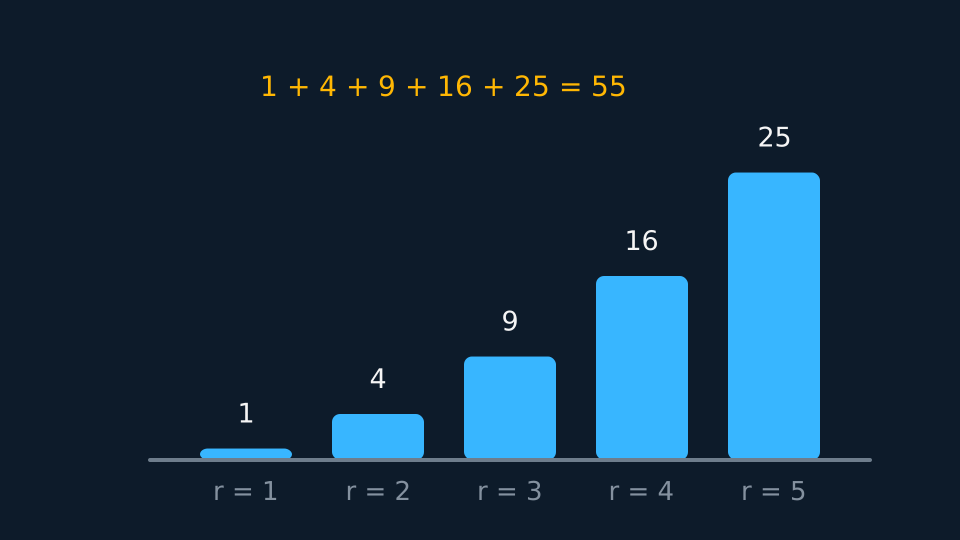
Three closed forms cover most of this topic.
Check the current formula booklet for your awarding organisation before assuming that a standard sum is supplied; provision differs between organisations, and Σr is often not printed. Any polynomial in r can be summed by splitting it into these standard sums, since sigma distributes over sums and constant factors can be taken outside. Note that Σr³ is the square of Σr: the sum of the first n cubes is the square of the sum of the first n integers.
Σr is also what decision maths counts with. An algorithm that compares each item on a list with each of the others makes 1 + 2 + … + (n − 1) = ½n(n − 1) comparisons, which is ½n² − ½n. The order of an algorithm is read off the dominant term, the one that outgrows the rest as n rises, so the −½n and the constant factor are discarded: this method is order n², written O(n²). Doubling the length of the list therefore multiplies the number of comparisons by approximately four.
WORKED EXAMPLE
A polynomial series
Show that Σ r(r + 1) from 1 to n equals n(n + 1)(n + 2)/3.
Split the sum: Σ r(r + 1) = Σ r² + Σ r = n(n+1)(2n+1)/6 + n(n+1)/2.
Take out the common factor n(n + 1)/6 to get n(n+1)[(2n + 1) + 3]/6 = n(n+1)(2n+4)/6.
So the sum is n(n + 1)(n + 2)/3. Check at n = 4: 2 + 6 + 12 + 20 = 40, and 4 × 5 × 6/3 = 40.
The method of differences
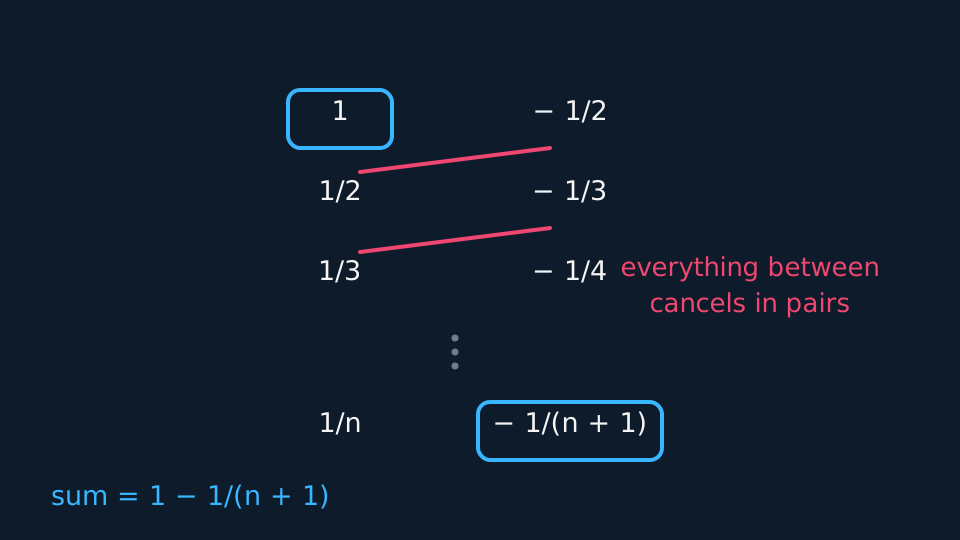
The method of differences applies when each term can be written as f(r) − f(r + 1), usually by partial fractions. Write out the first few terms and the last few in full. Each intermediate value appears once with a plus sign and once with a minus sign, so the sum reduces to the terms at the two ends.
WORKED EXAMPLE
A classic telescope
Find Σ 1/(r(r + 1)) from 1 to n.
Partial fractions give 1/(r(r + 1)) = 1/r − 1/(r + 1).
The sum is (1 − 1/2) + (1/2 − 1/3) + … + (1/n − 1/(n + 1)).
All the inner terms cancel in pairs, so the total is 1 − 1/(n + 1).
Check at n = 4: 1/2 + 1/6 + 1/12 + 1/20 = 4/5, and 1 − 1/5 = 4/5.
GUIDED PRACTICE
A gap-two telescope
Given that 1/(r(r + 2)) = ½(1/r − 1/(r + 2)), find Σ 1/(r(r + 2)) from 1 to n.
Show the working
With a gap of two, each term cancels against the term two rows further on, so two terms remain at each end.
The sum is ½(1 + 1/2 − 1/(n + 1) − 1/(n + 2)).
Tidied, that is 3/4 − (2n + 3)/(2(n + 1)(n + 2)). Check at n = 3: 1/3 + 1/8 + 1/15 = 21/40, and ½(3/2 − 1/4 − 1/5) = 21/40.
ASSESSMENT FOCUS
- Check the current formula booklet for your awarding organisation; Σr = ½n(n + 1) is often not supplied.
- The standard results start at r = 1. For a sum from r = k, subtract the sum up to k − 1.
- The order is read from the dominant term, with lower powers and constant factors discarded, so a count of ½n² − ½n is O(n²).
- Factorise while combining standard results rather than expanding first.
- In a method-of-differences answer, write at least two terms at each end before cancelling, and state which terms remain.
- A gap of two in the denominators leaves two terms at each end rather than one.
- When a question says 'hence', use the split obtained in the previous part.
CHECK YOURSELF
Evaluate Σ r² for r from 1 to 10.
Show a hint
n(n + 1)(2n + 1)/6 with n = 10.
Show the answer
10 × 11 × 21/6 = 385. Adding the ten squares directly confirms it, since 1 + 4 + 9 + … + 100 = 385.
Polynomial series split into Σr³, Σr² and Σr; check which of these your awarding organisation's formula booklet supplies.
The method of differences writes each term as f(r) − f(r + 1); write out both ends and state the terms that remain.
WORKBOOK
Printable practice for this topic: original exam-style questions with room to work, and a fully worked answer book. Free to use; please do not redistribute or sell.
Or read them with their worked answers on the summing series and the method of differences questions page.
USED LATER IN
CHECK YOUR PROGRESS
Rate how confident you feel with each objective for this lesson. Ratings are saved in this browser, on this device, unless you sign in.
- Quote and combine the standard results for Σr, Σr² and Σr³.
- Use Σr to count the comparisons an algorithm makes, read its order off the dominant term, and say what doubling the list does to the work.
- Split a term into a difference and telescope the sum.
Open the full revision checklist to see every objective in the course in one place.