Maths › Sequences and series › Sequences and sigma notation
Sequences and sigma notation
A sequence is defined either by a formula for the nth term or by a recurrence relation with a stated first term. Classify sequences as increasing, decreasing or periodic, giving the order of a periodic sequence, and use sigma notation for sums of terms.
Builds on Functions, inverses and the modulus.
IN THIS TOPIC
- Generate a sequence from an nth-term formula or from a recurrence, and classify how it behaves.
- Read and write sums in sigma notation.
- Total a stated number of terms of a sequence, by listing the terms or by pairing them where the sequence repeats.
COMMON MISCONCEPTION
A decreasing sequence must eventually go below zero.
A decreasing sequence need not be unbounded below. un = 1 + 1/n decreases at every step and stays above 1, so it never reaches zero, and un = 1/(3n + 1) sinks towards zero without arriving. Decreasing means un+1 < un at every step, and says nothing about where the terms end up.
Lists, and how they behave
An nth-term formula such as un = 1/(3n + 1) gives any term directly. A recurrence such as un+1 = 3un − 2 gives each term from the previous one, and it defines a sequence only when a first term is stated.
WORKED EXAMPLE
Running a recurrence
A sequence has u1 = 3 and un+1 = 3un − 2. Find the first four terms.
u2 = 3 × 3 − 2 = 7, then u3 = 3 × 7 − 2 = 19, then u4 = 3 × 19 − 2 = 55.
The list runs 3, 7, 19, 55, each term roughly tripling.
Write each substitution down: the terms follow from the recurrence, so the working is the sequence of substitutions rather than the list of values alone.
A sequence increases when un+1 > un at every step, and decreases when the inequality runs the other way. Either one may be called monotonic, the word for moving the same way throughout, which is the term further maths papers use. It is periodic if it repeats a fixed cycle, and the length of that cycle is called the order. The specification's own examples are 2n climbing, 1/(3n + 1) sinking, and un+1 = 1/un bouncing with period 2.
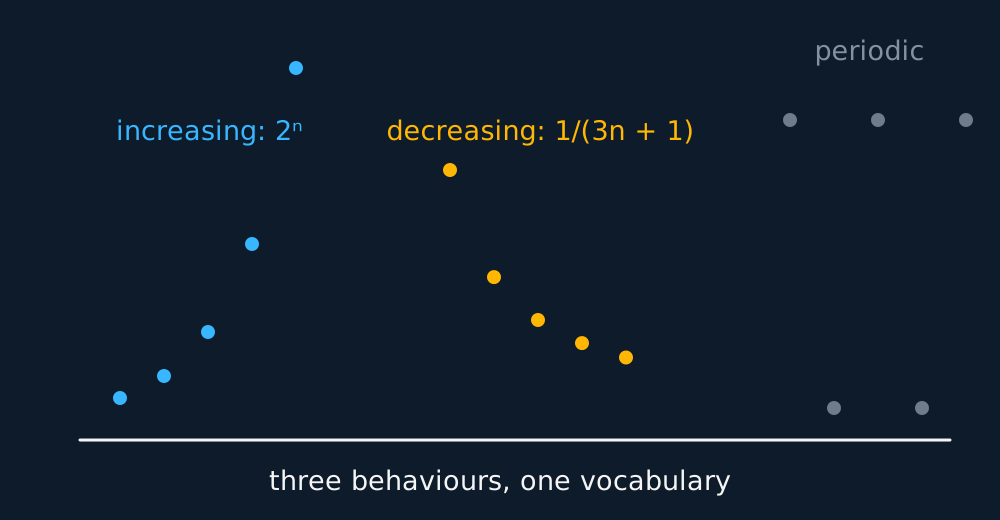
A decreasing sequence need not be unbounded below. The sequence un = 1 + 1/n decreases at every step and remains above 1, so it never reaches zero.
GUIDED PRACTICE
Classify with reasons
For un+1 = 1/un with u1 = 5, write down the first five terms and classify the sequence, before opening the working.
Show the working
The terms run 5, 1/5, 5, 1/5, 5.
Applying the rule twice returns the starting value, so the sequence is periodic with order 2.
A complete classification gives the order as well as the word periodic.
Sigma notation
Sigma notation records a sum in three pieces. Σ means add, the expression after it gives the general term, and the counter runs from the number below to the number above.
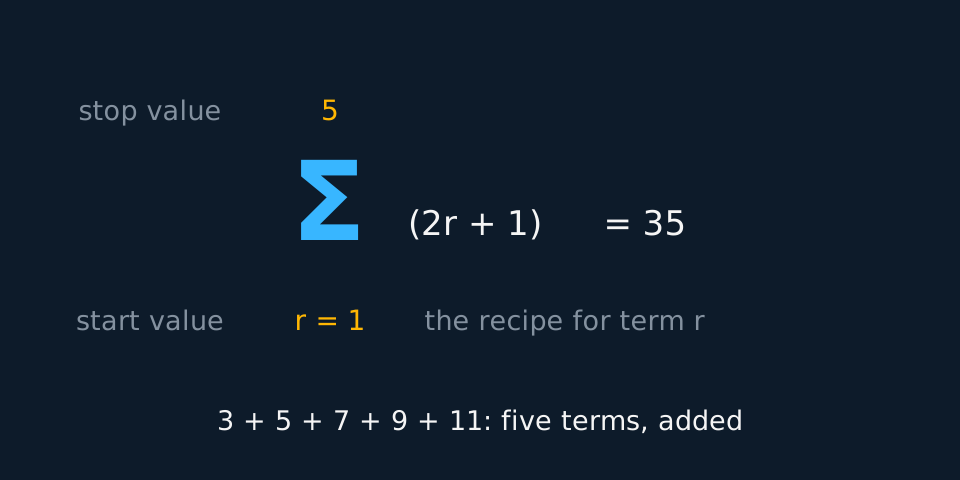
One result to remember: adding the constant 1 once for each of n terms gives Σ1 = n, which is used in the proof of the arithmetic sum formula.
INDEPENDENT PRACTICE
Both directions at once
Evaluate the sum of (2r + 1) for r from 1 to 5, and write the sum 4 + 9 + 14 + 19 + 24 in sigma notation.
Show the working
The terms are 3, 5, 7, 9, 11, totalling 35.
The second list increases in steps of 5 from 4, so term r is 5r − 1 and the sum is Σ(5r − 1) for r = 1 to 5.
A question may require a sum in sigma notation to be evaluated or a listed sum to be written in sigma notation.
ASSESSMENT FOCUS
- A recurrence defines a sequence only with a stated first term, so write u1 down before generating any terms.
- Classify with the comparison visible. Give un+1 − un and its sign, or exhibit the cycle, and for a periodic sequence state the order as well as the word.
- Identify the range of the counter and the expression for one term separately before evaluating a sum in sigma notation. For five or six terms, listing them is quicker than deriving a formula.
CHECK YOURSELF
A sequence has un = 40 − 3n. Find u10, determine when terms first go negative, and evaluate Σun for n from 1 to 4.
Show a hint
Linear in n throughout; list four terms for the sum.
Show the answer
u10 = 40 − 30 = 10.
Terms go negative once 40 − 3n < 0, so from n = 14 onward, u14 being −2.
The first four terms are 37, 34, 31, 28, so the sum is 130.
An nth-term formula gives any term directly; a recurrence gives each term from the previous one and needs a stated first term.
Classify a sequence as increasing, decreasing or periodic, giving the order in the periodic case; a sum in sigma notation states the counter, the expression for one term and the range.
WORKBOOK
Printable practice for this topic: original exam-style questions with room to work, and a fully worked answer book. Free to use; please do not redistribute or sell.
Or read them with their worked answers on the sequences and sigma notation questions page.
USED LATER IN
CHECK YOUR PROGRESS
Rate how confident you feel with each objective for this lesson. Ratings are saved in this browser, on this device, unless you sign in.
- Generate a sequence from an nth-term formula or from a recurrence, and classify how it behaves.
- Read and write sums in sigma notation.
- Total a stated number of terms of a sequence, by listing the terms or by pairing them where the sequence repeats.
Open the full revision checklist to see every objective in the course in one place.