Maths › Sequences and series › Geometric series
Geometric series
A geometric sequence multiplies by a constant ratio r at each step; the terms increase in size when |r| > 1 and tend to zero when |r| < 1. Multiplying the sum by r and subtracting proves the sum formula. An infinite geometric series converges when |r| < 1, and logarithms give the number of terms needed to reach a stated total.
Builds on Arithmetic series and Logarithms and their laws.
IN THIS TOPIC
- Use un = arn−1, and recover a and r from two given terms.
- Prove the finite sum formula by the subtraction trick, and use it.
- Say when a series converges, and find the sum to infinity.
- Answer how-many-terms and how-many-years questions with logarithms.
- Apply geometric series to modelling, compound growth included.
COMMON MISCONCEPTION
A sum that never ends must be infinite.
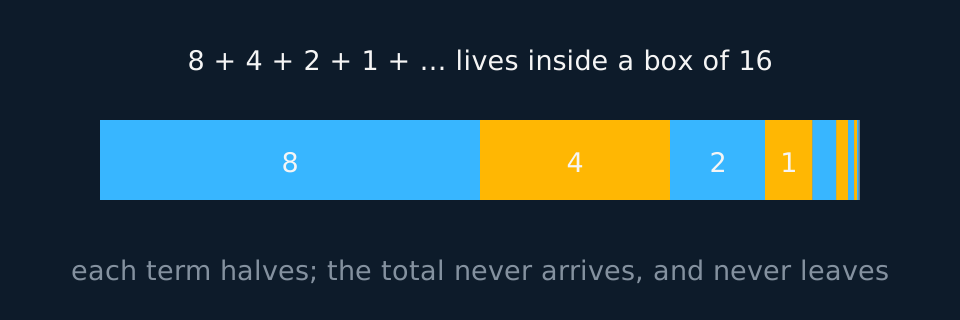
An infinite geometric series has a finite sum whenever |r| < 1, because the terms then decrease in size geometrically. For 8 + 4 + 2 + … the ratio is ½, and the partial sums increase towards 8/(1 − ½) = 16 without reaching it. State the condition |r| < 1 before using S∞ = a/(1 − r).
Ratio, term, sum
A geometric sequence multiplies by a fixed common ratio r at each step, so its nth term is
and the sum of the first n terms, printed in the booklet, is
Edexcel 9MA0 4.5 requires this proof. Multiply Sn by r and subtract the two lines: all but two terms cancel, leaving Sn − rSn = a − arn, and dividing by 1 − r, which requires r ≠ 1, gives the formula. ∎
WORKED EXAMPLE
A doubling series, summed
Find the sum of the first 10 terms of 3 + 6 + 12 + …
Here a = 3 and r = 2, so S10 = 3(210 − 1)/(2 − 1) = 3 × 1023 = 3069.
With r > 1 it is tidier to flip both brackets and write a(rn − 1)/(r − 1), which keeps every quantity positive.
The last term alone is 3 × 29 = 1536, more than half the total. Where |r| > 1 the later terms dominate the sum, which is useful when checking whether a total is of the right size.
The infinite sum
Where |r| < 1, rn tends to zero as n increases, so the term arn in the sum formula tends to zero and the sum tends to a finite limit,
An infinite sum has a finite value provided the terms decrease in size geometrically, that is provided |r| < 1.
GUIDED PRACTICE
Convergent, and summed
For the series 8 + 4 + 2 + …, explain why the sum to infinity exists and find it, before opening the working.
Show the working
The ratio is r = ½. Since |½| < 1, the series converges.
S∞ = 8/(1 − ½) = 16.
State the condition |r| < 1 before using the formula: the sum to infinity exists only when it holds.
Logs answer how long
A question asking how many terms, or how many years of compound growth, puts the unknown in an exponent, which is solved by taking logarithms of both sides.
INDEPENDENT PRACTICE
Money doubling
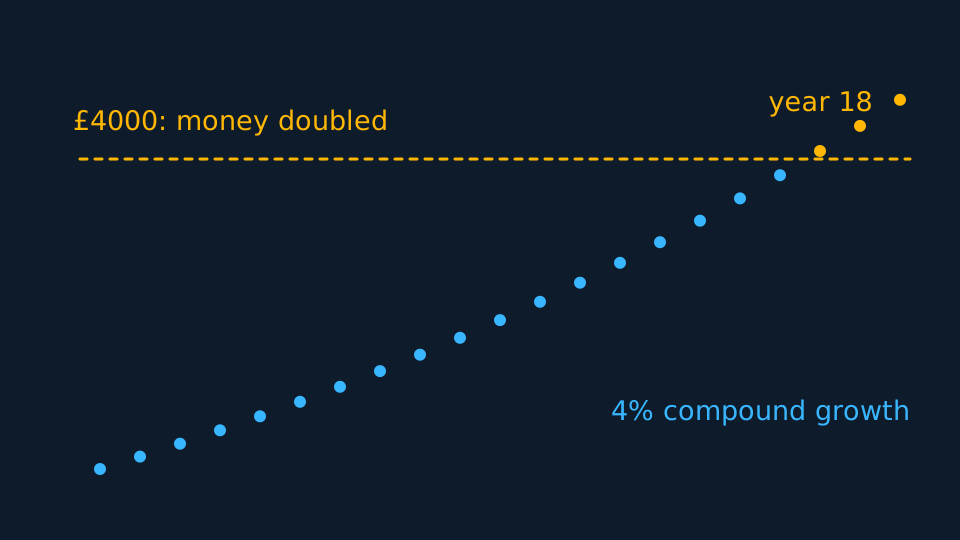
£2000 is invested at 4% compound interest per year. Show that the value after n years is 2000 × 1.04n, and find the first year in which the money has more than doubled.
Show the working
Each year multiplies the value by 1.04, so after n years it is 2000 × 1.04n, geometric growth with ratio 1.04.
Doubling needs 1.04n > 2. Taking logs gives n > ln 2/ln 1.04 = 17.67.
The first whole year past that is year 18, where the value is £4052. Year 17 gives £3896 and falls short.
Round up, then give the values for the years either side so that the crossing is shown.
ASSESSMENT FOCUS
- Write a and r down before using a formula: r is the ratio of consecutive terms, the second divided by the first.
- To prove the sum formula, multiply Sn by r, subtract the two lines, and show the cancellation.
- State |r| < 1 before using the sum to infinity: it is the condition for the series to converge.
- For r > 1, use the equivalent form a(rn − 1)/(r − 1), in which both brackets are positive.
- Recovering r from two non-adjacent terms means dividing, not subtracting. If u6/u3 = 8 then r3 = 8 and r = 2.
- A question asking for a number of terms ends with a logarithm and a rounding up. Give the neighbouring values so that the crossing is shown.
CHECK YOURSELF
For the series 5 + 4 + 3.2 + …, find the sum to infinity, and the sum of the first 10 terms to 4 significant figures.
Show a hint
The ratio is 0.8; then apply both formulae.
Show the answer
r = 4/5 = 0.8, and |0.8| < 1, so S∞ = 5/(1 − 0.8) = 25.
S10 = 5(1 − 0.810)/0.2 = 22.32 to 4 significant figures.
Ten terms give about 89% of the sum to infinity, since 0.810 ≈ 0.107.
Each term is r times the previous one, and subtracting rSn from Sn cancels all but two terms, which proves the sum formula for r ≠ 1.
The series converges when |r| < 1, with sum to infinity a/(1 − r); take logarithms to find the number of terms needed to reach a stated total.
WORKBOOK
Printable practice for this topic: original exam-style questions with room to work, and a fully worked answer book. Free to use; please do not redistribute or sell.
Or read them with their worked answers on the geometric series questions page.
USED LATER IN
CHECK YOUR PROGRESS
Rate how confident you feel with each objective for this lesson. Ratings are saved in this browser, on this device, unless you sign in.
- Use un = arn−1, and recover a and r from two given terms.
- Prove the finite sum formula by the subtraction trick, and use it.
- Say when a series converges, and find the sum to infinity.
- Answer how-many-terms and how-many-years questions with logarithms.
- Apply geometric series to modelling, compound growth included.
Open the full revision checklist to see every objective in the course in one place.