Maths › Trigonometry › Trigonometric modelling
Trigonometric modelling
Quantities that repeat, such as tides, daylight hours and the height of a point on a wheel, are modelled with sine and cosine. Read a model by identifying its centre line, amplitude, period and phase, and use the harmonic form on models containing both a sine and a cosine term.
Builds on Compound angles and the harmonic form and Functions in modelling.
Used in InkPhysics: Simple harmonic motion.
IN THIS TOPIC
- Build and read wheel-style models of the form k − R cos ωt, in radians.
- Extract centre, amplitude, period and phase from any periodic model.
- Use the harmonic form to analyse a model carrying two trig terms.
- Solve a model for the times at which it takes a given value, in a stated interval.
COMMON MISCONCEPTION
A bigger amplitude means a faster oscillation.
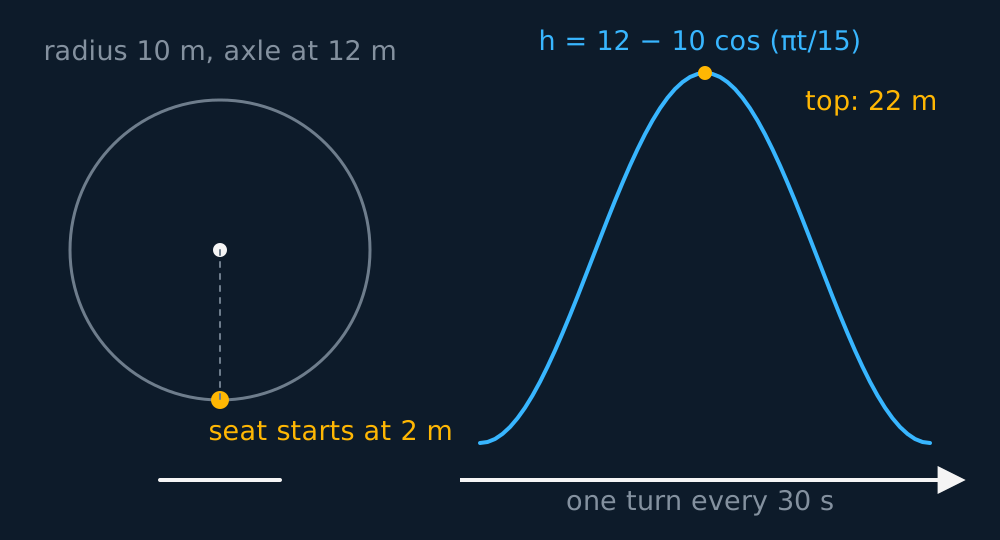
Amplitude and period are separate constants in separate positions. The amplitude R multiplies the trigonometric function and fixes how far the quantity varies from its centre line, while the coefficient ω sits inside the function and fixes the period, 2π/ω. In h = 12 − 10 cos (πt/15) the 10 is the wheel's radius and the π/15 gives one revolution every 30 s.
A seat on a wheel
A point on a turning wheel gives a direct periodic model. Put the axle at height k, give the wheel radius R and angular speed ω radians per second, and a seat starting at the bottom has height h = k − R cos ωt. cos 0 = 1, so h = k − R at t = 0, which is the lowest point of the wheel.
WORKED EXAMPLE
Reading the wheel
A wheel's seat height is modelled by h = 12 − 10 cos (πt/15), in metres and seconds. Find the period, the greatest and least heights, and the first time the seat is 17 m up.
The period is 2π ÷ (π/15) = 30 s, and h runs from 12 − 10 = 2 m up to 12 + 10 = 22 m.
Setting h = 17 gives cos (πt/15) = −½, so πt/15 = 2π/3 and t = 10 s.
Each constant in the formula corresponds to a feature of the wheel: the axle height is the centre line, the radius is the amplitude, and the coefficient of t determines the period as 2π divided by that coefficient.
Amplitude and period are separate quantities: the amplitude R multiplies the cosine and fixes how far the height varies from the centre line, while ω appears inside the cosine and fixes the period 2π/ω.
Two terms, one tide
A model may contain a sine term and a cosine term of the same period. The harmonic form combines them into a single sinusoid, from which the amplitude and phase can be read.
GUIDED PRACTICE
Combine, then read
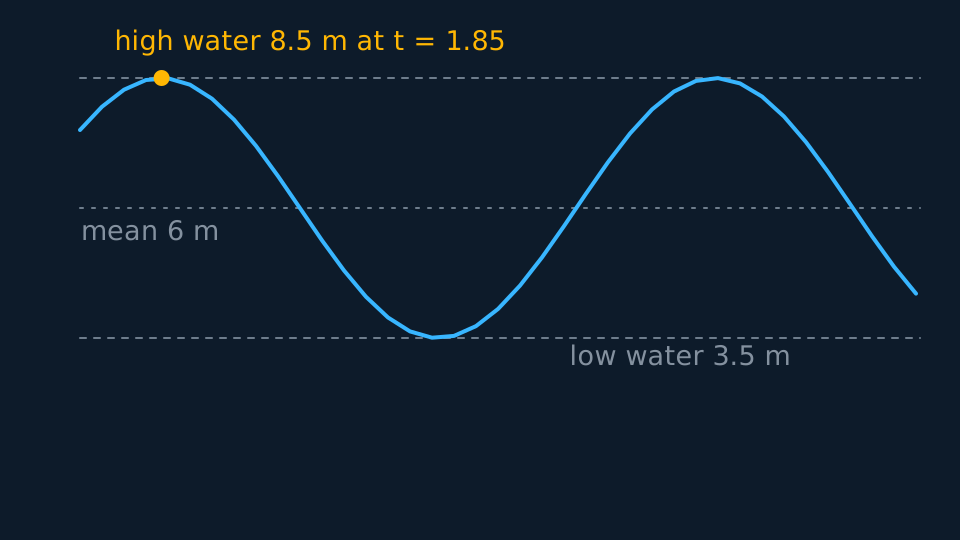
Water depth is modelled by d = 6 + 2 sin (0.5t) + 1.5 cos (0.5t), in metres and hours. Find the greatest and least depths, and the first time of high water, before opening the working.
Show the working
Combine the two trigonometric terms. R = √(4 + 2.25) = 2.5 and tan α = 1.5/2 gives α = 0.644, so d = 6 + 2.5 sin (0.5t + 0.644).
Depth runs from 6 − 2.5 = 3.5 m to 6 + 2.5 = 8.5 m.
High water needs 0.5t + 0.644 = π/2, so t = 1.85 hours, and every 4π hours after that.
The constant 6 is not part of the harmonic form: the combination applies to the oscillating terms, and the constant is the centre line about which they oscillate.
INDEPENDENT PRACTICE
Criticise the daylight model
Hours of daylight are modelled by D = 12 + 4.5 sin (2πt/365), with t in days after the spring equinox. State the period and the longest day, and give one reason the model needs refining for a real town.
Show the working
The period is 2π ÷ (2π/365) = 365 days, and the longest day is 12 + 4.5 = 16.5 hours, a quarter of a period in.
One limitation: amplitude depends on latitude, so a single fixed 4.5 cannot serve both Penzance and Aberdeen. The refinement is to fit the amplitude to local daylight data.
A complete criticism names the assumption, states the conditions under which it fails, and proposes a specific, testable refinement.
ASSESSMENT FOCUS
- Read the centre line, then the amplitude, then the period. Each corresponds to a fixed position in the formula.
- The period is 2π divided by the coefficient of t, with the angle in radians, so set the calculator to radians.
- Solve height and depth equations by substituting for the whole angle, widening the interval, solving and translating back, keeping exact multiples of π until the final answer.
- “First time” means the smallest positive solution; later times are that solution plus whole multiples of the period.
CHECK YOURSELF
A buoy's height above mean sea level is modelled by y = 1.2 sin (0.8t), in metres and seconds. Find the amplitude, the period, and the first time the buoy is 0.6 m above mean level.
Show a hint
sin = ½ has a familiar exact angle.
Show the answer
Amplitude 1.2 m, and the period is 2π/0.8 = 7.85 s.
For 0.6 m you need sin (0.8t) = ½, so 0.8t = π/6 and t = 0.654 s.
The next solution is at 0.8t = 5π/6. A periodic model has infinitely many solutions, one per period after each of these.
Centre line, amplitude and period are three separate constants, each in a fixed position in the formula.
Combine two-term models into harmonic form, and read the extreme values as the centre line plus or minus R.
WORKBOOK
Printable practice for this topic: original exam-style questions with room to work, and a fully worked answer book. Free to use; please do not redistribute or sell.
Or read them with their worked answers on the trigonometric modelling questions page.
CHECK YOUR PROGRESS
Rate how confident you feel with each objective for this lesson. Ratings are saved in this browser, on this device, unless you sign in.
- Build and read wheel-style models of the form k − R cos ωt, in radians.
- Extract centre, amplitude, period and phase from any periodic model.
- Use the harmonic form to analyse a model carrying two trig terms.
- Solve a model for the times at which it takes a given value, in a stated interval.
Open the full revision checklist to see every objective in the course in one place.