Physics › Periodic motion › Simple harmonic motion
Simple harmonic motion
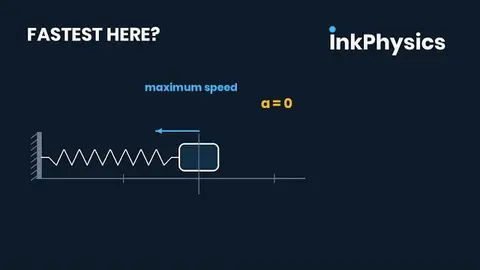
Simple harmonic motion is defined by a = −ω²x: the acceleration is proportional to the displacement and directed back towards equilibrium. From that condition follow x = A cos ωt, the speed ±ω√(A² − x²), a maximum speed ωA at the centre and a maximum acceleration ω²A at the extremes. The period is independent of the amplitude.
Choose your exam board to show the notes and questions relevant to your specification. You can change this setting at any time, and content for other boards remains available.
Builds on Circular motion and Motion graphs and the SUVAT equations.
The maths behind it: Trigonometric modelling on InkMaths.
IN THIS TOPIC
- Move between frequency, period and angular frequency, with f = 1/T and ω = 2πf.
- State and apply the SHM condition, a ∝ −x, and the defining equation a = −ω²x.
- Use x = A cos ωt and v = ±ω√(A² − x²) to place an oscillator at any moment.
- Locate vmax = ωA and amax = ω²A, and say where in the cycle each one happens.
- Sketch the x, v and a against t graphs and connect them through their gradients.
COMMON MISCONCEPTION
Bigger swings take longer.
In SHM the period is independent of amplitude. A larger swing travels further, but the restoring force and speed grow in proportion, so the period stays the same.
The defining condition
Simple harmonic motion is oscillation with one strict property. The acceleration is proportional to the displacement from equilibrium and directed against it, a ∝ −x. As an equation,
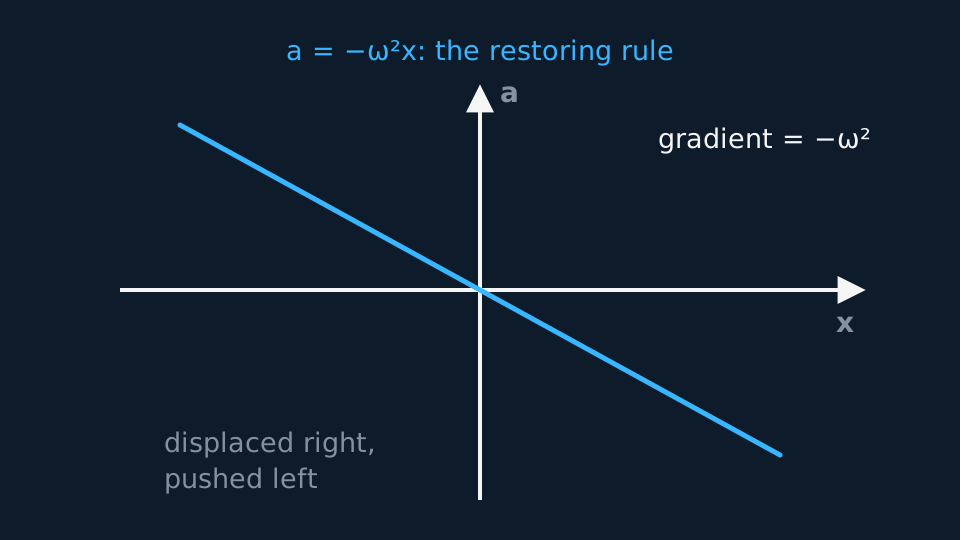
That minus sign carries the restoring character. Displaced right, accelerated left, always back towards the middle. The graph of a against x is the test for simple harmonic motion, a straight line through the origin of negative gradient −ω².
The solutions
An oscillator released from its amplitude A follows a cosine.
Its speed at any displacement follows from the exchange between kinetic and potential energy.
The ± matters. At any position short of the ends, the oscillator might be travelling either way. Two special cases fall straight out and are printed on the sheet. Maximum speed is ωA, reached at the centre where x = 0. Maximum acceleration is ω²A, reached at the extremes, where the displacement and so the restoring pull are largest.
The period is independent of the amplitude: neither ω nor T = 2π/ω contains A. A larger amplitude covers a greater distance at a proportionally greater speed, so the time per cycle is unchanged. SHM is isochronous, which is why pendulums were used to regulate clocks.
WORKED EXAMPLE
Where is it, and how fast?
An oscillator is released from its amplitude of 0.050 m and has a period of 2.0 s. Find its displacement and its speed 0.25 s after release.
Set the tools up first. ω = 2π/T = 3.14 rad s−1, and release from the amplitude means the cosine solution applies. Calculator into radians before anything else.
Displacement comes straight from x = A cos(ωt) = 0.050 × cos(3.14 × 0.25) = 0.050 × 0.707 = 0.035 m.
For the speed, use the equation for v. Its magnitude is ω × the square root of (A2 − x2) = 3.14 × 0.0354 = 0.11 m s−1.
Check it against the limits. Maximum speed here is ωA = 0.16 m s−1, and 0.11 sits below that, at a point about seven tenths of the way out from the centre. Consistent.
GUIDED PRACTICE
The pull towards the centre
The same oscillator, ω = 3.14 rad s−1, passes through x = +0.020 m. Start from the defining equation of SHM, find the acceleration there, and say which way it points.
Show the working
a = −ω2x = −(3.14)2 × 0.020 = −0.20 m s−2.
The minus sign carries the direction. Displacement is positive, so the acceleration points back towards the centre, which is the restoring condition that defines simple harmonic motion.
INDEPENDENT PRACTICE
Half the amplitude, not half the time
An oscillator with T = 2.0 s is released from its amplitude. How long does it take to first reach half its amplitude? Predict before calculating whether the answer is more or less than T/8, then work it through.
Show the working
Half amplitude means cos(ωt) = ½, and the first time that happens is at ωt = π/3, one sixth of a full 2π cycle.
So t = T/6 = 2.0/6 = 0.33 s.
That is longer than T/8 = 0.25 s. The oscillator starts from rest and moves slowly near the extreme, fastest through the centre, so the time taken is not proportional to the distance covered.
Graphs linked by gradients

Describe the drawing
A mass-spring oscillator, its three graphs drawing themselves over two periods, and the energy see-saw underneath. Where x crosses zero, v peaks and kinetic energy is full; at the extremes v dies, a peaks the other way, and the energy is all potential. After the graphs finish, the sweeping line replays them in step with the bob.
The three graphs are linked by gradients. The v–t graph is the gradient of the x–t graph, and the a–t graph is the gradient of the v–t graph, exactly as for motion graphs, applied here to a cosine. Two results follow. Velocity leads displacement by a quarter of a cycle, and the a–t graph is the x–t graph inverted and scaled by ω², which is a = −ω²x drawn against time. Any one of the three graphs determines the other two.
ASSESSMENT FOCUS
- Define SHM in words with both clauses. Acceleration proportional to displacement, and in the opposite direction, towards equilibrium.
- vmax = ωA happens at the centre, amax = ω²A at the extremes. State where each occurs as well as its value.
- The period does not depend on the amplitude, so a larger swing takes the same time.
- Graph work is gradient work, v from the slope of x–t and a from the slope of v–t. Check the zeros line up, since v is zero wherever x peaks.
- x = A cos ωt assumes timing starts at maximum displacement. Start at the centre and the sine version applies instead, so check the starting condition first.
CHECK YOURSELF
A point oscillates in SHM with amplitude 0.040 m and frequency 1.5 Hz. Find its maximum speed and maximum acceleration, and state where each occurs.
Show a hint
Build ω first; both maxima follow in one line each.
Show the answer
ω = 2πf = 2π × 1.5 = 9.42 rad s−1, so ω2 = 88.8 s−2.
Maximum speed is ωA = 9.42 × 0.040 = 0.38 m s−1, reached at the centre, where all the energy is kinetic.
Maximum acceleration is ω²A = 88.8 × 0.040 = 3.6 m s−2, reached at the extremes, where displacement and restoring pull are greatest.
Acceleration is proportional to displacement and directed towards equilibrium.
The period does not depend on the amplitude.
WORKBOOK
Printable practice for this topic: original exam-style questions with room to work, and a fully worked answer book. Free to use; please do not redistribute or sell.
Or read them with their mark schemes on the simple harmonic motion questions page.
WHERE TO GO NEXT
- Trigonometry and resolving vectors is the maths this lesson leans on, worked through step by step.
CHECK YOUR PROGRESS
Rate how confident you feel with each objective for this lesson. Ratings are saved in this browser, on this device, unless you sign in.
- Move between frequency, period and angular frequency, with f = 1/T and ω = 2πf.
- State and apply the SHM condition, a ∝ −x, and the defining equation a = −ω²x.
- Use x = A cos ωt and v = ±ω√(A² − x²) to place an oscillator at any moment.
- Locate vmax = ωA and amax = ω²A, and say where in the cycle each one happens.
- Sketch the x, v and a against t graphs and connect them through their gradients.
Open the full revision checklist to track your progress across the whole unit.