Maths › Vectors › Vectors in three dimensions
Vectors in three dimensions
Three-dimensional vectors add a third component in the direction k. Magnitude comes from Pythagoras applied twice, the vector from A to B is b − a, parallel vectors are scalar multiples, and problems about collinearity, midpoints and triangles in space are solved from components and distances.
Builds on Vectors in two dimensions.
IN THIS TOPIC
- Work with i, j, k components, magnitudes and distances in three dimensions.
- Solve geometric problems in space: collinearity, midpoints, and triangle shapes by distance alone.
COMMON MISCONCEPTION
Adding a third dimension needs a whole new toolkit.
Every rule carries over. Position vectors, the vector from A to B as b − a, and the scalar-multiple test for parallel vectors all apply unchanged, and the magnitude formula gains a third term, √(x2 + y2 + z2). That is Pythagoras applied twice: once to the two horizontal components, then to that result and the vertical one.
One more slot
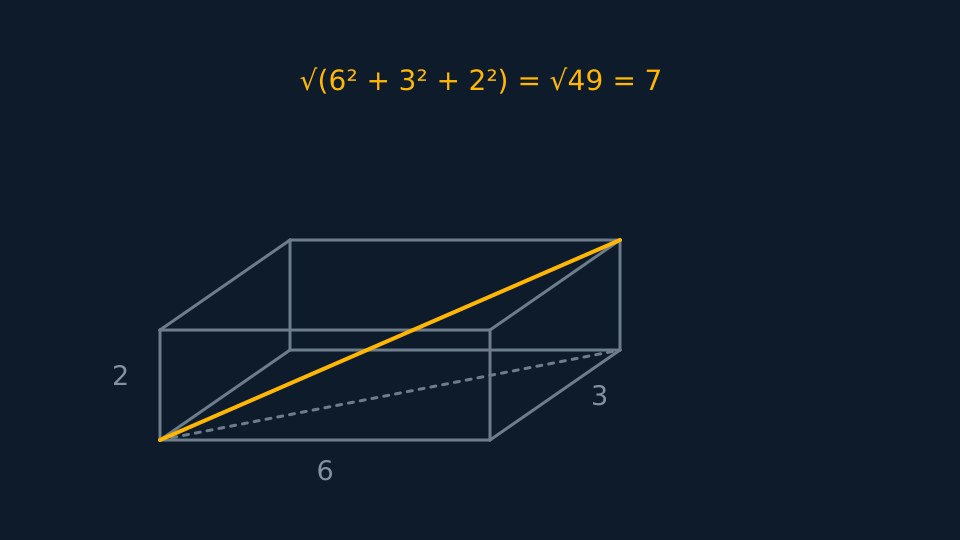
A third unit vector k is perpendicular to i and j, and every vector is written xi + yj + zk, or as a column of three components. The magnitude formula gains a third term and must be learnt.
The formula is Pythagoras applied twice: once to the two horizontal components, then to that result and the vertical component.
WORKED EXAMPLE
Magnitude, unit vector, distance
For a = 2i + 3j + 6k, find |a| and the unit vector in the direction of a; then find the distance between A(1, 2, 3) and B(3, −1, 5).
|a| = √(4 + 9 + 36) = √49 = 7, since 2² + 3² + 6² = 7².
The unit vector is a/7 = (2/7)i + (3/7)j + (6/7)k.
= b − a = 2i − 3j + 2k, so the distance is |AB| = √(4 + 9 + 4) = √17.
Each step is the two-dimensional method applied to three components.
GUIDED PRACTICE
Scaling to order
For p = 6i − 2j + 3k, find |p|, the unit vector in the direction of p, and a vector of magnitude 21 parallel to p, before opening the working.
Show the working
|p| = √(36 + 4 + 9) = 7, since 6² + 2² + 3² = 7².
The unit vector is (6/7)i − (2/7)j + (3/7)k.
21 = 3 × 7, so 3p = 18i − 6j + 9k has magnitude 21, and so does −3p, in the opposite direction along the same line. State both.
Geometry with components
Position vectors, the identity AB = b − a and the scalar-multiple test for parallel vectors all apply unchanged in three dimensions. Three points are collinear when the vectors joining them are scalar multiples of each other. Take P(1, 2, 3), Q(3, 3, 5) and R(7, 5, 9). Then PQ = (2, 1, 2) and PR = (6, 3, 6) = 3PQ, so the three sit on one line, with Q a third of the way from P to R. Midpoints still average position vectors, slot by slot.
WORKED EXAMPLE
Classifying a triangle by distances
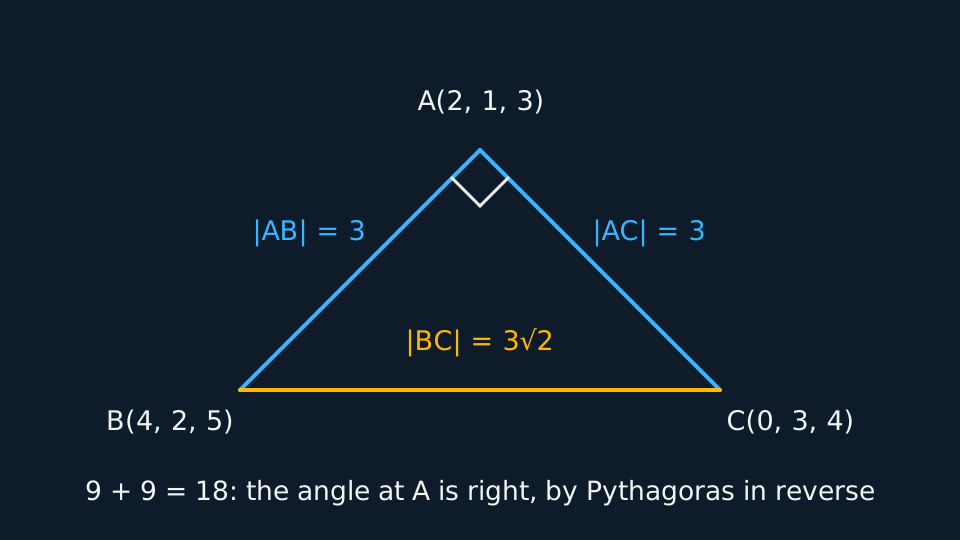
The points A(2, 1, 3), B(4, 2, 5) and C(0, 3, 4) form a triangle. Show it is right angled and isosceles.
AB = (2, 1, 2) with |AB| = 3, and AC = (−2, 2, 1) with |AC| = 3, so the triangle is isosceles.
BC = (−4, 1, −1) with |BC| = √18 = 3√2.
|AB|2 + |AC|2 = 9 + 9 = 18 = |BC|2, so by the converse of Pythagoras the angle at A is right.
The classification used distances only. The scalar product is not part of Edexcel 9MA0, so triangle questions in this unit are answered with distances and the converse of Pythagoras.
INDEPENDENT PRACTICE
A parallelogram in space
ABCD is a parallelogram with A(1, 0, 2), B(3, 1, 4) and C(6, 3, 5). Find the coordinates of D.
Show the working
As in two dimensions, = forces d = a + c − b.
d = (1 + 6 − 3, 0 + 3 − 1, 2 + 5 − 4), so D is (4, 2, 3).
Check: DC = (2, 1, 2) = AB, so the shape closes, and the third component follows the same rule as the other two.
ASSESSMENT FOCUS
- Magnitude is the square root of the sum of the three squared components. Component sets such as 2, 3, 6 and 1, 2, 2 give whole-number magnitudes.
- Collinearity is parallelism through a shared point. Write the scalar down and name the common point.
- Set the components out in a column as working, so that the sign of each component can be checked separately.
CHECK YOURSELF
P is (2, −1, 4) and Q is (4, 3, 8). Find |PQ|, the midpoint of PQ, and a unit vector parallel to PQ.
Show a hint
PQ = q − p first; the magnitude is a whole number.
Show the answer
PQ = 2i + 4j + 4k, and |PQ| = √(4 + 16 + 16) = 6, which is twice the magnitude of i + 2j + 2k.
The midpoint averages the position vectors: (3, 1, 6).
Dividing by the length, (1/3)i + (2/3)j + (2/3)k, with its negative equally valid the other way along the line.
A third component follows the same rules: the magnitude is the square root of the sum of three squares, and AB = b − a.
Geometry in three dimensions is settled by distances and scalar multiples, computed component by component.
WORKBOOK
Printable practice for this topic: original exam-style questions with room to work, and a fully worked answer book. Free to use; please do not redistribute or sell.
Or read them with their worked answers on the vectors in three dimensions questions page.
USED LATER IN
CHECK YOUR PROGRESS
Rate how confident you feel with each objective for this lesson. Ratings are saved in this browser, on this device, unless you sign in.
- Work with i, j, k components, magnitudes and distances in three dimensions.
- Solve geometric problems in space: collinearity, midpoints, and triangle shapes by distance alone.
Open the full revision checklist to see every objective in the course in one place.