Physics › Astrophysics › Hubble's law and the Big Bang
Hubble's law and the Big Bang
Almost every galaxy is receding, faster the further away it lies, so Hubble's law v = Hd turns a measured red shift into a distance. Run backwards, the expansion gives 1/H as an approximate age, and the 2.7 K microwave background and the three-to-one hydrogen to helium ratio support a hot dense beginning.
Choose your exam board to show the notes and questions relevant to your specification. You can change this setting at any time, and content for other boards remains available.
The Doppler effect and Hubble's law, part 2 of 2. Part 1 is The Doppler effect and red shift.
Builds on The Doppler effect and red shift and Black-body radiation and spectral classes.
IN THIS TOPIC
- Use Hubble's law to find distances, and estimate the age of the universe from 1/H.
- State the two pieces of Big Bang evidence AQA names, with the reason each counts.
- State the Cosmological principle in its three parts, and say what the Big Bang means for space-time.
- For OCR, tell the story of the universe from the Big Bang to now, stage by stage, with the reason each stage waited for its temperature.
COMMON MISCONCEPTION
The Big Bang was an explosion at a point in space, and the galaxies are its shrapnel.
The Big Bang was not an explosion at a point: space itself expands, carrying every galaxy away from every other, so there is no centre and every observer sees recession v = Hd.
Hubble's law, and what it implies
Apply the red shift measurement to galaxies and a clear pattern appears. Apart from a handful of close neighbours, every galaxy is receding, and the further away it is, the faster it goes. Speed is proportional to distance:
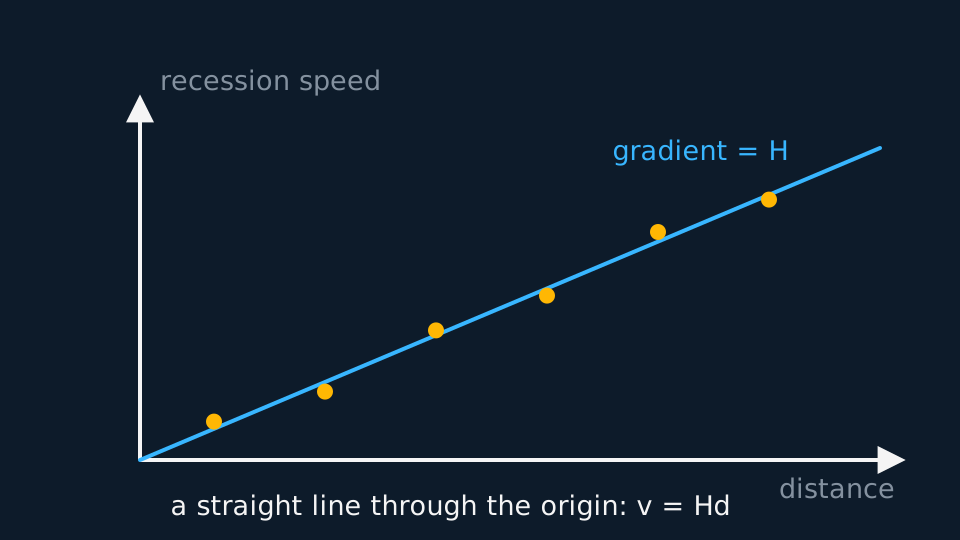
with H the Hubble constant, taken throughout as 65 km s−1 Mpc−1, the value the AQA booklet adopts for calculations; published measurements sit nearer 70. On the adopted value, every megaparsec of extra distance adds 65 kilometres per second of recession. The law reads naturally as evidence that the universe is expanding, and here the shrapnel picture needs dismantling carefully. The galaxies are not flying through space away from one privileged spot. Space-time itself is stretching, carrying the galaxies apart, and an observer in any galaxy sees the same law with themselves at the apparent centre. The expansion has no centre and no edge.
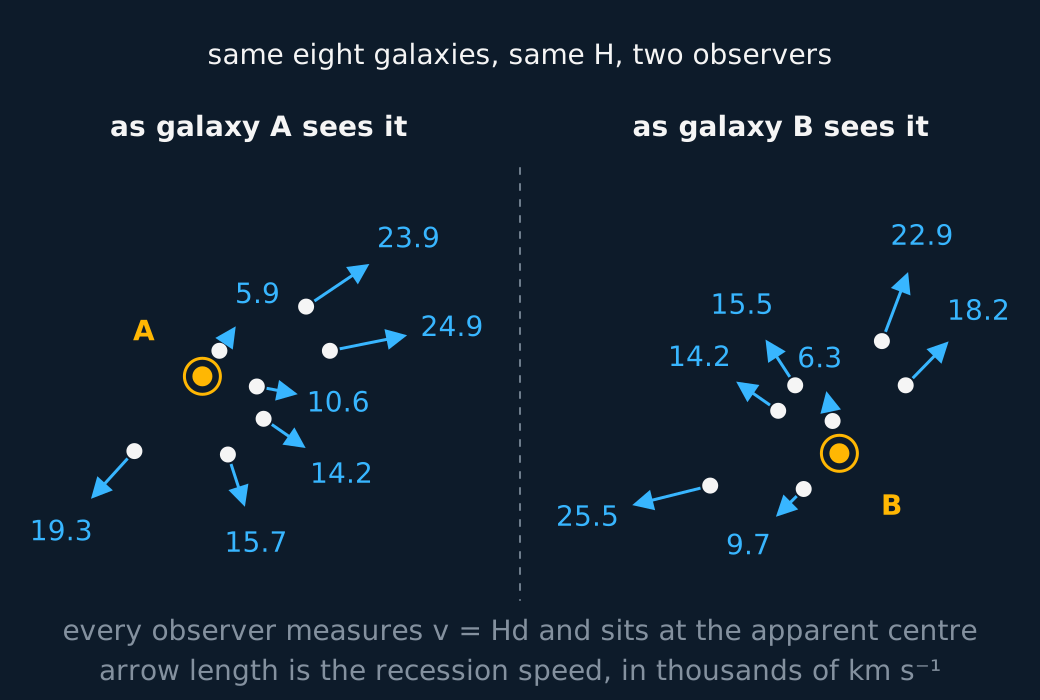
That last claim has a name, and OCR asks for it by name while the other boards only lean on it. The Cosmological principle is the assumption that, viewed on a large enough scale, the universe is homogeneous, of the same composition and density everywhere, so no place is special; isotropic, looking the same in every direction, so no direction is special; and that the laws of physics are universal, the same here as anywhere else. Learn those three together.
Two clauses in that are worth pressing on. The scale clause is the fine print, since close up the universe is plainly lumpy, all stars and voids and empty gaps, and the principle only claims smoothness once you average over hundreds of megaparsecs. The third part is what every measurement in this topic depends on, because reading a galaxy's red shift means assuming that hydrogen ten billion light years away absorbs at the same wavelengths as hydrogen in a laboratory here.
What the expansion will do next depends on what the universe is made of, and most of that mass and energy is not directly observed. Galaxies rotate as though they hold far more mass than shines, and the unseen extra is dark matter. The expansion, measured through distant supernovae, is also accelerating where gravity alone would demand a slowdown, driven by something labelled dark energy.
Between them they determine the universe's fate, but only within a model. Feed a cosmological model enough matter and little dark energy and it predicts an expansion that slows and one day reverses. Feed it the mix the current measurements favour, with dark energy dominant, and the standard model predicts an expansion that runs away, ending cold, dark and dilute. These are outputs of a model fitted to data, not things anyone has watched happen, and an answer that says so is the stronger answer.
Run the expansion backwards and everything was once together, in the Big Bang. Read that carefully: it was not an explosion at some address in space. Run the model back and it reaches an early state of space-time that was extremely hot and dense everywhere at once, and the expansion measured today is that same space-time still stretching; what, if anything, preceded that state lies beyond what present physics establishes.
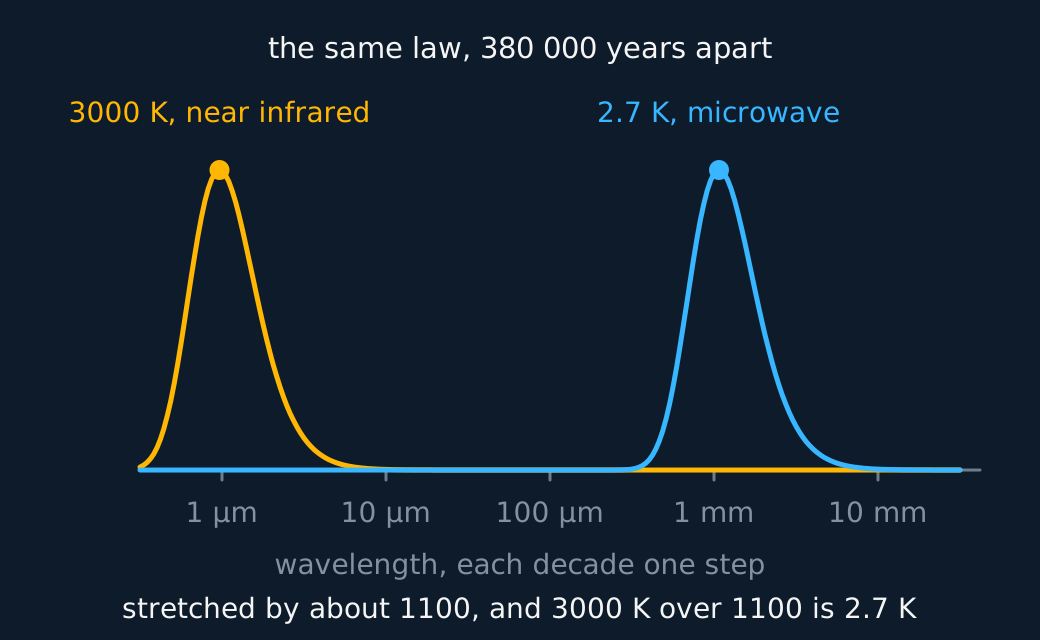
Two further observations support the Big Bang, and both are wanted by name. The cosmic microwave background is a faint glow arriving from every direction, a black-body spectrum at 2.7 K, the cooled and red-shifted afterglow of the hot early universe. Feed 2.7 K into Wien's law and the peak lands near one millimetre. Second, the universe's relative abundance of hydrogen and helium, about three to one by mass, matches what fusion in the first few minutes of a hot dense universe would cook up. No ordinary stellar history accounts for that much helium.
GUIDED PRACTICE
From red shift to distance
A galaxy shows z = 0.020. Taking H = 65 km s−1 Mpc−1, find its recession speed and its distance.
Show the working
v = zc = 0.020 × 3.0 × 108 = 6.0 × 10⁶ m s−1, which is 6000 km s−1.
d = v/H = 6000 / 65 = 92 Mpc. Keeping v in km s−1 and H in km s−1 Mpc−1 gives the distance in megaparsecs directly.
INDEPENDENT PRACTICE
The age of everything
Assuming the expansion speed of each galaxy has stayed constant, estimate the age of the universe from H = 65 km s−1 Mpc−1, with 1 Mpc = 3.08 × 10²² m.
Show the working
A galaxy now at distance d has travelled for a time t = d/v = d/(Hd) = 1/H, the same for every galaxy.
In SI units H = 65 000 / (3.08 × 10²²) = 2.1 × 10⁻¹⁸ s−1, so t = 1/H = 4.7 × 10¹⁷ s ≈ 15 billion years.
The estimate leans on H never changing, exactly what the type Ia supernova measurements in The HR diagram and stellar evolution called into question. The modern figure is 13.8 billion years. For an assumption that crude, landing within ten per cent is close.
What happened next, an OCR section
No other board sets this section, so read it only if OCR A is your specification. OCR A also requires a chronological account of the universe. In order: light nuclei formed during nucleosynthesis in the first few minutes; atoms formed after about 380 000 years, allowing the cosmic microwave background to travel freely; the first stars and galaxies then formed; and the present universe is about 13.8 billion years old and is undergoing accelerated expansion. Link each stage to the fall in temperature and density.
One process drives all of it. The universe expands, expansion cools it, and each stage below happens at the moment the temperature falls far enough to permit it. Learn the chapters in order and the reasons come with them.
| Time after the Big Bang | Temperature | What becomes possible |
|---|---|---|
| under a microsecond | above 1012 K | quarks, leptons and photons only; no composite particle survives the heat |
| about a microsecond | 1012 K | quarks bind into protons and neutrons |
| one second to twenty minutes | about 109 K | those nuclei fuse: the three-to-one hydrogen to helium ratio is fixed here |
| 380 000 years | about 3000 K | nuclei capture electrons, atoms form, the fog clears and the microwave background is released |
| a few hundred million years | tens of kelvin | gravity collapses the first stars; galaxies assemble |
| 9 billion years | a few kelvin | the Sun and its planets form from enriched material |
| 13.8 billion years, now | 2.7 K | expansion accelerating, with dark energy the dominant term |
The first two rows are quick. For a fraction of the first second nothing composite can hold together, and matter is a soup of quarks, leptons and photons; by about a microsecond the quarks have bound into protons and neutrons.
The third row sets a number that has survived ever since. Primordial nucleosynthesis runs from roughly one second to twenty minutes, fusing those protons and neutrons into helium nuclei. That window is short because the expansion is cooling the universe out of the fusion range, and what it leaves behind is the three to one hydrogen to helium ratio by mass quoted above. Stars have processed only a small share of the universe's matter since, which is why the ratio is still close to what those twenty minutes set.
The universe is nonetheless still opaque, because free electrons scatter photons before they can cross. At about 380 000 years the temperature has fallen to some 3000 K, cool enough for nuclei to hold on to electrons. Neutral atoms form, the scattering stops, and light travels freely for the first time. That released light is the microwave background, and the sum ties the two facts together: expansion has stretched its wavelengths by a factor of about 1100 since, and 3000 K divided by 1100 is the 2.7 K measured today.
A long dark age follows. Gravity works on the slight density variations printed on the young universe, pulling matter into clumps that collapse and heat until the first stars ignite, a few hundred million years in. Those stars fuse elements heavier than helium and scatter them when they die, so each generation forms from richer material, and clumps merge into galaxies. The Sun is a late arrival, forming from that enriched debris about 9 billion years in, which is why the Earth has iron in it at all.
For most of its history the expansion was slowing, gravity pulling back on it. The type Ia supernova measurements in The HR diagram and stellar evolution show that over the last few billion years it has instead been accelerating, with dark energy now the dominant term in the budget. The present age is 13.8 billion years, comfortably near the crude 1/H estimate above, with dark energy the dominant term in the energy budget described in the section before this one.
ASSESSMENT FOCUS
- The fate of the universe is a model's prediction, not a measurement. Say the current cosmological model predicts, then give the outcome. Stating it flatly reads as overclaiming.
- In v = Hd, match the units. Either v in km s−1 with d in Mpc, or H converted to SI. The age estimate 1/H needs H in s−1, and omitting that conversion gives an age wrong by a factor of about 3 × 10¹⁹.
- Big Bang evidence is two items, each with its reason. The 2.7 K microwave background as the cooled afterglow, and the hydrogen to helium ratio matching early-universe fusion.
- The Cosmological principle wants all three parts, so count them out. Homogeneous, isotropic, and the same laws of physics everywhere. Give all three separately: “the universe looks the same everywhere” collapses homogeneity and isotropy into a single statement.
- Asked why every galaxy seems to recede from us, do not answer that we are at the centre. Space-time is stretching everywhere, so every observer in every galaxy measures the same law with themselves apparently at the middle, which is the Cosmological principle doing its work.
- OCR only: give the evolution of the universe as landmarks in order. Fuse the light nuclei in the first twenty minutes, form atoms and release the microwave background at 380 000 years, light the first stars and build galaxies over the next few hundred million, and reach an accelerating expansion at 13.8 billion years. Attach the temperature to each one and the reason for each stage follows.
CHECK YOURSELF
A quasar shows z = 0.15. Estimate its recession speed and its distance for H = 65 km s−1 Mpc−1, and explain one reason the answer is only an estimate.
Show a hint
v = zc first, then keep v in km per second so H's units do the conversion.
Show the answer
v = zc = 0.15 × 3.0 × 108 = 4.5 × 10⁷ m s−1, or 45 000 km s−1.
d = v/H = 45 000 / 65 = 690 Mpc.
At fifteen per cent of light speed the small-shift approximation z = v/c is already straining, and H itself is only known roughly. Both keep the distance an estimate.
Hubble's law is v = Hd. Under the assumption of a constant expansion rate, 1/H gives an approximate age of the Universe.
The Cosmological principle: homogeneous, isotropic, and one set of physical laws everywhere.
Or read them with their mark schemes on the doppler effect and red shift questions page.
CHECK YOUR PROGRESS
Rate how confident you feel with each objective for this lesson. Ratings are saved in this browser, on this device, unless you sign in.
- Use Hubble's law to find distances, and estimate the age of the universe from 1/H.
- State the two pieces of Big Bang evidence AQA names, with the reason each counts.
- State the Cosmological principle in its three parts, and say what the Big Bang means for space-time.
- For OCR, tell the story of the universe from the Big Bang to now, stage by stage, with the reason each stage waited for its temperature.
Open the full revision checklist to track your progress across the whole unit.