Physics › Astrophysics › Black-body radiation and spectral classes
Black-body radiation and spectral classes
A star radiates approximately as a black body, so Wien's displacement law turns the peak wavelength of its spectrum into a surface temperature. Stefan's law P = σAT⁴ then converts that temperature and the star's surface area into a power output, and with the power known the two laws together give the radius. Absorption lines sort stars into the classes O to M.
Choose your exam board to show the notes and questions relevant to your specification. You can change this setting at any time, and content for other boards remains available.
Builds on Energy levels and photon emission and Star brightness and magnitude.
IN THIS TOPIC
- Use black-body curves, Stefan's law and Wien's law to find stellar temperatures, powers and radii.
- State the assumptions made when treating a star as a black body.
- Recall the spectral classes O to M with their colours, temperatures and absorption lines, and explain the Balmer condition.
COMMON MISCONCEPTION
A red-hot star is hotter than a white one.
Red stars are the coolest, at about 3000 K, not the hottest: Wien's law says a hotter star peaks at a shorter wavelength, so colour moves from red towards blue-white as temperature rises.
The black-body curve
A black body is a perfect absorber and therefore a perfect emitter. It emits a continuous spectrum whose shape depends only on temperature. Wien's law relates the peak wavelength to temperature; Stefan's law relates total radiated power to surface area and temperature. A star is, to a good approximation, a black body. Stefan's law gives the total power radiated:
where A is the star's surface area, T its surface temperature in kelvin, and σ the Stefan constant, 5.67 × 10⁻⁸ W m−2 K−4. The fourth power is steep: double the temperature and the output multiplies by sixteen. Wien's displacement law locates the curve's peak:
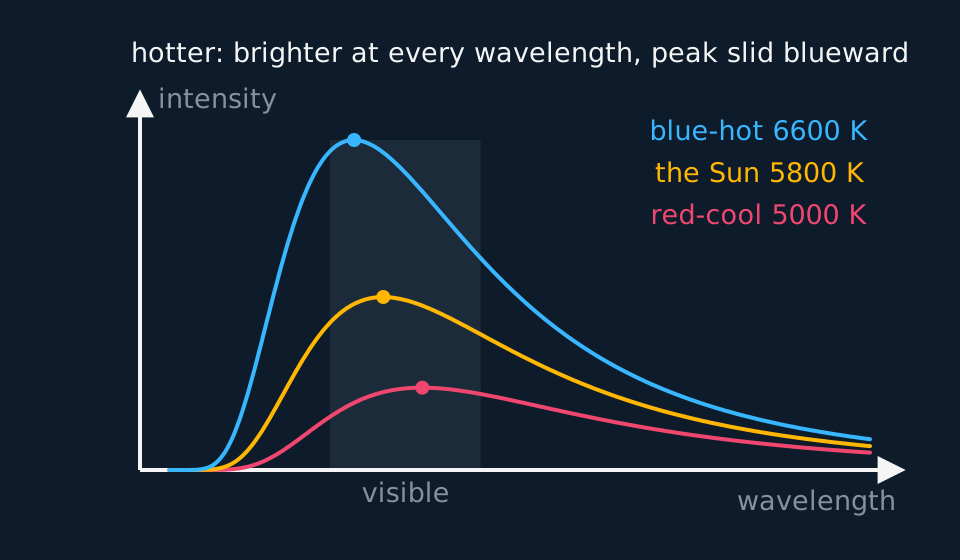
so hotter stars peak at shorter wavelengths. Red stars are the cool ones and blue-white stars the hottest, which makes "red hot" the mild end of stellar temperatures. Note that the unit of Wien's constant is the metre kelvin, a product, not metres per kelvin.
WORKED EXAMPLE
Weighing the Sun's output
The Sun's surface temperature is 5800 K and its radius 6.96 × 10⁸ m. Find its peak wavelength and total power output.
Wien first. λmax = 2.9 × 10⁻³ / 5800 = 5.0 × 10⁻⁷ m, in the green, matching the curve above.
Then the surface area, A = 4πr2 = 4π × (6.96 × 108)2 = 6.09 × 10¹⁸ m2.
Stefan finishes it. P = σAT4 = 5.67 × 10−8 × 6.09 × 1018 × 58004 = 3.9 × 1026 W.
That structure repeats in every question of this family. Wien for temperature or wavelength, geometry for area, Stefan for power, in whichever order the givens allow.
Reading a star from its light
The same three relationships also work from the measurements back to the star. The peak of its spectrum gives T through Wien's law. Its measured brightness and distance give P through the inverse square law, and Stefan's law then gives the surface area, and hence the radius. A star's size can be measured without ever resolving its disc.
Two assumptions underlie that, and a question that asks you to state them wants both. The star radiates as a black body, and the light reaches us undimmed, with nothing absorbed by dust or atmosphere on the way. Real measurements correct for both.
GUIDED PRACTICE
Two thermometers
Betelgeuse has a surface temperature of about 3500 K; Rigel runs near 12 000 K. Find each star's peak wavelength and state what colour each appears.
Show the working
Betelgeuse gives λmax = 2.9 × 10⁻³ / 3500 = 8.3 × 10⁻⁷ m, peaking in the infrared, so the visible light that escapes is reddish.
Rigel gives λmax = 2.9 × 10⁻³ / 12 000 = 2.4 × 10⁻⁷ m, peaking in the ultraviolet, and blue-white to the eye.
Both stars lie in Orion, and their colours indicate their surface temperatures directly.
INDEPENDENT PRACTICE
Same power, twice the temperature
Star X radiates the same total power as the Sun but has twice its surface temperature. Find the ratio of X's radius to the Sun's.
Show the working
Equal P means the σAT4 products match, so the areas trade against T4 and the area ratio is (1/2)4 = 1/16.
Area goes as radius squared, so the radius ratio is the square root, 1/4. A small hot star can radiate as much power as a large cool one, because the fourth power of temperature outweighs the difference in area.
The spectral classes
Starlight arrives with narrow wavelengths missing. These are the absorption lines, printed where atoms and ions in the star's cooler outer layers have soaked up their characteristic photons. Which lines appear depends almost entirely on temperature, and stars are filed by their lines into the spectral classes, hottest to coolest:
| Class | Colour | Temperature / K | Prominent absorption |
|---|---|---|---|
| O | blue | 25 000 to 50 000 | He+, He, H |
| B | blue | 11 000 to 25 000 | He, H |
| A | blue-white | 7500 to 11 000 | H (strongest), ionised metals |
| F | white | 6000 to 7500 | ionised metals |
| G | yellow-white | 5000 to 6000 | ionised and neutral metals |
| K | orange | 3500 to 5000 | neutral metals |
| M | red | below 3500 | neutral atoms, TiO |
The Sun, at 5800 K, is a class G star. The classic memory aid is the sentence "Oh Be A Fine Girl, Kiss Me", and the letters' scrambled order is a fossil of an older cataloguing scheme.
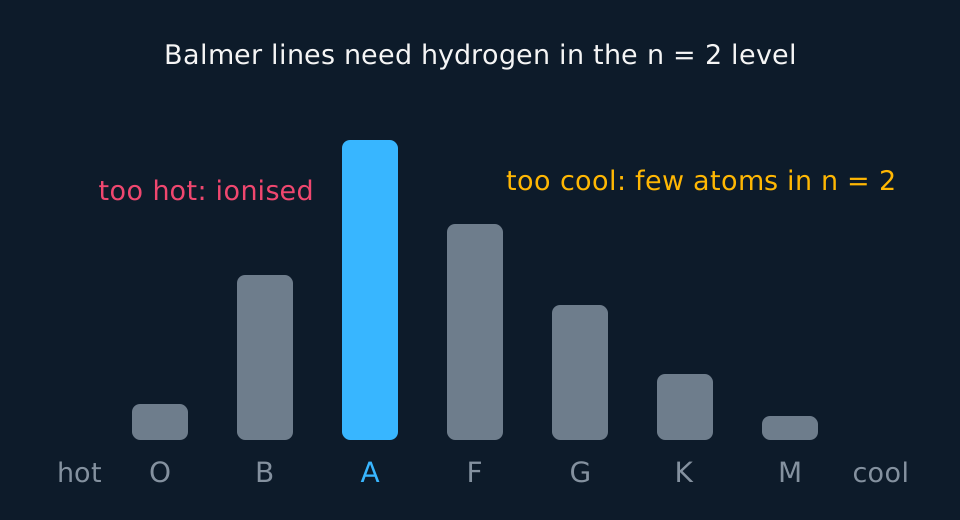
One detail is examinable in depth. Hydrogen's visible absorption lines, the Balmer series, come from atoms absorbing photons while sitting in the n = 2 energy level. In cool stars almost every hydrogen atom rests in the ground state, so Balmer absorption is feeble. In the hottest stars the hydrogen has been ionised, and an atom with no bound electron gives no lines at all. The strongest Balmer lines therefore appear in the middle, at class A around 7500 to 11 000 K, hot enough to lift plenty of atoms into n = 2 and cool enough to leave the atoms intact.
ASSESSMENT FOCUS
- Stefan's law needs area, not radius. Convert with A = 4πr2 and keep T in kelvin. The fourth power magnifies any slip.
- Wien's constant carries the unit m K, a product. Quote λmax in metres and resist writing it "per kelvin".
- Two assumptions, both wanted. The star radiates as a black body, and nothing between star and telescope absorbs the light.
- Learn the class table as data. Order OBAFGKM, colours blue through red, the temperature bands, the prominent lines. This is pure recall.
- The Balmer explanation must name the level. Absorption from n = 2, too few excited atoms when the star is cool, hydrogen ionised when it is hot, peak at class A. Give every clause in that chain.
CHECK YOURSELF
A white dwarf has surface temperature 25 000 K and radiates 9.5 × 1024 W. Find its peak wavelength and its radius, and comment on the size.
Show a hint
Wien for the peak, then rearrange Stefan for area and get the radius from A = 4πr².
Show the answer
λmax = 2.9 × 10⁻³ / 25 000 = 1.2 × 10⁻⁷ m, deep in the ultraviolet.
A = P/σT4 = 9.5 × 1024 / (5.67 × 10−8 × 25 0004) = 4.3 × 10¹⁴ m2, so r = = 5.8 × 10⁶ m.
That is about the radius of the Earth. It packs a star's worth of matter, hotter than the Sun's surface, into a planet's volume.
Wien reads the temperature off the peak of the curve.
Stefan turns temperature and area into power, and the fourth power dominates everything.
OBAFGKM files every star hot to cool.
Balmer lines peak at class A, because absorption needs atoms already sitting in n = 2.
WORKBOOK
Printable practice for this topic: original exam-style questions with room to work, and a fully worked answer book. Free to use; please do not redistribute or sell.
Or read them with their mark schemes on the black-body radiation and spectral classes questions page.
WHERE TO GO NEXT
- Proportional reasoning is the maths this lesson leans on, worked through step by step.
CHECK YOUR PROGRESS
Rate how confident you feel with each objective for this lesson. Ratings are saved in this browser, on this device, unless you sign in.
- Use black-body curves, Stefan's law and Wien's law to find stellar temperatures, powers and radii.
- State the assumptions made when treating a star as a black body.
- Recall the spectral classes O to M with their colours, temperatures and absorption lines, and explain the Balmer condition.
Open the full revision checklist to track your progress across the whole unit.