Physics › Astrophysics › Stellar distances and absolute magnitude
Stellar distances and absolute magnitude
One parsec is the distance at which one astronomical unit subtends one arcsecond, so a parallax of p arcseconds gives d = 1/p parsecs. Absolute magnitude M is the apparent magnitude a star would have at 10 pc, and the distance modulus m − M = 5 log(d/10) ties both magnitudes to distance.
Choose your exam board to show the notes and questions relevant to your specification. You can change this setting at any time, and content for other boards remains available.
Star brightness and magnitude, part 2 of 2. Part 1 is The apparent magnitude scale.
Builds on The apparent magnitude scale.
IN THIS TOPIC
- Define the parsec, the light year and the astronomical unit, and convert between them.
- Use p = 1/d with p in seconds of arc and d in parsecs, and say why the units are part of the equation.
- Say what absolute magnitude means without reaching for the equation.
- Convert between apparent and absolute magnitude with m − M = 5 log(d/10).
COMMON MISCONCEPTION
The bigger a star's parallax angle, the further away the star must be.
It is the inverse: d in parsecs is 1/p in arcseconds. A nearby star swings furthest against the background stars, so a larger parallax angle means a closer star.
Three ways to say how far
Astronomy keeps three units of distance, each built for its own scale. The astronomical unit (AU) is the mean Earth-Sun distance, 1.50 × 10¹¹ m. The light year (ly) is the distance light travels in a year, 9.46 × 10¹⁵ m. The third is subtler and matters most for this unit: watch a nearby star from opposite ends of the Earth's orbit and it appears to shift slightly against the distant background, an effect called parallax. The smaller the shift, the further the star.
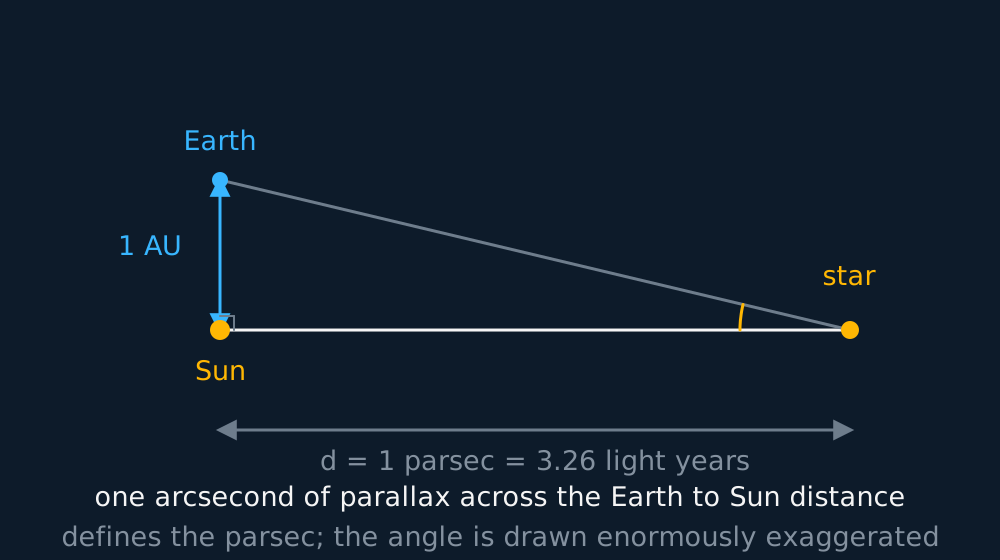
One parsec (pc) is the distance at which one AU subtends an angle of one arcsecond, a 3600th of a degree. The name is the definition compressed, parallax of one arcsecond. Work the triangle through and 1 pc = 3.08 × 10¹⁶ m, which is 3.26 light years. The unit justifies itself twice over. Real parallax measurements arrive in arcseconds, and the magnitude equation below is built around the parsec.
The parallax angle p of a star is the angle that one AU subtends at it, which is half the total sideways shift the star makes over six months. Because the parsec was defined to make that triangle come out at one, the distance follows with no constant to carry. OCR sets the relation as an equation, and no other board does:
p in seconds of arc, d in parsecs, and those units are not a footnote to the equation, they are the equation. Written in radians and metres the same physics needs the awkward constant that the parsec was invented to absorb, so p = 1/d is simply false in any other pair of units. Quote them every time you quote it.
Put numbers through it and the scale of the sky comes out. A star with a parallax of 0.10 arcseconds lies at 1/0.10 = 10 pc; halve the parallax to 0.050 arcseconds and the star is twice as far, at 20 pc. Proxima Centauri, the nearest star, holds the record at 0.77 arcseconds, which puts it at 1.3 pc, or 4.2 light years. Nothing lies closer, so every stellar parallax ever measured is below one arcsecond, and they shrink fast: the method runs out of precision within a few thousand parsecs, and the standard candles of the next lessons take the distance ladder on from there.
Absolute magnitude: the level playing field
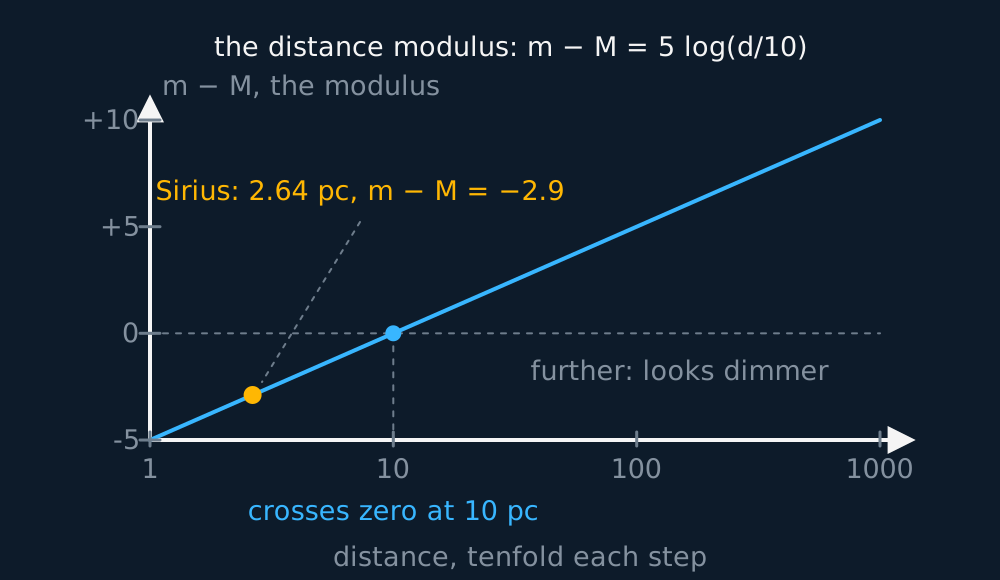
Apparent magnitude mixes up two different things, how much light a star pours out and how far away it happens to sit. A feeble nearby star can outshine a giant across the galaxy. To compare stars fairly, imagine picking every one up and placing it at the same distance, 10 parsecs. The apparent magnitude a star would have at 10 pc is its absolute magnitude M, a like-for-like measure of the star's own output. The two magnitudes are linked by the star's actual distance d, in parsecs:
The logic sits in the signs. A star nearer than 10 pc has d/10 below 1, the log goes negative, and m comes out smaller than M, so it appears brighter than its absolute magnitude. Further than 10 pc, the log is positive and the star looks dimmer than its absolute magnitude. The difference m − M is called the distance modulus, because knowing it gives d.
WORKED EXAMPLE
Sirius, ranked by absolute magnitude
Sirius has apparent magnitude −1.5 and sits 2.64 pc away. Find its absolute magnitude.
M = m − 5 log(d/10) = −1.5 − 5 log(0.264).
log(0.264) = −0.578, so M = −1.5 + 2.89 = +1.4.
Compare the two numbers. At its true distance Sirius has apparent magnitude −1.5; at 10 pc it would appear as an ordinary star of +1.4. It dominates our sky mainly because it is close.
GUIDED PRACTICE
A star at a round distance
A star of apparent magnitude +6.0, right at the naked-eye limit, lies 100 pc away. Find its absolute magnitude, and state whether it would be naked-eye visible from 10 pc.
Show the working
M = 6.0 − 5 log(100/10) = 6.0 − 5 log(10) = 6.0 − 5 = +1.0.
At 10 pc its apparent magnitude would equal its absolute magnitude, +1.0. That is comfortably visible, among the brighter stars in the sky. Distance was hiding a respectable star.
INDEPENDENT PRACTICE
Polaris, the other way round
Polaris has absolute magnitude −3.6 and lies about 133 pc away. Predict its apparent magnitude.
Show the working
m = M + 5 log(d/10) = −3.6 + 5 log(13.3) = −3.6 + 5 × 1.12 = +2.0.
Check that against the sky. Polaris is indeed a middling second-magnitude star. Its absolute magnitude of −3.6 says it is enormously luminous, and 133 parsecs of distance tames it.
ASSESSMENT FOCUS
- The parsec definition is one sentence. It is the distance at which one astronomical unit subtends one arcsecond. Have it word-perfect, with 1 pc = 3.26 ly.
- OCR only: state the units with p = 1/d. p in seconds of arc, d in parsecs. Converting the angle to radians or the distance to metres first makes the equation false, because it holds only in the units the parsec was built for.
- In m − M = 5 log(d/10), d must be in parsecs. Feeding in light years scales d by 3.26 and makes every later line wrong.
- Watch the direction of the subtraction too. Writing M − m instead of m − M flips the sign of the log and moves the star to the wrong side of 10 pc, which is worth doing a sanity check on before you write the final line.
- Absolute magnitude questions often ask what M means, which is the apparent magnitude the star would have at 10 pc. That definition mark comes before any algebra.
CHECK YOURSELF
Vega has apparent magnitude 0.0 and a parallax of 0.130 arcseconds. Find its distance in parsecs and its absolute magnitude, and state whether moving it out to 10 pc would brighten or dim it.
Show a hint
d = 1/p first, in the units the parsec was built for. Then decide whether Vega is nearer or further than 10 pc.
Show the answer
d = 1/p = 1/0.130 = 7.7 pc.
M = m − 5 log(d/10) = 0.0 − 5 log(0.77) = 0.0 + 0.57 = +0.6.
Vega is nearer than 10 pc, so moving it out to 10 pc would dim it: its apparent magnitude would rise from 0.0 to +0.6, which is exactly what the positive M says.
One parsec is the distance at which one astronomical unit subtends one arcsecond, and p = 1/d holds only in arcseconds and parsecs.
Absolute magnitude is the view from 10 parsecs; the distance modulus m − M gives d.
Or read them with their mark schemes on the apparent magnitude scale questions page.
CHECK YOUR PROGRESS
Rate how confident you feel with each objective for this lesson. Ratings are saved in this browser, on this device, unless you sign in.
- Define the parsec, the light year and the astronomical unit, and convert between them.
- Use p = 1/d with p in seconds of arc and d in parsecs, and say why the units are part of the equation.
- Say what absolute magnitude means without reaching for the equation.
- Convert between apparent and absolute magnitude with m − M = 5 log(d/10).
Open the full revision checklist to track your progress across the whole unit.