Physics › Electricity › Light-dependent resistors and superconductivity
Light-dependent resistors and superconductivity
A light dependent resistor drops from around 100 kΩ in darkness to 1 kΩ in daylight, because absorbed photons free extra conduction electrons. Below its critical temperature a superconductor's resistivity is exactly zero rather than merely small, which is what MRI magnets and lossless transmission rest on.
Choose your exam board to show the notes and questions relevant to your specification. You can change this setting at any time, and content for other boards remains available.
Watch Resistivity and superconductivity on the InkPhysics YouTube channel
Resistivity and superconductivity, part 2 of 2. Part 1 is Resistivity and temperature.
IN THIS TOPIC
- Model an LDR's fall in resistance as light freeing extra conduction electrons, and contrast it with the metal.
- Describe superconductivity below a critical temperature, with its two examinable applications.
COMMON MISCONCEPTION
A superconductor is a very good conductor, so a little resistance is left.
Below the critical temperature the resistivity is exactly zero, not merely small. A current started in a superconducting loop circulates for years with no source driving it, which no ordinary conductor can do however good it is.
Light-dependent resistors
Change the stimulus and the same argument runs a second time. A light dependent resistor (LDR) is a wafer of semiconductor, and in the dark almost every one of its electrons is locked into a bond. The number density of conduction electrons, the n in I = nAvq, is minute, so the wafer's resistance is enormous, a hundred kilohms and upwards.
Light undoes that, one electron at a time. A photon absorbed in the wafer can transfer its energy to a bound electron and free it, so the brighter the illumination the more conduction electrons there are to carry a current. A larger n means more current for the same pd, which is to say a lower resistance: the same LDR that reads 100 kΩ in darkness reads about 1 kΩ in daylight. Cover it again and the freed electrons settle back into bonds within milliseconds, and the resistance climbs.
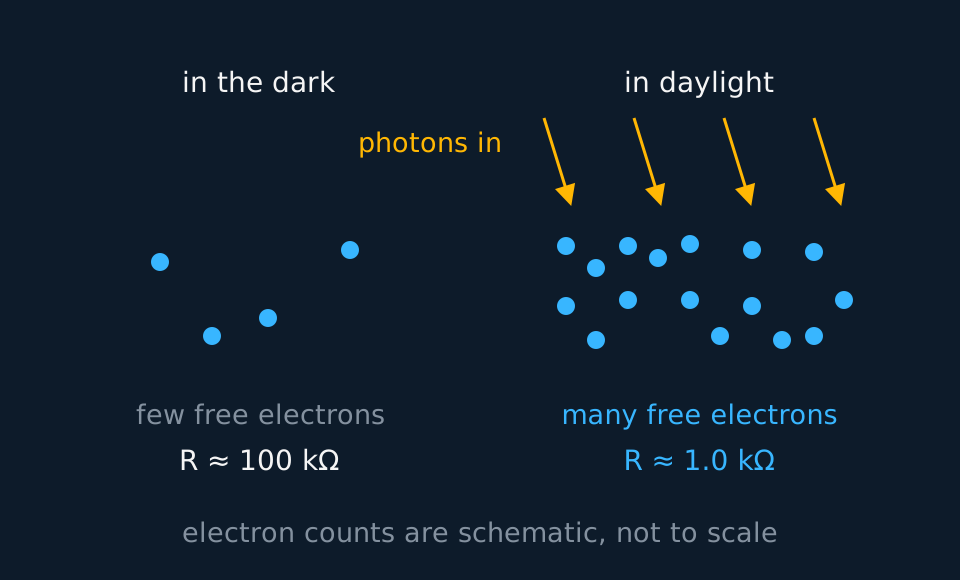
The mechanism is a change in carrier number, not a change in temperature. In a metal the carriers are already free, so warming increases the amplitude of the lattice vibrations, the carriers are scattered more often, and the resistance rises. In both semiconductor components the number of carriers changes instead: heat frees carriers in the thermistor and light frees carriers in the LDR, so n rises and R falls.
GUIDED PRACTICE
Three components, two mechanisms
An LDR and an ntc thermistor both show a falling resistance, one against illumination and one against temperature. Explain, in terms of conduction electrons, why both fall, and why a copper wire's resistance does the opposite as it warms.
Show the working
Both components are semiconductors in which most electrons start bound. Absorbed light in the LDR, and thermal energy in the thermistor, free extra conduction electrons, so n rises, more current flows for the same pd and the resistance falls.
Copper has its full complement of free electrons at any temperature, so n barely changes. Warming it makes the lattice ions vibrate with larger amplitude, the electrons collide with them more often, and the resistance rises. The semiconductor mechanism changes the number of carriers; the metal mechanism changes how often they are scattered.
Superconductivity
Cool certain materials below a critical temperature and their resistivity falls to exactly zero, rather than to a very small value. A current started in a superconducting loop circulates without measurable loss for years, which is how the magnets in an MRI scanner are operated. The zero has conditions beyond temperature that A-level does not examine: push the magnetic field or the current density past the material's own critical values and the superconductivity is lost too.
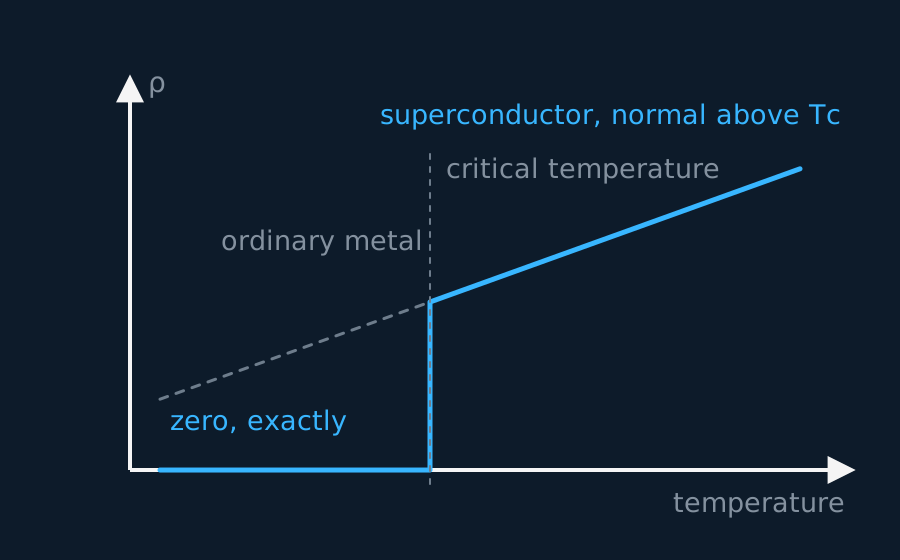
The critical temperature depends on the material, from a few kelvin for simple metals to above 130 K for certain ceramic compounds. Two applications are examinable. Superconducting coils produce the very strong magnetic fields inside MRI scanners and maglev systems, since currents up to the material's limit can flow without heating anything. Superconducting cables would allow power transmission with no resistive loss, because I2R vanishes when R does.
INDEPENDENT PRACTICE
The power lost in a cable
A copper cable of resistance 0.020 Ω carries 100 A to a building. Find the power lost in the cable, and state what the loss becomes if the cable is replaced by a superconductor below its critical temperature.
Show the working
P = I2R = 1002 × 0.020 = 200 W, transferred to internal energy in the cable and its surroundings.
Below the critical temperature the resistance is exactly zero rather than very small, so the loss is 0 W. The limitation is the energy needed for refrigeration to stay that cold, which is why superconducting transmission is not in general use.
ASSESSMENT FOCUS
- The LDR mechanism is a change in carrier number. Light frees extra conduction electrons, so n rises and the resistance falls; heating by the incident light is not the mechanism. Edexcel asks for that model by name; on the other boards it is the explanation behind the direction of change.
- Keep the two mechanisms apart. A semiconductor changes the number of carriers, and a metal changes how often the carriers it already has are scattered. An answer that warms a metal and frees more electrons has borrowed the wrong mechanism.
- For superconductivity, say the resistivity is zero at and below the critical temperature and that the critical temperature depends on the material. Zero, not very small.
- Two applications are examinable and they are worth naming precisely: very strong magnetic fields, as in an MRI scanner or a maglev system, and power transmission with no resistive loss, because I2R vanishes when R does.
CHECK YOURSELF
An LDR reads 120 kΩ in darkness and 900 Ω in daylight. (a) Explain the change in terms of what is carrying the current. (b) A copper wire is warmed from 20 °C to 80 °C and its resistance rises. Explain why the two changes run in opposite directions.
Show a hint
In I = nAvq, which quantity is free to change in each case?
Show the answer
(a) In darkness almost every electron in the wafer is locked into a bond, so the number density n of conduction electrons is minute and the resistance is high. An absorbed photon can free a bound electron, so brighter light raises n, more current flows for the same pd, and the resistance falls.
(b) Copper already has its full complement of free electrons, so n barely changes when it is warmed. What warming does is increase the amplitude of the lattice vibrations, so the electrons are scattered more often and the resistance rises.
One material gains carriers and the other keeps the carriers it has and loses mobility, which is why the same stimulus moves the two resistances opposite ways.
Light frees carriers, so n rises and R falls; warming a metal scatters the carriers it already has, so R rises.
Below the critical temperature the resistivity is exactly zero, not very small.
Or read them with their mark schemes on the resistivity and temperature questions page.
CHECK YOUR PROGRESS
Rate how confident you feel with each objective for this lesson. Ratings are saved in this browser, on this device, unless you sign in.
- Model an LDR's fall in resistance as light freeing extra conduction electrons, and contrast it with the metal.
- Describe superconductivity below a critical temperature, with its two examinable applications.
Open the full revision checklist to track your progress across the whole unit.