Physics › Engineering physics › Non-flow processes and p-V diagrams
Non-flow processes and p-V diagrams
Constant volume zeroes W, an isothermal change zeroes ΔU and an adiabatic one zeroes Q, so three of the four non-flow processes remove a term. The fourth, constant pressure, leaves the work as pΔV. On a p-V diagram the work done by the gas is the area under the curve, whatever shape it takes.
Choose your exam board to show the notes and questions relevant to your specification. You can change this setting at any time, and content for other boards remains available.
The first law of thermodynamics, part 2 of 2. Part 1 is The first law and its sign convention.
Builds on The first law and its sign convention and Ideal gases and the gas laws.
IN THIS TOPIC
- Handle the four non-flow processes, isothermal, adiabatic, constant pressure and constant volume, knowing which term each one reduces to zero.
- Use pV = constant and pV to the gamma = constant for isothermal and reversible adiabatic changes of an ideal gas.
- Calculate work from pΔV at constant pressure, and read work as area on a p-V diagram.
COMMON MISCONCEPTION
Heating a gas always makes it hotter.
Heat raises the temperature only if it stays as internal energy. In an isothermal expansion ΔU = 0, so Q = W: every joule supplied leaves again as work and the temperature never moves.
Four processes, four zero terms
Exam questions run gases through four named non-flow processes, and each one fixes a term of the first law, Q = ΔU + W. At constant volume nothing moves, so no work is done, W = 0, and every joule of heat lands in internal energy. At constant pressure the gas expands as it is heated, and the heat splits, Q = ΔU + pΔV.
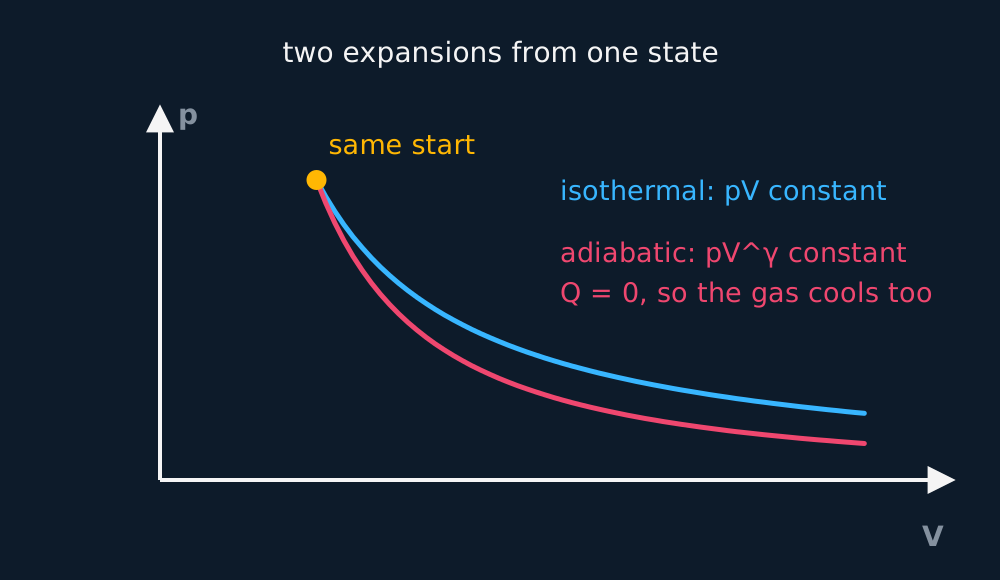
Isothermal means constant temperature. The gas stays on one isotherm of the ideal gas equation, so
and since U depends only on temperature, ΔU = 0 and Q = W. An isothermally expanding gas turns heat into work continuously, its temperature never rising. You can pour heat into a gas without warming it at all, provided it does work at the same rate. In practice isothermal means slow, in good thermal contact, so the temperature can equalise throughout.
Adiabatic is the opposite case, no heat transfer at all, Q = 0, in practice fast or well insulated. The definition gives ΔU = −W and nothing more. The power law below is a narrower claim needing two further conditions: the gas must be ideal, with constant heat capacities, and the change must be reversible, meaning slow and smooth enough that the gas holds one pressure and one temperature throughout. Granted those,
where γ, about 1.4 for air, is the ratio of the gas's two principal specific heat capacities. Q = 0 alone will not do it: a gas rushing into a vacuum takes in no heat and does no work on anything, so ΔU = 0 while pVγ does not stay constant. With Q = 0 the equation reads ΔU = −W, so a gas doing work adiabatically does that work at the expense of its internal energy and cools; a gas compressed adiabatically heats. A bicycle pump warming as you pump, and a diesel engine igniting fuel with no spark plug, are both adiabatic compression doing exactly this.
| Process | Held fixed | Q | ΔU | W |
|---|---|---|---|---|
| constant volume | V | = ΔU | = Q | zero |
| constant pressure | p | ΔU + pΔV | Q − W | pΔV |
| isothermal | T (pV = constant) | = W | zero | = Q |
| adiabatic | no heat flow (reversible: pVγ = constant) | zero | = −W | = −ΔU |
GUIDED PRACTICE
The diesel squeeze
Air at 1.0 × 10⁵ Pa fills 8.0 × 10⁻⁴ m3 of a cylinder. It is compressed adiabatically to 1.0 × 10⁻⁴ m3. Take γ = 1.4. Find the final pressure, and use pV/T to find the factor the absolute temperature rises by.
Show the working
p2 = p1(V1/V2)γ = 1.0 × 105 × 8.01.4 = 1.8 × 10⁶ Pa.
pV/T is constant, so T2/T1 = p2V2/p1V1 = 18.4 × (1/8.0) = 2.3. Room-temperature air at 290 K reaches about 670 K, far past diesel's ignition point, with not a joule of heat supplied.
Work as area
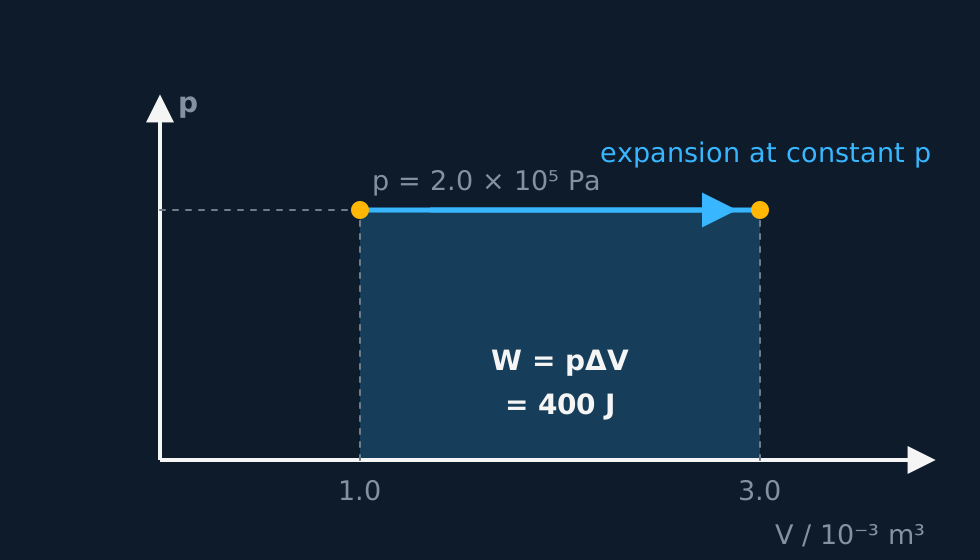
Plot any process on a p-V diagram, pressure against volume, and the work done by the gas appears as geometry. Each small expansion δV does work p δV, a thin strip under the curve, so the total work is the area under the curve between the two volumes. Constant pressure gives a rectangle, p × ΔV. Curved processes give areas that are estimated by counting squares, which is an accepted method.
Direction matters. Rightward along the curve, expansion, the gas does positive work. Leftward, compression, the surroundings do the work and W is negative. On the isotherm-and-adiabat figure above, the adiabat's steeper fall means less area beneath it, so an adiabatic expansion between two volumes does less work than an isothermal one, because no heat enters to replace the internal energy converted into work.
INDEPENDENT PRACTICE
A slow isothermal squeeze
A gas at 1.2 × 10⁵ Pa occupies 5.0 × 10⁻³ m3. It is compressed slowly at constant temperature to 2.0 × 10⁻³ m3. Find the final pressure, and account for the heat flow during the process.
Show the working
pV constant: p2 = 1.2 × 105 × 5.0/2.0 = 3.0 × 10⁵ Pa.
Isothermal, so ΔU = 0 and Q = W. The gas is compressed, W is negative, so Q is negative too. Every joule of work done on the gas flows straight out as heat, and slowness is what gives it time to escape, holding the temperature steady.
ASSESSMENT FOCUS
- Name the process, then set its zero term. Constant volume gives W = 0, isothermal gives ΔU = 0, adiabatic gives Q = 0. Write the full equation out and cross out the term that is zero.
- pΔV only serves at constant pressure. Anywhere else, work is the area under the p-V curve, and counting squares is a legitimate, expected method.
- Adiabatic calculations run on p1V1γ = p2V2γ, which assumes an ideal gas taken reversibly, as every adiabatic question set at this level is. Temperature questions then go through pV/T = constant. Do not reach for pV = constant when the process is adiabatic; that line belongs to the isotherm.
- Explain answers in molecules when invited. Adiabatic compression: the piston does work on the molecules, their mean kinetic energy rises, so temperature rises. Give that chain of reasoning rather than the formula alone.
CHECK YOURSELF
A gas in a rigid sealed cylinder receives 900 J of heat. It is then allowed to expand at constant temperature, doing 300 J of work. For each stage, state Q, ΔU and W, and the overall change in internal energy.
Show a hint
Rigid means constant volume; constant temperature means ΔU = 0. Take the equation one stage at a time.
Show the answer
Stage 1, constant volume: W = 0, so Q = ΔU = +900 J. All the heat becomes internal energy and the gas warms.
Stage 2, isothermal: ΔU = 0, so Q = W = +300 J. The gas draws another 300 J of heat and spends it entirely on work.
Overall ΔU = 900 + 0 = +900 J, while the total heat supplied was 1200 J. The missing 300 J left as work, and the totals balance.
Constant volume gives W = 0, isothermal gives ΔU = 0, adiabatic gives Q = 0.
On a p-V diagram, work is the area under the curve; pV is constant on an isotherm, pV^γ on a reversible adiabat of an ideal gas.
Or read them with their mark schemes on the first law and its sign convention questions page.
CHECK YOUR PROGRESS
Rate how confident you feel with each objective for this lesson. Ratings are saved in this browser, on this device, unless you sign in.
- Handle the four non-flow processes, isothermal, adiabatic, constant pressure and constant volume, knowing which term each one reduces to zero.
- Use pV = constant and pV to the gamma = constant for isothermal and reversible adiabatic changes of an ideal gas.
- Calculate work from pΔV at constant pressure, and read work as area on a p-V diagram.
Open the full revision checklist to track your progress across the whole unit.