Physics › Measurements › Prefixes, labels and unit conversions
Prefixes, labels and unit conversions
An SI prefix is a power of ten written as a letter, and a prefix on a squared or cubed unit is raised to that power with it. That single rule is behind most conversion errors. The same arithmetic heads a table column, labels a graph axis, and converts joules to electronvolts or to kilowatt hours.
Choose your exam board to show the notes and questions relevant to your specification. You can change this setting at any time, and content for other boards remains available.
Watch SI units, prefixes and conversions on the InkPhysics YouTube channel
SI units and prefixes, part 2 of 2. Part 1 is SI base and derived units.
IN THIS TOPIC
- Use your board's SI prefixes with standard form, and convert between units of the same quantity, such as J and eV, or J and kW h.
- Head a table column and label a graph axis in the quantity / unit form, so the entries are pure numbers.
COMMON MISCONCEPTION
A square centimetre is a hundredth of a square metre.
The prefix is squared with the unit. One centimetre is 10−2 m, so one square centimetre is (10−2)2 = 10−4 m2, a ten-thousandth of a square metre. Convert the length first and square afterwards.
Prefixes and standard form
Real quantities span an enormous range, so the SI attaches prefixes that multiply a unit by a power of ten. Each board requires about ten of them, and the eleven here cover all four:
| Prefix | Symbol | Multiplier |
|---|---|---|
| tera | T | |
| giga | G | |
| mega | M | |
| kilo | k | |
| deci | d | |
| centi | c | |
| milli | m | |
| micro | μ | |
| nano | n | |
| pico | p | |
| femto | f |
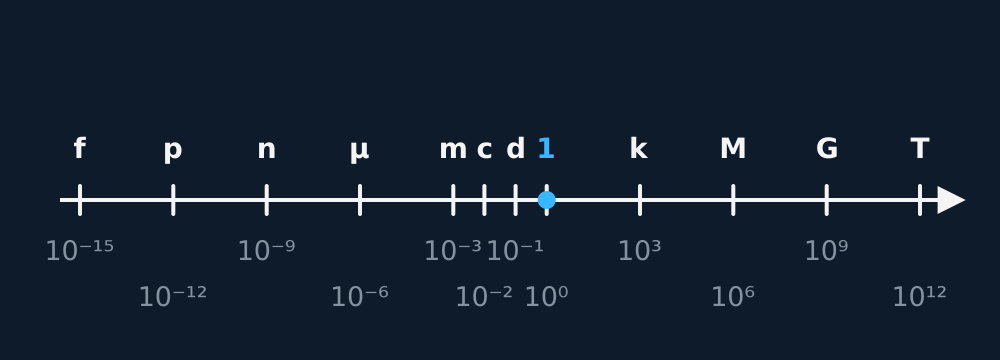
Most sit at multiples of three, which makes them easy to place on the line. Deci at and centi at are the odd ones out, kept alive by the decibel and the centimetre. AQA's list runs down to femto and omits deci; CIE and OCR require deci and stop at pico. Convert prefixed values to standard form in the base unit before any algebra starts. Write 250 μm as m and the calculation can no longer trip over the prefix.
Converting a prefixed unit
Every conversion between prefixes is the same two moves. Replace the prefix with the power of ten it stands for, then collect the powers. Going from a prefixed unit to the base unit multiplies by that power, and going back the other way divides by it, so decide which direction the conversion runs before any arithmetic starts.
| Converting | What to do | Example |
|---|---|---|
| A prefixed unit to its base unit | Replace the prefix with its power of ten | 4.7 kΩ = Ω |
| A base unit to a prefixed one | Divide by that same power of ten | m = 250 μm |
| A squared unit | Square the power of ten along with the unit | 1 cm2 = (10−2 m)2 = 10−4 m2 |
| A cubed unit | Cube the power of ten along with the unit | 1 mm3 = (10−3 m)3 = 10−9 m3 |
| A unit built from two others | Convert each part on its own, then combine | 1 g cm−3 = 10−3 kg / 10−6 m3 = 103 kg m−3 |
WORKED EXAMPLE
Square centimetres to square metres
A solar cell has an area of 250 cm2. Express that area in m2.
Convert the length first and apply the square afterwards. 1 cm = 10−2 m, so 1 cm2 = (10−2 m)2 = 10−4 m2.
250 cm2 = 250 × 10−4 m2 = m2.
The error to watch for is carrying the prefix across unsquared: writing 250 × 10−2 and finishing at 2.5 m2, a hundred times too large. It comes from reading the 2 in cm2 as belonging to the metre alone, when what is being squared is the whole of 10−2 m. Turning the conversion round is the other half of it: an area in m2 wanted in cm2 is multiplied by 104, not divided by it.
A sense-check settles the direction without any algebra. A square metre is the size of a small table and a square centimetre the size of a thumbnail, so the area measured in square metres has to be the smaller number.
Two conversions to work through yourself sit at the foot of this page, one guided and one unaided, and the SI base and derived units questions page holds the series' questions with a mark scheme under each one.
Labelling columns and axes
There is one settled convention for the heading of a table column and the label on a graph axis: write the quantity divided by its unit. Not “speed (m s−1)” and not “speed in m/s”, but speed / m s−1. The slash is doing real arithmetic. Dividing a speed by its unit leaves a pure number, and pure numbers are exactly what a column of readings contains, so a 12 in that column means the speed was 12 m s−1.
| load / N | extension / mm | extension / m |
|---|---|---|
| 2.0 | 1.4 | |
| 4.0 | 2.9 | |
| 6.0 | 4.3 | |
| 8.0 | 5.8 |
Any prefix goes into the label as well, which is what the middle and right columns are showing. Head a column extension / mm and its entries are bare numbers such as 1.4; head it extension / m and the same readings become . Either heading is correct. Writing “1.4 mm” in every cell of a column already headed with the unit is not, and neither is hanging units along a graph axis next to the numbers.
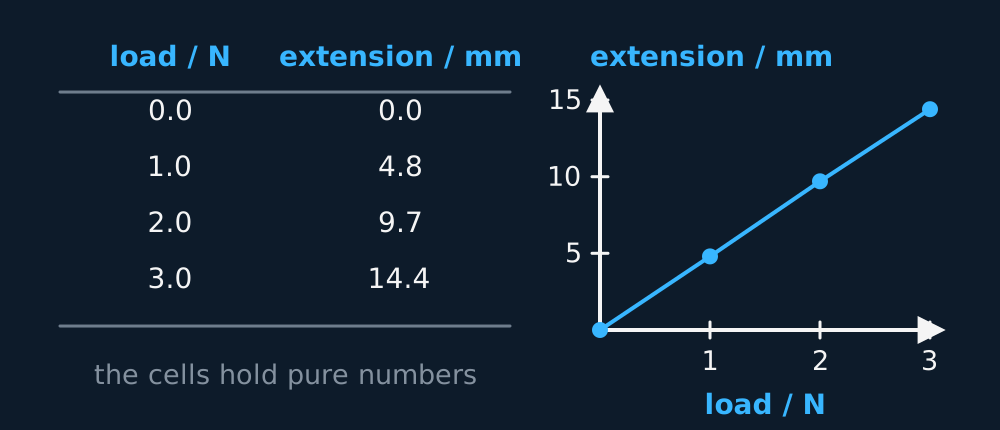
The convention becomes useful the moment you take a gradient. Divide the label on the vertical axis by the label on the horizontal one and the gradient's unit follows ready-made. Plot speed / m s−1 against time / s and the gradient carries (m s−1)/s, which is m s−2, an acceleration.
Converting between units of the same quantity
Some quantities come in more than one unit, and two conversions are worth knowing. One electronvolt is the energy gained by a charge of magnitude e moved through a potential difference of 1 V, so J. One kilowatt hour is a kilowatt delivered for an hour, and 1000 W running for 3600 s makes J.
Neither conversion is printed as an equation. The electronic charge C is, on the constants page, and that number is the eV factor. Knowing where to look saves you memorising it.
Both conversions run the same way. Write the factor as an equality, decide which direction the conversion runs, and multiply. Deciding the direction before multiplying prevents the factor being applied upside down.
WORKED EXAMPLE
A density, converted properly
Aluminium has a density of 2.7 g cm−3. Express it in SI units.
Convert each unit separately before touching the number. 1 g = 10−3 kg, and 1 cm3 = (10−2 m)3 = 10−6 m3. The cube applies to the prefix as well as to the metre.
So 2.7 g cm−3 = 2.7 × 10⁻³ kg / 10−6 m3 = 2.7 × 10³ kg m−3.
Does it sense-check? A cubic metre of aluminium ought to have a mass of a couple of tonnes, and 2700 kg is about 2.7 tonnes.
GUIDED PRACTICE
An area with a prefix inside
A wire's cross-section is quoted as 0.45 mm2. Write it in m2, remembering what squaring does to the prefix.
Show the working
1 mm = 10−3 m, so 1 mm2 = (10−3 m)2 = 10−6 m2.
0.45 mm2 = 0.45 × 10−6 = 4.5 × 10⁻⁷ m2. Writing 0.45 × 10⁻³ squares the metre but not the prefix, giving an answer a thousand times too large.
INDEPENDENT PRACTICE
A speed limit in SI
A road sign reads 36 km h−1. Convert it to m s−1, setting out both conversion factors explicitly.
Show the working
36 km h−1 = 36 000 m per 3600 s.
36 000/3600 = 10 m s−1. Kilometres pushed the number up, hours pulled it down, and only writing both factors keeps the directions straight.
ASSESSMENT FOCUS
- The prefixes are not printed in the data booklet. Learn your board's full list, including centi.
- Squared units square the prefix. 1 cm2 is m2, not , so convert the length first and square afterwards.
- Going from eV to J, multiply by . A photon energy that lands at J went the wrong way.
- Head a table column and label a graph axis as quantity / unit, as in speed / m s−1, so the entries are pure numbers. OCR A lists this convention at 2.1.2.
CHECK YOURSELF
(a) Write 250 μm in metres, in standard form. (b) An electron has 5.0 keV of kinetic energy. How many joules is that?
Show a hint
Take one prefix at a time: micro first, then kilo, then the eV to J factor.
Show the answer
(a) Micro means , so 250 μm = m = m.
(b) 5.0 keV = eV. Each eV is J, so the energy is = J.
About ten prefixes per board, and the booklet prints none of them.
A prefix on a squared unit is squared with it.
Or read them with their mark schemes on the si base and derived units questions page.
CHECK YOUR PROGRESS
Rate how confident you feel with each objective for this lesson. Ratings are saved in this browser, on this device, unless you sign in.
- Use your board's SI prefixes with standard form, and convert between units of the same quantity, such as J and eV, or J and kW h.
- Head a table column and label a graph axis in the quantity / unit form, so the entries are pure numbers.
Open the full revision checklist to track your progress across the whole unit.