Physics › Particles › Energy, momentum and particle tracks
Energy, momentum and particle tracks
A process that passes every quantum-number check can still be forbidden, because energy and momentum must balance too, as a free proton shows. On a detector photograph the same two checks are read off the picture: curl gives the sign of a charge, radius gives the momentum through r = p/BQ, and a tightening spiral marks energy lost.
Choose your exam board to show the notes and questions relevant to your specification. You can change this setting at any time, and content for other boards remains available.
Watch Conservation laws on the InkPhysics YouTube channel
Conservation laws, part 2 of 2. Part 1 is The conserved quantities.
IN THIS TOPIC
- Recognise that energy and momentum are conserved in every interaction, and that either can forbid one.
- For Edexcel, interpret a particle-track photograph, reading the sign of a charge from the curl, the momentum from the radius and lost energy from a spiral.
COMMON MISCONCEPTION
A pair of tracks springing out of empty space means a particle appeared from nothing.
Only a charged particle ionises, and only ionisation leaves a track, so a neutral parent crosses the chamber unseen and its daughters appear where it decayed. The gap is the evidence for it, not a hole in the picture.
The two laws that always apply
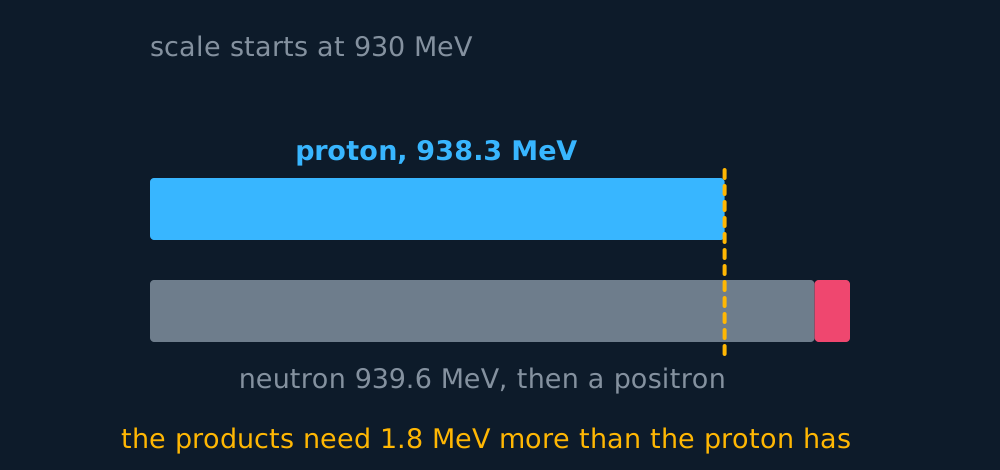
Beyond the quantum numbers, energy and momentum are conserved in every interaction, and either can forbid a process that the quantum numbers allow. The standard example follows. A free proton decaying by p → n + e+ + νe balances charge, baryon number and electron lepton number perfectly, and it never happens, because the products' rest energies, about 939.6 MeV plus 0.511 MeV, exceed the proton's 938.3 MeV. No energy is available to make up the difference, so the decay is forbidden, and that is why a free proton is stable. Inside a nucleus the energy balance is different, and bound protons can undergo β+ decay where free ones cannot.
Momentum forbids processes just as firmly, and the antimatter lesson has already shown it doing so. A lone photon in empty space cannot become an electron-positron pair however much energy it carries, because no arrangement of that pair balances energy and momentum at once, which is why pair production requires a nearby nucleus to take the recoil. Keep the two checks separate. Energy sets whether there is enough available, and momentum sets whether the products can be arranged so that it is conserved.
Reading particle tracks, an Edexcel skill
Interpreting a detector photograph is Edexcel content; the other three boards do not set it. The physics is the same set of conservation checks, applied to a picture instead of an equation.
A detector records a charged particle because the particle ionises whatever it flies through, and that trail of ions is made visible, as a string of bubbles in a bubble chamber or as a run of hits in a modern tracker. A neutral particle ionises nothing and so leaves no track at all. Treat the absence as evidence rather than a hole in the picture. A pair of tracks springing out of empty space, with a clear run behind them, says a neutral particle crossed that gap unseen, and it is drawn dashed because nobody saw it. A neutral kaon or a Λ0 appears in exactly this way, as a V with nothing leading into it.
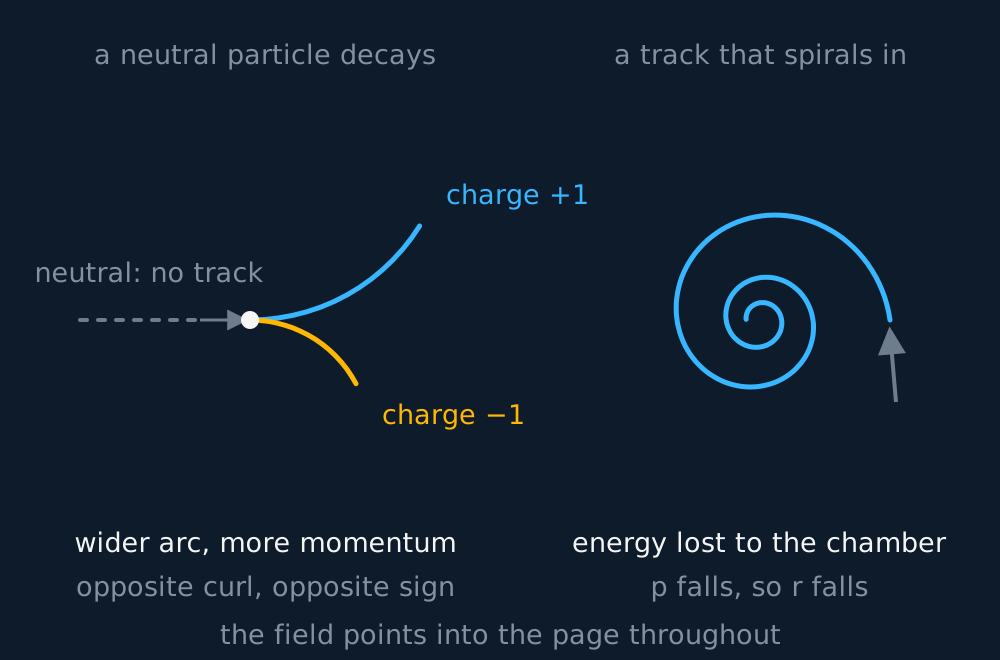
A magnetic field across the chamber bends every charged track, and the magnetic fields unit sets that magnetic force against the centripetal one to get the radius, which it writes as r = mv/BQ and Edexcel writes as . They are one relation, since p = mv.
Two readings come straight off the photograph. Which way a track curls gives the sign of the charge, once the field direction and the direction of travel are known; without those, the curl still separates the charges, since opposite signs bend opposite ways in one field. How tightly a track curls gives the momentum, a wide gentle arc marking high momentum and a tight one low; the photograph is read in the plane perpendicular to the field, so strictly the radius measures the momentum component in that plane, and speed follows only once the particle is identified. A straight track is simply the wide end of that scale, too much momentum to bend measurably.
A track that spirals is the same rule applied twice. The particle is ionising as it goes, every ion it makes takes energy from it, so its momentum falls, and by r = p/(BQ) the radius falls with it until the curve winds itself in. So a spiral reads two things at once. This particle is losing energy, and the tight end is the late end. Direction of travel follows from it, which matters more than it looks, because reading the same picture backwards turns every charge in it upside down.
At the vertex, apply the same conservation laws to the photograph. Charge is counted by curl, so two daughters curling opposite ways carry opposite signs, and if nothing led into the vertex those charges have to cancel exactly. Momentum is a vector sum, so the daughters' momenta, each read from a radius and pointed along its own track, must add to the parent's momentum along the invisible line, which is why the two arms of a V straddle that line instead of leaning to one side. Energy is the last check, the parent having to cover the daughters' rest energies with enough left over for the kinetic energy those momenta imply.
WORKED EXAMPLE
One V, read off the picture
Two tracks spring from a point with nothing leading into it. One curls clockwise on a tight arc and the other anticlockwise on an arc about three times wider, in a uniform field. State what can be deduced about the parent and the two daughters.
Nothing arrives at the vertex, so the parent was neutral: only a charged particle ionises, and only ionisation leaves a track. Its path is real but invisible, running back from the vertex along the direction in which the two daughters' momenta add up.
The daughters curl opposite ways, so they carry opposite signs, and since the parent's charge was zero their charges must cancel exactly rather than merely differ.
Radius is momentum. With one field and equal magnitudes of charge, r = p/(BQ) makes the wider track's momentum about three times the tighter one's.
Not one number came off a data sheet. The sign came from a direction of curl, the momentum from a radius, and the parent from a gap, which is what interpreting a track photograph involves.
INDEPENDENT PRACTICE
The track that tightens
A charged particle enters a bubble chamber and its track spirals inwards, tightening turn by turn. A classmate says the spiral shows the particle speeding up, since it is turning faster and faster. Correct them, and say which end of the spiral the particle reached last.
Show the working
Turning faster is not going faster. The radius is r = p/(BQ), so a tightening spiral is a falling momentum, and the particle is being slowed by ionising the liquid it crosses.
The tight end is therefore the late end, reached last. Getting that the right way round is what fixes the direction of travel, and the direction of travel is what fixes the sign of the charge, so one misread spiral takes the whole answer with it.
ASSESSMENT FOCUS
- When every quantum number balances and the process still cannot occur, check energy and compare rest energies from the data booklet. That is why a free proton does not decay. If the energy is available and the process still fails, check momentum, which is the lone photon's problem in pair production.
- Edexcel track questions are answered with four fixed sentences, so learn them. No track means the particle was neutral. Direction of curl gives the sign of the charge. Radius gives the momentum through r = p/(BQ). A tightening spiral means energy is being lost to the chamber, and the tight end came last.
- In a track question, settle the direction of travel before you name a single charge, because a photograph read backwards gives every sign the wrong way round. A spiral fixes it for you, and a vertex fixes it too: tracks that spring apart from a point were all made after it.
CHECK YOURSELF
A student proposes that a free proton decays: p → n + e+ + νe. Audit the conservation laws, then explain what actually forbids the decay. (Rest energies: p 938.3 MeV, n 939.6 MeV, e 0.511 MeV.)
Show a hint
Every quantum number balances. So check the one thing left.
Show the answer
Charge runs +1 → 0 + 1 + 0 ✓. Baryon number runs +1 → +1 ✓. Electron lepton number runs 0 → 0 − 1 + 1 = 0 ✓. Strangeness stays at 0 ✓. Every quantum number balances.
Energy does not. The products carry at least 939.6 + 0.511 = 940.1 MeV of rest energy, which is more than the proton's 938.3 MeV, and a free proton has no spare energy to make up the difference.
Energy conservation forbids the decay, and the proton stays the only stable free baryon. Inside a nucleus the binding-energy balance is different, and that difference is what permits β+ decay there.
Energy and momentum must be conserved as well, and either alone can forbid an interaction.
On a photograph, no track means a neutral particle, the curl gives the sign and the radius gives the momentum.
Or read them with their mark schemes on the conserved quantities questions page.
CHECK YOUR PROGRESS
Rate how confident you feel with each objective for this lesson. Ratings are saved in this browser, on this device, unless you sign in.
- Recognise that energy and momentum are conserved in every interaction, and that either can forbid one.
- For Edexcel, interpret a particle-track photograph, reading the sign of a charge from the curl, the momentum from the radius and lost energy from a spiral.
Open the full revision checklist to track your progress across the whole unit.