Physics › Magnetic fields › Force on a moving charge
Force on a moving charge
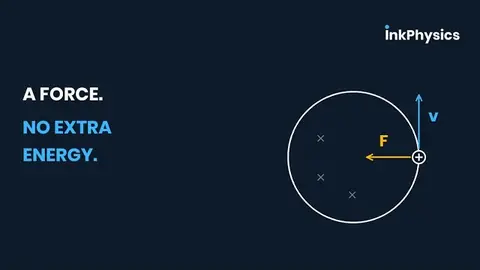
A moving charge in a magnetic field feels a force F = BQv at right angles to its velocity, so it does no work and the speed never changes. The path curves into a circle of radius r = mv/BQ. The Hall probe and the velocity selector balance that force against an electric one, and the cyclotron steers with it.
Choose your exam board to show the notes and questions relevant to your specification. You can change this setting at any time, and content for other boards remains available.
Builds on Magnetic flux density and the force on a wire and Circular motion and Charge carriers, drift speed and resistance.
IN THIS TOPIC
- Use F = BQv for a charge moving perpendicular to the field, with the correct direction for either sign.
- Explain why a magnetic force can do no work on a moving charge.
- Explain why the path is a circle, and derive r = mv/BQ.
- Explain the Hall probe and the velocity selector, each as an electric force set against the magnetic one.
- Describe the cyclotron, with magnetic steering set against electric acceleration.
COMMON MISCONCEPTION
Magnetic fields can speed particles up.
A magnetic field cannot speed a particle up: the force is always perpendicular to the velocity, so it does no work and only changes the direction of motion.
One charge, same rule
A current is charge in motion, so the force law for a wire has a single-particle form. A particle of charge magnitude Q moving at speed v at an angle θ to a field of flux density B experiences a force of magnitude BQv sin θ, at right angles to both the velocity and the field. Every board starts from the perpendicular case, θ = 90°, in which
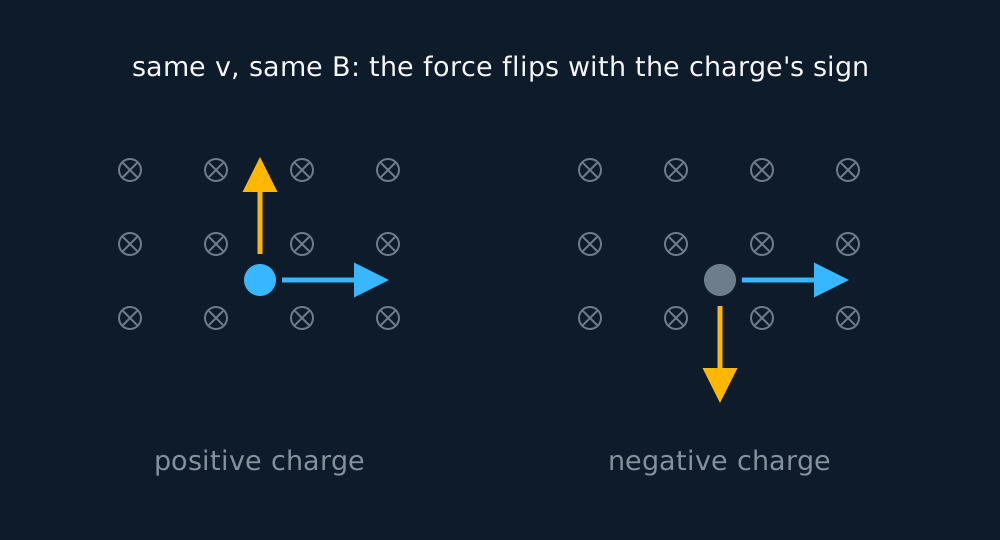
with the direction given by Fleming's left-hand rule, remembering that the seCond finger follows conventional current. A negative charge moving to the right is equivalent to conventional current to the left, so electrons deflect in the opposite direction to protons in the same field. A stationary charge, with v = 0, experiences no force.
CIE and Edexcel set the general form as an equation, with θ the angle between the velocity and the field,
Edexcel prints it and CIE does not, so it is a recall item on 9702 alone. It adds no new physics: B sin θ is the component of the field perpendicular to the velocity, so θ = 90° gives sin θ = 1 and returns F = BQv, while θ = 0 gives zero for a charge moving along the field, and intermediate angles scale with the sine. For 2.0 nC crossing a 0.40 T field at 5.0 × 10⁴ m s−1, the perpendicular force is 0.40 × 2.0 × 10−9 × 5.0 × 104 = 4.0 × 10⁻⁵ N, and at 30° to the field it is half of that, 2.0 × 10⁻⁵ N. AQA and OCR examine the perpendicular case only, and their data sheets print F = BQv.
Circles, because no work is done

Describe the drawing
The dot goes round at constant speed, and the cyan velocity arrow never changes length; but it never stops changing direction, so the velocity is changing and there must be an acceleration. The coral arrow shows it: aimed at the centre at every instant. Restyled, the same motion is a satellite held by gravity or a charge held by a magnetic field.
For motion perpendicular to a uniform magnetic field, F = BQv. Because the force is perpendicular to the velocity, it does no work on the charge: it changes direction but not speed, producing circular motion. Equating the magnetic force to the centripetal force, BQv = mv2/r, gives the radius,
so faster or more massive particles follow wider circles, while stronger fields and larger charges give tighter ones. This relation is how bubble-chamber photographs are analysed: the curvature of a track gives the particle's momentum, and the direction of curvature gives the sign of its charge.
WORKED EXAMPLE
A proton on a curve
A proton (m = 1.67 × 10⁻²⁷ kg) moves at 4.0 × 10⁶ m s−1 at right angles to a 0.30 T field. Find the force on it and the radius of its circle.
F = BQv = 0.30 × 1.60 × 10−19 × 4.0 × 106 = 1.9 × 10⁻¹³ N, at right angles to the motion.
r = mv/BQ = (1.67 × 10−27 × 4.0 × 106)/(0.30 × 1.60 × 10−19) = 0.14 m.
The speed is unchanged; only the direction changes, because the force does no work. The radius of 0.14 m is set by the proton's momentum, mv, divided by BQ.
Crossed fields, for CIE and OCR
CIE requires both the Hall effect and the velocity selector. OCR requires the velocity selector, in 6.3.2(c), but not the Hall effect. Neither appears in AQA 7408 or in Edexcel.
When a magnetic force and an electric force act at right angles on the same moving charge, each can be used to measure the other. In a current-carrying slice of semiconductor in a magnetic field, the magnetic force displaces the drifting charge carriers towards one face until the charge accumulated there produces an electric force that balances it, so eE = Bev. The steady pd across the faces is the Hall voltage,
with n the charge-carrier density and t the slice's thickness in the field direction. Since VH is proportional to B, a calibrated slice makes a magnetometer, the Hall probe, which is the standard instrument for measuring flux density.
The same balance of forces in a different geometry is the velocity selector. A beam crossing perpendicular E and B fields passes undeflected only when the electric and magnetic forces cancel, at v = E/B; particles at any other speed are deflected, so the pair of fields selects one speed from a beam with a range of speeds.
Accelerators, the cyclotron and the linac

Describe the drawing
Each time the particle crosses the gap the alternating voltage kicks it, so every half-circle is wider and faster than the last. But watch the gap flashes: perfectly even. Radius grows in step with speed, so the half-turn time never changes, and that is the machine's whole trick: one fixed frequency can keep kicking a particle that is forever speeding up.
The cyclotron is the named application here. Two hollow D-shaped electrodes sit in a uniform magnetic field, with an alternating pd across the gap between them. Inside each dee the magnetic field steers the particle round a half-circle without doing work on it. At every gap crossing the electric field does the accelerating, timed to act in the particle's direction of travel. Each crossing increases v, and by r = mv/BQ each half-circle is wider than the last, so the path is an outward spiral and the particle leaves at the rim with the energy of many small accelerations.
GUIDED PRACTICE
Why the half-turn time is constant
Show that the proton above (0.30 T) completes each half-circle in a time that does not depend on its speed, and find its orbital frequency.
Show the working
The full turn takes T = 2πr/v, and r = mv/BQ, so T = 2πm/BQ and each half-circle takes πm/BQ, with v cancelling. Faster protons follow larger circles in the same time.
f = BQ/2πm = (0.30 × 1.60 × 10−19)/(2π × 1.67 × 10−27) = 4.6 MHz.
That cancellation holds under one condition, which is why higher-energy machines are not simple cyclotrons. Treating T = 2πm/BQ as constant assumes the non-relativistic case, at speeds well below c. Close to the speed of light the momentum grows as p = γmv while the mass remains the invariant rest mass, so the turns take longer and a fixed drive frequency falls out of step. (AQA's Turning Points option uses the older relativistic-mass wording, m = γm₀, for the same physics.) High-energy machines address this by sweeping the frequency or ramping the field as the beam gains energy.
The linac uses no magnetic field to steer the beam, only a line of tube electrodes with an alternating pd between neighbouring tubes. The particle is accelerated in each gap and travels at constant speed inside each tube while the polarity reverses, so successive tubes must be longer as the particle speeds up if the timing is to stay in step. Edexcel requires both machines: the cyclotron spirals within a fixed magnetic field, and the linac accelerates the beam along a straight line.
Real linacs are not free of magnets, and an exam answer should not claim that they are. They use magnets to focus the beam and to keep it on axis, and a medical linac uses one to direct the beam onto the patient. The difference from the cyclotron is the purpose of the magnets: in a linac, no magnetic field curves the path into the circle on which the acceleration depends.
ASSESSMENT FOCUS
- F = BQv needs the perpendicular condition stated, and it gives zero for a charge moving along the field or standing still.
- CIE and Edexcel both set the general F = BQv sin θ, with θ measured between the velocity and the field. Edexcel prints it on its sheet; CIE makes you recall it. AQA and OCR examine only the perpendicular form, which is on the sheet, so learn the angle form only if your board sets it.
- Handle the sign first. Convert the particle's motion into conventional current before the left hand comes out, because electrons curl opposite to protons.
- State the no-work argument in full: the force is perpendicular to the velocity, so no work is done and the speed stays constant, while only the direction changes.
- Derive r = mv/BQ by equating BQv to mv2/r. It is asked frequently and is not printed with the magnetism equations. The Turning Points option page carries an electron-only r = mv/Be, so practise the derivation rather than relying on finding that.
- For the cyclotron, separate the two functions: the magnetic field provides the circular steering, and the alternating electric field between the dees supplies the energy. The explanation marks depend on that distinction.
- T = 2πm/BQ is speed-independent only while the speed is well below c, so write the non-relativistic condition into the “show that” answer. The contrast with the linac is that no magnetic field bends its beam, not that it has no magnets.
- In a question with both an electric and a magnetic field, only the magnetic force is guaranteed to do no work, so a charge crossing the electric field can change speed.
CHECK YOURSELF
An electron moves at 2.0 × 10⁷ m s−1 at right angles to a field of 0.50 mT. Find the force on it and the radius of its circular path.
Show a hint
Use F = BQv for the force, then equate it to the centripetal force.
Show the answer
= 5.0 × 10−4 × 1.60 × 10−19 × 2.0 × 107 = 1.6 × 10⁻¹⁵ N.
= (9.11 × 10−31 × 2.0 × 107) / (5.0 × 10−4 × 1.60 × 10−19) = 0.23 m.
The speed stays 2.0 × 10⁷ m s−1 throughout, because the magnetic force is perpendicular to the velocity and does no work.
For motion perpendicular to a uniform magnetic field, F = BQv. Because the force is perpendicular to the velocity, it changes direction but not speed, producing circular motion.
The radius r = mv/BQ, so the curvature of a track gives the particle's momentum.
WORKBOOK
Printable practice for this topic: original exam-style questions with room to work, and a fully worked answer book. Free to use; please do not redistribute or sell.
Or read them with their mark schemes on the force on a moving charge questions page.
WHERE TO GO NEXT
- Trigonometry and resolving vectors is the maths this lesson leans on, worked through step by step.
USED LATER IN
CHECK YOUR PROGRESS
Rate how confident you feel with each objective for this lesson. Ratings are saved in this browser, on this device, unless you sign in.
- Use F = BQv for a charge moving perpendicular to the field, with the correct direction for either sign.
- Explain why a magnetic force can do no work on a moving charge.
- Explain why the path is a circle, and derive r = mv/BQ.
- Explain the Hall probe and the velocity selector, each as an electric force set against the magnetic one.
- Describe the cyclotron, with magnetic steering set against electric acceleration.
Open the full revision checklist to track your progress across the whole unit.