Physics › Thermal physics › Specific heat capacity and latent heat
Specific heat capacity and latent heat
The specific heat capacity of a material is the energy that raises one kilogram of it by one kelvin, and Q = mcΔθ covers a temperature change. Specific latent heat of fusion and of vaporisation take over at a plateau, through Q = ml. Both constants are measured electrically, a second run cancelling the losses.
Choose your exam board to show the notes and questions relevant to your specification. You can change this setting at any time, and content for other boards remains available.
Watch Specific heat capacity and latent heat on the InkPhysics YouTube channel
Thermal energy transfer and specific heat capacity, part 2 of 2. Part 1 is Internal energy and changes of state.
Builds on Internal energy and changes of state.
IN THIS TOPIC
- Calculate energy transfers with Q = mcΔθ and Q = ml, stage by stage where a problem needs it.
- Describe an electrical determination of a specific latent heat, for melting and for boiling, and say how the heat losses are cancelled.
COMMON MISCONCEPTION
A kilogram of steam at 100 °C and a kilogram of water at 100 °C carry the same energy.
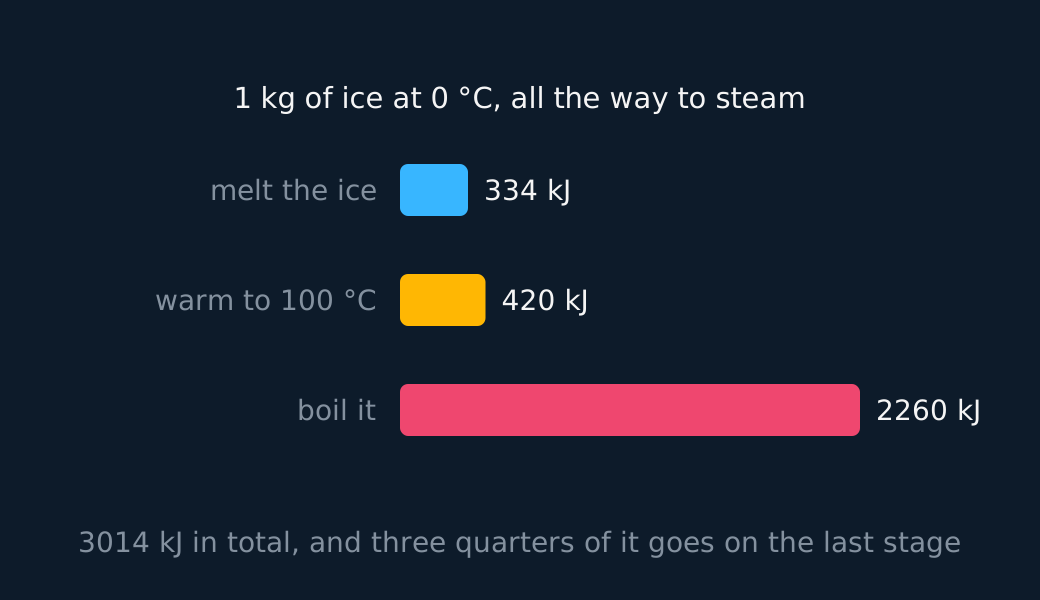
Steam at 100 °C carries far more energy than water at the same temperature: turning the water into steam took a further 2260 kJ per kilogram, the specific latent heat of vaporisation, and that is why a steam scald is so much worse than a hot-water one.
Calculating a temperature rise
The specific heat capacity c of a material is the energy needed to raise 1 kg of it by 1 K.
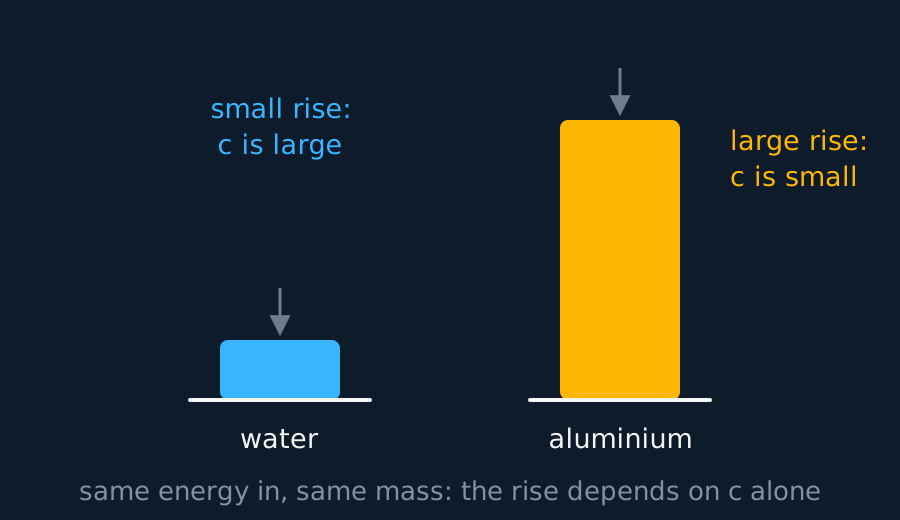
Water's enormous c, about 4200 J kg−1 K−1, is what lets the sea moderate coastal climates and what makes a kettle take as long as it does. One practical method deserves knowing. In continuous-flow heating, liquid streams steadily past an electrical heater, and three things get measured. The heater power P, the mass m carried past each second (a mass flow rate, in kg s−1), and the temperature rise Δθ from inlet to outlet. Each second the heater supplies P, the liquid takes mcΔθ of it, and the rest leaks to the surroundings as a loss h. One run therefore has two unknowns in it, c and h, so one run can never settle c.
The second run is what does. Change the flow rate and adjust the power until the inlet and outlet temperatures read exactly as before. The apparatus now sits at the same temperatures as in the first run, so the loss h is the same number, and subtracting the two power equations deletes it,
with m1 and m2 the masses carried past per second in the two runs, flow rates in kg s−1 rather than plain masses, so that both sides of the equation are powers, in watts. Divide the power difference by Δθ and by the difference in those two masses and c drops out, loss and all. Both powers are the point of the method. The flow readings on their own carry no energy in them at all.
WORKED EXAMPLE
Sizing a shower
A 9.0 kW electric shower warms water by 25 K as it flows through. Find the flow rate it can sustain. (c = 4200 J kg−1 K−1.)
Power is energy per second, so apply Q = mcΔθ to one second of flow. That gives 9000 = m × 4200 × 25.
So m = 9000/105 000 = 0.086 kg each second, about five litres a minute.
Your own bathroom is the sense check. Electric showers run gentler than mains-pressure taps, and this is the arithmetic reason. More flow would mean less warming, because the wire fixes the energy budget.
Latent heat and changes of state
The specific latent heat l is the energy to change the state of 1 kg with no temperature change.
Latent heat of fusion for melting, of vaporisation for boiling, and the second is far larger, since boiling must separate the particles almost completely. Use Q = mcΔθ when the temperature changes without a change of state, and Q = ml during a change of state at constant temperature. For a multi-stage process, warm the ice, melt it, warm the water, calculate the energy for each stage separately and add the results.
Both latent heats are measured electrically, and both measurements are built the same way. An immersion heater supplies a known power, read as P = VI from a voltmeter across the heater and an ammeter in series with it, so the energy delivered in a timed run is VIt. A balance then weighs the substance that changed state. What separates a good version of the experiment from a poor one is entirely what it does about the energy the room is quietly adding or taking away, and in both cases the answer is a second run rather than more lagging.
For fusion, the heater sits in crushed melting ice held in a funnel, and the meltwater it produces is collected in a beaker on the balance for a measured time. Warm air melts the ice as well, so an identical funnel of ice stands beside the first with its heater switched off, draining into its own beaker over the same time. That control run measures what the room does on its own, m0, and the heater is then answerable only for the difference, so VIt = (m − m0)lf. The ice must be melting to begin with, since any energy spent warming it from a freezer temperature belongs to c and not to l.
For vaporisation, the liquid stands on a top-pan balance with the heater immersed in it, and readings begin only once it is boiling steadily, so that the apparatus has stopped warming up and every extra joule leaves as vapour or as loss. Record the mass boiled away in a measured time, then repeat at a different heater power while the liquid boils just as steadily. The apparatus sits at the same temperature in both runs, so the loss to the room is the same number in each, and subtracting the two equations deletes it exactly as the continuous-flow method did.
That leaves , with m1 and m2 the masses boiled away in the same time t at the two heater powers, and the heat loss gone from the answer without ever having been measured.
WORKED EXAMPLE
A latent heat from two runs, and the loss it cancels
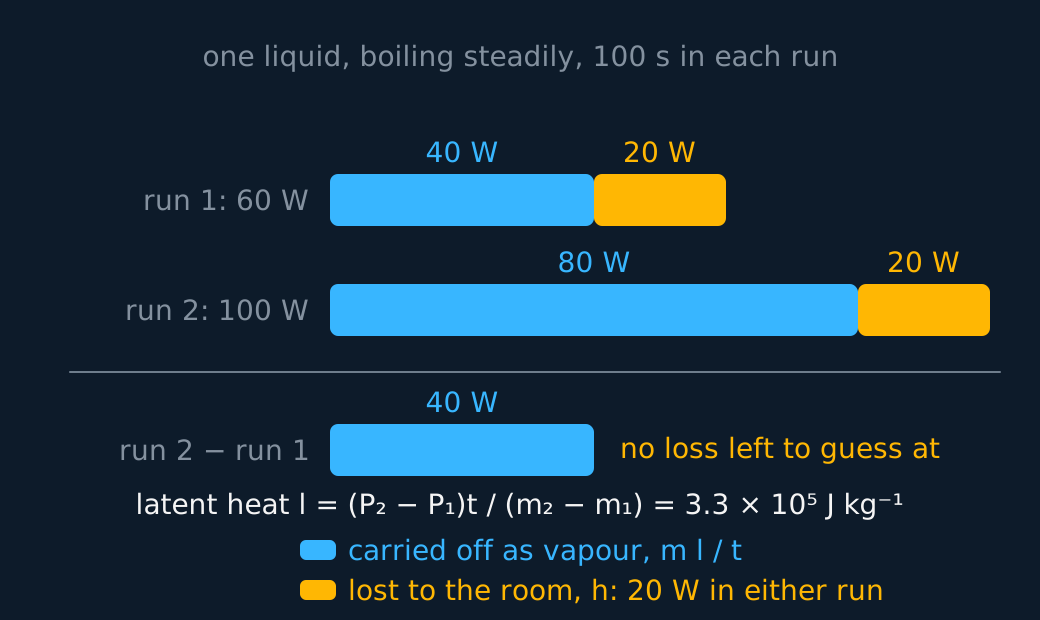
A heater in a boiling liquid runs at 60 W and the balance shows 12 g lost in 100 s. Raised to 100 W, with the liquid boiling just as steadily, it loses 24 g in the same 100 s. Find the specific latent heat of vaporisation, then the power going to the surroundings.
Subtract the runs. lv = (100 − 60) × 100/(0.024 − 0.012) = 3.3 × 10⁵ J kg−1, with the masses in kilograms.
Now go back to either run for the loss. In the first, boiling off 0.012 kg in 100 s costs (0.012 × 3.3 × 105)/100 = 40 W, so the other 20 W of the 60 W went to the room.
The second run agrees, which is the check worth doing: 0.024 kg in 100 s costs 80 W, leaving the same 20 W. A third of the smaller heater's power never reached the liquid at all, and no single run could have told you that.
GUIDED PRACTICE
Ice to drinking water
Find the energy to turn 0.50 kg of ice at 0 °C into water at 20 °C. (lf = 3.3 × 10⁵ J kg−1, c = 4200 J kg−1 K−1.) Work the two stages separately.
Show the working
Melting comes first, at constant temperature. Q = ml = 0.50 × 3.3 × 105 = 1.65 × 10⁵ J.
Then warming the meltwater. Q = mcΔθ = 0.50 × 4200 × 20 = 4.2 × 10⁴ J.
Total 2.1 × 10⁵ J, with the melt costing roughly four times the warming. Latent heats are large compared with mcΔθ over a few tens of kelvin, which is why the state change dominates the total.
INDEPENDENT PRACTICE
Why sweating works
During exercise, 0.030 kg of sweat evaporates from a runner's skin. Find the energy carried away. (lv for water at skin temperature is about 2.3 × 10⁶ J kg−1.)
Show the working
Q = mlv = 0.030 × 2.3 × 106 = 6.9 × 10⁴ J.
Seventy kilojoules out of thirty grams. Evaporation is the body's most powerful cooling channel, because latent heat dwarfs specific heat. That energy left with the vapour, taken from the skin that supplied it.
ASSESSMENT FOCUS
- Δθ is a temperature difference and comes out identical in °C and K, so no conversion is needed.
- Multi-stage heating means one Q per stage, then a sum. Applying mcΔθ across a plateau, where ml belongs, charges the energy to a temperature change that does not happen.
- In the electrical latent-heat experiments, the second run is the essential part. For melting, an identical funnel of ice with the heater off measures what the room melts, and that mass is subtracted. For boiling, a second power at the same steady boil holds the loss fixed so that subtracting the two runs removes it. A description of one run, with the discrepancy attributed to heat losses, does not account for them; the second run is what removes them from the result.
- Summarise the continuous-flow method in one line. Two runs, two flow rates, two powers, the same temperature rise, then subtract to eliminate the heat loss: P1 − P2 = (m1 − m2)cΔθ. The flow rates alone give no route to c, since c comes out of the power difference.
CHECK YOURSELF
A 2.2 kW kettle holds 0.80 kg of water at 15 °C. How long does it take to reach 100 °C? (c of water = 4200 J kg−1 K−1; assume no losses.)
Show a hint
Find the energy for the temperature rise first, then divide by the power.
Show the answer
Energy needed is Q = mcΔθ = 0.80 × 4200 × 85 = 2.86 × 10⁵ J.
Time follows from t = Q/P = 2.86 × 10⁵ / 2200 = 130 s, a little over two minutes.
A real kettle takes slightly longer, since some energy heats the kettle body and the room. That is exactly the loss the continuous-flow method is built to cancel.
Q = mcΔθ while the temperature moves, Q = ml while it stands still, and a problem that crosses a state change is one Q per stage added up.
Δθ is a difference, so it is the same number in °C and in K and needs no conversion.
The electrical experiments cancel their losses with a second run rather than by lagging: same temperature, different power, and the difference is what the substance took.
Or read them with their mark schemes on the internal energy and changes of state questions page.
CHECK YOUR PROGRESS
Rate how confident you feel with each objective for this lesson. Ratings are saved in this browser, on this device, unless you sign in.
- Calculate energy transfers with Q = mcΔθ and Q = ml, stage by stage where a problem needs it.
- Describe an electrical determination of a specific latent heat, for melting and for boiling, and say how the heat losses are cancelled.
Open the full revision checklist to track your progress across the whole unit.