Physics › Thermal physics › Internal energy and changes of state
Internal energy and changes of state
Spacing, ordering and motion separate the three states, and internal energy sums the random kinetic and potential energies of the particles. Heating and doing work are the only two ways to change that total. While a substance melts or boils, the potential energy of its particles rises and the temperature stays constant.
Choose your exam board to show the notes and questions relevant to your specification. You can change this setting at any time, and content for other boards remains available.
Thermal energy transfer and specific heat capacity, part 1 of 2. Part 2 is Specific heat capacity and latent heat.
Builds on Work, energy and power.
IN THIS TOPIC
- Describe solids, liquids and gases by the spacing, the ordering and the motion of their particles.
- Define internal energy, and describe the two ways of changing it.
- State that energy passes from the hotter body to the colder one, and that two bodies at the same temperature are in thermal equilibrium.
- Explain why temperature holds still through a change of state.
COMMON MISCONCEPTION
Heat and temperature are the same thing.
They are different quantities. Temperature tracks the average random kinetic energy of the particles, exactly proportional to it for an ideal gas; heat is energy transferred between bodies because of a temperature difference.
Solids, liquids and gases
Start with the picture of matter itself. Three states, and everything separating them comes down to three questions. How far apart do the particles sit, how tidily are they arranged, and how do they move?
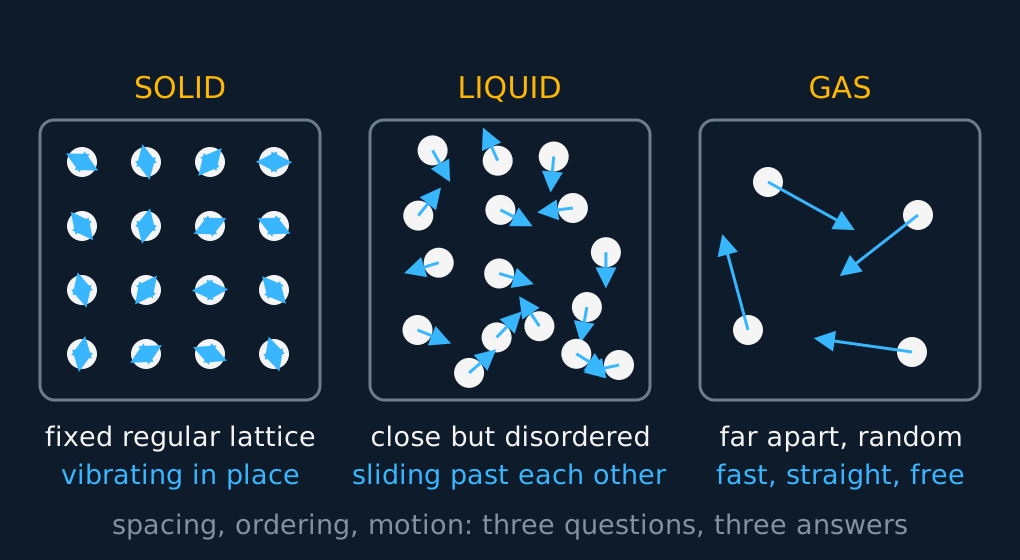
Describe the drawing
Three panels of equal area. The solid holds sixteen particles on a regular lattice, each with a small double-headed arrow for the vibration about its fixed site. The liquid holds the same sixteen at much the same spacing but in no pattern, each with an arrow for sliding past its neighbours. The gas holds only four, far apart and disordered, each with a long arrow for its free straight-line flight between collisions.
In a solid the particles sit close, touching their neighbours, held in a regular repeating arrangement by strong forces between them. They are not still. Each one vibrates about a fixed position and cannot swap places with the particles around it. Fixed positions in a fixed pattern are why a solid keeps its own shape and its own volume.
A liquid keeps the spacing and throws away the order. Its particles still touch, which is why melting barely changes the density of a substance, but past the nearest few neighbours the arrangement is disordered, and each particle carries enough energy to slide past the others while staying in contact. Contact fixes the volume. The lost order lets a liquid pour and take the shape of its container.
A gas throws away both. At ordinary pressures its particles sit roughly ten times as far apart as a liquid's, which is about a thousand times the volume for the same number of them, and in no arrangement whatsoever. They travel in rapid straight lines, in random directions, and feel almost no force from one another between collisions. Nothing holds them together, so a gas has neither a fixed shape nor a fixed volume and expands to fill whatever it is put in.
Those three paragraphs are the simple kinetic model, and the word kinetic names what settles the state: how the particles move. Supply energy and the particles move faster and range further. Give them enough to break out of the lattice and the solid melts; give them enough to escape their neighbours' attractions altogether and the liquid boils. Internal energy adds the kinetic energy of that motion to the potential energy of those attractions, and the heating formulas are written in terms of it.
Internal energy
Internal energy is the sum of the randomly distributed kinetic and potential energies of the particles in a system: kinetic energy in the motion of the particles, potential energy in their arrangement and separation.
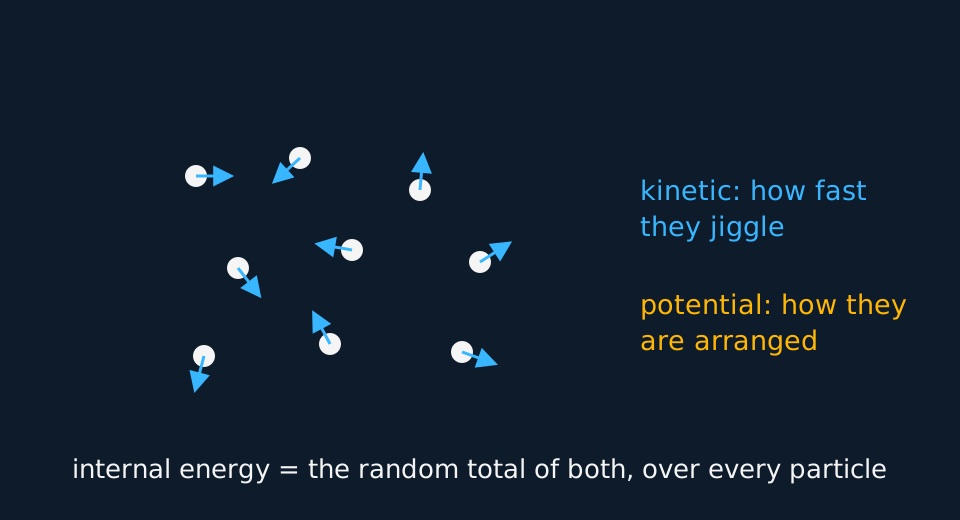
One consequence is worth keeping to hand. An ideal gas has no intermolecular forces and so no potential-energy term, which leaves its internal energy as the total kinetic energy of its molecules and nothing else. The word randomly is part of the definition: a thrown ball's ordered motion is kinetic energy without being internal energy.
Exactly two ways exist to change internal energy. Heating the system is one. Doing work on it is the other, and compressing a gas raises its temperature with no heating involved. The first law of thermodynamics, ΔU = q + w, puts the two together. The rise in internal energy equals the heat supplied to the system plus the work done on it, with energy leaving counted negative. A gas doing work as it expands takes w negative; a gas being squeezed takes w positive. CIE examines the equation with exactly this sign convention, so fix the direction of each term before you substitute.
Temperature is what decides where heat flows. Energy passes from the hotter body to the colder one until the two reach the same temperature and the net transfer stops. Two objects left in contact always drift towards that state, thermal equilibrium. Heat is energy in transfer, measured in joules; temperature is measured in kelvin. For an ideal gas, the mean translational kinetic energy per molecule is 3kT/2. More generally, temperature is not itself an energy and its microscopic interpretation depends on the system. A sparkler runs far hotter than a warm bath, while the bath, with vastly more molecules, holds far more internal energy.
Changes of state
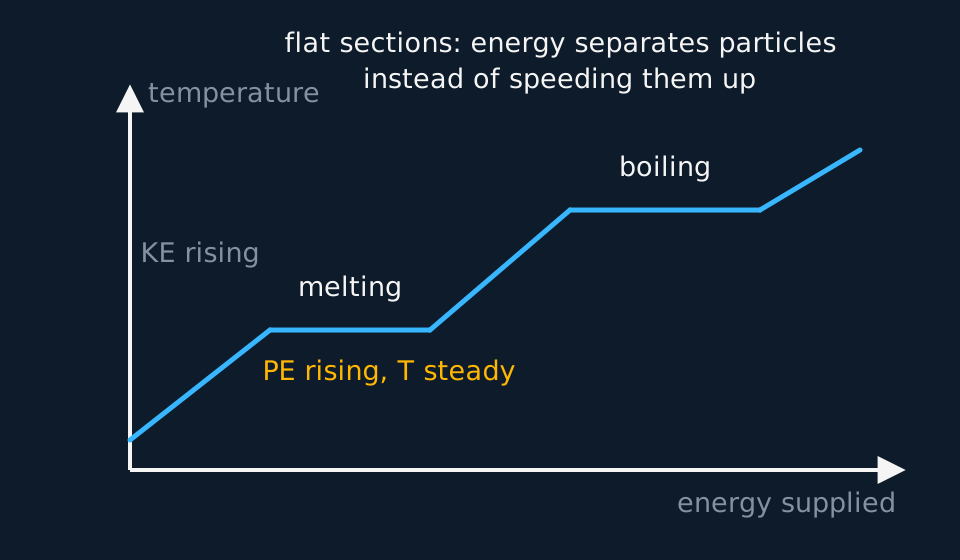
Supply energy steadily and the temperature climbs, until a change of state begins. Then it stops climbing entirely. Through melting or boiling the incoming energy goes into potential energy, prising particles apart against their attractions, while the kinetic energy, and so the temperature, stays constant. Only when the rearrangement finishes does the plateau end. A complete explanation of a flat section names both halves: potential energy rising, kinetic energy unchanged.
Calculating a temperature rise has moved to the next part of this lesson.
Latent heat and changes of state has moved to the next part of this lesson.
ASSESSMENT FOCUS
- Three words answer any solid-liquid-gas comparison: spacing, ordering, motion. Give all three for each state, and make the middle contrast explicit, since a liquid keeps a solid's spacing while losing its order.
- Define internal energy with all three flags flying. The sum of the randomly distributed kinetic and potential energies of the particles.
- For a flat section of a heating curve, say the energy raises potential energy while kinetic energy and temperature stay put. Both halves are needed, since one alone does not explain why the temperature is constant.
CHECK YOURSELF
A block of ice at −10 °C is heated steadily until it is water at +10 °C. Describe how its temperature behaves, say what happens to the internal energy at each stage, and name the two ways a system's internal energy can be changed at all.
Show a hint
Two sloping stages and one flat one. Ask, for each, whether the particles are moving faster or being pulled apart.
Show the answer
From -10 °C to 0 °C the temperature rises: the energy supplied goes into the random kinetic energy of the particles, which is what temperature measures.
At 0 °C the temperature holds still while the ice melts. The energy is going into potential energy, breaking the rigid arrangement of the lattice, so the particles are not moving faster and the thermometer does not move.
From 0 °C to +10 °C the temperature rises again, kinetic energy once more.
Internal energy is the sum of both stores, and there are exactly two ways to change it: heating the system, and doing work on it.
Internal energy is random KE plus PE, summed over the particles.
Heating and working are the only two ways in.
A state change spends the energy on PE, so T stands still.
WORKBOOK
Printable practice for this topic: original exam-style questions with room to work, and a fully worked answer book. Free to use; please do not redistribute or sell.
Or read them with their mark schemes on the internal energy and changes of state questions page.
WHERE TO GO NEXT
- Exponentials and logarithms is the maths this lesson leans on, worked through step by step.
- Significant figures, units and checking is the maths this lesson leans on, worked through step by step.
USED LATER IN
CHECK YOUR PROGRESS
Rate how confident you feel with each objective for this lesson. Ratings are saved in this browser, on this device, unless you sign in.
- Describe solids, liquids and gases by the spacing, the ordering and the motion of their particles.
- Define internal energy, and describe the two ways of changing it.
- State that energy passes from the hotter body to the colder one, and that two bodies at the same temperature are in thermal equilibrium.
- Explain why temperature holds still through a change of state.
Open the full revision checklist to track your progress across the whole unit.